Most people shopping for an engagement ring start with the stone. They compare cuts, weigh carat sizes, and study colour grades, and only afterwards turn to the setting. That order is backwards. The setting holds the stone, protects it, and decides how it feels on the hand every day.
A setting is simply the metalwork that secures the centre stone to the band. A solitaire lifts one stone on slender prongs. A halo wraps it in a ring of smaller diamonds. A bezel encloses it in a smooth rim of metal. Each one changes the look of the same diamond completely.
This guide walks through the decision in order: the main settings, which ones suit which stones and lifestyles, what is changing in 2027, how to choose a metal, and the mistakes to avoid.
Key takeaways
- The setting decides how the stone looks, how secure it is, and how comfortable the ring feels every day, so choose it with as much care as the diamond.
- Solitaire, halo, pavé, bezel, and three-stone settings cover almost every taste.
- For 2027, the settings to watch are hidden halos, east-west orientations, geometric halos, and slightly thicker bands.
- Match the setting to the stone shape first: some flatter round and oval stones, while others suit emerald, marquise, and pear cuts.
- Think about daily life first: active hands and sensitive skin point to different settings.
What a Setting Actually Does
A setting has four jobs. First, it holds the stone securely: prongs grip it from the sides, a bezel wraps around its edge, and a tension setting holds it with the pressure of the band. Second, it lets light in. A diamond sparkles because light enters it and returns to the eye, and a setting that covers too much of the stone will dim that sparkle.
Third, the setting protects the stone. The edges and corners of a diamond are its most vulnerable points, and a well-chosen setting shields them from everyday knocks. A bezel is the most protective style of all. Fourth, the setting sets the style of the whole ring, and decides whether a wedding band will sit flush against it.
The Classic Settings, Explained
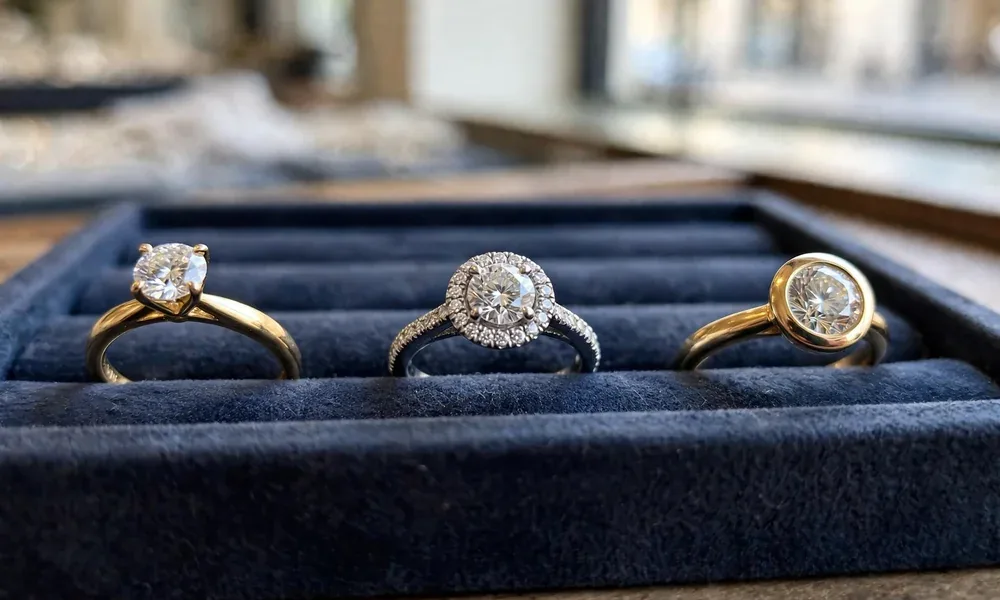
The solitaire is the oldest and most enduring engagement ring setting. One centre stone is held by four or six prongs on a plain band, with nothing to distract from the diamond itself. It suits almost every stone shape and it is easy to clean.
The halo setting surrounds the centre stone with a ring of small diamonds, which makes the centre stone look larger and adds sparkle from every angle. It is a good choice when the centre stone is modest in size and you want more presence. It needs a little more care, because the small stones can loosen over time.
A pavé setting lines the band with small diamonds set closely together, like a path of light along the shoulders of the ring. It adds sparkle without adding bulk. The trade-off is maintenance: a hard knock can dislodge a small stone, so the ring should be checked once a year.
The bezel setting wraps a thin rim of metal completely around the centre stone, holding it flush and secure. It is the most practical setting there is: nothing sticks out, nothing catches on clothing, and the stone’s edges are fully protected. It suits active lifestyles and anyone who wants a clean, modern look.
The three-stone setting places a centre stone between two smaller side stones, traditionally said to represent the past, present, and future of a relationship. It gives the ring more presence than a solitaire and more meaning than a halo.
Settings to Watch in 2027
Engagement ring fashion moves slowly, but 2027 has a clear direction: classic settings with a twist. The hidden halo is the most requested update of the moment. A delicate ring of small diamonds sits just below the centre stone, hidden from the front and visible only from the side.
The east-west setting is the boldest trend of the year. Elongated stones such as oval, emerald, and marquise cuts are usually set vertically, pointing towards the fingertip. In an east-west setting, the stone is turned sideways, lying across the finger. The effect is modern and striking, and it works especially well in a bezel setting.
Geometric halos are replacing the soft, round halos of the past decade, with hexagonal outlines, baguette sunbursts, and floating halos. Bands are getting slightly thicker too, with more requests for bands of three to five millimetres. Yellow gold continues its comeback. For the stones themselves, our round-up of the best engagement rings for 2027 covers the shapes that pair best.
How to Match the Setting to the Stone
The stone and the setting should be chosen together, because some pairings flatter each other and some fight. Round stones are the most versatile of all: they suit every classic setting equally well. Oval stones are the rising favourite, and they look their best in solitaires, hidden halos, and three-stone settings.
Emerald and Asscher cuts, with their long straight edges, suit settings that echo their geometry: a bezel, or a three-stone setting with baguette sides. Marquise and pear cuts have pointed ends that need protection, so ask for a V-shaped prong at the tip, and consider a bezel for a marquise. Cushion and radiant cuts suit almost any setting.
Size matters too. A larger centre stone needs a setting that can support it: six prongs rather than four for a round stone above two carats, or a bezel for a very large stone worn every day. Softer stones such as morganite, sapphire, and emerald need the protection of a bezel or a low prong setting. Our comparison of diamond versus moissanite engagement rings for 2027 explains how the stone changes the setting decision.
Choosing the Metal
The metal is part of the setting, not a separate decision, and it affects durability, colour, maintenance, and cost. Platinum is the most durable and the most secure choice: it is naturally white, it does not wear away over time, and it is hypoallergenic. It is also the heaviest and the most expensive metal.
White gold offers the same bright white look at a lower cost, but it is coated with rhodium, which wears away over time, so expect to have it re-plated every one to two years. Yellow gold is the warmest and most traditional choice, and it is having a moment in 2027. Rose gold, coloured by copper, is romantic and distinctive. Within gold, fourteen-karat gold is harder and more scratch-resistant than eighteen-karat gold, making it the more practical choice for daily wear.
| Setting | Best for | Sparkle | Everyday wear | Care | Stone shapes | Look | Budget |
|---|---|---|---|---|---|---|---|
| Solitaire | Timeless taste | High | Very good | Prongs yearly | Round, oval | Classic | Good value |
| Halo | More presence | Very high | Good | Check yearly | Round, oval, pear | Romantic | Mid-range |
| Pavé band | Extra sparkle | Very high | Good | Annual check | Round, oval | Delicate | Mid-range |
| Bezel | Active hands | Moderate | Excellent | Very little | Emerald, oval | Sleek | Good value |
| Three-stone | Meaning, presence | High | Good | Check yearly | Oval, emerald, round | Balanced | Mid to higher |
| Hidden halo | A secret sparkle | High | Very good | Check yearly | Round, oval | Classic | Mid-range |
| East-west | Modern taste | High | Good | Prongs yearly | Oval, emerald | Bold | Standard |
| Tension | Minimalist taste | Very high | Fair | Specialist check | Round, oval | Dramatic | Higher |
Lifestyle and Comfort: The Questions to Ask Before You Buy
A ring is worn every day, so the wearer’s daily life should shape the setting as much as their taste does. Someone who works with their hands, goes to the gym, or looks after small children needs a low, secure setting: a bezel, a low solitaire, or a hidden halo. Tall prongs and delicate pavé are beautiful, but they catch on fabric and need more frequent checks.
Comfort matters in ways that only become clear after a few hours of wear. A ring with a high setting can feel top-heavy, while a very thin band can dig into the finger by the end of the day. Try the ring on and wear it around the shop for a few minutes The inside of the band should be smooth and slightly rounded. Skin sensitivity is worth asking about too: platinum is hypoallergenic, while some white gold alloys contain nickel.
Mistakes to Avoid
The most common mistake is choosing a setting for how it looks in a photograph rather than how it will live on a hand. A ring that sparkles under shop lights but catches on every sleeve will spend more time in a jewellery box than on a finger. Always try the ring on, move your hand, and imagine a normal Tuesday, not a photoshoot.
The second mistake is going too thin on the band. Bands under two millimetres look delicate and elegant, but they bend, wear thin, and are harder to resize. For a ring worn for decades, a band of at least two millimetres is a sensible minimum. The third mistake is buying the setting and the stone separately. A warm-toned stone can look dull in a white metal, and a soft stone can be damaged in an exposed prong setting. Choose them as a pair. Our diamond buying guide for 2027 walks through the stone itself.
Your Engagement Ring Setting Checklist
- Decide the priority first: maximum sparkle, maximum security, or lowest maintenance.
- Match the setting to the stone shape, and ask the jeweller to show you the stone in the setting first.
- Try the ring on for a few minutes: check comfort, weight, and whether it catches on fabric.
- Check the band width: aim for at least two millimetres.
- Ask about the metal: durability, plating, and allergies.
- Confirm the practical details: cleaning, annual checks, resizing, and the warranty.
Frequently Asked Questions
What is the most popular engagement ring setting in 2027?
The solitaire remains the most popular setting overall, because it is timeless, versatile, and easy to wear. The fastest-growing choices for 2027 are the hidden halo, and the bezel setting, which has moved from a practical choice to a fashionable one.
Which setting is the most secure for everyday wear?
The bezel setting is the most secure, because a rim of metal wraps completely around the stone and protects its edges. A six-prong solitaire is the next most secure option. Pavé and halo settings are secure when well made, but their small stones need an annual check.
Does the setting affect how big the diamond looks?
Yes, considerably. A halo makes the centre stone look larger, and a pavé band adds to the overall impression of size. A thin band also makes the stone look bigger by contrast.
Which setting is easiest to clean and maintain?
A plain solitaire is the easiest setting to clean, because there are few places for dirt to hide. A bezel is also easy to clean, since its smooth rim wipes clean. Halo and pavé settings need more care, because dirt gathers around the small stones.
Can any setting be resized later?
Most settings can be resized a size or two, but some are harder than others. Pavé bands, tension settings, and rings with stones all the way around are the hardest to resize. Ask about resizing before you buy, not after.
Should the setting match the wedding band?
It should work with the wedding band, though it does not need to match it exactly. Many people choose the same metal for both rings, and a low setting lets the two sit flush together. A high setting or a curved band can leave a gap. Try them as a pair in the shop before deciding.
The bottom line
Choosing an engagement ring setting comes down to three questions: how does it look, how does it protect the stone, and how does it feel to wear every day. The solitaire answers all three with quiet confidence, which is why it has lasted for generations. The halo and pavé settings add sparkle, the bezel adds security and modern style, and the three-stone setting adds meaning.
Start with the wearer’s life and taste, match the setting to the stone shape, choose a metal that suits their skin, and try the ring on before you decide. A setting chosen that way will still look beautiful, and still feel comfortable, decades later.
Note: Ring settings and metals are a matter of personal taste and lifestyle, and what suits one person may not suit another. If you are choosing a ring as a surprise, note the wearer’s existing jewellery, their daily routine, and any skin sensitivities, and ask a jeweller to check the fit before the proposal.