A bangle bracelet is one of the oldest pieces of jewellery in the world, and one of the simplest. It is a rigid circle that slips over the hand and rests on the wrist, with no clasp, no chain, and nothing to fasten. That simplicity is the whole point. A bangle does not move like a chain, does not flex like a cuff, and does not need adjusting. It sits where it sits, and it makes its statement by being there.
The confusion around bangles is understandable, because the word is used loosely. Shops call almost any round bracelet a bangle, and many that look like bangles are actually cuffs, which are open at the back, or rigid bracelets with a hidden hinge. The difference matters when you buy, because a true bangle has to fit over your hand, and that decides the size, the comfort, and whether you will wear it every day.
Below are nine facts that explain what a bangle bracelet really is, how to choose the right size and material, and how to wear it well in 2027. Each fact is described by what it shows, what to watch for, and who it suits best, so you can buy a bangle with confidence.
Key takeaways
- A bangle is a rigid, closed circle with no clasp, unlike a cuff, which is open, and a chain bracelet, which drapes.
- The size is decided by your hand, not your wrist: a bangle must slip over your knuckles to reach your wrist.
- Bangles come in solid, hinged and open forms, and the form decides how easy the bracelet is to put on and take off.
- Metal, wood, glass and lacquer all make bangles, and each material has its own weight, sound and care needs.
- No bangle suits every hand, and a bangle that is too tight will hurt, while one that is too loose will slide and clatter.
What a bangle bracelet actually is
A bangle bracelet is a rigid bracelet in the form of a closed circle, worn by slipping it over the hand and onto the wrist. It has no clasp and no opening, which is what makes it a bangle rather than a cuff or a chain bracelet. The word comes from the Hindi word bangri, meaning a glass bracelet, and glass bangles are still worn across South Asia today, often in stacks of many colours for festivals and weddings.
That history explains why bangles feel different from other bracelets. A bangle is not a piece of jewellery you adjust. You choose the size, you slip it on, and it stays where it lands. The rigidity is the design: a bangle holds its shape and makes a soft sound when it moves, which is part of its charm and, for some people, part of its annoyance.
Bangles are worn all over the world now, in every material from gold to wood to plastic, and in every width from a hair-thin wire to a broad band. The simplest way to tell a bangle from its neighbours is to ask two questions. Does it close? If it has a clasp, it is not a bangle. Is it rigid? If it bends or drapes, it is not a bangle. A bangle is a closed, rigid circle, and everything else follows from that.
How to choose a bangle and what to look for
Look first at the size, and measure your hand, not your wrist. Bring your thumb and little finger together, as if you were slipping a bracelet on, and measure around the widest part of your hand, across the knuckles. That is the inside circumference your bangle needs. A bangle that matches your wrist but not your hand will not go on at all, and one that is too large will slide and clatter.

Look next at the form. A solid bangle is a single unbroken circle, the most traditional form, and the hardest to put on if your hand is wide. A hinged bangle opens on one side, which makes it far easier to wear, and it is the best choice if you have a wide hand or stiff fingers. An open bangle, sometimes called a slip-on, has a small gap, which makes it adjustable, but it is closer to a cuff than a true bangle. If you are buying your first bangle, a hinged one is the most forgiving choice. Our guide to the best bangle bracelets shows examples of each form, so you can see the difference before you buy.
Finally, look at the width and the weight. A slim bangle, two or three millimetres wide, is light, quiet, and easy to wear every day, and it stacks well with others. A wide bangle, ten millimetres or more, makes a statement, but it is heavier, louder, and harder to wear with a watch or a long sleeve. Start slim if you are unsure, and add width later. A bangle should feel present on your wrist, not like a weight you are carrying.
9 facts about bangle bracelets
A bangle is a rigid, closed circle
What it shows: A bangle holds its shape completely. It does not drape, bend or flex, and it keeps the same circle whether it is on your wrist or in a box.
What to consider: Rigidity means the fit has to be right, because there is no clasp to adjust and no chain to lengthen. Best for: Anyone who likes a clean, structured look. Material: Any, from gold to wood. Price range: Affordable to premium. Standout feature: The perfect, unbroken circle.
Bangles predate most modern jewellery
What it shows: Bangles have been worn for thousands of years, in shell, bone, glass and metal, across South Asia, Africa and the Middle East, long before the modern bracelet existed.
What to consider: Traditional bangles are often worn in stacks, which is a different look from a single Western bangle, and the cultural meaning varies. Best for: Anyone who likes jewellery with history. Material: Traditionally glass, shell and gold. Price range: Affordable to premium. Standout feature: A design that has barely changed in thousands of years.
The fit is measured, not guessed
What it shows: A bangle must pass over your hand, so the inside circumference has to be at least as large as your hand at its widest point, across the knuckles.
What to consider: Hands swell in heat and shrink in cold, so a bangle that fits in winter may feel tight in summer. Best for: Anyone buying a bangle for the first time. Material: Any. Price range: Affordable to premium. Standout feature: A fit you can measure with a tape and two minutes.
Bangles come in solid, hinged and open forms
What it shows: A solid bangle is one unbroken circle, a hinged bangle opens on one side, and an open bangle has a small gap and is adjustable.
What to consider: Hinges can wear and loosen over time, and open bangles can snag, while solid bangles are the most durable but the hardest to put on. Best for: Solid for durability, hinged for easy wear, open for adjustability. Material: Any. Price range: Affordable to premium. Standout feature: The hinge, which makes a bangle easy to wear.
The material changes the weight and the sound
What it shows: A gold bangle is heavy and quiet, a silver bangle is bright and cool, a wooden bangle is light and warm, and a glass bangle is delicate and musical.
What to consider: Glass bangles can chip or break, wood can swell with water, and metal bangles can dent if they are thin. Best for: Gold for permanence, wood for lightness, glass for colour. Material: Gold, silver, wood, glass, lacquer, plastic. Price range: Affordable to premium. Standout feature: The sound, a soft knock that is different for every material.
Stacking is part of the design
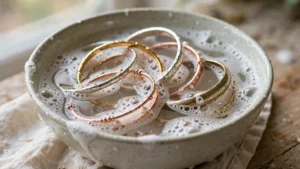
What it shows: Bangles are made to be worn in stacks, several on one wrist, in matching or mixed materials, widths and colours.
What to consider: A stack is heavier and louder than a single bangle, and the bangles can scratch each other if they are different metals. Best for: Anyone who likes a bold wrist, and for festive or evening looks. Material: Mixed, often gold with glass or wood. Price range: Affordable to premium. Standout feature: The way a stack moves and sounds as one piece.
Stacking is where bangles are at their best: start with three slim bangles in the same metal, then add one in a different texture. A cuff bracelet is a useful comparison, because a cuff is open and rigid too, but it does not stack in the same way.
Bangles suit every wrist, with the right width
What it shows: A slim bangle suits a slim wrist, a medium bangle suits most wrists, and a wide bangle suits a broader wrist or a bold look.
What to consider: A wide bangle on a slim wrist can look heavy and feel uncomfortable, while a very slim bangle on a broad wrist can look lost. Best for: Slim bangles for small wrists, medium for most, wide for statement wear. Material: Any. Price range: Affordable to premium. Standout feature: How the width changes the whole look.
Care is simple but not optional
What it shows: A metal bangle needs polishing, a wooden bangle needs to stay dry, a glass bangle needs protection from knocks, and a lacquer bangle needs to stay away from perfume.
What to consider: Bangles are rigid, so they cannot be bent back into shape if they are dented, and a dropped glass bangle will break. Best for: Anyone willing to store bangles flat, separately, and dry. Material: Any. Price range: Affordable to premium. Standout feature: How little care a bangle needs, if it is stored properly.
Store bangles flat, in a single layer, so they do not roll against each other and scratch, and keep them away from water and perfume. Our guide to luxury bangle brands is worth a look if you are investing in a piece you want to keep for years.
A bangle works for day and evening
What it shows: A single slim bangle works for work and daytime, a stack works for evenings and celebrations, and a wide gold bangle works for formal occasions.
What to consider: A stack can be noisy and impractical for typing, and a wide bangle can catch on sleeves. Best for: Slim for day, stacked for evening, wide for formal. Material: Any. Price range: Affordable to premium. Standout feature: The way one piece changes with the occasion.
Which bangle is right for you
Start with your hand, not your eye. Measure it, and buy a bangle that fits over it with a little room to spare. Then choose the form: solid if you want durability, hinged if you want easy wear, open if you want adjustability. Then choose the width: slim for everyday, medium for most occasions, wide for a statement. The metal or material comes last, and it should match what you already own, or deliberately contrast with it.
Then think about how you will wear it. If you want one bangle for every day, choose a slim, hinged bangle in gold or silver, in a medium width, that sits comfortably and does not clatter. If you want a stack, start with three slim bangles in the same metal, and add one in a different texture. If you want a single statement piece, choose a wide gold bangle, and wear it alone. A bangle that is too tight, too heavy, or too loud for your day will end up unworn, however beautiful it is.
Finally, think about the rest of your jewellery. A bangle sits on the same wrist as a watch, and the two need to get along: a slim bangle beside a slim watch is elegant, while a wide bangle beside a chunky watch is a lot. A bangle in the same metal as your rings ties the look together, and a contrasting metal makes a deliberate statement.
The caveats that matter
Bangles are simple, but they are not foolproof. The most common problems are a bangle that will not go over the hand, which is simply the wrong size, a bangle that is too loose and slides, catching on things and clattering, and a bangle that breaks, usually glass, or dents, usually thin metal.
| Detail | What is known |
|---|---|
| What it is | A rigid, closed circle, slipped over the hand onto the wrist, with no clasp |
| How to size it | Measure around the widest part of the hand, across the knuckles |
| Easiest form to wear | Hinged, which opens on one side and suits wide hands |
| Best everyday width | Four to eight millimetres, visible without being heavy |
| Best everyday material | Gold, gold-filled or silver, which are durable and easy to polish |
| What to avoid | Glass bangles for rough handling, and a size that is too tight |
| Storage | Flat, in a single layer, dry, and away from perfume |
| What they do not do | They do not adjust, they do not suit every hand size, and they can be noisy in a stack |
If you have a metal allergy, choose stainless steel, titanium, or a high-quality gold-filled bangle, and avoid nickel-heavy base metals. If a bangle feels tight, do not force it over your hand, because a stuck bangle is painful and can cut off circulation. Use soap and water to ease it off, and if it will not come off, see a jeweller rather than pulling harder.
Checklist: choosing a bangle honestly
Use these checks before you buy, and again after a week of wearing it.
- Check the size: measure your hand across the knuckles, and choose a bangle that slips over it with a little room.
- Check the form: solid for durability, hinged for easy wear, open for adjustability.
- Check the width: four to eight millimetres for everyday wear, slim for layering, wide for a statement.
- Check the material: metal for durability, wood for lightness, glass for colour, and think about the sound.
- Check the finish: smooth edges, no rough joins, and a hinge that opens and closes cleanly.
- Check the wear: after a week, look for pinching, sliding, or scratches, and return it if any appear.
Frequently asked questions
What is the difference between a bangle and a cuff bracelet?
A bangle is a closed, rigid circle with no opening, while a cuff is open at the back and can be squeezed to fit. A bangle has to slip over your hand, while a cuff slips on from the side.
How do I measure my bangle size?
Bring your thumb and little finger together, wrap a tape around the widest part of your hand, across the knuckles, and note the number. That is the inside circumference your bangle needs, plus a few millimetres for comfort.
Are bangles comfortable to wear all day?
Yes, if the size and width are right. A slim, well-fitting bangle is comfortable all day, while one that is too tight, too wide, or too heavy will feel uncomfortable by evening.
Can I wear a bangle with a watch?
Yes. Wear a slim bangle beside a slim watch on the same wrist, or wear the bangle on the opposite wrist if it is wide or part of a stack. Check that the bangle does not scratch the watch case.
How do I stop bangles from scratching each other?
Store them flat, in a single layer, with a soft cloth between them, and avoid mixing very hard and very soft materials in the same stack. Polish metal bangles regularly to remove light scratches.
Are bangles suitable for work?
A single slim bangle is ideal for work, because it is quiet and unobtrusive. A stack of bangles can be noisy and impractical for typing, so save stacks for evenings and celebrations.
The bottom line
A bangle bracelet is a rigid, closed circle, and everything about it follows from that one fact. The size is decided by your hand, the form decides how easy it is to wear, the width decides how it looks, and the material decides how it sounds and how it ages. A slim, hinged bangle in gold or silver is the safest first choice, and a stack of three slim bangles is the easiest way to make a statement.
Measure your hand, choose the form and width that suit your day, and buy a bangle you will actually wear. One that fits well will be on your wrist for years, and one that does not will be in a drawer by the end of the week.