Bangle bracelets are the easiest jewellery to damage by storing them badly. They are rigid, they are round, and they have no clasp to keep them in place. Tossed loose into a drawer, they roll, knock against each other, and pick up scratches and dents. Hung on a hook, they slide off. Piled in a jewellery box without dividers, they tangle with chains and chip against harder stones.
The fix is simple, but it is not the same as storing a chain bracelet or a necklace. Bangles need to stand upright or lie flat in their own space, separated from each other and from harder jewellery, away from humidity and sunlight. A good storage setup does not need to be expensive. A lined box with dividers, a bangle roll, or even a row of individual pouches will do the job, as long as each bangle has its own place.
Below are nine steps for storing bangle bracelets properly in 2027, from cleaning each piece before you put it away to building a routine you will actually keep. Each step explains what to do, what to avoid, and how long it takes, so your bangles stay bright, unscratched, and ready to wear.
Key takeaways
- Bangles need their own space, standing upright or lying flat, because loose bangles in a drawer roll, knock together, and scratch.
- Clean and dry every bangle before storing it, since sweat, cream, and moisture left on the metal will tarnish it while it sits.
- Keep bangles away from harder jewellery, especially diamond and gemstone pieces, which can scratch gold and silver.
- Store bangles in a cool, dry place away from sunlight and humidity, and use anti-tarnish strips or silica gel in the box.
- No storage setup protects a bangle that is thrown in wet or dirty, and thin vermeil bangles will still fade over time even with good storage.
What bangle bracelets actually need from storage
A bangle is a rigid loop, and that shape decides how it should be stored. It cannot be folded, coiled, or hung from a hook the way a chain can. It needs to stand on its edge, lie flat in a lined compartment, or slide onto a bangle stand or roll. The key is that it does not move once it is put away. Every scratch on a bangle comes from movement, either against another bangle, against a harder piece of jewellery, or against the hard surface of an unlined box.
The material changes the details, but not the principle. Solid gold bangles scratch and dent, so they need a soft lining and separation. Silver bangles tarnish in humidity and air, so they need a dry, enclosed space. Gold vermeil bangles are the most fragile, because the thin gold layer wears through with friction, so they need the gentlest handling of all. Our guide to how to store bracelets covers the general rules for all bracelet types, while this guide focuses on the rigid shape that makes bangles different.
Humidity is the quiet enemy. A bathroom looks convenient, but steam from a shower raises the humidity every day, and that moisture speeds up tarnish on silver and dulls the finish on gold. A bedroom drawer or a lined jewellery box in a cool, dry room is a far better home. If you live somewhere humid, a small silica gel packet in the box makes a real difference, and it costs almost nothing.
How to store bangles and what to look for
Look first at what you already own. Count your bangles, note which are solid gold, gold-filled, vermeil, silver, or stone-set, and notice which ones you wear most. The everyday pieces need the easiest access, while the special-occasion pieces can live further back in the box. A storage setup that hides your favourite bangle at the bottom of a pile is a setup you will stop using.

Look next at the storage itself. A lined jewellery box with dividers, a bangle roll with individual slots, or a bangle stand all work, as long as each bangle has its own place and cannot roll into its neighbour. Avoid bare wood, bare metal, and hard plastic, which can scratch. Velvet, suede, or soft cotton lining is what you want against the metal. A guide to storing jewellery properly covers the wider principles for necklaces, rings, and earrings, which share the same rules about separation and dryness.
Finally, look at the routine. Storage only works if it is easy. If putting a bangle away takes more than a few seconds, you will leave it on the bedside table instead, and that is where the scratches happen. Keep the box where you get dressed, keep the everyday bangles at the front, and make the steps below a habit rather than a chore.
How to store bangle bracelets in 9 steps
Clean each bangle before you put it away
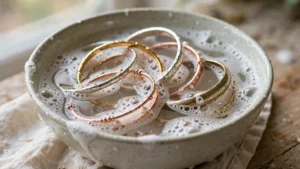
What to do: Wipe each bangle with a soft, dry cloth after wearing it, and wash it in warm water with a drop of mild soap if it has been in contact with sweat, cream, or perfume.
What to avoid: Do not put a bangle away while it is still damp or dirty, and do not use a rough cloth or a chemical dip, which can strip vermeil and scratch polished gold. Best for: Every bangle, every time. Time needed: 1 minute per bangle. Standout tip: A quick wipe after wearing does more than a deep clean once a month.
Dry every bangle completely
What to do: Let a washed bangle air-dry on a soft towel for a few minutes, then pat it dry with a lint-free cloth, including the inside of the band.
What to avoid: Do not put a bangle away wet, and do not dry it with a hairdryer, which can heat the metal and loosen stone settings. Best for: Silver and vermeil bangles especially. Time needed: 2 minutes. Standout tip: Check the inside of the band, where water hides and tarnish starts.
Moisture trapped inside a closed box is worse than moisture in the open air, because it has nowhere to go. A bangle that feels dry on the outside can still be damp on the inside of the band, so give it a moment before it goes away.
Give each bangle its own slot or pouch
What to do: Place each bangle in its own divided compartment, its own slot on a bangle roll, or its own soft pouch, so it cannot touch another bangle.
What to avoid: Do not stack loose bangles in a pile, and do not store them in a single pouch together, because they will knock and scratch each other. Best for: Collections of more than three bangles. Time needed: 5 minutes to set up. Standout tip: Individual pouches are the cheapest fix if you do not want to buy a new box.
Stand bangles upright or lay them flat
What to do: Stand bangles upright in a divided box or on a bangle stand, or lay them flat in a lined tray with space between them.
What to avoid: Do not hang bangles from hooks, where they slide off and fall, and do not lean them against a hard edge, which can dent a thin band. Best for: Wide cuffs and heavy bangles. Time needed: 1 minute. Standout tip: Upright storage also makes it easy to see what you own at a glance.
Standing a bangle upright uses its own shape to keep it still, and it lets you see the whole collection without digging. Laying it flat works just as well, as long as the tray is lined and the bangles are not touching.
Keep bangles away from harder jewellery
What to do: Store bangles in their own section, separate from rings with diamonds or gemstones, and from any jewellery with sharp edges or rough settings.
What to avoid: Do not store a gold bangle in the same compartment as a diamond ring, because diamond is harder than gold and will scratch it. Best for: Gold and vermeil bangles. Time needed: 2 minutes to rearrange. Standout tip: If you only have one box, use pouches to create separation inside it.
Store in a cool, dry place away from sunlight
What to do: Keep your bangle box in a bedroom drawer or on a dresser in a cool, dry room, away from windows and radiators.
What to avoid: Do not store bangles in a bathroom, where steam raises humidity daily, and do not leave them in direct sunlight, which can fade some stones and dry out leather or wood elements. Best for: Silver bangles and stone-set bangles. Time needed: 5 minutes to move the box. Standout tip: A silica gel packet in the box absorbs moisture for months at almost no cost.
Use anti-tarnish strips or silica gel
What to do: Place an anti-tarnish strip or a small silica gel packet in each section of your bangle box, and replace them every few months.
What to avoid: Do not use mothballs or scented sachets, which can leave residue on metal, and do not rely on a single strip for a large box. Best for: Silver bangles and humid homes. Time needed: 2 minutes. Standout tip: Anti-tarnish strips are cheap, and they work quietly for months.
Anti-tarnish strips absorb the sulphur compounds in the air that cause silver to darken, and silica gel absorbs moisture. Together they keep a closed box dry and clean, which is exactly what bangles need.
Fasten clasps and keep chains separate
What to do: If you store bangles alongside chain bracelets, fasten the chains and keep them in their own pouches, so they cannot wrap around a bangle and scratch it.
What to avoid: Do not leave open chains loose in the same compartment as bangles, because they will tangle around the rigid loops and mark the metal. Best for: Mixed jewellery boxes. Time needed: 1 minute. Standout tip: A chain that is fastened cannot tangle, and a tangled chain is what scratches bangles.
Bangles are the most likely piece in a box to get tangled with, because their closed loop catches anything loose. Keeping chains fastened and pouched removes the problem entirely.
Check your bangles every few months
What to do: Take each bangle out every two or three months, check for scratches, dents, loose stones, and tarnish, and clean it before putting it back.
What to avoid: Do not leave bangles untouched for a year, because a small problem, like a loose stone or a tarnish spot, is easy to fix early and expensive to fix late. Best for: Every bangle in the collection. Time needed: 10 minutes for a full collection. Standout tip: A regular check is also a good moment to rotate which bangles you wear.
A bangle that is checked regularly stays in good condition for years. A bangle that sits forgotten in a drawer for a year can come out tarnished, scratched, or with a stone missing, and by then the repair is harder.
Which storage suits your bangle collection
For a small collection of three or four bangles, a lined box with dividers is enough. It keeps each bangle separate, it sits on a dresser, and it costs little. For a larger collection, a bangle roll is often better, because it holds many bangles in a small space and travels well. For a single special bangle, an individual pouch inside a drawer is the safest and simplest option.
Think about how you get dressed. If you choose your bangle in the morning from the box on your dresser, the box needs to be there, not in a cupboard. If you travel with bangles, a roll with individual slots protects them in a suitcase far better than a pouch full of loose pieces. The best storage is the one you will actually use every day, not the prettiest one you own.
Our roundup of the best bangle bracelets of 2027 is a useful place to check which styles you own, because the storage advice changes slightly by type: wide cuffs need more space, slim bangles can stand closer together, and stone-set bangles need the most separation of all.
The caveats that matter
Good storage protects bangles, but it does not make them indestructible. A thin vermeil bangle will still lose its gold layer over time, even if it is stored perfectly, because the layer is thin and friction wears it away. A silver bangle will still tarnish slowly, even in a dry box, because air alone is enough. Storage slows these processes down, it does not stop them.
| Detail | What is known |
|---|---|
| Best storage for bangles | Upright in a divided, lined box, or flat in a lined tray, one bangle per space |
| What to clean first | Wipe with a soft cloth after every wear; wash with mild soap if dirty |
| What damages bangles in storage | Contact with other bangles, harder stones, moisture, and humidity |
| Worst place to store them | A bathroom, or a loose pile in an unlined drawer |
| Best place to store them | A cool, dry bedroom drawer or dresser, away from sunlight |
| What helps against tarnish | Anti-tarnish strips and silica gel packets, replaced every few months |
| How often to check them | Every two to three months, for scratches, dents, loose stones, and tarnish |
| What storage does not do | It does not stop vermeil wearing thin or silver tarnishing slowly; it only slows them down |
If a bangle is already badly scratched or tarnished, storage will not fix it. Clean it, have it polished by a jeweller if it is solid gold, and then store it properly from that point on. Prevention is cheaper than repair.
Checklist: storing bangle bracelets honestly
Use these checks when you set up your storage, and again every few months.
- Check each bangle is clean and completely dry before it goes away.
- Check each bangle has its own slot, compartment, or pouch, and cannot touch another.
- Check the box is lined with velvet, suede, or soft cotton, not bare wood or metal.
- Check the box sits in a cool, dry room, not a bathroom and not in direct sunlight.
- Check anti-tarnish strips and silica gel are in place and not past their life.
- Check your bangles every two to three months for scratches, dents, and loose stones.
Frequently asked questions
Can I store bangles together in one pouch?
It is better not to. Bangles stored touching will knock and scratch each other over time, even in a soft pouch. One bangle per pouch, or a divided box, is the safer choice.
Should bangles be stored upright or flat?
Either works, as long as they are separated and cannot roll. Upright in a divided box makes them easy to see, while flat in a lined tray suits wide cuffs and heavy bangles better.
Can I hang bangle bracelets on a hook?
It is not a good idea. Bangles slide off hooks easily, and a fall onto a hard surface can dent a thin bangle or chip a stone. A box or a roll is safer.
How do I stop silver bangles from tarnishing in storage?
Keep them clean, dry, and enclosed, with an anti-tarnish strip in the box and a silica gel packet to absorb moisture. Store them away from the bathroom, and check them every few months.
Can I store bangles with my other jewellery?
Yes, as long as they are separated. Keep bangles in their own section, away from diamond and gemstone rings, and keep chains fastened and pouched so they cannot wrap around a bangle.
What is the best storage for travelling with bangles?
A bangle roll with individual slots is the best option for travel. It keeps each bangle separate, it is padded, and it fits in a suitcase without taking up much space. Avoid a loose pouch full of bangles, which will let them knock together.
The bottom line
Storing bangle bracelets well is simple: clean them, dry them, give each one its own space, and keep the box cool, dry, and out of the bathroom. A lined box with dividers, a bangle roll, or a set of individual pouches will do the job, and the whole routine takes about a minute a day.
Do that, check your bangles every few months, and they will stay bright, unscratched, and ready to wear for years. The bangles that get damaged are almost always the ones that were tossed loose into a drawer, not the ones that were stored with a little care.