A gold bangle is the simplest piece of jewellery you can buy — a plain circle of gold — and one of the easiest to get wrong. There is no chain to adjust and no second chance on size: a bangle either slides over your hand and sits comfortably on your wrist, or it does not. What decides whether it lasts five years or fifty is hidden in the metal: karat, thickness, solid or hollow, and how it opens.
That matters more for a bangle than for almost any other piece of jewellery. A rigid bangle cannot flex around a knock the way a chain can. It meets desks and door frames head-on all day, and a thin or hollow bangle dents where a solid one would shrug the blow off. The hinge or opening — if it has one at all — is worked every time you put it on.
This guide walks through the checks that matter, in the order a jeweller would make them: karat and hallmark first, then type, fit, weight, finish and care. There are no brand recommendations here, only the signs of a well-made bangle and the warning signs of one that is not. If you are weighing a bangle against a chain bracelet, our guide to what to look for in a gold bracelet covers the clasp and link checks that matter there.
Key takeaways
- A bangle must pass over your hand, not just around your wrist: measure your hand, not your wrist, and test the fit before you pay.
- Match the karat to the shape: 14K suits daily wear, 18K brings richer colour, and 22K — too soft for fine chains — suits a rigid bangle.
- Always find the hallmark on the inside of the band — 585 means 14K, 750 means 18K and 916 means 22K — and treat an unmarked bangle as unverified.
- Hollow tube bangles look big for the price but dent easily and are hard to repair; ask for the weight in grams before you decide.
- Hinged bangles should close with a firm click and sit flush with no gap; slip-on bangles should need gentle pressure over the hand and then sit comfortably.
Bangle versus bracelet: why the checks differ
A bracelet is a flexible band held together by a clasp. A bangle is a rigid circle, and that single difference changes almost everything about how you judge one. A bracelet can be shortened or re-clasped; a bangle cannot be resized in any meaningful way. Buy the wrong size and the piece is unwearable, however beautiful the gold.
Start with karat: what the number really means
Karat measures how much of the metal is pure gold, on a scale of 24 parts. Pure gold is 24 karat, but it is far too soft for jewellery worn every day, so jewellers mix it with metals such as copper, silver and zinc. Divide the karat by 24 to get the share of pure gold: 18K is 75 percent, and 14K is about 58.3 percent.
That is the one place where bangles break the usual rules. In a bracelet, 22K is risky because the links are constantly worked. In a solid bangle, the rigid circle holds its shape, so the softness of 22K is far less of a problem, and the deep colour is at its best. South Asian kadas are traditionally 22K for exactly this reason.
Read the hallmark before you believe the label
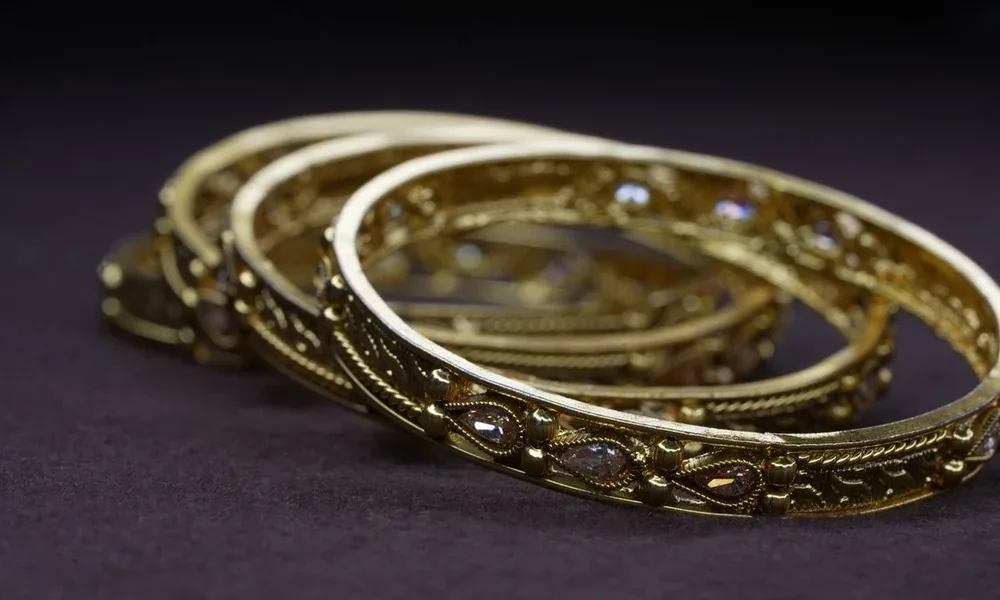
A hallmark is a small stamp, usually on the inside of the bangle, and it is the one part of a gold purchase that does not depend on trusting the seller. Everything else — the quoted karat, the weight, the description — is a claim. The millesimal system stamps 417 for 10K, 585 for 14K, 750 for 18K, 916 for 22K and 999 for 24K.
Check the stamp itself, not just its presence. A genuine hallmark is usually crisp and evenly struck. Be wary of stamps that look shallow or blurred, and of pieces priced as solid gold with no mark at all. An unmarked piece is not automatically fake, but its purity is unverified.
Solid, filled, plated or vermeil: know what you are paying for
Four bangles can look identical on the day you buy them and be in completely different condition a year later. The difference is how much gold there is and what lies underneath it. Solid gold means the karat alloy runs through the whole piece, with no base metal core. It can be repaired and keeps its metal value.
| Type | Underneath | Gold layer | Stamp | Lasts | Repairs | Best for |
|---|---|---|---|---|---|---|
| Solid gold | None | Whole piece | 14K, 585, 750 | Generations | Yes | Daily wear |
| Gold filled | Brass core | 1/20 of weight | 1/20 14K GF | Years | Limited | Everyday wear |
| Vermeil | Silver | 2.5 microns | 925 vermeil | Months to years | Replate only | Occasions |
| Heavy electroplate | Brass, steel | 2.5 microns | HGE | Months | Rarely | Occasional wear |
| Gold plated | Brass, steel | 0.175 microns | GP, GEP | Weeks to months | Rarely | Trend pieces |
| Hollow gold | Air | Varies | Karat mark | Shorter than solid | Hard | Big look, low budget |
| Rolled gold plate | Brass core | 1/40 of weight | RGP | Longer than plating | Limited | Vintage styles |
| Gold over steel | Steel | Thin PVD coat | Often none | Months | No | Fashion bangles |
Buy solid gold if the bangle is meant to last, gold filled if you want the gold look for everyday wear at a lower price, vermeil for occasional pieces over silver, and plated only when you accept that the finish will wear. Whatever the type, the listing should name it plainly — a listing that says only “gold bangle” is one to question.
Hinged, slip-on or open: the three bangle types
Every bangle gets on to the wrist in one of three ways, and each has its own checks. A slip-on bangle is a closed circle: press your thumb to your little finger, squeeze your hand as narrow as it goes, and slide the bangle over it. It should need gentle pressure and then sit comfortably on the wrist.
A hinged bangle opens on one side, usually with a small pin hinge and a push-in catch — the practical choice for larger hands and for wide bangles that cannot pass over the knuckles. Open and close the hinge several times before you buy: it should move smoothly, close with a firm click, sit perfectly flush with no gap, and show no wobble.
Sizing a bangle: the hand test
Sizing a bangle is a measurement of your hand, not your wrist. Bring your thumb to your little finger, squeeze your hand as narrow as it goes, then wrap a soft tape measure around the widest part — across the knuckles and thumb joint. That number is your bangle size. A bangle sized to your wrist alone will not pass over your hand.
Test the fit in person whenever you can. The bangle should pass over the hand with gentle pressure — no forcing, no soap, no wincing — and then sit on the wrist with a little room to move. It should slide a short way up the forearm without falling over the hand when you lower your arm.
Weight, wall thickness and why grams matter
Much of the price difference between two similar-looking gold bangles comes down to weight. Gold is sold by weight and karat, so a heavier bangle of the same karat costs more. Ask for the weight in grams, and compare the price per gram rather than the headline price. For a bangle, weight also tells you whether the piece is solid or a hollow tube.
A hollow bangle is not a bad purchase — it is a way to get a big look for less money — but it should be disclosed as hollow and priced accordingly, not described simply as solid.
Finish, edges and comfort
Run a finger slowly around the inside of the bangle. A well-finished piece feels smooth everywhere, with no sharp edge, burr or rough patch. The inner edge matters most, because it rests against your skin all day; a sharp inner rim will irritate your wrist within hours. Wide bangles should have a gently rounded inner profile, not a square edge.
Style, width and stacking in 2027
Once the practical checks are done, style is the fun part. The profiles that keep coming back are the slim round bangle, worn alone or stacked; the wide flat band, a single bold statement; the twisted rope bangle, which catches the light as you move; and the hammered bangle, whose dimpled surface hides small scratches better than a mirror polish ever will.
Width changes how a bangle wears as much as how it looks. A slim bangle of 2 to 4 mm is light, comfortable and easy to stack. A medium bangle of 5 to 8 mm makes a clear statement. A wide bangle of 10 mm or more suits occasion wear, but it is heavier and harder to fit, so wide bangles are often hinged. Our guide to gold jewellery for everyday wear shows how one or two pieces can carry an outfit. For a first gold bangle, a slim or medium solid bangle in 14K or 18K is safest; our round-up of the best gold jewellery brands compares makers.
Care, storage and keeping it looking new
Gold does not tarnish the way silver does, but a bangle still picks up a film of skin oils, soap and dust that dulls the shine. Clean it gently and often: soak it in warm water with a drop of mild dish soap, brush it softly with a soft toothbrush, rinse and dry it with a soft, lint-free cloth.
Before you buy: a quick checklist
- Measure your hand, not your wrist, and test the bangle over your knuckles before you pay.
- Find the hallmark inside the band: 417, 585, 750, 916 or 999, plus a maker mark.
- Confirm the construction in writing: solid, hollow, gold filled, vermeil or plated.
- Ask for the weight in grams and compare the price per gram with similar bangles.
- Test the hinge or catch several times on a hinged bangle, and check the spring on an open cuff.
- Run a finger around the inside for sharp edges, check the seam and the finish, and keep the receipt with the hallmark details.
Frequently asked questions
What karat is best for a gold bangle?
For daily wear, 14K is usually the best balance of strength, colour and price. Eighteen-karat gold has a richer colour, while 22K works well in a rigid bangle because the solid circle holds its shape.
How can I tell if a gold bangle is real?
Look for a hallmark on the inside of the band first: 585 means 14K, 750 means 18K and 916 means 22K. A jeweller can confirm purity with an acid test or an X-ray fluorescence reading.
Is a hollow gold bangle worth buying?
A hollow bangle gives you a big look for less money, which is a fair trade if you know what you are buying.
How should a gold bangle fit?
Measure your hand across the knuckles with your thumb touching your little finger, and choose a bangle that passes over the hand with gentle pressure. It should then sit on the wrist with a little room to move.
What is the difference between a bangle and a bracelet?
A bangle is a rigid circle that slips over the hand or opens on a hinge, with no chain and usually no clasp. A bracelet is a flexible band held together by a clasp.
How do I stop my gold bangles from scratching each other?
Store each bangle in its own soft pouch and keep them separate in a lined box. A hammered or brushed finish hides small scratches better than a mirror polish, and a gentle soap-and-water clean restores the shine.
The bottom line
A good gold bangle is bought with the eyes and the hands, not with the listing. Measure your hand, read the hallmark inside the band, confirm solid or hollow, ask for the weight in grams, and test the hinge or slip-on fit before you pay.
When those basics are right, the rest is pleasure. A well-chosen gold bangle needs little care, suits almost everything you own, and only gets better with wear — a simple circle of gold, bought once and worn for decades.
Note: karat and hallmark rules vary by country, and a stamp certifies purity, not weight or fair price.