



An opal necklace is the most forgiving way to wear opal, and the easiest way to buy it badly. A necklace keeps the stone away from the knocks a ring takes, so a stone too soft for a ring can live happily at the throat for decades.
The stone itself is the puzzle. Opal is hydrated silica, holding water inside its structure, usually around 6 to 10 per cent in gem material. It rates only 5 to 6.5 on the Mohs hardness scale, with toughness the Gemological Institute of America describes as poor to fair. Its beauty comes from play-of-colour, flashes of blue, green, orange and red that move as the stone moves.
This guide covers the buying check in the order that matters: opal type, play-of-colour, solid or assembled stone, setting and chain, length, price, and care.
Key takeaways
- Play-of-colour decides value more than size: look for bright flashes that cover most of the stone and shift as you move it.
- Opal rates 5 to 6.5 on the Mohs scale with poor to fair toughness, so a necklace is a kinder setting than a ring, but the stone still needs protection and gentle care.
- Ask whether the stone is solid, a doublet or a triplet, natural or lab-grown, and get the answer in writing before you pay.
- Bezel settings protect opal best, and the chain must suit the pendant weight: a heavy stone on a fine chain will snap the chain or wear the bail.
- Clean with lukewarm soapy water and a soft cloth only, never use ultrasonic or steam cleaners, and store the necklace in its own pouch away from heat and hard jewellery.
Know the five opal types
Opal is not one stone but a family, and the type decides the look, the price and how carefully you must treat it. Black opal has a dark body tone, from dark grey to jet black, which makes the play-of-colour stand out sharply; it is the rarest and usually the most expensive. White opal has a milky white to light body tone, softer in effect and far more common, so it costs much less than a black opal of the same brightness. Crystal opal is transparent, so the colour seems to float inside the stone.
Boulder opal is cut with its ironstone host rock still attached, so dark matrix shows around the thin seam of opal; it is tough, characterful and often more affordable than a solid black opal of similar colour. Fire opal, mostly from Mexico, is transparent orange, red or yellow and usually shows little or no play-of-colour; it is bought for its body colour and clarity instead. Do not pay a black opal price for a white opal in a dark setting: a dark backing behind a pale stone can fake the contrast of a black opal, and that is exactly what a doublet does.
Read the play-of-colour
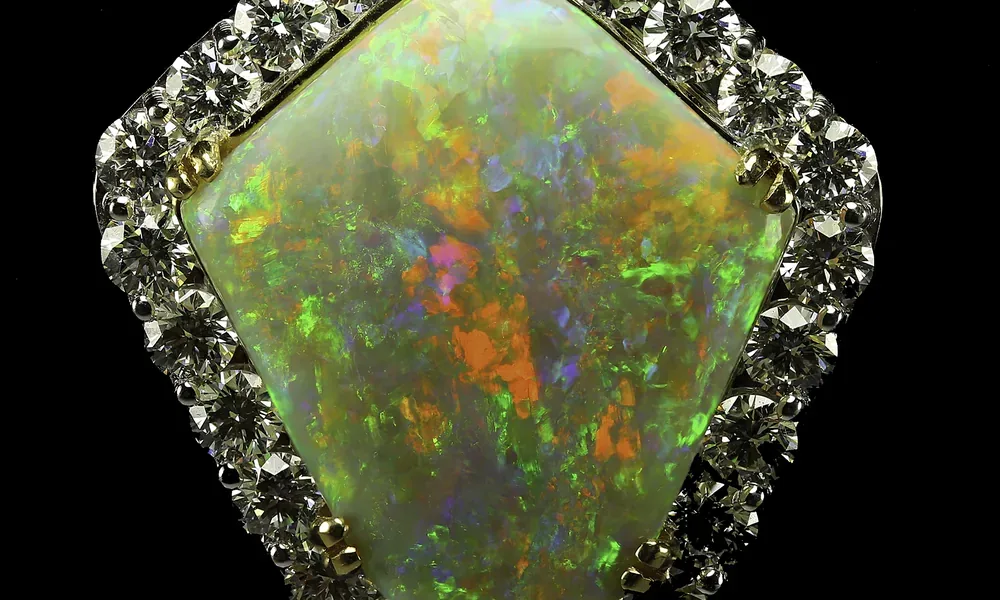
Play-of-colour is the first thing to judge and the hardest to describe, so judge it with your eyes, not the label. Hold the pendant against dark cloth, tilt it slowly, and watch what happens. Good play-of-colour is bright, covers most of the face of the stone, and shows more than one colour.
Pattern matters too: pinfire means tiny dots of colour, broad flash means large sheets that roll across the stone, and harlequin means a mosaic of regular blocks. Also check the body tone, the background colour beneath the play-of-colour, graded from N1, jet black, to N9, very light. Look for crazing, a network of fine cracks that can appear when an opal dries out or suffers a knock, and for pits or cloudy patches. A little matrix in a boulder opal is normal; crazing in a solid opal is a fault, and it will only get worse.
Solid, doublet or triplet: know what you are buying
This is the single most important question to ask, and the one most often skipped. A solid opal is one continuous stone, cut and polished. A doublet is a thin slice of opal glued to a dark backing, usually black potch or glass, which makes a pale stone look like a black opal. A triplet adds a clear dome of quartz or glass on top, which protects the slice and magnifies the colour. Doublets and triplets are genuine opal on top, but they are assembled stones, and they should cost far less than a solid stone of the same face-up appearance.
A doublet or triplet can be a sensible buy at the right price, especially for a large, dramatic pendant, but only if it is labelled as one and priced as one. If a seller describes a stone only as Australian opal, ask for the full description in writing: solid or assembled, natural or lab-grown, treated or untreated. Lab-grown opal is real opal grown in a laboratory, and it can be very convincing; under magnification it often shows a regular, lizard-skin pattern, while natural opal shows irregular colour patches. The same question matters for every opal piece: our guide to what to look for in an opal ring explains how it plays out when the stone takes far more knocks.
Settings, chains and metals
A bezel setting, where a rim of metal wraps the edge of the stone, is the most protective choice for an opal pendant, because it guards the edges that chip first and shields the stone from side knocks. A prong setting shows more of the stone and lets more light in, which flatters crystal opal in particular, but the prongs must be sturdy and even, and a tall stone in a prong setting is more exposed.
The chain matters as much as the setting, and it is where cheap necklaces fail. A pendant of 5 grams or more needs a chain with real substance: a cable, curb or rope chain in solid gold or sterling silver, not a hollow or plated chain that will snap at the clasp. Yellow gold warms opal; white gold and platinum give a cooler frame. For everyday wear, our guide to gold jewellery for everyday wear in 2027 covers which karats and finishes hold up best when a necklace is worn daily.
Lengths and necklines
Necklace length is measured in inches, and the standard lengths are 14, 16, 18, 20, 22, 24, 30 and 36 inches. A 16-inch chain sits at the base of the throat, an 18-inch chain at or just below the collarbone, and a 20-inch chain at the top of the bust. The 18-inch princess length is the most versatile default for a pendant, because it shows the stone clearly without hiding it under a collar, and it layers well with a shorter chain.
Remember to add the pendant drop: an 18-inch chain with a 2-inch pendant carries the lowest point to about 20 inches, so measure to where the bottom of the stone will fall, not to the chain alone.
| Length | Style name | Where it sits | Best with |
|---|---|---|---|
| 14 inches | Choker | Base of the neck | Off-the-shoulder tops, small opal beads |
| 16 inches | Choker to princess | Base of the throat | Crew necks, small pendants, layering |
| 18 inches | Princess | At or just below the collarbone | Everyday pendants, V-necks, most outfits |
| 20 inches | Matinee | Top of the bust | Statement pendants, turtlenecks, blouses |
| 22 inches | Matinee | Above the bust line | Larger pendants, dresses, layering |
| 24 inches | Matinee | Upper bust | Bold boulder opal, evening wear |
| 30 to 36 inches | Opera and rope | Below the bust | Beaded opal strands, formal gowns, knotting |
| Adjustable | Extender chain | 2 to 3 inches of give | Any pendant, for switching necklines |
What is a fair price in 2027
Opal pricing has no single scale like the diamond 4Cs, so the price is set by type, brightness, pattern, size and whether the stone is solid. A small white opal pendant in sterling silver can cost less than a dinner out, while a solid black opal pendant with bright red and green play-of-colour in 18-karat gold can run into four figures and beyond.
Look for a hallmark stating the metal and its fineness, and for any significant purchase ask for a written description of the stone, its type, its construction, any treatment, and the metal. Our roundup of the best diamond pendants of 2027 shows how the same settings and chains are priced when the stone is a diamond, a useful cross-check on what the metalwork alone should cost.
Caring for an opal necklace
Opal is one of the few gemstones where ordinary jewellery cleaning can do real damage. GIA rates opal at 5 to 6.5 on the Mohs scale with poor to fair toughness, and warns that heat and sudden temperature changes can cause crazing, a network of fine fracture lines, or fracture the stone outright. Its only recommended cleaning method is warm soapy water, applied gently. Never use an ultrasonic cleaner or a steam cleaner, never soak the necklace, and never use bleach, acids or harsh chemicals.
Put the necklace on last, after perfume, hairspray and moisturiser, and take it off before the gym, the pool, the shower or cleaning with chemicals. Store it in its own soft pouch or a lined compartment, away from harder jewellery that can scratch it, because ordinary household dust rates about 7 on the Mohs scale, harder than opal itself.
Before you buy checklist
- Identify the type in writing: black, white, crystal, boulder or fire opal, and whether the stone is solid, a doublet or a triplet.
- Judge the play-of-colour against a dark background in natural light: bright, broad flashes across most of the stone.
- Look for crazing, pits, cloudy patches or a seam along the edge.
- Test the setting: bezel smooth and even, prongs firm with no wobble, bail soldered closed and wide enough for the chain.
- Check the chain suits the pendant weight, the clasp closes firmly, and the length puts the stone where you want it on your neckline.
- Confirm the metal hallmark, the written description of stone and treatment, and a return policy that gives you time to inspect the necklace at home.
Frequently asked questions
Is opal good for an everyday necklace?
Yes, and a necklace is the kindest setting for opal, because it takes far fewer knocks than a ring. Choose a solid stone in a bezel setting on a chain strong enough for its weight.
How can I tell if an opal necklace is real?
Real precious opal shows play-of-colour that shifts as you move the stone, with some natural variation in the pattern. Glass imitations often contain round bubbles and feel warmer to the touch, while a stone that is perfectly uniform in colour with no variation at all is worth questioning.
What is the difference between a doublet and a triplet?
A doublet is a thin slice of opal glued to a dark backing, which makes a pale stone look darker and brighter. A triplet adds a clear quartz or glass dome on top, which protects the slice and magnifies the colour. Both are assembled stones and should cost far less than a solid opal of the same appearance.
Can I wear an opal necklace in the shower or pool?
No. Water, soap residue, chlorine and heat are all bad for opal, and prolonged soaking can weaken the glue in a doublet or triplet.
Why does my opal look dull indoors?
Opal needs light to show its play-of-colour, and a stone that only flashes under a shop spotlight may look flat in a dim room.
Does opal need special storage?
Yes. Opal contains water, and very dry air or heat can cause it to craze, so store it at normal room humidity in its own soft pouch, away from harder jewellery.
The bottom line
Buy the play-of-colour first, the type second, and the setting third, in that order. A bright, well-patterned stone in a protective bezel on a chain strong enough to hold it will outlast a bigger, duller stone in a showy setting every time.
An opal necklace is not a stone you buy once and forget: it is a stone you look after, and it rewards that care with colour no other gem shows.
Note: Opal is a soft stone with poor to fair toughness, so treat any price, hardness or care claim as a guide rather than a guarantee, and confirm the stone type, construction and return terms with the seller before you buy.


