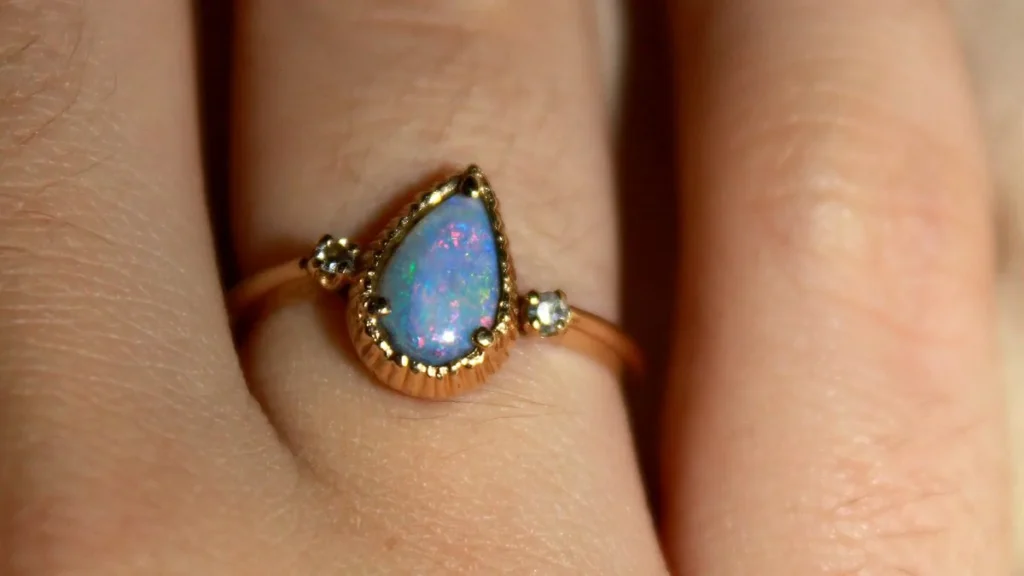
An opal ring is the most personal buy in fine jewellery, and the easiest to get wrong. In a jeweller’s window, almost every opal looks like the same flash of rainbow colour. On your hand, in daylight, the differences appear at once: one glows from every angle, another only flashes when you tilt it just so, and a third looks milky and flat.
Opal is unlike any other gemstone you can put in a ring. It is not judged by the four Cs that govern diamonds, because it has no single body colour at all. What it has is play-of-colour: patches of spectral light that appear, move and vanish as the stone turns. That living quality is why people fall for opal, and why buying one needs a different eye than buying a sapphire.
This guide covers what matters before you buy: what opal is, judging play-of-colour, the types, solid versus doublet, triplet and synthetic, durability, settings, prices, and paperwork.
Key takeaways
- Judge play-of-colour first: brightness, colour range and pattern, checked in daylight from several angles.
- Body tone matters as much as colour: a dark background makes the same flashes read far stronger, so black opal costs the most.
- Know what you are buying: a solid natural opal, a doublet, a triplet or a synthetic are different products at very different prices.
- Opal is soft, at 5.5 to 6.5 on the Mohs scale, and holds water, so a bezel setting and gentle care are part of the purchase.
- Get the type, origin and any treatment in writing, and ask for a lab report on any dear ring.
What opal actually is
Opal is hydrated silica, formed over millions of years as silica-rich water seeped into rock and hardened. Inside a precious opal, microscopic silica spheres are packed in a regular grid, and where they are uniform and evenly stacked, they split white light into spectral colours, like a diffraction grating. That is play-of-colour.
Sphere size decides the colours: small spheres return blue and violet, larger ones green, then orange, then red. Opal also holds water, usually 3 to 21 per cent of its weight, which makes it both beautiful and delicate. It is October’s birthstone; most fine opal comes from Australia, Lightning Ridge for black and Coober Pedy for white.
Play-of-colour comes first
With a diamond, cut usually comes first. With opal, play-of-colour comes first and drives nearly all of the value. Judge it on brightness, colour range and pattern. Brightness is how vivid the flashes are; the best stones show strong colour at arm’s length in ordinary light. A stone that only wakes up under a spotlight will look dull on your hand, so see it by a window.
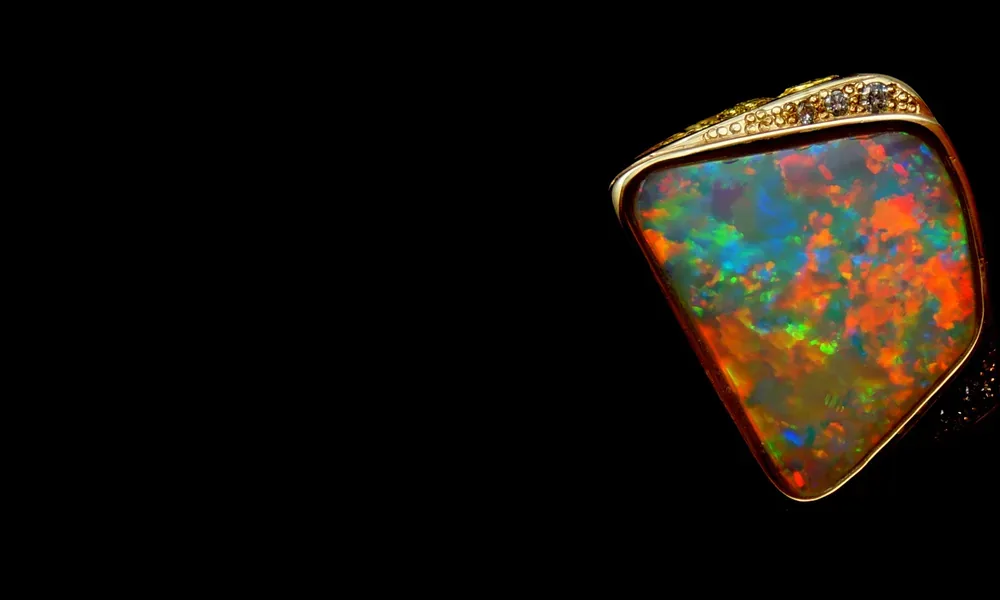
Colour range is the second test. Red is the rarest flash and the dearest, then orange, then green, then blue and violet. But brightness beats range: a bright stone showing only blue and green will outsell a dull one that technically shows red. Pattern is the third test: broad, well-defined patches beat a fine pinfire speckle, and harlequin, large angular blocks fitted like a mosaic, is the rarest and priciest pattern of all. Also watch directionality: colour holding across angles is worth far more than colour from one sweet spot.
The types of opal, and why the name matters
Type in opal is mostly body tone, the background the colour plays against: dark backgrounds make colour read stronger. The trade names are different products at different prices.
| Type | What it is | What to expect |
|---|---|---|
| Black opal | Dark body, N1 to N4 | Most valuable; darkest background |
| White opal | Pale milky body, N7 to N9 | Most common, least expensive |
| Crystal opal | Transparent to translucent | Priced on brightness |
| Boulder opal | Thin opal seam on ironstone | Dark backing, great value; each unique |
| Fire opal | Orange-red body, often no play-of-colour | Priced as a colour stone |
| Ethiopian opal | Light, translucent Welo | Bright, affordable; absorbs water and oils |
| Common opal | Opaque, no play-of-colour | Not for a fine ring |
| Matrix opal | Colour scattered through host rock | Rustic; buy for character |
Body tone runs from N1, jet black, to N9, near white. A red flash on an N2 black opal reads stronger than the same flash on an N7 white opal. That explains most of the price gap between black and white opal rings.
Cut, shape and size
Opal is almost always cut as a cabochon, a smooth dome with no facets, because a faceted top would scatter the play-of-colour. A high dome shows the colour best; a flat dome can look dull even when the material is good. Oval is the classic shape, but round, cushion, pear and freeform all work well.
Size is the least important factor, and the easiest to overpay for. A huge pale stone is no bargain; a smaller, brighter one is the better ring. A one-carat black opal with vivid red flash can cost many times more than a five-carat white opal. Buy colour first.
Solid, doublet, triplet or synthetic
This decides whether a bargain is a bargain. A solid opal is one piece of natural opal all the way through. A doublet is a thin slice of opal glued to a dark backing, usually ironstone or black glass, which makes a pale stone look like a black opal. A triplet adds a domed cap of clear quartz or glass on top, which magnifies the colour. All three are legitimate if disclosed, but the prices are worlds apart.
Look at the stone from the side: a solid opal shows one continuous material, a doublet shows a straight line where the opal meets its backing, and a triplet shows two lines. Doublets and triplets dislike water, because moisture can seep between the layers and cloud the glue, so never soak them. A doublet costs tens of dollars per stone, not hundreds per carat, and a triplet less still.
Synthetic opal is lab-grown from silica spheres in a lattice, and modern material can look convincing. The giveaway is usually a pattern that is too perfect: overly uniform flashes or repeating shapes. Some pale opals are smoked or treated with sugar and acid to darken the body, and some porous Ethiopian opals are impregnated with resin or oil. All must be disclosed in writing.
Durability: the honest part
Opal is soft, at 5.5 to 6.5 on the Mohs scale, softer than a sapphire, a morganite or even a citrine, and it can scratch, chip and crack if knocked. Left in very dry heat, or in a safe for months, it can lose water and craze, developing fine cracks that will not heal, so check under a loupe before you buy. It is a ring for someone who wears it with awareness, not for the gym, the garden or the dishwasher. If you want a ring for every day without thinking about it, a harder stone is safer, and our guide to choosing an engagement ring setting explains which protective settings suit softer stones.
Settings and metals
A bezel setting, where a rim of metal wraps around the stone’s edge, is the best choice for opal: it shields the vulnerable edges, holds the stone low, and suits the cabochon shape. A halo of small diamonds adds protection and sparkle. Tall prongs are the worst choice, leaving the edges exposed; if you love a prong look, choose a low basket with at least six prongs and a rail underneath.
Yellow gold warms a white or crystal opal and flatters the orange and red flashes, while white gold or platinum makes the blue and green flashes stand out and suits a black opal. Whatever the metal, keep the band sturdy: a thin band and a soft stone are a bad combination.
What a fair price looks like in 2027
Opal prices are not standardised the way diamond prices are. As a rough guide, a fine white opal ring might run from a few hundred dollars into the low thousands, a bright boulder opal ring from the mid-hundreds to several thousand, and a fine black opal ring from a few thousand upward, with top stones beyond ten thousand dollars a carat. Ethiopian Welo opal is usually the most affordable route to bright colour, while a doublet or triplet should cost well under a solid stone. Price follows brightness, colour range, pattern, body tone and size, in that order. If you are weighing opal against other coloured stones, our non-diamond engagement rings guide shows how the alternatives compare.
Paperwork and where to buy
For any opal ring above a few hundred dollars, ask for a lab report from a recognised gemmological laboratory, and check it matches the stone: type, body tone, weight, dimensions, origin, and natural, treated or assembled. Keep the report with a receipt naming the stone exactly as sold, such as natural black opal, solid, untreated. Buy from a jeweller who specialises in opal, and beware market stalls and auction sites, where doublets are often sold as solid stones.
Caring for an opal ring
Clean it with lukewarm water, a drop of mild soap and a soft cloth, then dry it straight away. Never use an ultrasonic or steam cleaner, never soak it, and keep it away from chemicals, perfumes and hairspray. Put the ring on last and take it off first. Store it alone in a soft pouch, and have the setting checked once a year.
Checklist: before you pay
- View the ring in daylight and tilt it to check the colour holds from several angles.
- Confirm type in writing: black, white, crystal, boulder or fire opal; solid, doublet, triplet or synthetic.
- Look at the stone from the side for the straight glue lines that reveal a doublet or triplet.
- Check the surface under a loupe for crazing, cracks and chips, and that the dome is smooth.
- Choose a bezel or halo setting, with a band sturdy enough to protect a soft stone.
- Get a lab report on any expensive ring, plus a receipt naming the stone exactly as sold.
Frequently asked questions
Is an opal ring suitable for everyday wear?
Yes, with awareness. Opal is soft and holds water, so it needs a bezel setting and a wearer who takes it off for the gym, gardening and heavy work. With that care, many wear one daily for years.
What is the difference between a doublet and a triplet?
A doublet is a thin slice of natural opal glued to a dark backing, which makes a pale stone look like a black opal. A triplet adds a domed quartz or glass cap on top. Both are legitimate if disclosed, and far cheaper than a solid stone. A doublet shows one glue line from the side, a triplet two.
Why is black opal so much more expensive than white opal?
Because of body tone: a dark background makes the same play-of-colour read far stronger, so black opal, N1 to N4, shows its flashes at their most vivid. It is also rarer, from Lightning Ridge above all.
Can an opal ring get wet?
Brief contact with water is fine for a solid opal, though it is best to take the ring off. Never soak an opal ring, and never wear a doublet or triplet in water: moisture can seep between the layers and cloud the glue.
Does opal fade in sunlight?
A solid natural opal does not fade in normal sunlight, though strong heat and very dry air can dry it out and cause crazing. Do not leave one on a sunny windowsill or in a hot car.
How do I know if my opal is real?
Look for irregularity: natural play-of-colour is uneven, with patches that shift as you turn the stone, while synthetic opal often shows overly uniform flashes or repeating patterns. For certainty, get a lab report before you buy.
The bottom line
The best opal ring is not the biggest or the most expensive one. It is the one whose colour stays bright in daylight from more than one angle, whose type and construction are stated honestly in writing, and whose setting protects a soft, water-bearing stone. Judge play-of-colour first, body tone second, and size last. If you are still comparing styles, our best opal rings round-up shows these rules applied to real rings.
Note: Opal prices vary widely by brightness, pattern, body tone and origin, and the figures here are broad 2027 indications, not quotes. Always ask for the stone’s type, construction and any treatment in writing, and get a lab report before paying a premium price.