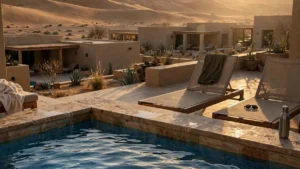
A desert hotel is a different kind of luxury from a city hotel with a desert view. The best ones are built around the landscape itself: low walls the colour of sand, courtyards that catch the evening breeze, pools that look out over dunes rather than rooftops, and a stillness at night that no city property can offer. The trade-off is real too.
That is why choosing a desert hotel deserves more care than choosing a city stay. The right property matches the desert you want to be in, the season you are travelling in, and the way you actually spend a holiday, whether that means long slow mornings by a pool, dawn walks in the dunes, or a base for exploring a region.
Below are nine luxury desert hotels worth considering in 2027, from the great sand sea of the Empty Quarter to the red rock country of Utah and the Namib Desert.
Key takeaways
- The best desert hotels are designed around their landscape, with architecture, shade and water used to make extreme heat comfortable rather than hidden.
- Season matters more in the desert than almost anywhere else: the same hotel can be perfect in November and punishing in July.
- Transfers, activities and meals are often priced separately, so compare the full cost of the stay, not just the room rate.
- Desert hotels suit slow travel best — plan for at least two or three nights, because the first day is usually spent arriving and adjusting.
- No desert hotel can guarantee clear skies, comfortable temperatures or a private dune, and remote locations mean limited medical facilities and patchy phone signal.
What makes a desert hotel different
A desert is not one landscape. The Empty Quarter in Abu Dhabi is a sea of tall orange dunes. The Negev is rocky, pale and steep. Utah is red rock canyons and open sky. The Namib is fog, gravel plains and dunes that meet the Atlantic. A hotel that works in one of these places would feel wrong in another, and the best properties are the ones that take their cues from where they stand: thick walls, shaded courtyards, local stone, and layouts that turn the building into shelter from the sun rather than a box that fights it.
That local character is also what separates a real desert hotel from a resort that happens to sit near sand. Look for design that uses the region’s materials and building traditions, staff who know the desert and can read its weather, and activities that belong to the place, such as guided dune walks, camel rides at dawn, stargazing with a local astronomer, or a dinner cooked in the sand.
Distance is the other defining feature. Many of the best desert hotels are deliberately remote, which is exactly what makes them quiet and dark at night, and exactly what makes logistics matter. Ask how you get there, how long the transfer takes, what happens if your flight is delayed, and whether the hotel provides its own vehicles. A 90-minute drive on a rough track after a long flight is a different thing entirely.
How we chose these hotels and what to look for
Look first at the setting and the season. A hotel in the dunes is at its best in the cooler months, roughly November to March in the Middle East and North Africa, and spring and autumn in the American Southwest. Check average daytime and night-time temperatures for your dates, not just the headline season, and remember that desert nights can be cold even when the days are hot.

Look next at what is actually included. Some desert hotels include breakfast and dinner, some include activities such as dune drives and guided walks, and some charge for almost everything beyond the room. Ask for a clear list before you book, and compare properties on the total cost of the trip you actually want, not on the starting price.
Finally, look at the practical details that matter in a remote place. How strong is the phone signal and the Wi-Fi? Is there a doctor or a clinic within reasonable reach? What happens if the weather turns, with sandstorms or heavy rain? Our guide to the best luxury desert retreats covers the smaller, quieter end of desert stays, while this list focuses on full-service hotels.
The 9 best luxury desert hotels of 2027
Qasr Al Sarab Desert Resort by Anantara, Abu Dhabi
What we like: A palace-like resort deep in the Liwa Desert, surrounded by some of the tallest dunes in the Empty Quarter, with villa rooms, a desert spa, and falconry, camel trekking and dune drives on site. What to consider: It is a long drive from Abu Dhabi city, summer heat is extreme, and activities and dining add to the bill. Best For: A grand, once-in-a-lifetime desert stay. Style: Fortress-style resort with courtyards and a large pool. Price Range: From around $600 a night. Standout Feature: The setting itself — dunes in every direction, with nothing else in sight.
Al Maha, a Luxury Collection Desert Resort and Spa, Dubai
What we like: Private tented villas with plunge pools inside the Dubai Desert Conservation Reserve, with wildlife drives, falconry and archery included in the experience. What to consider: Rates are high and the resort is adults-focused, so it is not the best choice for young children. Best For: A private, romantic desert stay near Dubai. Style: Bedouin-inspired tented villas with private pools. Price Range: From around $900 a night. Standout Feature: Each villa has its own plunge pool facing the dunes.
Bab Al Shams Desert Resort, Dubai
What we like: A low-rise, fort-style resort in the Dubai desert with courtyards, an infinity pool, a spa and a well-regarded restaurant, at a more approachable price than the most exclusive desert properties. What to consider: It is larger and livelier than a small desert hideaway, and the dunes nearby are flatter and less dramatic than the Liwa. Best For: A first desert stay that still feels luxurious. Style: Fort-style resort with arches, courtyards and gardens. Price Range: From around $300 a night. Standout Feature: The desert infinity pool at sunset.
Six Senses Shaharut, Negev Desert, Israel
What we like: A small, quiet resort on a cliff edge in the Negev, with 60 suites and villas, a spa built into the rock, and views across the desert to Jordan. What to consider: It is remote, the landscape is stark rather than soft dunes, and getting there takes planning. Best For: Travellers who want stillness, walking and wellness. Style: Low stone villas that blend into the cliff. Price Range: From around $700 a night. Standout Feature: The spa and the silence — few desert hotels are this quiet.
Amangiri, Utah, United States
What we like: A strikingly minimal resort in the Utah desert near Lake Powell, with suites built around a central pool, a spa, and guided hikes, climbing and horse riding in the surrounding canyons. What to consider: Prices are among the highest in the desert hotel world, and the nearest town is a long drive away. Best For: Design lovers and serious hikers. Style: Minimal concrete and stone, open to the desert. Price Range: From around $1,500 a night. Standout Feature: The main pool, set into the rock like a slot canyon.
Amangiri is less a hotel than a piece of architecture placed in the desert. It is expensive, and it knows it, but for travellers who love modern design and empty landscapes, there is nothing quite like it. Book activities early, as guides and slots are limited.
Four Seasons Resort Scottsdale at Troon North, Arizona
What we like: A large, polished resort in the Sonoran Desert with casita-style rooms, several pools, a spa, a golf course and direct access to desert trails. What to consider: It is a big resort, so it does not feel remote, and summer temperatures in Scottsdale can be punishing. Best For: A comfortable desert stay with a town nearby. Style: Southwestern casitas with courtyards and cactus gardens. Price Range: From around $400 a night. Standout Feature: The desert trail network that starts at the resort edge.
This is the practical choice for a desert holiday that still has restaurants, shops and a town within reach. Our roundup of the best luxury hotels in Dubai shows the same full-service approach in a city setting, but here the desert is the setting itself.
Longitude 131°, Uluru, Australia
What we like: Sixteen tented pavilions facing Uluru, with fine dining under the stars, guided walks and a small, personal scale that larger resorts cannot match. What to consider: It is expensive, remote, and the heat and flies in summer are real; the best months are the cooler ones. Best For: A bucket-list stay at one of the world’s great desert landmarks. Style: Luxury tented pavilions with views of Uluru. Price Range: From around $1,800 a night. Standout Feature: Waking up to Uluru from your bed.
Longitude 131° is built around a single view, and it earns it. The dining experience under the stars is genuinely memorable, and the small size means the staff know every guest. Plan your dates carefully, as the cooler months book out well ahead.
Sossusvlei Desert Lodge, Namib Desert, Namibia
What we like: A lodge in the Namib Desert with direct access to the dunes of Sossusvlei, stargazing from a dedicated observatory, and hot-air ballooning at dawn. What to consider: Reaching it involves long drives or light aircraft, and the desert is harsh, dry and very hot at midday. Best For: Photographers and stargazers. Style: Stone and glass suites set into the gravel plain. Price Range: From around $800 a night. Standout Feature: Some of the darkest, clearest night skies anywhere.
Anantara Sahara Tozeur Resort and Villas, Tunisia
What we like: A resort on the edge of the Sahara near Tozeur, with villa rooms, a spa, a large pool and excursions into the dunes and the nearby oasis towns. What to consider: Tunisia’s desert is less well known to many travellers, so check current travel advice and plan transfers in advance. Best For: A Sahara stay that combines desert and oasis culture. Style: Low, sand-coloured villas around courtyards and a pool. Price Range: From around $350 a night. Standout Feature: The location, where the Sahara meets the palm groves of Tozeur.
Tozeur is a good choice for travellers who want the Sahara without the long journey to the more famous Moroccan dunes, and who are interested in oasis towns and desert culture as well as the sand itself. Stay three nights to allow time for both.
Which desert hotel is right for you
Start with the desert, not the hotel. If you want tall dunes and a grand setting, the Empty Quarter and the Sahara are the places to look. If you want red rock and hiking, Utah and Arizona suit better. If you want wildlife and vast empty space, Namibia is hard to beat. The hotel should follow from that choice, not the other way around.
Then think about how you travel. Couples who want privacy should look for villas with plunge pools and a small room count. Families need connecting rooms, a pool that children can use, and activities that work for different ages. Solo travellers often do better at hotels with communal dining or guided group activities, where the desert feels social rather than isolating.
Budget is the last filter, and it should be applied to the whole trip. A hotel at $300 a night with a $150 transfer and $100 of activities a day costs more than a hotel at $500 a night with transfers and activities included. Add up flights, transfers, meals and activities before you compare, and remember that desert hotels often have minimum stays of two or three nights in peak season.
The caveats that matter
Desert hotels are wonderful, but they are not for every trip. Heat is the main risk. In the Middle East and North Africa, daytime temperatures in high summer can pass 45 degrees, which makes outdoor activity unsafe for much of the day. Our guide to the best luxury desert camps covers the tented end of desert stays, where the same heat rules apply even more strongly.
| Detail | What is known |
|---|---|
| Best season, Middle East and North Africa | November to March, with the coolest nights in December and January |
| Best season, American Southwest | March to May and September to November; summers are very hot |
| Best season, Namibia and Australia | Cooler months, roughly May to September in Namibia and April to September at Uluru |
| Minimum stay | Often two to three nights in peak season; one night is rarely enough |
| What is often extra | Transfers, dune drives, guided walks, spa treatments and some meals |
| Who should be cautious | Young children, older travellers and anyone with a heart or breathing condition in extreme heat |
| Connectivity | Wi-Fi and phone signal can be weak or absent in remote locations |
| What no hotel can guarantee | Clear skies, comfortable temperatures, wildlife sightings or a private dune |
If you have a medical condition, are travelling with small children, or are pregnant, check with your clinician before booking a remote desert stay, and tell the hotel in advance.
Checklist: choosing a luxury desert hotel honestly
Use these checks before you book, and again before you travel.
- Check the season: look up average daytime and night-time temperatures for your exact dates, not just the headline season.
- Check the total cost: add transfers, activities, meals and taxes to the room rate before comparing hotels.
- Check the transfer: how long it takes, what road it uses, and what happens if your flight is delayed.
- Check the room: ask whether it has shade, a plunge pool, a view of the dunes, and how far it is from the main building.
- Check the activities: which are included, which cost extra, and how far ahead they need to be booked.
- Check the practical details: phone signal, Wi-Fi, medical access, and what happens in bad weather.
Frequently asked questions
When is the best time to visit a desert hotel?
The cooler months are best almost everywhere: November to March in the Middle East and North Africa, spring and autumn in the American Southwest, and the cooler dry months in Namibia and Australia.
How many nights should I stay at a desert hotel?
At least two, and three is better. The first day is usually spent arriving and adjusting to the heat and the quiet, and the best activities — dawn dune walks, sunset drives, stargazing — need more than one day to fit in properly.
Are desert hotels suitable for children?
Some are, and some are not. Larger resorts with pools, family rooms and a range of activities work well for children. Small, quiet, adults-focused properties often do not.
What should I pack for a desert hotel stay?
Layers for cold mornings and evenings, sun protection, a hat, closed walking shoes, and a light scarf for wind and sand. Many hotels provide water and sunscreen, but bring your own if you have sensitive skin or a preferred brand.
Is the food included at a desert hotel?
Sometimes. Some hotels include breakfast and dinner, some include all meals, and some charge for everything beyond the room.
Can I visit a desert hotel for one night?
Usually yes, but it is rarely the best use of the trip. The transfer alone can take half a day, and one night leaves little time for the activities that make a desert stay special. If you only have one night, choose a hotel close to your arrival point.
The bottom line
The best luxury desert hotel in 2027 is not the most expensive or the most famous. It is the one in the desert you actually want to be in, at the right time of year, with a room and a rate that match how you travel. A grand resort in the Empty Quarter, a quiet villa in the Negev, or a tented pavilion facing Uluru can each be the right choice, but only for the right trip.
Choose the desert first, then the season, then the hotel, and add up the full cost before you book. That is the honest way to choose a desert hotel, and the way to come home feeling rested rather than rushed.