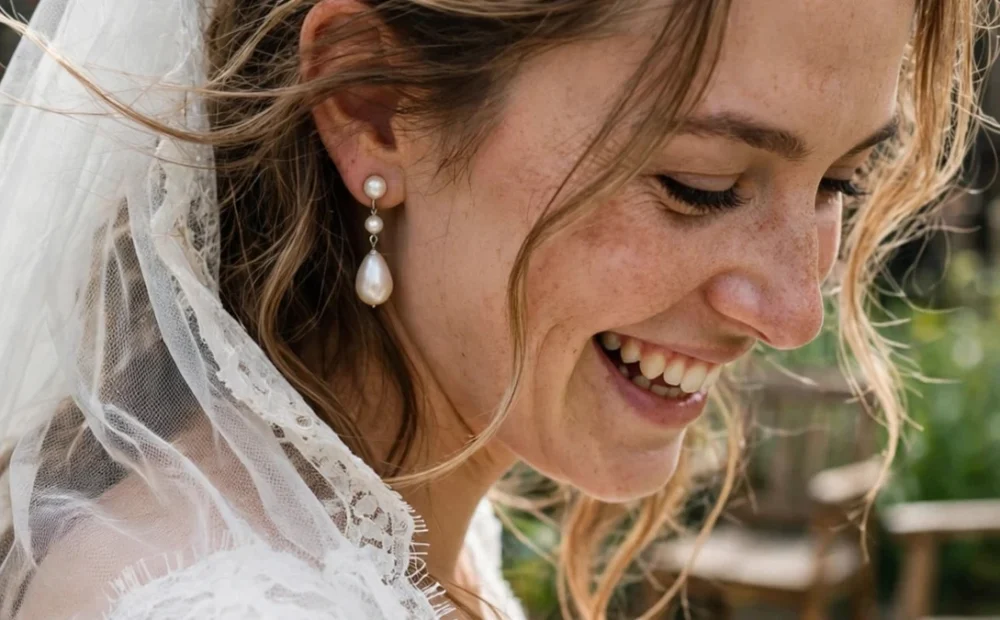
A pearl earring looks simple. Two small pearls, a pair of posts, and that is the whole piece. Yet two pairs that look almost identical in a shop window can be worlds apart in quality, comfort, and value. One pair glows every time you wear it. The other looks flat, feels heavy, or loses its shine within a year.
The difference is not the brand name on the box. It is a short list of qualities you can check in a few minutes: lustre, nacre, surface, shape, colour, size, and how well the two pearls match. Add the setting, the back, and the weight, and you have everything that decides whether a pair is a pleasure to wear or a regret.
This guide explains what to look for in a pearl earring in 2027, covering type, size, backs, settings, fakes, and prices.
Key takeaways
- Lustre comes first: a pearl with sharp, bright reflections beats a larger, duller pearl every time.
- The two pearls must match in size, shape, colour, and lustre.
- Freshwater pearls offer the best value for everyday wear, while Akoya pearls give the brightest, most classic lustre.
- Check the backs, the posts, and the weight before you buy.
- Buy from a seller who discloses the pearl type, any treatments, and a clear returns policy in writing.
Start with lustre, the quality that matters most
Gemologists judge pearls on seven value factors: size, shape, colour, lustre, surface quality, nacre quality, and matching. There is no single worldwide grading scale for pearls, so letter grades such as AAA are set by each seller, not by an independent body.
Of the seven factors, lustre matters most. Lustre is the sharpness and brightness of the light a pearl returns. A high-lustre pearl shows a crisp, almost mirror-like reflection, while a low-lustre pearl looks milky or flat. Hold the earrings in daylight and tilt them slowly. If your reflection stays clear, the lustre is strong.
For earrings, lustre matters even more than for a necklace, because earrings sit beside your face and catch the light with every movement. Nacre decides how long the beauty lasts: thick nacre gives a deep glow and durability, while thin nacre can yellow, chip, or peel.
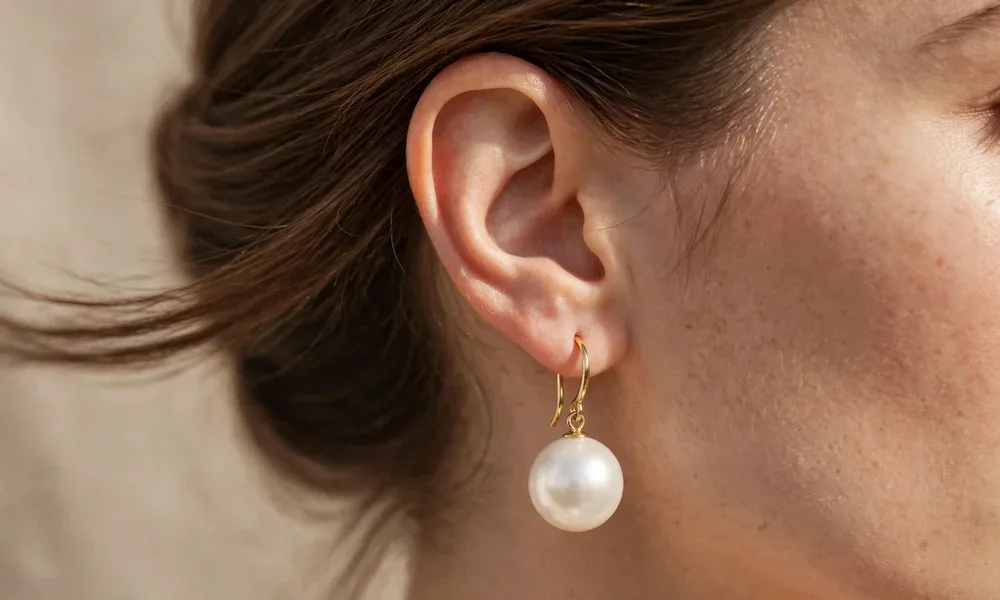
Know the four main pearl types
Nearly all pearl earrings sold today use cultured pearls, grown with human help inside a living mollusc. Natural pearls are extremely rare and far too expensive for most earrings.
Freshwater pearls are grown in mussels, mostly in China, and are the most commonly produced type. Because many pearls can grow in a single mussel, they are also the most affordable, making them the natural starting point for a first pair.
Akoya pearls are the classic saltwater pearl, farmed mainly in Japan and China. They are usually 6 to 9 millimetres across, white or cream with rose or silver overtones, and prized for the brightest, most mirror-like lustre of any pearl type.
South Sea pearls, from Australia, Indonesia, and the Philippines, are the largest cultured pearls, typically 9 to 16 millimetres, in white, silver, and gold, with thick nacre and a soft, satiny lustre. Tahitian pearls, from French Polynesia, are usually 8 to 14 millimetres.
| Pearl type | Typical size | Lustre | Colour | Best for | Price per pair |
|---|---|---|---|---|---|
| Freshwater | 5 to 12 mm | Soft to bright | White, pink, lavender, peach | Everyday studs and drops | $30 to $150 |
| Akoya | 6 to 9 mm | Bright, mirror-like | White or cream | Classic studs, formal wear | $100 to $500 |
| South Sea | 9 to 16 mm | Soft, satiny | White, silver, gold | Statement drops and studs | $500 to $2,000+ |
| Tahitian | 8 to 14 mm | Strong, bright | Grey, green, peacock | Bold drops and dangles | $300 to $1,500+ |
| Baroque freshwater | 7 to 12 mm | Soft to bright | White, pink, peach | Modern drops and hoops | $40 to $200 |
| Imitation glass or plastic | Any size | Flat, too perfect | Uniform white | Costume jewellery only | Under $30 |
| Shell pearl | 6 to 12 mm | Bright but shallow | White, pink, grey | Budget fashion earrings | $20 to $80 |
| Mabe pearl | 10 to 20 mm | Bright, high shine | White, pink, blue | Large studs and clips | $80 to $400 |
Use the table as a reality check. If a seller offers large South Sea studs for the price of freshwater pearls, something is wrong. The order stays the same: freshwater is the most affordable, Akoya sits in the middle, and South Sea and Tahitian pearls cost the most.
Choose the right size for your face and your ears
Size is measured in millimetres across the widest part of the pearl. For everyday studs, 6 to 7 millimetres suits most faces. A 7 to 8 millimetre stud is the classic size: visible, elegant, and comfortable. An 8 to 9 millimetre stud makes more of a statement and suits a longer face or a special occasion.
For drop earrings, the pearl can be larger because the movement carries the size. A 9 to 11 millimetre drop looks graceful, while a 12 millimetre or larger drop is a bold evening choice.
Shape, colour, and the matching of the pair
Round pearls command the highest prices, because a perfectly round pearl is the hardest to grow. Near-round pearls, which look round at a normal distance, offer almost the same look for much less money. Baroque pearls are irregular, each one unique, and suit modern designs.
Colour is a matter of taste, but matching is not. On earrings, you only have two pearls, and they sit on either side of your face, where any difference is easy to see. Hold the pair side by side in daylight. The two pearls should be the same size, shape, colour, and lustre. Even half a millimetre of difference can be visible when worn.
Small blemishes, spots, or wrinkles are normal, especially in freshwater pearls. Deep pits, cracks, or chips are different: they weaken the pearl and spoil the shine. Check the drill hole, where the post enters. It should be clean and smooth, with no chipping around the edge.
Settings, backs, and comfort matter as much as the pearl
A pearl earring is only as good as its setting, the metalwork that holds the pearl. The pearl should sit straight, centred, and firmly fixed, with no wobble and no gap where dirt can collect. The metal should be smooth against your skin, with no sharp edges.
Gold is the classic choice, in yellow, white, or rose, and 14 karat gold is strong enough for everyday wear. Sterling silver is lighter and cheaper, but it tarnishes. Platinum is strong and hypoallergenic, but it costs much more.
The back decides whether your earrings stay in. A butterfly back is the standard push-on back, light and easy, but it can loosen over time. A screw back twists on and is far more secure, making it the best choice for valuable pearls and for children.
Weight is the comfort test. Try the earrings on and wear them for a few minutes in the shop. They should feel light, almost forgettable. If you can feel them pulling, they are too heavy for all-day wear.
How to spot fakes before you pay
Imitation pearls are made from glass, plastic, or shell, coated to look like pearl. Real pearls have tiny imperfections and a deep, layered glow. Imitation pearls are often too perfect: perfectly round, perfectly smooth, and perfectly identical to each other.
Try the tooth test, gently, and only if the seller allows it. Rub a pearl lightly against the edge of a front tooth. A real pearl feels slightly gritty, because of the layers of nacre, while an imitation feels smooth and slippery. Check the drill hole too: on a real pearl it shows layers of nacre with a clean edge, while on a coated imitation the coating may flake near the hole.
No single test is proof on its own. The strongest protection is the seller: a reputable jeweller, a written description of the pearl type, a clear returns policy. If a deal looks too good to be true, it almost certainly is.
What to pay, and where the money goes
Prices depend on type, size, lustre, surface, matching, setting, and metal. A good pair of freshwater studs costs about $30 to $150. Akoya studs usually cost $100 to $500. Tahitian studs start around $300, and South Sea studs around $500, rising well past $2,000 for large, well-matched pairs in gold.
Spend your money in the right order. First, pay for lustre, because it is what you see. Second, pay for matching, because it is what other people see. Third, pay for a good setting and secure backs, because they decide comfort and safety.
If you are buying as a gift, the safest choice is a classic pair of white Akoya or freshwater studs in 7 to 8 millimetres, in a metal the wearer already uses. If you are choosing between pearl earrings and other classic pieces, our guide to the best diamond earrings is a useful comparison, and our diamond buying guide explains how to judge a second classic stone with the same care.
Your buying checklist
- Check lustre in daylight: look for a sharp, bright reflection that stays clear as you tilt the pearl.
- Compare the pair side by side: the two pearls must match in size, shape, colour, and lustre.
- Inspect the surface and the drill holes for chips, cracks, deep pits, and flaking.
- Check the setting, the posts, and the backs: the pearls should sit straight, and the backs should close firmly.
- Try them on and wear them for a few minutes: they should feel light, with no pulling or drooping.
- Ask for the pearl type, any treatments, the metal, and the returns policy in writing before you pay.
Frequently asked questions
What size pearl earring is best for everyday wear?
For everyday wear, 6 to 8 millimetres is the best size for most people. A 6 to 7 millimetre stud is neat and light, while a 7 to 8 millimetre stud is the classic size.
Are freshwater pearls good for earrings?
Yes, freshwater pearls are an excellent choice for earrings, especially for everyday wear. They are affordable, nearly solid nacre, and available in many shapes and soft colours.
How can I tell if pearl earrings are real?
Look for tiny surface imperfections, a deep layered glow, and a drill hole with clean edges. Rub a pearl gently against your tooth: a real pearl feels slightly gritty, while an imitation feels smooth.
Are Akoya or freshwater pearls better for earrings?
Akoya pearls have brighter, more mirror-like lustre and a rounder shape, making them the classic choice for formal studs. Freshwater pearls are more affordable and more varied, and nearly solid nacre makes them durable for everyday wear.
How do I care for pearl earrings?
Put pearl earrings on last, after perfume, hairspray, and makeup, because chemicals damage nacre. Wipe them with a soft, damp cloth after wearing, and store them separately in a soft pouch.
Do pearl earrings suit everyone?
Pearl earrings suit almost everyone, because the size, shape, and colour can be chosen to suit the wearer. Small white studs suit a classic look, baroque drops suit a modern look, and dark Tahitian pearls suit a bold look. Pearl necklaces follow the same idea, and our guide to whether pearl necklaces are in style shows how the same pearls work as a longer piece.
The bottom line
What to look for in a pearl earring comes down to a short list: bright lustre, thick nacre, a clean surface, a shape you love, and a pair that matches perfectly. Then check the setting, the backs, and the weight, because an earring you cannot wear comfortably is not a bargain at any price. Spend your money on lustre and matching before size.
Take your time, look at the pearls in daylight, try them on, and ask the seller to put the details in writing.
Note: Prices in this guide are typical retail ranges for 2027 and vary with quality, setting, metal, and seller. Treat them as a guide for comparison, not as a fixed price for any single pair.