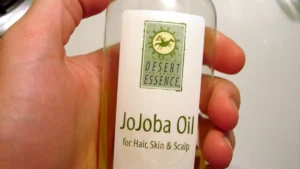
Jojoba oil has survived every skincare trend of the last decade without needing a relaunch. It was in the formulas your grandmother used, it is in the minimalist serums sold today, and it keeps turning up in dermatology reviews as one of the few plant lipids with a clear reason for working. Most ingredients earn their place with a story; jojoba earns its place with a structure.
The reason is chemical, and it is simple. Jojoba is not really an oil at all. It is a liquid wax, made almost entirely of long-chain wax esters, built from the same kinds of molecules, in the same size range, as the wax esters in your own sebum. Skin recognises the material and lets it slot into the lipid layer between surface cells, which is why it feels dry and silky rather than greasy.
This article stays on that mechanism, not the general case for face oils. It follows one question through skin, scalp and hair: what happens when jojoba meets your barrier, why does it feel different, where does the evidence stop, and how do you use it well?
Key takeaways
- Jojoba is a liquid wax ester, not a triglyceride oil: over 97% wax esters in the same C20 to C22 range as human sebum.
- It works in the uppermost layer of skin, filling gaps in the lipid mortar between surface cells and slowing water loss.
- It is both an emollient and a mild occlusive, so it softens skin without the heavy film thicker oils leave behind.
- Its comedogenic rating is 2 on a 0 to 5 scale, low but not zero, and the claim that it trains skin to make less oil is unproven.
- On hair and scalp its wax esters dissolve hardened sebum and coat the cuticle, but no trial shows it makes hair grow.
The one structural fact that explains everything
Almost every plant oil is a triglyceride: three fatty acids attached to a glycerol backbone. Olive, sweet almond, argan and coconut oil all share that architecture. Jojoba breaks the pattern. Pressed from the seeds of the desert shrub Simmondsia chinensis, it contains almost no triglycerides: roughly 97 to 98% is long-chain wax esters, each a fatty acid joined to a fatty alcohol, mostly C20 to C22, with gadoleic acid dominant.
That matters because human sebum is itself about a quarter wax esters, with a very similar chain-length distribution. Jojoba copies only the wax-ester fraction, but it copies it closely, with the right length, shape and polarity to sit alongside the skin’s own wax esters. It also carries small amounts of tocopherols, the vitamin E family, with soothing activity in laboratory work, though the load is modest; if vitamin E is what you are chasing, our guide to the best vitamin E oils for skin in 2027 compares formulas built around it.
Two consequences follow: jojoba stays liquid at skin temperature, melting around 10°C, yet resists rancidity far better than most seed oils, because wax esters oxidise slowly.
How it behaves once it touches skin
The stratum corneum, the outermost skin layer, is often described as a brick wall: corneocytes are the bricks, and the lipid matrix between them is the mortar, ceramides, cholesterol and fatty acids in stacked sheets called lamellae. When the sheets are intact, water stays in and irritants stay out. When over-cleansing, cold, retinoids or age disrupt them, water escapes faster, and skin feels tight and reactive.
Jojoba works at the level of that mortar. Its wax esters slot in between the lipid sheets rather than sitting as a greasy layer on top, and imaging work has shown it reinforcing lamellar spacing, with small human studies measuring reduced water loss within an hour or two.
Crucially, jojoba does not go deep. A small German study in six volunteers traced four plant oils, including jojoba, and paraffin oil through the skin, and found all stayed in the top layers of the stratum corneum. That is a feature: the barrier lives there. It also explains why jojoba rarely stings, working on the dead, lipid-rich surface rather than living cells below.

What the evidence actually shows, and what it does not
The claim you hear most often is that jojoba balances oil production, tricking oily skin into making less sebum. One industry-sponsored study reported a 23% reduction in sebum secretion, but independent trials have not confirmed it: treat it as a hypothesis, not a promise.
The acne evidence is similarly modest. A 2012 pilot study in 194 people with mild acne used a clay mask containing jojoba oil two to three times a week for six weeks, and recorded fewer spots, but there was no comparison group, so no one can say how much came from the jojoba, the clay, or time. Jojoba is usually rated 2 on the 0 to 5 comedogenic scale, low, but that is a rough guide, not a guarantee: patch test first.
How jojoba compares with other familiar oils
| Oil | Lipid type | Sebum similarity | Feel on skin | Comedogenic rating | Best fit | Main weakness |
|---|---|---|---|---|---|---|
| Jojoba | Wax ester, over 97% | Closest, wax-ester match | Dry, silky | 2, low | Barrier support, all types | No hydration alone |
| Squalane | Hydrocarbon | High, mimics squalene | Weightless, dry | 0 to 1, very low | Light barrier support | Less occlusive |
| Argan | Triglyceride, oleic-rich | Moderate | Rich, slightly heavy | 0, low | Dry, mature skin | High oleic, flaky-scalp risk |
| Rosehip | Triglyceride, linoleic-rich | Moderate | Light, fast-absorbing | 1, low | Texture and tone | Oxidises quickly |
| Sweet almond | Triglyceride, oleic-rich | Moderate | Smooth, medium | 2, low | Body and massage | Heavy on oily faces |
| Coconut | Triglyceride, saturated | Low | Heavy, greasy | 4, high | Body, hair lengths | Often clogs facial pores |
| Olive | Triglyceride, oleic-rich | Low to moderate | Rich, slow to absorb | 2, low | Body care | High oleic can disrupt barrier |
| Marula | Triglyceride, oleic-rich | Moderate | Silky, medium | 3 to 4, moderate | Dry skin softening | Can congest acne-prone skin |
Squalane is the closest lightweight rival: a stable hydrocarbon mimicking sebum’s squalene fraction, while jojoba mimics the wax-ester fraction, so the two complement each other and many formulas pair them. Compare them in our round-up of the best squalane products for 2027.
Who benefits most, and who should be cautious
Oily and combination skin is the classic jojoba success story. Oily skin already produces abundant sebum, so a heavy triglyceride oil often looks shiny within an hour. Jojoba adds a lipid the skin recognises, in a thin film that adds no shine, and supports the barrier without feeding congestion.
Dry and mature skin benefits differently. Wax-ester production falls with age and the barrier thins, so jojoba replenishes that fraction, softening roughness and easing tightness after cleansing. As a final seal over a hydrating serum or moisturiser it extends the comfort beneath. Sensitive, barrier-damaged skin is a good fit too: jojoba rarely sensitises, carries no fragrance in pure form, and does not sting like acids or retinoids.
Acne-prone skin sits in the middle. The low comedogenic rating and light feel are in its favour, but the evidence is not strong enough to call jojoba an acne treatment: use it as barrier support alongside proven acne care, not instead of it, and stop if congestion increases within two to three weeks. Anyone with a seed or nut allergy should patch test carefully. Jojoba is for external use only; as a non-digestible plant wax it is not meant to be swallowed.
How to use it so the mechanism works for you
Application order is where the chemistry either helps or quietly works against you: a jojoba film laid down first can reduce how well water-based products on top are absorbed. The reliable order is water first, oil last. Cleanse, apply any water-based serum while skin is still slightly damp, follow with moisturiser if you use one, then press two to four drops over the top, warming them between your palms first and pressing rather than rubbing. Choose 100% pure, cold-pressed jojoba oil, with Simmondsia chinensis seed oil as the only ingredient, and store it away from heat and light.
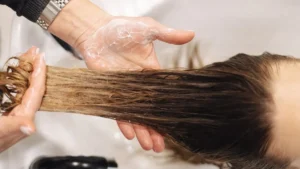
On hair and scalp, the mechanism is the same wax-ester story in a different setting. The scalp carries the densest sebaceous glands on the body, and hardened sebum collects around the follicles. Jojoba mixes with that sebum and loosens it, because like dissolves like, and its low oleic share, only 5 to 15% against 43 to 49% in argan oil, makes it kinder for a flake-prone scalp. Massage five to ten drops into the scalp, leave it for twenty to thirty minutes, then shampoo it out. For lengths, a few drops on damp hair coat the cuticle and add shine without weight. It will not make hair grow: no published trial shows jojoba stimulating growth, thickening hair, or repairing split ends. Our guide to the best hair oils for 2027 places jojoba among the wider field for shine, smoothing and scalp care.
Your jojoba checklist
- Buy 100% pure, cold-pressed jojoba oil with a single ingredient on the label.
- Patch test one drop on your inner forearm and wait 24 hours before using it on your face.
- Apply it last, after water-based serums and moisturiser, on clean, slightly damp skin.
- Use two to four drops for the face, warming them between your palms and pressing them in.
- For scalp care, massage it in as a pre-wash treatment for twenty to thirty minutes, then shampoo it out.
- Store the bottle away from heat and light, and replace it if the smell turns sharp.
Frequently asked questions
Is jojoba oil actually an oil?
Technically, no. Jojoba is a liquid wax ester, pressed from the seeds of Simmondsia chinensis, and over 97% of it is wax esters rather than the triglycerides in almost every other plant oil. Its molecules match the wax-ester fraction of human sebum, so they integrate into the barrier instead of sitting on top.
Does jojoba oil clog pores?
It rarely does, but the risk is not zero. Jojoba is usually rated 2 on the 0 to 5 comedogenic scale, which is low, and its wax-ester geometry means it does not accumulate in pores the way heavier oils can. That rating is a rough guide, not a guarantee, so patch test first.
Will jojoba oil make my oily skin produce less oil?
That is the popular claim, and the theory is plausible: skin sensing a sebum-like lipid might dial down its own production. One industry-sponsored study reported a 23% reduction in sebum secretion, but independent trials have not confirmed it, so treat it as unproven. What jojoba reliably does is support the barrier with a light, non-greasy film, which often makes oily skin look calmer.
Can I use jojoba oil with retinol or vitamin C?
Yes, with the order right. Apply water-based vitamin C or retinol first, let it absorb, and use jojoba last as a seal; a film laid down first can reduce how well the active on top is absorbed.
Does jojoba oil help hair grow?
There is no published evidence that it does. Jojoba helps the scalp by loosening hardened sebum and build-up, and helps the lengths by coating the cuticle and adding shine, but no trial has shown it thickening hair, stimulating growth, or repairing split ends.
How is jojoba oil different from other face oils?
The difference is structural. Most face oils are triglyceride blends, while jojoba is almost entirely wax esters that mirror the wax esters in sebum, giving it a dry, fast-absorbing feel and a specific talent for barrier support.
The bottom line
Jojoba oil works because it is, chemically, the closest thing in a bottle to a fraction of your own skin. Its long-chain wax esters slot into the lipid mortar of the stratum corneum, slow water loss, soften the surface and calm irritation.
It is not a miracle, and it should not be sold as one. It does not hydrate on its own, it has not been proven to reduce oil production or grow hair, and the acne evidence is promising but thin. Used correctly, as the last step over damp, well-treated skin, in small amounts, it is one of the most rational ingredients in skincare.
Note: This article explains how jojoba oil works and is for general information only; it is not medical advice. If you have a skin condition, are pregnant, or are using prescription treatments, speak to a dermatologist before changing your routine, and stop using any product that causes persistent redness, itching or breakouts.