

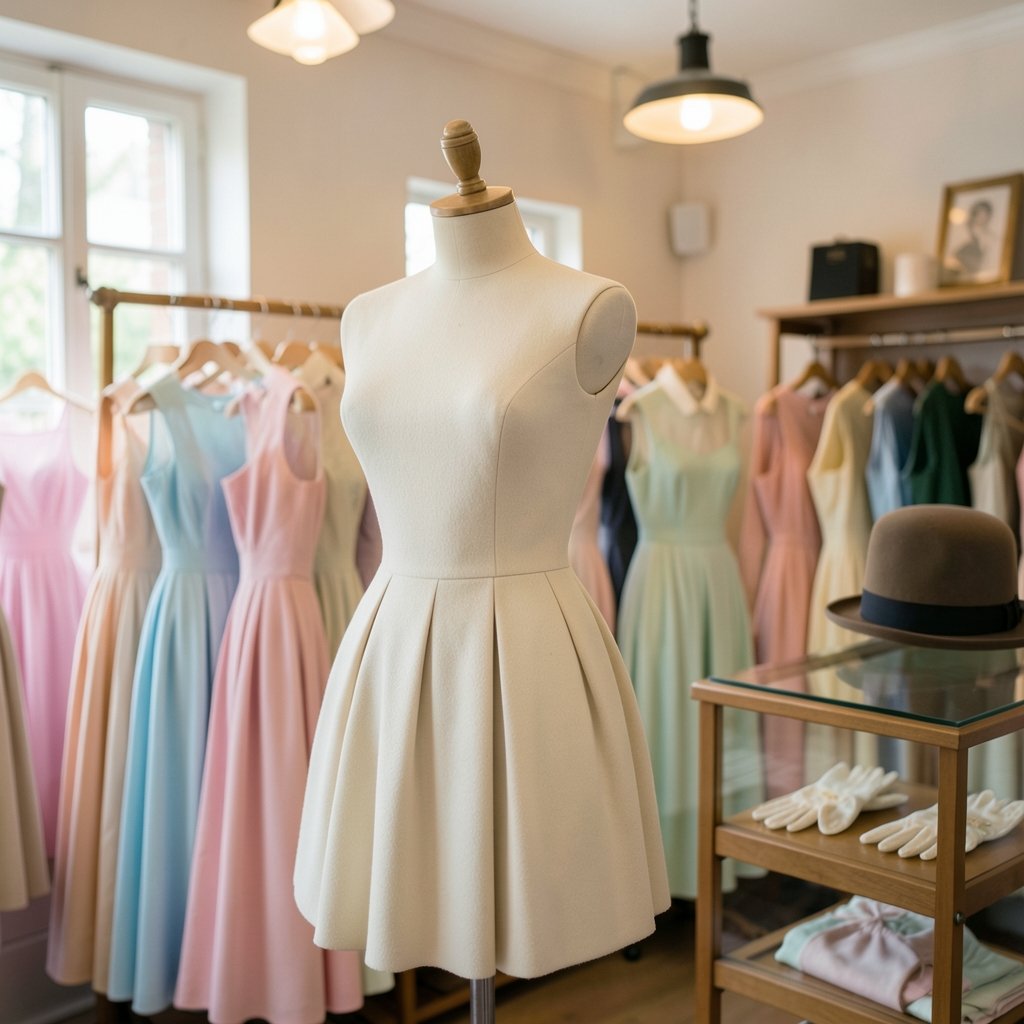
What if a single collection, shown in Paris in February 1947, could reshape what millions of women wore for an entire decade? That is essentially what happened. Christian Dior’s first post-war line, soon nicknamed the New Look, set the template for 1950s women’s fashion: rounded shoulders, a fitted bodice, a dramatically nipped waist, and a full calf-length skirt. Everything that followed in the decade, from the shirtwaist dress to the girdle, played variations on that theme.
This guide breaks down the real 1950s wardrobe, the designers behind it, and the practical details most articles skip, including what women actually wore day to day, how the look was built from the inside out, and why the decade’s fashion ended with a dramatic silhouette flip.
Why the New Look Defined the Decade
The timing mattered as much as the design. After years of wartime utility clothing, fabric rationing, and make-do styling, Dior’s 1947 collection went the other way: yards of fabric in a skirt, a constructed shape, and a deliberate rejection of austerity. The silhouette became the dominant ideal of the 1950s and held that position for roughly a decade.
The look was built on a specific architectural formula:
| Element | What It Looked Like | Why It Mattered |
|---|---|---|
| Shoulders | Soft, rounded, natural | Contrasted with wartime padded, squared shoulders |
| Bodice | Fitted, often with darts and seams | Created a tailored, close fit |
| Waist | Corseted or girdled, sharply defined | The visual center of the whole silhouette |
| Skirt | Full, calf-length, often pleated or gathered | Required significant yardage |
| Bust | Padded and lifted, sometimes conical | Emphasized the hourglass line |
The hourglass silhouette was the mainstream ideal throughout the decade, reinforced by foundation garments rather than achieved naturally. That distinction matters. The 1950s look was engineered, and the engineering started underneath the clothes.
The Foundation Garments That Built the Shape
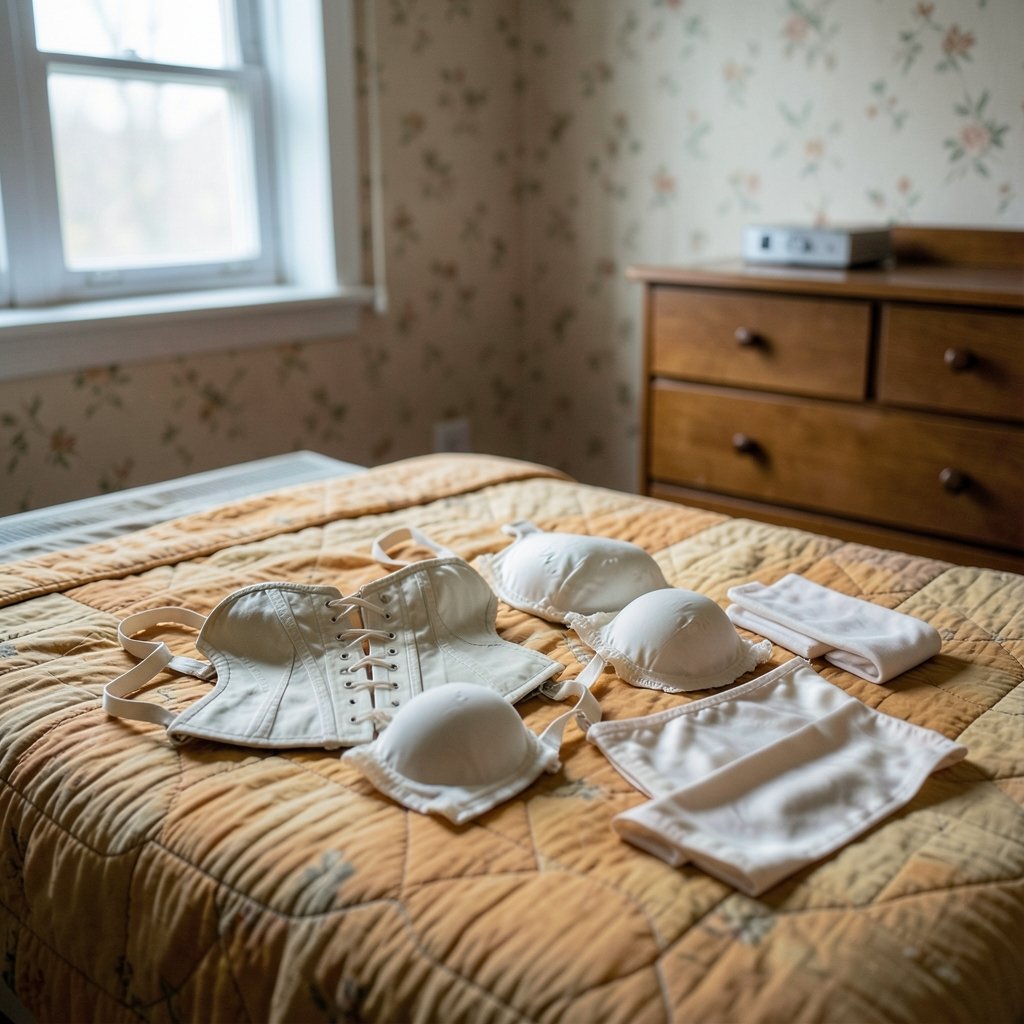
Here is where most modern retro guides get vague. The 1950s hourglass was not a body type; it was a construction project. Women wore girdles to smooth and control the hips, and structured bras, including bullet or cone styles, to create the lifted, pointed bust line the era favored.
The waspie, a short boned corset worn over or under clothing to cinch the waist, is associated with the mid-to-late 1950s. Dating of its peak popularity varies by source, but its function was clear: pull the waist in sharply while leaving the hips and bust free. Worn under a dress, it disappeared. Worn over a fitted top, it became a statement.
Practical tip for anyone recreating this look: start with the foundation, not the dress. A modern dress cut in a 1950s style will hang flat without waist definition. A good structured undergarment changes the entire line of the garment, which is exactly how women of the era approached dressing.
Common mistake: buying a full-skirted dress in a stiff modern fabric and expecting the 1950s effect. Original dresses were often made from fabrics with enough body to hold a pleat but enough drape to swing. Stiffness reads as costume; movement reads as authentic.
Daywear: Shirtwaist Dresses and Home Dressmaking
Full-skirted dresses with fitted bodices were everyday wear, not special occasion wear. The shirtwaist dress, with its buttoned bodice and attached skirt, was the workhorse of the decade. Women wore it to the office, to the shops, and to lunch. A belt at the waist, a small collar, and a pair of pumps completed the outfit.
Home dressmaking remained significant in the 1950s, and paper patterns made the New Look accessible well beyond designer price points. The scale of home sewing varied by country and by source, but the cultural pattern is clear: women copied the silhouette at home, adjusting it to their budget and their bodies.
The British picture shifted meaningfully mid-decade. Fabric rationing and the Utility clothing scheme wound down around 1952, freeing British fashion from wartime restrictions. The exact end date and scope of the scheme’s wind-down should be checked against a primary source, but the direction is not in dispute: by the mid-1950s, British women had far more freedom in what they could buy and sew.
To see how the previous decade set up these changes, the 1950s men’s style guide traces the same post-war shift from utility to plenty, and the parallel is clear.
Teen Fashion Becomes Its Own Market
One of the decade’s biggest structural changes had nothing to do with couture. Teen fashion became a distinct market in the 1950s, and it looked nothing like what their mothers wore. Poodle skirts, bobby socks, and saddle shoes became associated with American teenagers, a visual language of youth that retailers were suddenly eager to serve.
The poodle skirt is commonly dated to the late 1940s or early 1950s, though its precise origin is disputed. What is not disputed is its function: a cheap, cheerful, easily made garment that signaled membership in a generation rather than a class.
This split matters for anyone studying the decade. There was no single 1950s woman’s wardrobe. There was a formal, structured adult wardrobe and a looser, more playful teen wardrobe, and the gap between them widened as the decade progressed.
The Designers Who Shaped the Look
Dior was the gravitational center, but he was not alone.
Cristóbal Balenciaga spent the 1950s quietly dismantling the fitted waist from the inside of the industry. His late-1950s work introduced the sack dress, also called the chemise, a loose waistless silhouette that appeared around 1957 and began to displace the cinched waist toward 1960. Sources differ on whether it emerged in 1957 or 1958 and on which designer led it, with Givenchy frequently named alongside Balenciaga.
Coco Chanel returned with a 1954 collection that reintroduced the tweed suit, helping establish a more relaxed, less corseted alternative in the later 1950s. The contrast with Dior was philosophical: construction versus ease, armor versus comfort.
Yves Saint Laurent succeeded Dior after Dior’s death on 24 October 1957. His first collection in 1958, the Trapèze line, shifted the silhouette away from the cinched waist entirely. Within a single season, the defining shape of the 1950s was being retired.
If you want to see how runway moments get translated into illustration and editorial, this piece on how a fashion illustrator turns runway moments into images shows the process of capturing a silhouette before photography does.
What Women Actually Wore, Season by Season
The decade was not static. Here is how the wardrobe shifted:
- Early 1950s: The New Look settles in. Fitted bodices, full skirts, gloves, hats, and matching accessories. Home sewing booms.
- Mid-1950s: The waspie peaks. Teen fashion separates from adult fashion. Chanel’s tweed suit offers a relaxed counterpoint.
- Late 1950s: The sack dress and chemise appear. Waists loosen. Dior dies in 1957; Saint Laurent’s Trapèze line lands in 1958.
- 1960: The fitted waist is largely gone. The shift dress and the coming youthquake take over.
Accessories did heavy lifting throughout. Gloves were near-mandatory for town. Hats were expected in formal settings. A handbag matched to the shoes was the standard, not the exception. Pearls, real or otherwise, finished almost every outfit.
How to Wear 1950s Style Today Without Looking Costumed
The decade translates well to modern wardrobes, but only if you respect its logic instead of copying its surface. A few things actually work in practice:
Choose one silhouette, not five. A single well-cut full skirt with a fitted knit top reads 1950s. A full skirt, petticoat, gloves, pillbox hat, and pearls reads costume. Pick the one element you love and let the rest of the outfit stay modern.
Pay attention to hem length relative to your frame. Calf-length skirts were the era’s standard, but they are unforgiving on shorter frames. A midi that hits just below the knee keeps the proportion without swallowing the wearer.
Use modern fabrics deliberately. Stretch cotton and ponte hold a fitted bodice beautifully. Taffeta and organza hold a full skirt. Mixing the two in one garment usually fails.
Skip the shapewear if it hurts. The 1950s waist was built with boning and elastic that was genuinely uncomfortable by modern standards. A well-tailored waist seam achieves most of the visual effect with none of the bruising.
For a broader look at which retro-inspired pieces are actually worth buying now, this breakdown of 2026 fashion trends women should buy, skip, and actually wear applies the same filter to current season pieces.
The Color and Print Palette
The 1950s palette was confident. Think cherry red, powder pink, mint green, navy, and butter yellow, often worn in bold blocks rather than subtle mixes. Prints ran to florals, polka dots, gingham, and novelty motifs. The teen market embraced the poodle appliqué and the felt circle skirt precisely because both were cheap to produce in bright colors.
Fabric choice followed the silhouette. Crisp cottons for day dresses, wool for suits and skirts, taffeta for evening, and chiffon for occasion wear. The era loved a fabric with enough structure to hold a shape, which is why so many surviving 1950s dresses still look sharp on a hanger seven decades later.
If the Italian approach to luxury fabrication interests you, the Italian luxury fashion archive covers how Italian houses built on similar principles of cut and cloth.
Why the 1950s Still Influence Fashion Today
Designers return to the decade constantly because its silhouette is so legible. A nipped waist and a full skirt communicate femininity and formality in a single glance, which is why the shape resurfaces every time fashion swings back toward polish after a period of looseness.
The decade also established the seasonal trend cycle as a mass-market force, along with the idea that teenagers constituted a fashion market worth designing for. Both ideas outlived the clothes.
For a wider view of where those cycles have landed now, the 2026 fashion trends guide maps what is in, out, and worth wearing this year, and the women’s fashion 2026 tag collects ongoing coverage. Readers tracking how the female silhouette keeps evolving can follow the 2026 fashion trends female archive.
Conclusion
1950s women’s fashion was never just about pretty dresses. It was a constructed system: foundation garments that engineered an hourglass, home sewing that democratized couture shapes, a teen market that split off and invented its own rules, and a decade-long argument between Dior’s architecture and Chanel’s ease. By 1960, the argument was over and the waist had loosened, but the silhouette never really disappeared. It just waits for the next moment when fashion decides that structure is worth the effort again.
Frequently Asked Questions
What was the defining silhouette of 1950s women’s fashion?
The hourglass: rounded shoulders, a fitted bodice, a sharply cinched waist, and a full calf-length skirt. It came from Dior’s 1947 New Look collection and dominated the decade, reinforced by girdles, structured bras, and corsetry rather than achieved naturally.
Did women in the 1950s really wear corsets every day?
Not corsets in the Victorian sense, but most women wore girdles and structured bras as everyday foundation garments. The waspie, a short boned corset, is associated with the mid-to-late 1950s and was worn to cinch the waist, sometimes over clothing as a statement piece.
Who ended the 1950s fitted-waist look?
Several forces converged. Balenciaga and Givenchy introduced the loose sack dress or chemise around 1957. Dior died in October 1957, and Yves Saint Laurent’s 1958 Trapèze collection pushed the silhouette decisively away from the cinched waist.
What did 1950s teenagers wear?
A separate teen market emerged in the 1950s, with poodle skirts, bobby socks, and saddle shoes associated with American teenagers. The poodle skirt is usually dated to the late 1940s or early 1950s, though its exact origin is disputed.
When did British clothing rationing end?
Fabric rationing and the Utility clothing scheme wound down around 1952, freeing British fashion from wartime restrictions. The exact end date and scope of the scheme’s wind-down should be confirmed against a primary or museum source, as accounts vary.
Can you wear 1950s style without looking like you’re in costume?
Yes, by choosing one era element rather than the full outfit. A full skirt with a modern knit top works; the same skirt with gloves, a petticoat, and a pillbox hat reads as fancy dress. Modern fabrics that hold structure, and a hem length suited to your frame, do most of the work.














