

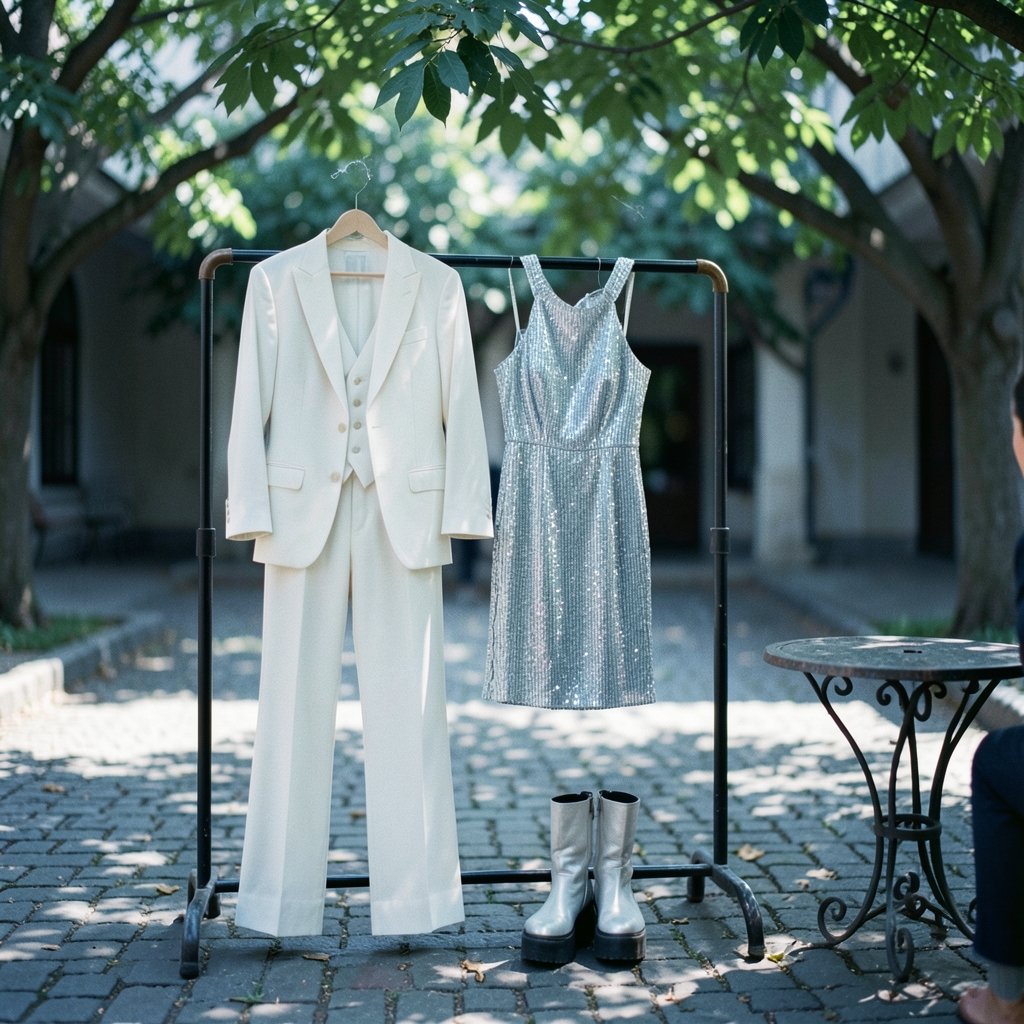
What do you wear to a party where the lights are low, the music is loud, and everyone is watching? That question shaped 70s disco fashion, and the answer changed what people wore for decades after the music faded. Disco style went beyond sequins and platform boots, though there were plenty of both. It was a full visual language built for movement, shine, and the simple joy of being seen.
The look is usually dated to roughly 1974 through 1979, with the 1977 film Saturday Night Fever as its loudest advertisement. The film’s costume design is widely credited with popularizing the white three-piece suit and flared trousers. But the dance floor did more than sell a suit. It gave women a wrap dress that meant business, gave men permission to wear color and width, and gave a generation synthetic fabrics that caught every beam of light in the room.
What Actually Defined the Disco Look
Disco fashion was a response to a specific physical environment. Clubs were dark, lights were theatrical, and bodies were moving. Clothes had to look good in motion and under colored spotlights. That single practical demand explains most of the era’s signatures.
Shine came first. Sequins, metallic fabrics, and satin were used because they catch light under club lighting, turning a dancer into part of the show. Drape came second. Synthetic fabrics like polyester, rayon, and spandex blends held their shine and fell in ways that cotton and wool could not. Spandex itself was invented in 1959 and moved into clothing through the 1960s and 70s, which is why disco-era garments could be tight and flexible at the same time.
Silhouette came third, and it split sharply by gender. Women’s disco style leaned on halter tops, tube tops, and bare-shoulder cuts that freed the arms and back. Men’s style leaned on fitted shirts with wide collars, often worn open at the chest, paired with trousers that flared from the knee.
| Element | Women | Men |
|---|---|---|
| Top | Halter, tube, bare-shoulder | Fitted shirt, wide collar, open chest |
| Bottom | Wrap dress, flared skirt, wide-leg trousers | Flared trousers, wide-leg cuts |
| Footwear | Platform shoes, stacked heels | Platform shoes, stacked heels |
| Fabric | Polyester, satin, sequins, spandex blends | Polyester, satin, shiny knits |
| Overall goal | Movement plus light-catching shine | Height, width, and confidence |
Notice how many elements were shared. Platforms and synthetic shine crossed gender lines, which is part of why disco style reads today as both glamorous and slightly androgynous.
The Wrap Dress and the Working Woman

No single garment carries more meaning from this era than the wrap dress. Diane von Furstenberg popularized it from 1974, and it is often treated as a symbol of 1970s women’s fashion and workplace change. That framing is interpretive rather than a hard historical fact, but the logic is easy to follow.
The wrap dress did something clever. It offered the ease of a dress you could throw on and tie, but it looked polished enough for an office. It moved with the body instead of fighting it. It packed flat. It flattered a range of shapes without tailoring. For women entering workplaces in larger numbers, it was a garment that refused to choose between professional and feminine.
This is where disco fashion connects to the broader story of the decade. The club look and the work look were not separate universes. Both pushed toward clothes that let the body move and let the wearer decide how much to reveal. If you want to see how that instinct evolved over the following decades, the shift from tailored constraint to comfort-first dressing is traced well in this look at how 2010s fashion athleisure streetwear and Instagram rewrote the rules, which picks up the thread disco started.
Platform Shoes, Flared Trousers, and the Geometry of Height
Platform shoes and stacked heels were the signature disco accessory, usually worn with flared or wide-leg trousers. The pairing was not random. A flared hem needs clearance, and a platform lifts the hem off the floor while adding height. The result is a long, uninterrupted line from waist to toe, which photographs beautifully and looks dramatic in motion.
Platforms were already present in late-1960s fashion and became widespread in the early to mid-1970s, so the disco era inherited them rather than inventing them. What disco did was make them taller, shinier, and more theatrical.
Here is where practical advice matters, because platforms are the item most people get wrong when they try to recreate the look.
- Check the flare against your shoes. A wide-leg trouser with a flat shoe drags and looks sloppy. Either commit to a platform or have the hem tailored.
- Break in platforms indoors first. The lack of ankle flex is the real challenge, not the height. Walk on carpet, then stairs, then pavement before a long night.
- Watch the heel-to-toe drop. A tall platform with a thin heel is unstable. A chunky block distributes weight and is far easier to dance in.
- Skip the vintage sole if it is brittle. Old rubber hardens. A modern reproduction with the same silhouette is usually the smarter buy.
The most common mistake is buying platforms a full size too small because they look better on the shelf. Your foot slides forward on an incline. Size up, not down.
Fabric, Shine, and Why Polyester Came Back
Synthetic fabrics were central to disco because they held shine and drape. Polyester, rayon, and spandex blends could be cut tight, sewn with sequins, and finished with a sheen that natural fibers rarely matched. Sequins, metallic weaves, and satin were chosen specifically to catch club lighting.
This is also why disco fashion aged badly in the eyes of later critics and then came back around. The same qualities that made polyester look cheap under office fluorescents made it electric under a strobe. Context was everything.
For anyone shopping today, the practical test is simple. Hold the fabric up to a strong light. If it goes flat and gray, it will read as costume. If it throws a highlight, it will read as disco. Weight matters too. Thin satin clings and shows every seam, while a heavier polyester crepe hangs cleanly and photographs far better.
If you are planning a look for an event, the broader direction of party dressing this year is worth checking against the era’s rules. The 2026 fashion trends guide maps what is in, out, and worth wearing, and you can see how much of the current shine-and-drape instinct is disco DNA returning under a new name. For a wider sweep of the season, the running coverage of fashion trends 2026 shows how often the dance floor gets recycled.
Men’s Disco Style and the Permission to Dress Up
Men’s disco fashion deserves its own paragraph because it broke a long stretch of restraint. The fitted shirt with a wide collar, worn open at the chest, was a genuine departure from the buttoned-up norm. Wide-lapel suits, jumpsuits, and unisex androgynous styling all sat in the same orbit.
The white three-piece suit associated with Saturday Night Fever became the era’s most recognizable menswear image. It worked because it was simple, high contrast, and built for movement, with a jacket that could come off and trousers that flared enough to dance in.
The practical lesson for anyone dressing in this style now is proportion. Wide collar plus wide lapel plus flared trouser plus platform shoe is four wide elements competing. Pick two. A wide collar with a straight leg, or a flared trouser with a slim shirt, reads far more intentional than stacking every signature at once.
Why Disco Fashion Ended, and Why It Never Really Left
Disco fashion declined alongside disco music after the Disco Demolition Night at Comiskey Park on July 12, 1979, an event often cited as a cultural turning point. Historians debate how much that single night caused versus symbolized, but the timing lines up with a sharp shift in taste. Shine gave way to restraint. Wide gave way to narrow. The 1980s wanted shoulders, not flares.
Yet the ingredients never disappeared. They went underground, into club culture, into pop performance, and eventually into fast fashion. Every few years a designer sends platforms and sequins down a runway and the cycle restarts. The current appetite for maximalism and Italian glamour keeps the flame lit, and the coverage of Italian luxury fashion shows how often that country’s houses return to the era’s playbook of drape, shine, and confident cut.
The revival also runs through illustration and image-making, which is where disco’s visual grammar gets translated for new audiences. A good example is how Angelica Hicks turns runway moments into drawings that strip a look down to its most recognizable gesture, and disco style is unusually easy to caricature because its signals are so strong. The same instinct shows up in publishing, where something like the Barbie world tour book treats costume as storytelling rather than decoration. And for anyone who wants to follow fashion’s churn without drowning in it, this guide to finding the best fashion substacks is a sensible filter.
How to Wear 70s Disco Fashion Today Without Looking Like a Costume
The line between homage and costume is thin, and it comes down to editing. Here is what works in practice.
Choose one hero piece. A sequined top, a flared trouser, or a platform shoe. Not all three at once. Let the rest of the outfit stay quiet.
Keep the silhouette modern. A high-waisted wide-leg trouser with a simple knit reads as current. The same trouser with a halter, a satin jacket, and a headband reads as a party theme.
Use shine as an accent. Satin lapels, a metallic bag, a sequined cuff. Disco worked because light hit small areas hard, not because everything glittered.
Get the fit right at the waist. Flares depend on a defined waist to avoid looking like a tent. This is the single most common failure point in modern recreations.
Test the outfit in motion. Dance in it before you commit. If the hem catches your heel, the strap digs, or the top rides up, it will fail on the night. Disco clothes were engineered for movement, and yours should be too.
Buy one good vintage piece, not five cheap ones. A well-made 1970s satin jacket often outlasts three fast-fashion versions and looks better doing it.
The biggest mistake people make is treating the era as a single costume. Disco fashion was a real wardrobe worn by real people going to real places, and it had range. There were quiet disco looks, loud ones, cheap ones, and expensive ones. The best modern version borrows the confidence and leaves the excess.
Conclusion
Seventy disco fashion was never really about clothes. It was about a room where people were allowed to be seen, and a wardrobe built to survive that visibility. The wrap dress gave women a garment that worked as hard as they did. The platform shoe and flared trouser gave everyone height, movement, and a silhouette that photographs like a promise. Synthetic fabrics and sequins turned club lighting into part of the outfit.
The era’s end came fast, as cultural shifts often do, but its vocabulary stuck around. Shine, drape, wide legs, and the simple idea that getting dressed can be fun all trace back to a few years when the dance floor set the rules. Wear it with restraint and it still works. Wear it with everything at once and it becomes a costume. The choice, as it was in 1977, is yours.
Frequently Asked Questions
What years count as the 70s disco fashion era?
Most sources place it at roughly 1974 to 1979, with the 1977 release of Saturday Night Fever as its peak moment. These are cultural markers rather than formal dates, and different sources draw the boundaries slightly differently.
What was the most important disco fashion item for women?
The wrap dress, popularized by Diane von Furstenberg from 1974, is the most cited. It combined ease of wear with a polished look and became a symbol of 1970s women’s fashion and workplace change. Halter tops and platform shoes were close behind in visibility.
Why was polyester so common in disco clothing?
Polyester, rayon, and spandex blends held shine and drape in ways natural fibers did not. That mattered in dark clubs with theatrical lighting, where sequins, satin, and metallic fabrics were chosen specifically to catch the light. The fabric’s weakness, a slightly synthetic look in daylight, did not matter on a dance floor.
Did men really wear platforms and wide collars?
Yes. Platform shoes and stacked heels crossed gender lines, and men’s disco style included fitted shirts with wide collars, often worn open at the chest, plus wide-lapel suits and jumpsuits. The white three-piece suit from Saturday Night Fever became the era’s defining menswear image.
What ended the disco fashion trend?
Disco fashion declined alongside disco music after Disco Demolition Night at Comiskey Park on July 12, 1979, an event often cited as a cultural turning point. Taste shifted sharply toward the narrower, more structured looks of the 1980s, though historians debate how much that single event caused versus symbolized.
How can I wear disco style today without it looking like a costume?
Pick one hero piece, such as a sequined top or a flared trouser, and keep everything else quiet. Make sure the waist fits properly, test the outfit by dancing in it, and choose one good vintage item over several cheap ones. Shine works best as an accent rather than a full-body statement.














