
Do You Shed More Hair in Summer? 9 Things to Know
Every summer, the same thing happens. You run your fingers through your hair and more strands come away than usual. The shower drain fills faster, the hairbrush needs emptying more often, and the pillow has a few more hairs on it in the morning. If you have ever wondered whether you shed more hair in summer, the answer is yes, for most people, and it is usually nothing to panic about.
Human hair follows a seasonal rhythm. Like many animals, we shed more in the warmer months and grow more in the cooler ones. the shift is small but real: a few dozen extra hairs a day, peaking in late summer. The problem is that a normal seasonal shed and a genuine hair problem can look identical from the bathroom floor.
Below are nine things worth knowing, from why it happens and how much is normal, to what sun, chlorine and heat styling do to your hair, and when shedding is a sign to get help.
Key takeaways
- Most people shed more hair in summer, with the peak usually in late summer and early autumn, and it is a normal seasonal pattern.
- Normal shedding is about 50 to 100 hairs a day, and a summer increase of 20 to 30 extra hairs a day is still within the normal range.
- Sun, chlorine, salt water and heat styling damage the hair shaft and make breakage worse, which can look like extra shedding.
- A gentler routine, scalp care, sun protection and a deep conditioning mask will usually settle a summer shed within a few weeks.
- Shedding alone does not mean hair loss, but sudden, patchy, or very heavy shedding, or shedding that does not ease by autumn, needs a professional opinion.
Why summer shedding happens
Hair grows in cycles. Each strand spends years in a growth phase, then a short transition, then a resting phase, and finally it sheds and a new hair takes its place. In summer, a larger share of hairs shifts into the resting phase at the same time, which means more of them shed together a few months later. This is why the peak is often in late summer and early autumn.
In winter, the body holds on to more hair for insulation, and in summer it lets more go. Longer days and stronger UV light also shift the hormones that influence the hair cycle.
What makes summer feel worse is that breakage joins the shed. Sun dries the hair shaft, chlorine and salt water strip its protective oils, and sweat and oil build up on the scalp. Dry, rough hair breaks more easily, and broken hairs look exactly like shed hairs. The real question is how much of what you see is breakage rather than true shedding, because the two need different fixes.
How we chose these nine things and what to look for
Look first at the root. A shed hair has a small, pale bulb at the end, which is the root that released it. A broken hair has no bulb, just a snapped end. If most of what you find has no bulb, the problem is damage and dryness, not shedding, and the fix is conditioning and gentler handling.
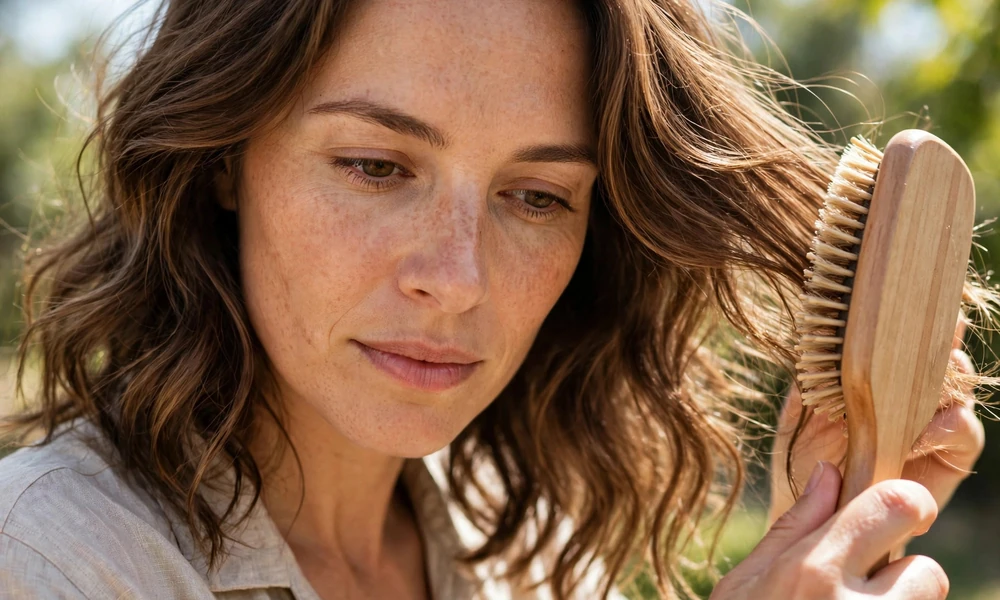
Look next at the pattern. Normal seasonal shedding is even, all over the head, and your parting and hairline stay the same. Patchy shedding, a widening part, or visible thinning at the crown or temples is a different pattern and should not be written off as seasonal. Photograph your parting in June and again in September, in the same light. That comparison tells you far more than counting hairs in the shower.
Finally, look at the timing. A seasonal shed usually starts to build in mid-summer, peaks in late summer or early autumn, and eases within six to eight weeks. If your shedding started suddenly, if it is still heavy in November, or if it came with itching, scaling, pain or a sore scalp, that is not the seasonal pattern. Our guide to how to wash your hair properly is worth reading alongside this one, because a gentler wash routine is the first step in telling a seasonal shed from a scalp problem.
The 9 things to know about summer shedding
1. The summer shed is real
Best for: Anyone who notices more hair in the brush from July onwards. Cost: Free to observe. Time needed: A few weeks of watching the pattern.
Seasonal shedding is a real, measured pattern, not an old wives’ tale. Studies that tracked hair counts through the year found that the share of hairs in the resting phase rises in summer, and shedding peaks in late summer and early autumn. The shift is modest, but it is consistent across climates, and it is more noticeable if your hair is long, because long hairs are easier to see.
2. How much shedding is normal
Best for: Anyone who wants a number to compare against. Cost: Free. Time needed: A few minutes a day for a week.
Normal shedding is roughly 50 to 100 hairs a day, and a summer increase to 120 or 130 is still within the normal range for many people. Counting every hair is miserable and unreliable, so use a simpler test instead. If you wash your hair every two or three days, you will see more hairs on wash day, because the hairs that would have shed over those days all come out at once. That is normal, not a sign that washing causes shedding.
3. Sun damage makes shedding look worse
Best for: Anyone who spends long hours outdoors in summer. Cost: A hat, or a UV-protective hair product. Time needed: A few seconds before going outside.
UV light breaks down the protein in the hair shaft and strips its natural oils, which makes hair dry, rough and prone to snapping. Colour-treated and fine hair suffer most, because the shaft is already thinner and more fragile. A hat is the simplest protection, and it works better than any product. If you swim or sunbathe for hours, a leave-in conditioner with UV filters helps, but it is a supplement to shade and a hat, not a replacement.
4. Chlorine and salt water strip the hair
Best for: Regular swimmers and beachgoers. Cost: A swim cap, or a rinse and a conditioner. Time needed: Two minutes after each swim.
Chlorine dries the hair and can leave a greenish tint on light hair, while salt water draws moisture out of the shaft and leaves it stiff and tangled. The damage is not usually permanent, but repeated exposure without rinsing makes breakage much worse, and breakage looks like shedding. Wet your hair with fresh water before you swim, so it absorbs less pool or sea water, and rinse it with fresh water and conditioner as soon as you get out.
5. Sweat, oil and scalp buildup
Best for: Anyone whose scalp feels itchy or greasy in the heat. Cost: A gentle shampoo, used more often. Time needed: Five extra minutes per wash.
Summer means more sweat, more oil and more product on the scalp, and that buildup can irritate the skin, clog follicles and make hair look thinner at the roots. It does not usually cause true hair loss on its own, but an irritated scalp sheds more easily. Wash more often in summer if you need to, and massage the shampoo into the scalp with your fingertips rather than your nails.
6. Heat styling in summer
Best for: Anyone who straightens, curls or blow-dries daily. Cost: A heat protectant, or nothing if you air-dry. Time needed: A few minutes saved per styling session.
Heat styling on hair that is already sun-dried is a double hit. The shaft is drier, so it snaps more easily, and the heat makes the cuticle rougher, which makes the hair tangle and break when you brush it. Summer is the best season to give heat styling a rest. Air-dry where you can, use the lowest heat setting when you cannot, and always use a heat protectant.
7. Diet, water and iron in summer
Best for: Anyone whose diet changes in the heat. Cost: A normal balanced diet, plus water. Time needed: No extra time, just attention.
Hair is mostly protein, and it needs iron, zinc, vitamin D and enough calories to grow. In summer, people often eat less and drink less water, which can leave hair undernourished just when it is under the most stress. A sudden crash diet is a common cause of heavy shedding a few months later, because the hair cycle reacts to a shortage with a delay.
8. How to reduce summer shedding
Best for: Anyone who wants a practical routine. Cost: A gentle shampoo, a mask and a hat. Time needed: About 15 minutes a week extra.
The most effective routine is simple: wash gently and often enough to keep the scalp clean, condition every time, use a deep mask once a week, protect the hair from sun and chlorine, and handle it gently when it is wet. Our guide to the best hydrating hair masks of 2027 is a useful companion here, because a weekly mask is the single most effective step for sun-dried hair.
9. When to worry and get help
Best for: Anyone whose shedding does not fit the seasonal pattern. Cost: A consultation with a dermatologist or trichologist. Time needed: One appointment.
Get help if your shedding is sudden and very heavy, if it is patchy, if your part is visibly widening, if you have itching, scaling, pain or sores on the scalp, or if it has not eased by late autumn. A dermatologist can check for iron deficiency, thyroid problems, hormonal changes and scalp conditions, all of which cause shedding that looks seasonal at first. Bring a photo of your parting from a few months ago and a list of any new medicines. Most seasonal sheds need no treatment, but a real problem is much easier to treat when it is caught early.
What summer shedding looks like by hair type
Fine hair shows shedding most, because each strand is thinner and the scalp is easier to see through it, but fine hair also recovers fastest once the season passes. Thick hair sheds the same number of strands, but they are easier to see in the shower, which makes the shed feel worse than it is. Curly hair traps shed hairs in the curls, so they come out in clumps on wash day, which looks dramatic but is usually just a week’s worth of normal shedding released at once.
Colour-treated and bleached hair needs the most care in summer, because the shaft is already porous and the sun and chlorine hit it hardest. Grey and white hair is also vulnerable, because it has less melanin to absorb UV, and it can turn yellow in the sun and green in a pool, so a purple toning shampoo and a hat are worth having.
Whatever your hair type, the test is the same. Check the roots for bulbs, check the pattern for patchiness, and check the calendar for timing. If the shed is even, if most hairs have bulbs, and if it eases as the days shorten, it is almost certainly seasonal. Our guide to the best hair oils of 2027 can help too, because a light oil on the lengths protects sun-dried ends and makes brushing gentler, which cuts the breakage that makes a summer shed look worse than it is.
The caveats that matter
Summer shedding is normal, but it is also easy to misread. A shed that looks seasonal can hide a real problem, and waiting makes it worse. The most common mistake is to stop washing your hair in the hope of keeping it in, which does the opposite: buildup irritates the scalp and makes the shed worse. Another is to buy a supplement and wait three months, when a simple blood test would have found an iron or thyroid problem in a week.
| Detail | What is known |
|---|---|
| Normal daily shedding | About 50 to 100 hairs a day, rising to 120 or 130 in summer |
| When it peaks | Late summer and early autumn, as resting-phase hairs shed together |
| How long it lasts | Usually six to eight weeks, easing as the days shorten |
| Shedding vs breakage | A shed hair has a small pale bulb at the root; a broken hair has none |
| Biggest summer culprits | UV light, chlorine, salt water, heat styling and scalp buildup |
| Most effective fixes | Gentle washing, weekly mask, sun protection, gentle handling when wet |
| What does not help | Washing less, crash diets, and waiting months on a supplement alone |
| When to get help | Sudden, patchy, or very heavy shedding, or shedding that lasts past autumn |
If you are taking new medication, if you have recently been ill, or if you have had a major stress or a big weight change in the last three months, mention it to your doctor.
Checklist: handling a summer shed honestly
- Check the roots: look for a small pale bulb on shed hairs, and a snapped end with no bulb on broken ones.
- Photograph your parting in June and again in September, in the same light, and compare the two.
- Wash often enough to keep the scalp clean, and massage shampoo in with your fingertips, not your nails.
- Protect your hair from sun and chlorine with a hat, a swim cap, and a rinse with fresh water after swimming.
- Use a deep conditioning mask once a week, and handle wet hair gently with a wide-tooth comb.
- Book a dermatologist appointment if the shedding is patchy, very heavy, or still going strong by late autumn.
Frequently asked questions
Do you really shed more hair in summer?
Yes, for most people. A larger share of hairs enters the resting phase in summer, and they shed together in late summer and early autumn. The increase is usually modest, around 20 to 30 extra hairs a day, and it reverses on its own.
How long does summer shedding last?
Usually six to eight weeks, peaking in late summer or early autumn. If it is still heavy in November, or if it started suddenly rather than building gradually, that is not the usual seasonal pattern and it is worth getting checked.
Does washing your hair more make shedding worse?
No. Washing releases the hairs that were already ready to shed, so wash day looks worse, but those hairs would have come out anyway. Washing less lets sweat and oil build up on the scalp, which can irritate it and make shedding worse, not better.
Can sun damage cause hair loss?
Sun does not usually cause true hair loss from the scalp, but it dries and weakens the hair shaft, which makes breakage much worse. Breakage looks like shedding, and it is the main reason a summer shed feels so dramatic. A hat and a UV-protective leave-in are the simplest fixes.
Do hair supplements stop summer shedding?
They help only if you have a genuine deficiency, such as low iron, and they take months to work. A normal seasonal shed does not need a supplement, and a heavy shed caused by a deficiency needs a blood test first, not a guess.
When should I see a doctor about shedding?
See a dermatologist if the shedding is sudden and very heavy, if it is patchy, if your part is visibly widening, if your scalp itches, scales or hurts, or if it has not eased by late autumn. Bring a photo of your parting from a few months ago and a list of any new medicines.
The bottom line
Yes, you do shed more hair in summer, and for most people it is a normal seasonal pattern that peaks in late summer and eases within six to eight weeks. The shed is modest, even across the head, and it reverses on its own. What makes it feel worse is breakage from sun, chlorine, salt water and heat styling, which is why a gentler routine, a weekly mask and a hat will usually settle it faster than any supplement.
Check the roots for bulbs, check the pattern for patchiness, and check the calendar. If the shed is even, if most hairs have bulbs, and if it eases as the days shorten, it is almost certainly the season. If it is patchy, very heavy, or still going strong by late autumn, get it checked.