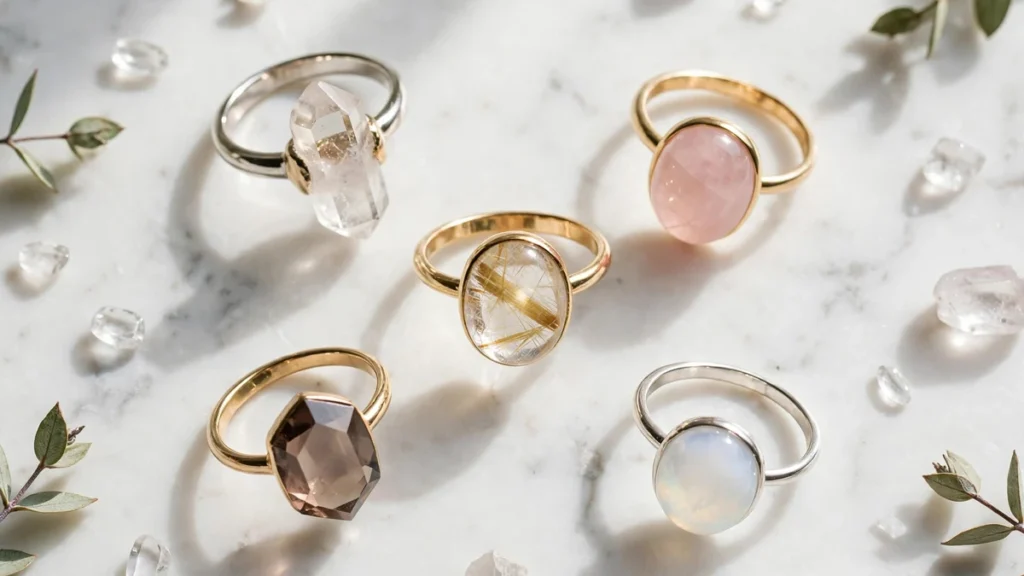
Quartz is the most versatile stone in jewellery, and the most misunderstood. Clear quartz, rose quartz, smoky quartz, citrine and amethyst are all the same mineral, silicon dioxide, in different colours. The problem is that the market treats them as five different stones, and prices them accordingly, while glass imitations and heat-treated stones are sold under the same names. A ring that looks like citrine may be heat-treated amethyst, and a ring that looks like smoky quartz may be glass.
That is why this guide is organised by the type of quartz and by what it is really worth, not just by colour. Quartz is hard, at Mohs 7, which makes it one of the most practical stones for a ring you plan to wear every day. It takes a polish well, it holds up to knocks better than most coloured stones, and it is affordable enough that you can choose on looks rather than on price.
Below are nine quartz rings worth considering in 2027, from a classic clear quartz solitaire to a rose quartz signet, a smoky quartz cocktail ring and a citrine halo. Each one is described by what it is good at, what to watch for, and who it suits best, so you can choose with the stone in mind, not just the colour.
Key takeaways
- Quartz is silicon dioxide at Mohs 7, hard enough for everyday ring wear and far tougher than amber, opal or pearl.
- Clear quartz, rose quartz, smoky quartz, citrine and amethyst are all quartz; colour comes from trace elements and natural irradiation.
- Most citrine on the market is heat-treated amethyst, which is standard practice but must be disclosed.
- Glass is the main imitation, and it is easy to spot: it feels cold, it often contains round bubbles, and it scratches more easily than quartz.
- Quartz has no proven healing properties and is not an investment stone, and it should still be kept out of ultrasonic and steam cleaners.
What quartz actually is
Quartz is one of the most common minerals on earth, and one of the most useful in jewellery. It is silicon dioxide, hard at Mohs 7, and it forms in a range of colours because tiny amounts of other elements get trapped in the crystal as it grows. Iron makes amethyst purple and citrine yellow. Manganese and titanium make rose quartz pink. Natural irradiation makes smoky quartz brown and grey. Clear quartz has almost no impurities at all.
That shared chemistry is the key to buying quartz well. A rose quartz ring and a smoky quartz ring are the same stone in different colours, so there is no reason for one to cost five times the other unless the setting or the brand justifies it. What matters is the quality of the colour, the clarity, the cut and the setting, not the name on the label.
Hardness is the practical advantage of quartz. At Mohs 7 it is harder than most everyday objects it will meet, so it resists scratches well and suits rings that are worn daily. It can still chip if it is dropped on a hard floor or knocked against a metal edge, and a pointed stone is more vulnerable than a smooth cabochon, but for a ring stone at this price, quartz is one of the most forgiving choices you can make.
How we chose these rings and what to look for
Look first at the colour and whether it is natural. A pale, even rose quartz is natural. A vivid, saturated pink is usually dyed. A pale yellow citrine is usually natural, while a deep orange citrine is almost always heat-treated amethyst. Heat treatment is standard and stable, and it is not a reason to avoid a stone, but it should be disclosed, and a heat-treated stone should not be sold at the price of a natural one.

Look next at the cut and the setting. Quartz is usually faceted, which suits its hardness and its clarity, and a well-cut stone will be bright and lively in daylight. A cabochon suits rose quartz and smoky quartz, where the soft, even colour matters more than sparkle. Prong settings work well for quartz because the stone is hard enough to hold them, but a bezel is still the safest choice for a ring you wear every day. Our guide to quartz bracelets explains the same logic for a stone that is just as hard on the wrist as it is on the finger.
Finally, look at the price and ask what it is paying for. Quartz itself is affordable, so a very expensive quartz ring is paying for the brand, the metal or the design, not the stone. That is a fair trade if you love the design, but it is worth knowing. A simple quartz ring in sterling silver should be modestly priced, and a quartz ring in 14-karat gold should cost roughly what the gold and the workmanship are worth.
The 9 best quartz rings of 2027
Tiffany & Co. Clear Quartz Solitaire
What we like: A bright, clean clear quartz solitaire in a classic six-prong setting, with a crisp, icy look that suits a minimalist style. What to consider: Clear quartz is colourless, so it will never have the fire of a diamond, and the price reflects the brand more than the stone. Stone: Natural clear quartz. Setting: Prong, sterling silver. Best for: Minimalist styling and everyday wear. Price range: High.
Cartier Clear Quartz Ring
What we like: A faceted clear quartz stone in 18-karat yellow gold, with a warm, understated look that works as an alternative to a diamond. What to consider: A luxury price for an affordable stone, and the stone should be cleaned gently, never in an ultrasonic cleaner. Stone: Natural clear quartz. Setting: Prong, 18-karat yellow gold. Best for: A refined, understated piece. Price range: Luxury.
David Yurman Clear Quartz Cable Ring
What we like: A clear quartz cabochon set in the brand’s signature cable band, which gives a simple stone a strong, recognisable frame. What to consider: A cabochon shows scratches less than a faceted stone but is softer to the eye, so do not expect sparkle. Stone: Natural clear quartz. Setting: Bezel, sterling silver with 18-karat gold accents. Best for: Everyday wear with a designer signature. Price range: High.
Mejuri Rose Quartz Signet Ring
What we like: A soft pink rose quartz cabochon in a clean signet shape, in solid 14-karat gold, with a gentle, romantic colour. What to consider: Rose quartz can fade in strong sunlight over time, so store it away from a sunny windowsill. Stone: Natural rose quartz. Setting: Bezel, 14-karat gold. Best for: Everyday wear and a soft, romantic look. Price range: Mid to high.
Monica Vinader Smoky Quartz Cocktail Ring
What we like: A deep smoky quartz cabochon in a bold cocktail setting, with a warm brown-grey colour that suits autumn and evening wear. What to consider: Very dark smoky quartz can look almost black indoors, so check the colour in daylight before you buy. Stone: Natural smoky quartz. Setting: Bezel, 18-karat gold vermeil over silver. Best for: Evening wear and occasions. Price range: Mid.
Missoma Citrine Ring
What we like: A warm golden citrine stone in a slim gold vermeil band, light on the finger and easy to wear every day. What to consider: Most citrine is heat-treated amethyst, which is standard, but the seller should say so. Stone: Heat-treated citrine, disclosed. Setting: Prong, 18-karat gold vermeil over silver. Best for: Everyday styling and a warm, golden look. Price range: Affordable to mid.
Maria Black Amethyst Sculptural Ring
What we like: A deep purple amethyst stone in a sculptural silver setting, with a modern, art-led look that suits the stone’s strong colour. What to consider: Amethyst can fade in strong sunlight or heat, so keep it away from a sunny windowsill and hot water. Stone: Natural amethyst. Setting: Half-bezel, sterling silver. Best for: Modern styling and a bold colour. Price range: Mid to high.
Astrid & Miyu Clear Quartz Stacking Ring
What we like: A small clear quartz stone in a slim band, designed to stack, with a bright, icy look that works well against gold. What to consider: A small stone is harder to see on its own, and the band is slim, so it suits stacking rather than solo wear. Stone: Natural clear quartz. Setting: Prong, 18-karat gold vermeil over silver. Best for: Stacking and layering. Price range: Affordable.
Thomas Sabo Rose Quartz Ring
What we like: A soft pink rose quartz cabochon in a sterling silver setting, with a gentle colour that suits most skin tones. What to consider: Rose quartz is soft in colour, so a very pale stone can look washed out in bright light. Stone: Natural rose quartz. Setting: Bezel, sterling silver. Best for: A gentle, affordable piece. Price range: Affordable to mid.
Which quartz ring is right for you
For everyday wear, choose a clear quartz or rose quartz ring in a bezel setting, in silver or 14-karat gold. It is the most forgiving combination: the stone is hard enough to hold up, the setting protects it, and the colour suits most outfits. A signet or a solitaire in this style is the safest first quartz ring, and it is the one you are most likely to reach for every day.
For occasions, a smoky quartz or amethyst cocktail ring makes a confident statement, and gold suits both better than silver. Smoky quartz is warm and understated, while amethyst is bold and unmistakable. Keep both away from strong sunlight for long periods, and take them off before you do anything with your hands. Our guide to quartz necklaces shows how the same colours work at the neckline, if you want a matching set.
For a warm, golden look, citrine is the obvious choice, but buy it with your eyes open. Most citrine is heat-treated amethyst, and that is fine, as long as the seller says so and the price reflects it. A pale yellow citrine is more likely to be natural, and a deep orange one is almost certainly treated. Either is a good ring, as long as you know which one you are buying.
Quartz also pairs well with other jewellery, which is part of its appeal. A clear quartz solitaire sits comfortably beside a gold wedding band, and a rose quartz signet stacks neatly with thin gold bands without clashing. Because quartz is affordable, you can build a small collection in different colours, one for everyday wear and one for occasions, without spending what a single diamond ring would cost. Keep the metals consistent, all gold or all silver, and the stack will look deliberate rather than accidental.
The caveats that matter
Quartz is hard, but it is not indestructible. It can chip if it is dropped on a hard floor, and a pointed stone is more vulnerable than a smooth cabochon. It can also fade in strong sunlight over a long time, which matters most for amethyst and rose quartz. None of that makes quartz a difficult stone. It makes it a stone that rewards the same simple care as any other piece of jewellery: take it off for rough work, clean it gently, and store it away from sun and heat.
| Detail | What is known |
|---|---|
| What it is | Silicon dioxide, one of the most common minerals on earth |
| Hardness | Mohs 7, hard enough for everyday ring wear |
| Main varieties | Clear, rose, smoky, citrine and amethyst are all quartz |
| Common treatments | Heat treatment, especially for citrine, standard but must be disclosed |
| Common imitations | Glass, which feels cold and often contains round bubbles |
| Best setting | Bezel for daily wear, prong for a faceted stone you wear carefully |
| Care | Warm water and a soft cloth, never ultrasonic or steam cleaning |
| What it does not do | It has no proven healing properties and is not an investment stone |
If you are buying quartz as a gift, remember that the colour is the whole point, so check it in daylight, not just under shop lights. A rose quartz that looks pink in the shop can look pale at home, and a smoky quartz that looks brown in the shop can look almost black indoors. Daylight is the honest test, and a good seller will let you take the ring to a window.
Checklist: choosing a quartz ring honestly
Use these checks before you buy, and again when the ring arrives.
- Check the variety: clear, rose, smoky, citrine and amethyst are all quartz, so compare on colour and quality, not on name.
- Check the treatment: most citrine is heat-treated amethyst, and the seller should disclose it.
- Check the colour in daylight: a vivid pink is usually dyed, and a very dark smoky quartz can look almost black indoors.
- Check for glass: round bubbles, a cold feel and a flat surface are signs of glass, not quartz.
- Check the setting: a bezel protects a daily ring, while a prong suits a faceted stone worn with care.
- Check the price: quartz itself is affordable, so a very expensive ring is paying for the brand, the metal or the design.
Frequently asked questions
Is rose quartz the same stone as clear quartz?
Yes. Rose quartz, clear quartz, smoky quartz, citrine and amethyst are all silicon dioxide, coloured by different trace elements. They have the same hardness and the same care needs, so the choice between them is a choice of colour, not of quality.
Is most citrine really heat-treated amethyst?
Yes, most citrine on the market is amethyst that has been heated to turn it yellow or orange. Natural citrine is rarer and usually paler. Heat treatment is standard and stable, and it is not a reason to avoid a stone, but it should be disclosed and reflected in the price.
Can I wear a quartz ring every day?
Yes, quartz is one of the best stones for daily wear. At Mohs 7 it resists scratches well, and a bezel setting protects it further. Take it off for rough work and for cleaning, and keep amethyst and rose quartz out of strong sunlight for long periods.
How can I tell quartz from glass?
Glass feels cold to the touch, often contains round air bubbles, and scratches more easily than quartz. Genuine quartz feels cool but warms quickly in the hand, and its bubbles, when present, are irregular. A seller who will put the stone’s identity in writing is worth more than any home test.
Does quartz fade in sunlight?
Amethyst and rose quartz can fade in strong sunlight or heat over a long time. Clear, smoky and citrine quartz are more stable. Store any quartz ring away from a sunny windowsill and take it off before sunbathing or a sauna. Everyday gold jewellery needs the same care, as our guide to gold jewellery for everyday wear explains.
Is quartz a good investment?
No, not in the usual sense. Quartz is beautiful, hard and affordable, but it is widely available, and its value does not rise the way a fine diamond or ruby might. Buy it because you love the colour and the price lets you choose on looks, not because you expect it to gain value.
The bottom line
The best quartz ring in 2027 is not the most expensive or the rarest colour. It is the one with a clear, even colour you love, in a setting that suits how you actually wear rings, at a price that reflects the metal and the design rather than an inflated idea of the stone. For most people that means a clear or rose quartz ring in a bezel setting, in silver or 14-karat gold.
Choose one ring, check the colour in daylight, ask about any treatment, and wear it every day with the simple care any piece of jewellery deserves. That is the honest way to enjoy quartz, a stone that is hard, affordable and beautiful, without paying a premium for a name that does not change what it is.