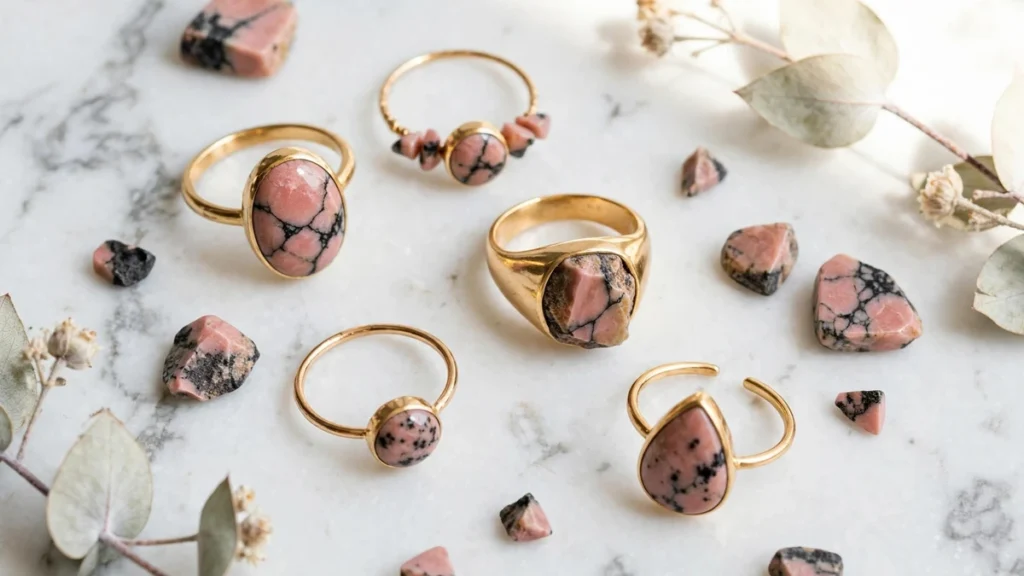
Rhodonite is the pink stone that looks like it was made for a ring. Its rose colour, threaded with black veins, is warm, distinctive, and easy to wear every day. The problem is not finding a pretty pink stone. It is finding a rhodonite ring that is honestly made, set to survive daily wear, and priced for what the stone actually is, rather than what a seller claims it to be.
That is why this guide is organised by durability and setting first, not by brand name. Rhodonite is a soft stone, softer than sapphire, emerald, or even garnet, and it needs a protective setting to last on a hand that types, cooks, and carries bags. A bezel or a low halo will keep it safe for years, while a high prong setting on a stone this soft is a chip waiting to happen.
Below are nine rhodonite rings worth considering in 2027, from a classic solitaire to a sculptural statement piece. Each one is described by what it is good at, what to watch for, and who it suits best, so you can choose with your eyes open, not just your heart.
Key takeaways
- Rhodonite is a pink manganese silicate, Mohs 5.5 to 6.5, with natural black manganese-oxide veins that prove it is genuine.
- Bezel and halo settings protect this soft stone best; high prongs and tension settings are a poor choice for everyday wear.
- Dyed howlite, dyed quartz, and pink glass are the commonest imitations, so ask for disclosure and a fair price.
- Clean a rhodonite ring only with lukewarm water and mild soap, and never put it in an ultrasonic or steam cleaner.
- Rhodonite has no proven healing properties and is not an investment stone, so buy it for its beauty, not for a return.
What rhodonite actually is, and why it suits a ring
Rhodonite is a manganese silicate, and its colour comes from manganese itself. The pink ranges from pale rose to a deep, almost raspberry tone, and the black veins running through it are manganese oxide. Those veins are not a flaw. They are the stone’s fingerprint, and a clean, vein-free stone with a flat, uniform pink should make you suspicious, because natural rhodonite almost always shows some veining.
At Mohs 5.5 to 6.5, rhodonite is softer than most ring stones. That does not mean it cannot be worn daily, but it does mean the setting has to do the protecting. A bezel wraps the stone in metal and guards its edges. A halo adds a ring of small diamonds or metal that takes the knocks first. A solitaire held by four thin prongs leaves the stone exposed, and on a hand that is always busy, that is asking for a chip.
Rhodonite is also a stone where honesty matters more than pedigree. Most rhodonite is untreated, which is good news, but the imitations are common. Dyed howlite and dyed quartz are sold as rhodonite at low prices, and pink glass is sold as rhodonite at high ones. A reputable seller will tell you what the stone is, whether it has been dyed, and why it costs what it does. If they cannot, walk away.
How we chose these rings and what to look for
Look first at the setting. For rhodonite, a bezel, a half-bezel, or a low halo is the right choice for a ring you will wear every day. Check that the stone sits low and snug, with no wobble, and that the metal wraps the girdle, the stone’s widest edge, rather than leaving it bare. A stone that sits high on tall prongs looks dramatic in a photograph and chips easily in real life.
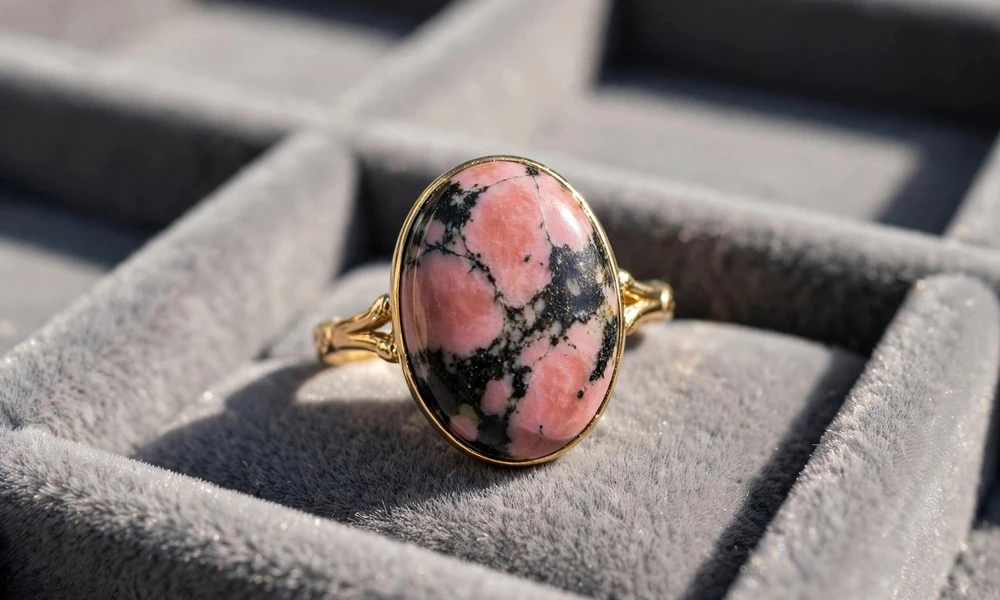
Look next at the stone itself. A good rhodonite is a clear, saturated pink with veins that look natural and irregular, not painted on. The best stones have a strong pink with fine black veining that adds character without overwhelming the colour. Avoid stones that look chalky or washed out, and be wary of a vivid, uniform pink with no veining at all, because that is often dyed. Our guide to rhodonite bracelets explains how to spot the same differences in a larger stone, and the same eye for colour and veining applies here.
Finally, look at the metal and the price. Rhodonite is an affordable stone, so the price of the ring should reflect the metal and the making, not the stone. Gold, vermeil, and solid silver are all sensible choices. A rhodonite ring priced like a ruby ring is a warning sign, not a bargain.
The 9 best rhodonite rings of 2027
Tiffany & Co. Rhodonite Solitaire
What we like: A clean, classic solitaire in a low bezel, with a well-chosen pink stone and the kind of finishing that makes a simple ring feel special.
What to consider: Premium price for an affordable stone, and the bezel is the only sensible setting here, so do not expect a prong version. Stone: Natural rhodonite, oval cut. Setting: Low bezel in 18-karat yellow gold. Best for: A first rhodonite ring, worn every day. Price range: High.
This is the ring to buy if you want rhodonite done properly, with a setting that protects the stone and a maker that stands behind it. The price is for the gold and the name, not the stone, and that is honest value if you know what you are paying for.
Cartier Rhodonite Cocktail Ring
What we like: A bold, polished cocktail ring with a large, saturated pink stone and a halo of small diamonds that frames the colour beautifully.
What to consider: A statement piece, not an everyday ring, and the price reflects the house and the diamonds, not the rhodonite. Stone: Natural rhodonite, cushion cut. Setting: Halo in 18-karat rose gold. Best for: Evenings and occasions. Price range: High.
Cartier’s cocktail ring is about presence. The halo protects the stone’s edges while making the pink look richer, and the rose gold warms the colour. Wear it for occasions, not for the gym, and it will stay beautiful for years.
David Yurman Rhodonite Cable Ring
What we like: The signature cable band gives a soft stone a strong frame, and the bezel-set rhodonite sits low and secure in the design.
What to consider: The cable band is a statement in itself, so the ring suits people who like the Yurman look. Stone: Natural rhodonite, cabochon. Setting: Bezel on a sterling silver cable band with 14-karat gold accents. Best for: Everyday wear with character. Price range: Mid to high.
Yurman’s cable design is a good match for rhodonite, because the band is sturdy and the bezel is protective. It is a ring that looks distinctive without being fragile, which is exactly what this stone needs.
Mejuri Rhodonite Dome Ring
What we like: A smooth, modern dome in vermeil with a polished rhodonite cabochon, at a price that matches what the stone is actually worth.
What to consider: Vermeil wears faster than solid gold, so expect to replate after a few years of daily wear. Stone: Natural rhodonite, cabochon. Setting: Bezel in gold vermeil over sterling silver. Best for: A first pink-stone ring on a sensible budget. Price range: Low to mid.
Mejuri’s dome ring is the honest entry point. The stone is genuine, the setting is protective, and the price is fair. It is a good way to find out whether you love wearing pink before spending more.
Monica Vinader Rhodonite Signet Ring
What we like: A neat signet with a flat rhodonite top, clean lines, and a comfortable fit that works as well on its own as in a stack.
What to consider: The flat top shows scratches more readily than a domed stone, so it needs gentle handling. Stone: Natural rhodonite, flat cut. Setting: Bezel in 18-karat gold vermeil. Best for: Stacking and everyday wear. Price range: Mid.
The signet is a practical shape for rhodonite, because the bezel wraps the stone completely and the flat top sits close to the finger. It is a quiet, wearable ring that still shows off the stone’s colour.
Missoma Rhodonite Stacking Ring
What we like: A slim, delicate band with a small rhodonite, designed for stacking, with a low profile that rarely catches on anything.
What to consider: The stone is small, so the pink reads as an accent rather than a statement. Stone: Natural rhodonite, round cut. Setting: Bezel in gold vermeil. Best for: Stacking with plain bands. Price range: Low.
Maria Black Rhodonite Sculptural Ring
What we like: A sculptural, architectural design that treats the rhodonite as a piece of art, with a bold shape and a polished finish.
What to consider: A fashion-forward design that suits confident styling, and the sculptural shape is less comfortable for all-day wear than a plain band. Stone: Natural rhodonite, freeform cut. Setting: Bezel in sterling silver. Best for: Making a statement. Price range: Mid.
Maria Black’s sculptural ring is for people who want jewellery that looks like design, not just decoration. The bezel keeps the stone secure, and the shape makes the pink and black veining look deliberate and striking.
Astrid & Miyu Rhodonite Halo Ring
What we like: A pretty halo ring with a pink centre stone and a ring of small white stones, at a price that makes it an easy gift or a first ring.
What to consider: The halo stones are small, so the ring needs gentle cleaning to keep them bright. Stone: Natural rhodonite, round cut. Setting: Halo in gold vermeil. Best for: Gifting and special occasions. Price range: Low to mid.
Thomas Sabo Rhodonite Charm Ring
What we like: A playful charm-style ring with a rhodonite cabochon and a detailed band, full of character and easy to wear.
What to consider: A charm design, so it suits casual styling more than formal occasions. Stone: Natural rhodonite, cabochon. Setting: Bezel in sterling silver. Best for: Casual, everyday wear. Price range: Low.
Thomas Sabo’s charm ring is the most relaxed of the nine. The cabochon is smooth and comfortable, the bezel is protective, and the price is fair for a genuine stone in solid silver.
Which rhodonite ring is right for you
If you want a ring to wear every day, choose a bezel or a low halo in gold or silver, with a stone that sits close to the finger. The Tiffany solitaire and the David Yurman cable ring are the strongest everyday choices, because their settings protect the stone and their bands are comfortable. A signet or a dome is also sensible, because the stone is wrapped in metal on all sides.
If you want a ring for occasions, a cocktail or halo design makes sense, because the stone can be larger and the setting more decorative. The Cartier cocktail ring and the Astrid & Miyu halo are made for evenings, and they look their best when the rest of your jewellery is kept simple. A rhodonite necklace in the same pink can complete the look, but keep one piece as the focus and let the other stay quiet.
If you are buying on a budget, the Mejuri dome and the Missoma stacking ring are the honest choices. Both use genuine rhodonite in protective bezels, and both are priced for what the stone is worth. Avoid any ring that charges a premium for the stone alone, because rhodonite is an affordable gem and the price should come from the metal and the making.
The caveats that matter
Rhodonite is a soft stone, and that is the single most important thing to know before you buy. At Mohs 5.5 to 6.5, it can scratch and chip if it is knocked against hard surfaces, and it should not be worn for gardening, cleaning, or the gym. Take the ring off for heavy work, and it will last far longer than if you wear it through everything.
| Detail | What is known |
|---|---|
| What rhodonite is | A pink manganese silicate, coloured by manganese, with natural black manganese-oxide veins |
| Hardness | Mohs 5.5 to 6.5, softer than sapphire, emerald, or garnet, so it needs a protective setting |
| Best setting | Bezel, half-bezel, or low halo; high prongs and tension settings are a poor choice |
| Common imitations | Dyed howlite, dyed quartz, and pink glass; ask for disclosure before buying |
| Cleaning | Lukewarm water and mild soap only; never use an ultrasonic or steam cleaner |
| Who should avoid it | Anyone wanting a hard-wearing ring for heavy manual work or constant rough use |
| What it does not do | It has no proven healing properties and is not an investment stone |
| Price honesty | Rhodonite is affordable, so the price should reflect the metal and the making, not the stone |
Cleaning is simple but strict. Lukewarm water, a drop of mild soap, and a soft cloth are all you need. Never put a rhodonite ring in an ultrasonic cleaner or a steam cleaner, because the vibrations and heat can crack a stone this soft. Dry it gently, store it in a soft pouch away from harder jewellery, and have the setting checked once a year, because a loose bezel is the commonest reason a soft stone is lost.
Checklist: choosing a rhodonite ring honestly
Use these checks before you buy, and again when the ring arrives.
- Check the setting: bezel, half-bezel, or low halo, with the stone sitting low and snug, not high on tall prongs.
- Check the stone: a clear, saturated pink with natural, irregular black veins, not a flat, uniform pink with no veining.
- Check the disclosure: ask whether the stone is natural or dyed, and whether the seller will say so in writing.
- Check the price: it should reflect the metal and the making, because rhodonite itself is an affordable stone.
- Check the fit: wear it for a day before deciding, because a ring that catches or spins will not be worn.
- Check the care: lukewarm water and mild soap only, no ultrasonic or steam cleaner, and a soft pouch for storage.
Frequently asked questions
Is rhodonite durable enough for a ring?
Yes, if the setting protects it. At Mohs 5.5 to 6.5, rhodonite is softer than most ring stones, so it needs a bezel or a low halo, and it should be taken off for heavy manual work. In a good setting, worn with normal care, it lasts for years.
Are the black veins in rhodonite a flaw?
No. The black veins are manganese oxide, and they are a natural part of the stone. They are also a good sign of authenticity, because dyed imitations often have a flat, uniform pink with no veining at all.
How do I tell real rhodonite from dyed howlite?
Real rhodonite has a clear, saturated pink with irregular black veins and a slightly translucent quality. Dyed howlite is usually a flatter pink with grey or black veining that looks painted on, and it is often sold very cheaply. A reputable seller will disclose what the stone is.
Can I wear a rhodonite ring every day?
Yes, with care. Choose a bezel or low halo setting, take the ring off for cleaning, gardening, and the gym, and clean it only with lukewarm water and mild soap. Daily wear is fine for a protected stone on a hand that is not doing heavy work.
Does rhodonite have healing properties?
No. Rhodonite has no proven healing properties, and no reputable seller should claim otherwise. Buy it for its colour and its beauty, not for any health benefit.
Is a rhodonite ring a good investment?
No. Rhodonite is an affordable stone, and its value does not rise like a rare gem. A rhodonite ring is a good buy for its beauty and its making, and our guide to engagement rings explains why a soft, affordable stone is a poor choice if investment value is what you want. Buy rhodonite because you love the pink, not because you expect a return.
The bottom line
The best rhodonite ring in 2027 is not the most expensive or the most dramatic. It is the one with a genuine stone, a protective bezel or halo setting, and a price that reflects the metal and the making rather than the stone. For everyday wear, a low bezel in gold or silver is the honest choice. For occasions, a halo or cocktail design makes the pink look its best.
Choose one ring, check the stone’s colour and veining, ask for disclosure, and wear it with the care a soft stone deserves. That is the honest way to enjoy rhodonite, without the chip, the disappointment, or the overpayment that comes from buying a soft stone in the wrong setting.