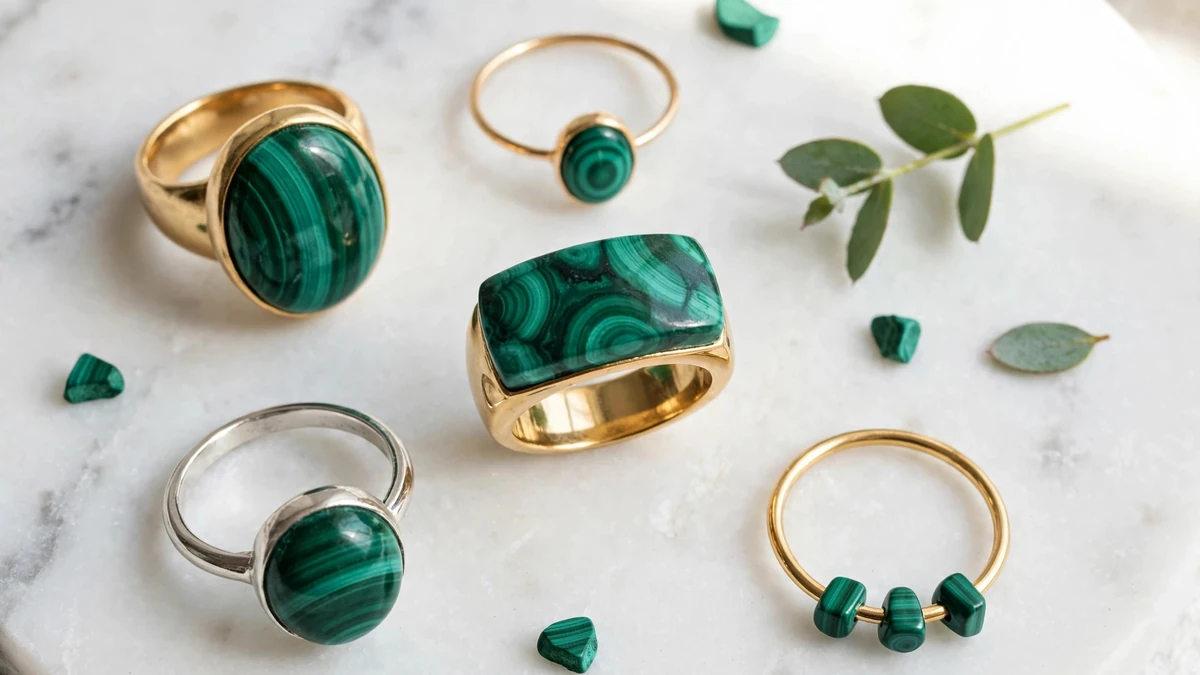
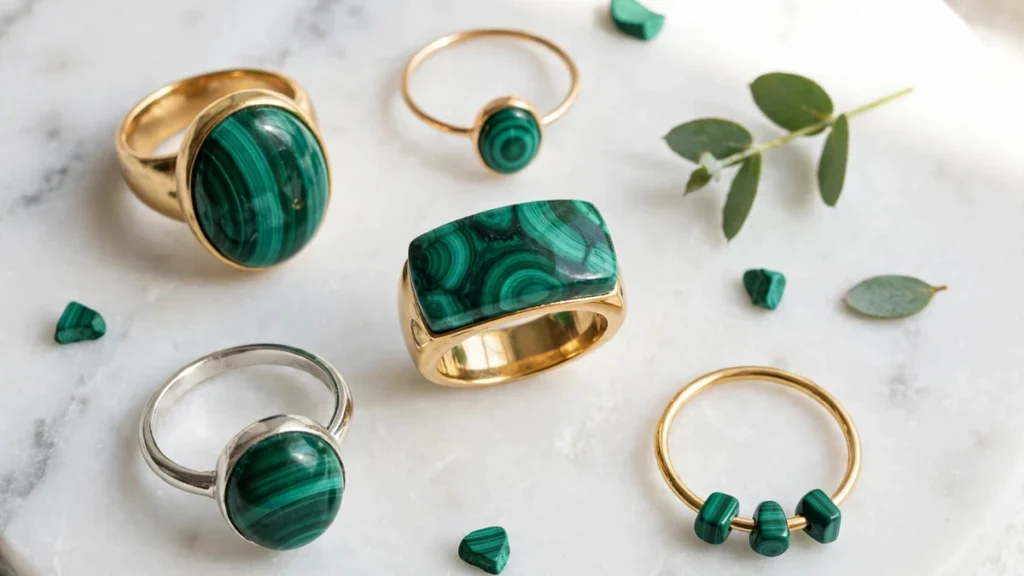
Malachite is the most dramatic green stone in jewellery. Its swirling bands of deep forest green and pale mint look like a landscape seen from above, and no two stones ever look alike. That is exactly why it photographs so well and why it keeps appearing in ring collections from high jewellery houses to affordable contemporary brands. A malachite ring is a statement piece, not a quiet one.
The problem is that malachite is also one of the softest stones ever set in a ring. At 3.5 to 4 on the Mohs scale, it scratches and chips far more easily than sapphire, emerald or even turquoise. A malachite ring worn carelessly will show its age quickly, which is why the setting matters more here than with almost any other gemstone. A good bezel or halo setting protects the stone; high prongs leave its edges exposed to every knock.
Below are nine malachite rings worth considering in 2027, from a classic solitaire to sculptural and stacking styles. Each one is described by what it is good at, what to watch for, and who it suits best, so you can choose a ring you will actually enjoy wearing, not one that lives in a box because it feels too fragile.
Key takeaways
- Malachite is a copper carbonate mineral at 3.5 to 4 on the Mohs scale, one of the softest stones used in rings.
- Real malachite has irregular, wavy banding; perfectly regular stripes usually mean plastic or resin imitation.
- Bezel or halo settings protect malachite best, because they shield the stone’s edges from knocks and scratches.
- Never put malachite in water, an ultrasonic cleaner or a steam cleaner; wipe it with a soft, dry cloth only.
- Malachite has no proven healing properties and is not an investment stone, so buy it for its beauty and wear it with care.
What malachite actually is
Malachite is a copper carbonate hydroxide mineral that forms in the upper, oxidised parts of copper deposits. Its green colour comes from copper, and its famous banding comes from the way the mineral grows in layers, each one a slightly different shade of green. The result is a stone that can be deep forest green, bright emerald green or pale mint, often all in the same piece, with bands that curve, swirl and feather into each other.
People have worked malachite for thousands of years. It was mined in ancient Egypt, carved into amulets and inlay, and later used for tabletops, columns and ornamental objects in Russia, where the great Demidov mines produced enormous masses of it. As a gemstone it has always been valued for its pattern rather than its rarity. Good malachite is not scarce, and its price reflects that, which is part of its appeal: the stone itself is affordable, so you are paying for design, metal and craftsmanship.
What makes malachite tricky as a ring stone is purely physical. At 3.5 to 4 on the Mohs scale it is softer than a steel nail, softer than a copper coin, and far softer than everyday dust, which contains quartz. It scratches easily, chips at the edges, and is damaged by water, acids and heat. None of that makes it unwearable. It makes it a stone that needs the right setting and a little respect, which is what the rest of this guide is about.
How we chose these rings and what to look for
Look first at the setting. A bezel setting, where a rim of metal wraps around the stone, is the safest choice for malachite because it protects the vulnerable edges. A halo setting, where small diamonds or crystals surround the stone, offers similar protection. Prong settings can work for a ring worn occasionally, but high prongs leave the stone’s edges exposed, and a knock that would only scuff a sapphire can chip a malachite.
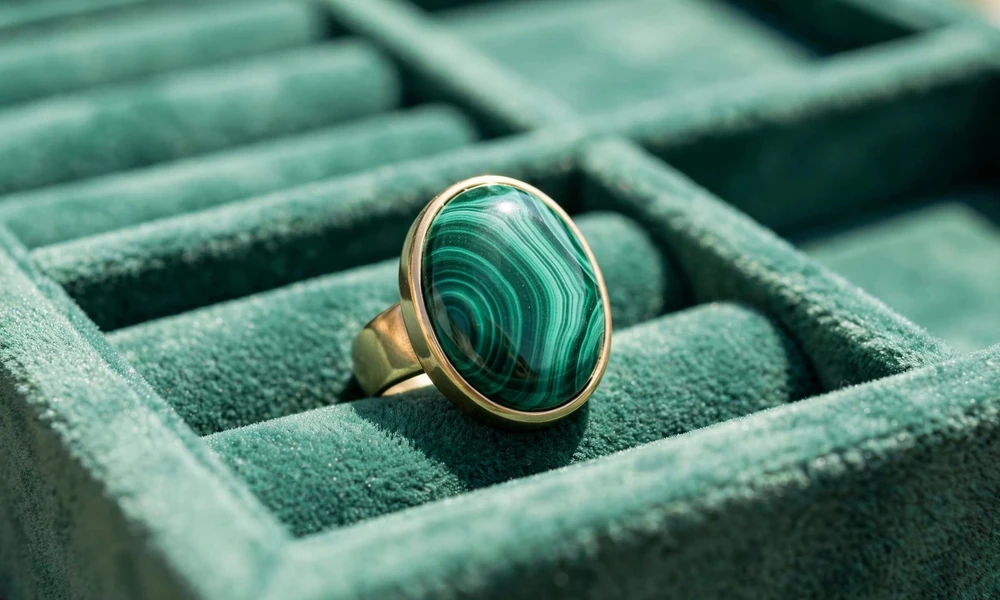
Look next at the stone itself. Good malachite has vivid, varied green banding that is irregular and organic. Be suspicious of bands that are perfectly regular, evenly spaced or unnaturally bright, because those are signs of plastic, resin or dyed stone. Ask the seller whether the malachite is natural or stabilised, and whether any dye has been used. Reputable sellers disclose this. A stone that looks almost black-green in the shop may be very dark indoors, so look at it in daylight before deciding.
Finally, look at the metal and the price. Solid gold or sterling silver is worth paying for, because a malachite ring is a piece you keep and re-polish, not a disposable trend buy. Plated base metal wears through quickly on a ring that is handled all day. Our guide to malachite bracelets covers the same stone in a safer setting, and it is a useful comparison if you love the look but are unsure about wearing malachite on your hand.
The 9 best malachite rings of 2027
Tiffany & Co. Solitaire
What we like: A clean, classic solitaire with a beautifully banded oval malachite in a low, protective bezel, set in 18-karat yellow gold. The stone is well chosen, with vivid green banding and no dull patches. What to consider: Premium price for a soft stone, and the polished gold bezel will pick up fine scratches with wear. Stone: Natural malachite, oval cabochon. Setting: Bezel, 18-karat yellow gold. Best for: A timeless statement ring worn on special occasions. Price range: $1,500–$3,000.
This is the most considered malachite ring in the roundup. The low bezel is exactly what a soft stone needs, and the Tiffany name means the stone’s quality and treatment are fully disclosed.
Cartier Cocktail
What we like: A bold cocktail ring with a large cushion-cut malachite surrounded by a pavé diamond halo, in 18-karat gold. The halo protects the stone’s edges while making the green look richer. What to consider: A large, tall ring that catches on clothing and is best kept for evenings. Stone: Natural malachite, cushion cabochon. Setting: Halo, 18-karat gold with pavé diamonds. Best for: Evening wear and collectors of statement jewellery. Price range: $2,000–$4,500.
The halo does real work here, not just decoration. It shields the malachite’s edges, which is the single most useful thing a setting can do for this stone.
David Yurman Cable
What we like: Malachite set into Yurman’s signature cable design, with a twisted gold band that gives the ring a sculptural, handcrafted feel. The stone is a deep, even green with strong banding. What to consider: The cable texture can trap dirt around the stone, so it needs regular gentle cleaning. Stone: Natural malachite, round cabochon. Setting: Bezel with cable band, 18-karat gold or sterling silver. Best for: A designer piece with a distinctive silhouette. Price range: $600–$1,400.
Yurman’s cable band makes this ring recognisable from across a room. The bezel setting keeps the stone safe, which is the right call for a ring designed to be worn often.
Mejuri Dome
What we like: A smooth, polished dome of malachite in a slim gold vermeil band, at a price that makes the stone accessible. The dome shape shows off the banding beautifully and has no sharp edges to chip. What to consider: Gold vermeil wears over time on a ring, and the stone is on the smaller side. Stone: Malachite, dome cabochon. Setting: Bezel, gold vermeil over sterling silver. Best for: A first malachite ring and everyday styling. Price range: $150–$280.
This is the easiest entry point in the roundup. The dome shape is forgiving, the price is fair, and it is a good way to find out whether you enjoy wearing malachite before spending more.
Monica Vinader Signet
What we like: A modern signet with a flat, polished malachite inlay set flush into a gold vermeil band. The flush setting protects the stone completely, and the signet shape is easy to wear with other rings. What to consider: The inlay is thin, so it cannot be re-polished many times, and vermeil will wear with daily use. Stone: Malachite inlay, flat. Setting: Flush inlay, gold vermeil over sterling silver. Best for: Stacking and everyday wear. Price range: $180–$320.
A flush inlay is the most protective way to set malachite in a ring, because there is almost nothing to catch or chip. This is the practical choice if you want to wear malachite daily.
Missoma Stacking
What we like: A slim stacking ring with a small malachite cabochon in a gold vermeil band, designed to be layered with plain bands. The small stone keeps the price down and the risk of damage low. What to consider: The stone is small, so the banding is less visible, and vermeil wears with daily use. Stone: Malachite, small round cabochon. Setting: Bezel, gold vermeil over sterling silver. Best for: Stacking and subtle everyday colour. Price range: $120–$220.
Small stones are a smart way to wear a soft gem. There is less surface to scratch, less edge to chip, and the ring still gives you that unmistakable malachite green.
Maria Black Sculptural
What we like: An asymmetric, sculptural ring where the malachite sits in an off-centre, organic-shaped setting in sterling silver. It looks modern and artistic rather than traditional. What to consider: The sculptural shape can snag, and the stone’s edges are partly exposed. Stone: Natural malachite, freeform cabochon. Setting: Partial bezel, sterling silver. Best for: A contemporary, artistic look. Price range: $200–$400.
Astrid & Miyu Halo
What we like: A neat halo ring with a round malachite centre stone surrounded by small cubic zirconia, in gold-plated sterling silver. It gives a high-jewellery look at a very accessible price. What to consider: Gold plating wears quickly on rings, and the stone is modest in size. Stone: Malachite, round cabochon. Setting: Halo, gold-plated sterling silver. Best for: A fashionable, affordable statement. Price range: $90–$180.
Thomas Sabo Charm
What we like: A playful charm-style ring with a small malachite cabochon in a detailed sterling silver setting, with the brand’s signature engraved band. It is sturdy, affordable and easy to wear. What to consider: The setting is busy, which can distract from the stone, and the stone is small. Stone: Malachite, small cabochon. Setting: Bezel, sterling silver. Best for: A casual, collectible ring. Price range: $100–$200.
Which malachite ring is right for you
If you want to wear malachite every day, choose a low, flush or bezel-set ring with a small to medium stone. The Monica Vinader signet and the Mejuri dome are the best options here, because their settings protect the stone and their profiles sit close to the finger. Avoid tall cocktail rings for daily wear, however beautiful they are, because height is what catches on things and chips soft stones.
If you want a statement piece for evenings and special occasions, go bigger. The Cartier cocktail and the Tiffany solitaire are designed for exactly that, and their settings are good enough to justify the price. A large malachite worn occasionally will last for decades, because the damage comes from daily knocks, not from sitting in a jewellery box.
If you love the stone but are nervous about wearing it on your hand, consider the same stone in a safer place. Our guide to malachite necklaces shows how the banding looks even better on a pendant, where it is protected from knocks and visible all day. Many people end up owning both, and wearing the necklace daily and the ring for occasions.
The caveats that matter
Malachite’s softness is the whole story. It scratches, chips and is damaged by water, chemicals and heat, and those are not minor footnotes. A malachite ring that is worn while washing hands, applying hand cream or doing housework will deteriorate. The good news is that all of this is avoidable: take the ring off before washing your hands, keep it away from perfume and cleaning products, and store it in a separate pouch so harder jewellery cannot scratch it.
| Detail | What is known |
|---|---|
| Hardness | Mohs 3.5 to 4, one of the softest stones used in rings |
| Best setting | Bezel, halo or flush inlay; high prongs leave edges exposed |
| Cleaning | Soft, dry cloth only; never water, ultrasonic or steam cleaners |
| What to avoid | Perfume, hairspray, household chemicals, hard knocks, heat |
| Real vs imitation | Irregular, wavy banding is real; perfectly regular stripes usually mean plastic or resin |
| Dust warning | Malachite dust is toxic if inhaled; a risk only when cutting the stone, not when wearing it |
| Who should skip it | Anyone who wants a daily-wear ring without extra care |
| What it does not do | No proven healing properties; not an investment stone |
There is one more honest point. Malachite dust is toxic when inhaled, because of its copper content, which is why lapidaries wear masks when cutting it. That is a workshop hazard, not a wearing hazard: a finished, polished malachite ring is safe to wear. It is still worth knowing, because it is a reminder that this is a real mineral with real chemistry, not a decorative plastic, and it deserves to be treated as such.
Checklist: choosing a malachite ring honestly
Use these checks before you buy, and again after a month of wear.
- Check the banding: it should be irregular and wavy, not perfectly regular or evenly striped.
- Check the setting: bezel, halo or flush inlay protects the stone; high prongs do not.
- Check the metal: solid gold or sterling silver is worth it; plated base metal wears through fast on a ring.
- Check the profile: a low, flat ring knocks less and lasts longer than a tall one.
- Ask about treatments: dyed or stabilised malachite should be disclosed by the seller.
- Plan the care: dry cloth only, no water or chemicals, and store it in its own pouch.
Frequently asked questions
Can I wear a malachite ring every day?
You can, but only if the setting is protective and you are willing to take it off for washing hands, cleaning and exercise. A low bezel or flush inlay ring will cope with daily wear far better than a tall cocktail ring. If you want a ring you never have to think about, malachite is not the right stone.
Can malachite get wet?
No, not if you want it to last. Water, soap and hand cream all damage malachite over time, dulling its polish and weakening the surface. Take the ring off before washing your hands or showering, and wipe it with a soft, dry cloth if it does get damp.
How do I tell real malachite from fake?
Look at the banding. Real malachite has irregular, wavy bands in varied shades of green, and no two stones look alike. Imitations made of plastic or resin usually have perfectly regular, evenly spaced stripes, often in a very bright or uniform green. Glass imitations feel colder and heavier, and often have bubbles. When in doubt, buy from a seller who discloses treatments in writing.
Is malachite toxic to wear?
No. A finished, polished malachite ring is safe to wear. The toxicity concern is about malachite dust inhaled during cutting and polishing, which is why lapidaries wear masks. Wearing a polished stone on your skin carries no such risk.
Does malachite fade?
It can dull rather than fade. Prolonged exposure to sunlight, heat and chemicals can weaken the surface and reduce the polish, which makes the green look flatter. Stored properly and kept away from chemicals, malachite keeps its colour well. Re-polishing by a jeweller can restore the shine if the stone has dulled.
Is a malachite ring a good investment?
No. Malachite is not rare, and its value comes from design and craftsmanship, not from the stone itself. Buy it because you love the colour and the pattern, not because you expect it to appreciate. If you want jewellery that holds value, spend on the metal and the maker instead. Our guide to gold jewellery for everyday wear explains which pieces are worth the spend and which are not.
The bottom line
The best malachite ring in 2027 is not the biggest or the most expensive. It is the one with a protective setting, a genuinely well-banded stone, and a profile that suits how you actually live. For daily wear, a low bezel or flush inlay ring in solid gold or sterling silver is the smart choice. For occasions, a cocktail ring with a halo setting gives you the drama without leaving the stone defenceless.
Choose one ring, wear it with a little care, and take it off before water and housework. That is the honest way to enjoy malachite: a stone whose beauty is entirely real, and whose fragility is entirely manageable, as long as you know what you are buying.