Malachite is the most dramatic green stone in jewellery. Its surface is a swirl of deep forest green and pale mint, banded in rings and waves that no two stones share. It has been carved and worn for thousands of years, from ancient Egyptian ornaments to Victorian tableware, and it still stops people in a way that a plain green stone never does. A malachite bracelet is not a quiet piece. It is a conversation.
The problem is that malachite is also one of the softest stones used in jewellery, at just 3.5 to 4 on the Mohs scale, which means it scratches easily, chips if knocked, and cannot be cleaned the way harder stones can. Much of what is sold as malachite is plastic or resin with painted bands, and the real thing is often set badly, with thin bezels that leave the stone exposed to knocks. A good malachite bracelet protects the stone, shows off its pattern, and is honest about the care it needs.
Below are nine malachite bracelets worth considering in 2027, from a classic beaded strand to sculptural cuffs and fine tennis styles. Each one is described by what it is good at, what to watch for, and who it suits best, so you can choose with the stone in mind, not just the colour.
Key takeaways
- Malachite is a copper carbonate mineral, famous for its swirling bands of deep and pale green.
- At Mohs 3.5 to 4, malachite is soft and easy to scratch, so it needs a protective setting and gentle handling.
- Real malachite has irregular, natural banding; perfectly regular stripes usually mean plastic or resin imitation.
- Beaded strands and cuffs suit malachite best, because they show off the pattern without exposing thin edges.
- Malachite has no proven healing properties and is not an investment stone, so buy it because you love how it looks, not as a financial asset.
What malachite actually is
Malachite is a copper carbonate hydroxide mineral, formed when copper ore weathers near the surface of the earth. Its colour comes from copper, and its famous banding comes from the way the mineral grows in layers, each one a slightly different shade of green. Cut and polished, it shows concentric rings, waves and bullseye patterns that are different in every single stone. That is the whole point of malachite. No two bracelets will ever look exactly alike.
The stone’s beauty comes with a real weakness. At 3.5 to 4 on the Mohs scale, malachite is softer than most everyday objects. A steel key, a door handle or a stone worktop can scratch it. It is also sensitive to water, acids and heat, and it should never go in an ultrasonic or steam cleaner. Lapidaries who cut malachite wear masks, because the dust is toxic if inhaled, which is a useful reminder that this is a stone to admire on the wrist, not to chew, grind or soak.
Imitations are common, because real malachite is not cheap and its pattern is easy to fake at a glance. Plastic and resin copies have regular, repeating stripes that look printed rather than grown. Glass copies are too uniform and too light. Real malachite feels cool in the hand, has weight for its size, and shows irregular banding that changes direction across the stone. If a seller cannot tell you where the stone came from, or if the price seems far too low for the size, that is a reason to be cautious.
How we chose these bracelets and what to look for
Look first at the pattern. Good malachite has bold, irregular banding with a clear contrast between deep and pale green, and the pattern should run across the whole stone, not just the surface. In a beaded bracelet, the beads should show different patterns from one to the next, because that is what natural stone does. In a cuff or tennis bracelet, the stones should be matched for tone, so the bracelet reads as one piece rather than a collection of leftovers.
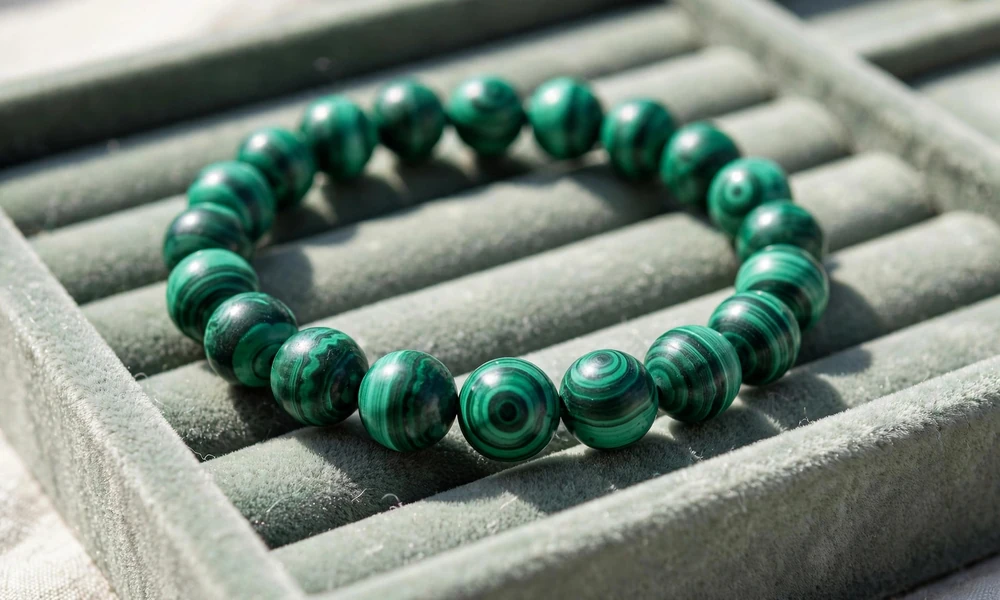
Look next at how the stone is protected. Malachite needs a setting that shields its edges, because a thin, exposed edge is the first thing to chip. A bezel setting, where the metal wraps around the stone, is the safest choice. A prong setting can work for a cabochon, but the prongs need to be sturdy and well finished. A beaded strand is naturally protective, because each bead is rounded and there are no sharp edges. Our guide to the chunky bracelet trend explains how a bolder bracelet changes an outfit, and the same logic applies here: a malachite bracelet should feel like it belongs with what you already wear, not like a piece you have to plan around.
Finally, look at the metal and the price. Sterling silver and gold vermeil are the most common settings for malachite, and both are sensible choices at this price point. Solid gold is rarer and much more expensive, and it is only worth it if the design is one you will wear for years. Prices in this guide run from under fifty pounds for a simple beaded strand to several hundred for a designer cuff, and the difference is mostly brand, metal and finish, not the stone itself.
The 9 best malachite bracelets of 2027
Tiffany & Co. Bead Bracelet
What we like: A clean beaded strand in polished malachite with a sterling silver bead, simple, well finished, and easy to wear with smart outfits. What to consider: Premium price for a simple design, and the beads need gentle handling. Stone: Malachite, 8 mm beads. Setting: Sterling silver. Best for: Everyday wear and layering. Price range: £250 to £350.
This is the quiet classic of the group. The beads are well matched in tone and show strong banding, the silver bead adds a small point of contrast, and the whole piece feels considered rather than flashy.
Cartier Beaded Bracelet
What we like: Beautifully matched malachite beads with a small gold accent bead, refined proportions, and a clasp that closes with a satisfying click. What to consider: The price reflects the name as much as the stone, and it is best kept away from hard surfaces. Stone: Malachite, 7 mm beads. Setting: 18k yellow gold accent. Best for: Smart daytime outfits. Price range: £400 to £600.
A restrained, elegant piece that works as well with a linen shirt as with a tailored jacket. The gold accent is small but well judged, and the banding is genuinely beautiful.
David Yurman Cable Bracelet
What we like: The signature twisted cable in sterling silver with a polished malachite cabochon, comfortable to wear and instantly recognisable. What to consider: The cabochon sits proud of the cable, so it needs care around hard surfaces. Stone: Malachite cabochon. Setting: Sterling silver cable. Best for: A signature everyday piece. Price range: £300 to £450.
The cable design gives the bracelet a sculptural feel that a plain strand cannot match, and the single banded stone keeps it calm rather than busy.
Mejuri Beaded Bracelet
What we like: A well-priced beaded strand with good banding and a small gold vermeil bead, designed for everyday wear and stacking. What to consider: Gold vermeil will wear over time with heavy daily use, so it needs care. Stone: Malachite, 6 mm beads. Setting: Gold vermeil. Best for: Stacking and everyday wear. Price range: £60 to £90.
Good value and genuinely wearable. This is the bracelet to choose if you want to try malachite without committing to a designer price.
Monica Vinader Tennis Bracelet
What we like: A neat row of small, evenly matched malachite stones in a fine tennis setting, light on the wrist and easy to dress up or down. What to consider: Small stones mean the banding is subtler, and the setting needs occasional checking. Stone: Malachite, 4 mm stones. Setting: Gold vermeil. Best for: Evenings and special occasions. Price range: £150 to £220.
A delicate take on the tennis bracelet that keeps the green visible without overwhelming the wrist. It pairs well with a watch or a plain bangle.
Missoma Chain Bracelet
What we like: A fine gold vermeil chain with a single malachite drop, minimal, modern, and easy to layer with other bracelets. What to consider: The single stone is small, so the pattern is subtle rather than bold. Stone: Malachite drop. Setting: Gold vermeil chain. Best for: Layering and minimal styling. Price range: £90 to £140.
For anyone who prefers a whisper of green to a full strand, this is the right scale. It sits quietly on the wrist and works with almost everything.
Maria Black Sculptural Cuff
What we like: A bold, sculptural cuff with a polished malachite inlay, striking without being heavy, and made to be a statement piece. What to consider: A cuff is less flexible than a strand, so the fit needs to be right. Stone: Malachite inlay. Setting: Sterling silver cuff. Best for: Statement styling and evenings. Price range: £200 to £300.
This is the most architectural piece in the roundup, and it rewards a confident outfit. The inlay shows the banding at its best, and the cuff protects the stone well. Try it on before buying, because cuff fit matters more than with any other style.
Astrid & Miyu Beaded Bracelet
What we like: A relaxed beaded strand with a small gold charm, affordable, well made, and easy to wear with casual outfits. What to consider: The elastic cord will need replacing after a year or two of daily wear. Stone: Malachite, 6 mm beads. Setting: Gold-plated charm. Best for: Casual, everyday wear. Price range: £40 to £70.
A friendly, low-commitment entry point. The beads show good banding for the price, and the charm adds a small personal touch.
Thomas Sabo Link Bracelet
What we like: A sturdy link bracelet with malachite cabochons set into each link, with a secure clasp and a satisfying weight. What to consider: Heavier than a beaded strand, so it suits some wrists better than others. Stone: Malachite cabochons. Setting: Sterling silver links. Best for: A substantial everyday bracelet. Price range: £120 to £180.
The link construction makes this the most durable bracelet in the roundup, and the repeated cabochons give it a rhythm that a single stone cannot.
Which malachite bracelet is right for you
Start with how you actually dress. If your wardrobe is mostly casual, with linen, denim and soft knits, a beaded strand is the natural choice. It sits comfortably, it does not catch on sleeves, and it adds colour without demanding attention. If your wardrobe leans smarter, with tailoring and silk, a tennis bracelet or a cable bracelet will sit more naturally with those fabrics and that polish.
Think about your wrist, too. A slim wrist suits finer beads and tennis settings, which keep the proportions balanced. A broader wrist can carry a cuff or a chunky link bracelet without it looking oversized. And if you wear a watch every day, a beaded strand or a fine chain will sit alongside it more comfortably than a wide cuff. Our guide to gold jewellery for everyday wear is a useful companion here, because the metal you choose for a bracelet should sit happily next to the rings and earrings you already own.
Finally, be honest about how much care you will give it. Malachite is a soft stone, so it needs more care than aventurine or quartz. A beaded strand is the easiest to wear but the first to need restringing. A tennis bracelet needs its prongs checked once a year. A cuff needs almost no care at all, but it needs the right fit. Choose the bracelet whose care routine matches your habits, not the one that looks best in a photograph.
The caveats that matter
Malachite is a beautiful stone, but it is not a tough one. It scratches easily, it chips if knocked against a hard surface, and it reacts badly to water, acids and heat. It should never go in an ultrasonic or steam cleaner, and it should never be worn swimming, in the shower, or while using household cleaners. Plastic and resin imitations are common, with regular, printed-looking stripes, and they are much lighter than real stone.
| Detail | What is known |
|---|---|
| What it is | Copper carbonate hydroxide, famous for swirling bands of deep and pale green |
| Hardness | Mohs 3.5 to 4, soft and easy to scratch, so it needs a protective setting |
| Natural pattern | Irregular, concentric banding, different in every stone |
| Common imitations | Plastic and resin with regular, printed stripes; glass copies that feel too light |
| Cleaning | Soft, dry cloth only; no water, no soap, no ultrasonic or steam cleaners |
| What to avoid | Swimming, showering, perfume, acids, heat and hard knocks |
| Safety note | Malachite dust is toxic if inhaled, so never grind, drill or polish it yourself |
| What it does not do | It has no proven healing properties and is not an investment stone |
If you wear your bracelet every day, have a beaded strand restrung every year or two, and have a tennis bracelet’s prongs checked annually. A few minutes of care keeps a good bracelet looking good for years, and it is far cheaper than a repair after a stone is chipped.
Checklist: choosing a malachite bracelet honestly
Use these checks before you buy, and again after a month of wear.
- Check the pattern: irregular, natural banding with clear contrast, not regular printed stripes.
- Check the feel: real malachite feels cool and has weight for its size, not light and plasticky.
- Check the setting: a bezel or sturdy prongs that protect the stone’s edges from knocks.
- Check the clasp: firm, secure, and easy to open and close without catching on clothing.
- Check the fit: snug enough not to slide over your hand, loose enough to move comfortably on the wrist.
- Check the care: soft dry cloth only, and never swim, shower or spray perfume on it.
Frequently asked questions
Is malachite a real gemstone?
Yes. Malachite is a genuine copper carbonate mineral, used in jewellery and carving for thousands of years. It is a semi-precious stone, and its value comes from the quality of the banding and the setting rather than rarity.
Can I wear a malachite bracelet every day?
Yes, with care. At Mohs 3.5 to 4, malachite is soft, so take it off for swimming, heavy exercise, housework and anything that might knock it. A beaded strand or a cuff is more forgiving than a tennis bracelet for daily wear.
Why does some malachite look striped and regular?
Perfectly regular stripes usually mean a plastic or resin imitation. Real malachite has irregular, natural banding that changes direction across the stone. If the pattern looks printed, it probably is.
How do I clean a malachite bracelet?
With a soft, dry cloth only. Do not use water, soap, ultrasonic or steam cleaners, and keep it away from perfume, sunscreen and household chemicals. Water and acids can damage the surface and dull the polish.
Does malachite have healing properties?
There is no scientific evidence that malachite, or any gemstone, heals illness or changes luck. It is a beautiful, historic stone, and it is best bought for how it looks and how it makes you feel, not for any claimed medical benefit.
Is malachite a good investment?
No. Malachite is relatively plentiful and affordable, and its softness means it loses condition with wear, so it does not hold or gain value the way a rare diamond or emerald might. Buy it because you love wearing it. Our guide to malachite earrings for spring shows the same stone in a lighter, seasonal setting if you want to build a small matching set.
The bottom line
The best malachite bracelet in 2027 is the one whose stone shows strong, natural banding, whose setting protects its soft edges, and whose style fits the way you actually dress. For most people, that is a well-made beaded strand or a simple tennis bracelet in gold vermeil or sterling silver, at a price that leaves room for a second piece later.
Choose one bracelet, wear it for a month before deciding whether you want another, and look after it with a soft, dry cloth. Malachite rewards that kind of simple care, and a bracelet you reach for every morning is worth far more than one that stays in the box.