A silk scarf is one of the few accessories that can change an outfit without changing anything else. Tied at the neck, it makes a plain shirt look considered. Folded into a bag handle, it adds colour to a neutral outfit. The problem is not finding a silk scarf. It is knowing whether the one in your hand is worth its price.
Silk scarves range from a few pounds at a market stall to several hundred at a luxury house, and the difference is not always obvious at a glance. A printed polyester scarf can look like silk in a photograph. And a beautiful scarf in the wrong size or colour will sit in a drawer no matter how good it is. Buying well means checking a handful of things before you pay, not after.
Below are nine things to check before you buy a silk scarf in 2027, from the label and the hem to the size, the colour and the seller. Each one is explained plainly, with what to look for, what to watch out for, and how much it should matter to your decision.
Key takeaways
- Check the label first: 100 percent silk is the standard, and a vague label or a very low price is a warning sign.
- Feel the scarf: real silk feels warm and slightly dry to the touch, with a soft sheen, not a slippery plastic shine.
- Hand-rolled hems, a good weight, and a clean print are the signs of a well-made scarf at any price.
- Size decides how you can wear it: a small square suits the neck, a large square suits the head and shoulders, and a long rectangle suits the bag and the belt.
- No scarf suits everyone, and even a good silk scarf needs gentle care, so check the care label before you buy, not after.
What buying a silk scarf actually involves
Buying a silk scarf is different from buying most accessories, because the quality is in details you have to look for. A handbag shows its quality in the leather and the stitching. A watch shows it in the weight and the movement. A silk scarf shows it in the hem, the weight, the print and the way the fabric falls.
The first thing to understand is that silk is a natural fibre with a particular feel. It is smooth, but not slippery in the way polyester is. It feels warm when you hold it, and it has a soft, changing sheen rather than a flat shine. It also drapes in soft folds and holds a knot well, while a polyester scarf tends to slide and crease sharply.
The second thing to understand is that price is a poor guide on its own. A luxury scarf can be worth its price for the design, the print and the finishing, but a mid-priced scarf from a good maker can be just as well made. What matters is whether the scarf is genuinely silk, well finished, and the right size and colour for you.
How we chose these tips and what to look for
Look first at the label, and do it before anything else. A scarf that says 100 percent silk, or 100 percent mulberry silk, is the standard to aim for. Blends with cotton, wool or viscose can still be beautiful and practical, but they should be labelled honestly and priced accordingly. If the label says nothing about the fibre, or if it uses vague words like silky or silk-like, that is a warning sign.
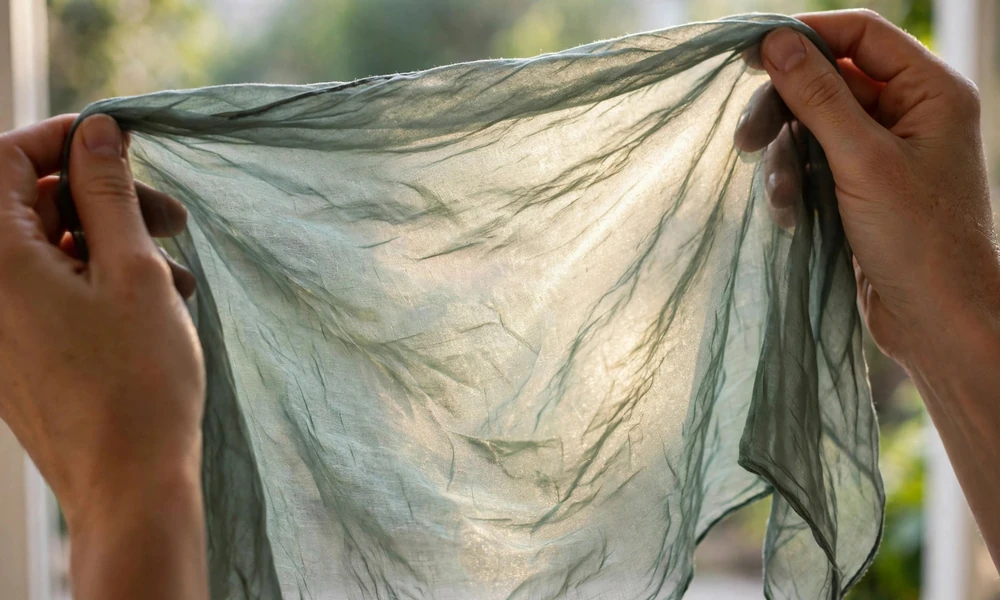
Look next at the hem. A well-made silk scarf has a hand-rolled hem, where the edge is rolled by hand and stitched with small, even stitches. A machine-stitched hem is not necessarily bad, especially on a lower-priced scarf, but a raw, fraying or uneven edge is a sign of poor making, and it will only get worse with wear.
Finally, think about how you will wear the scarf before you fall in love with the pattern. A small square is perfect at the neck and in the hair, but it will not work as a shawl. A large square is versatile but needs confidence to wear well. A long, narrow scarf is easy to wear with a bag or a belt, but it will not keep your neck warm. The right size is the one that fits the way you actually dress, not the way you imagine you might dress one day. Our guide to how to style a silk scarf covers the wearing side of the same question, because a scarf you know how to wear is a scarf you will actually reach for.
The 9 things to check before you buy a silk scarf in 2027
Check the fabric label first
What we like: A clear label that says 100 percent silk, or 100 percent mulberry silk, with the country of origin and care instructions. What to consider: Some labels are sewn into the hem and hard to find, and a label alone does not prove quality. Best for: Every purchase, without exception. Cost: Free, it only takes a minute. Time needed: A minute in the shop, or a quick message to the seller online.
Feel the weight and the hand
What we like: A scarf that feels warm to the touch, with a soft, slightly dry hand and a gentle sheen that changes as it moves. What to consider: Very light silk can feel insubstantial, and very heavy silk can be hard to knot neatly. Best for: Judging quality in a shop, where you can hold the scarf yourself. Cost: Free. Time needed: A minute of handling.
Look at the edges and the hem
What we like: A hand-rolled hem with small, even stitches, neatly finished corners, and no loose threads. What to consider: Hand-rolled hems take time, so they are rarer on lower-priced scarves, where a neat machine hem is acceptable. Best for: Spotting good making at any price. Cost: Free. Time needed: A minute of looking closely.
Check how the print is made
What we like: A print with clear, even colours, fine detail, and a design that looks considered from edge to edge, not just in the middle. What to consider: Digital prints can be very good, but they can also look flat, and a print that stops short of the edge looks unfinished. Best for: Anyone buying a patterned scarf, which is most silk scarves. Cost: Free. Time needed: A couple of minutes of looking.
Choose the right size for how you will wear it
What we like: A size that matches a real use: around 55 centimetres square for the neck, 90 centimetres square for the head and shoulders, and a long rectangle for a bag or a belt. What to consider: A size that looks generous in the shop can feel unwieldy at home, and a small scarf can feel fiddly if you have large hands or thick hair. Best for: Anyone who has bought a beautiful scarf and never worn it. Cost: Free to check, but the wrong size is the most expensive mistake. Time needed: A few minutes trying it on.
Look at the colour in daylight
What we like: A colour that looks good in natural light, against your skin and your usual clothes, not just under the shop lights. What to consider: Shop lighting is often warm and flattering, and a colour that looks rich indoors can look washed out outside. Best for: Anyone choosing between two similar colours. Cost: Free. Time needed: A minute by a window or outside the door.
Read the care label before you pay
What we like: A care label that is honest and practical, whether it says dry clean only or hand wash in cool water. What to consider: Dry clean only adds cost and effort, and a scarf that needs professional cleaning every time you wear it may not get worn often. Best for: Anyone who will not dry clean a scarf, or who wants to wash it at home. Cost: Free to read, but dry cleaning costs add up. Time needed: A minute.
Buy from a seller you can return to
What we like: A seller with a clear returns policy, a real address, and a reputation you can check, whether it is a shop, a brand, or an online store. What to consider: A very cheap scarf from an unknown seller is hard to return, and a fake label is hard to prove after the fact. Best for: Online purchases and first-time buys from a new brand. Cost: Free to check. Time needed: A few minutes of reading reviews or the returns page.
Set your budget before you fall in love
What we like: A clear budget, decided before you start looking, so you can judge a scarf on its quality rather than its price tag. What to consider: A luxury scarf can be worth its price for the design and the finishing, but a mid-priced scarf can be just as well made. Best for: Anyone who has ever bought a scarf they could not afford and then felt guilty wearing it. Cost: Free. Time needed: A minute of honest thinking.
Which silk scarf is right for you
Start with your wardrobe, not the scarf. Look at the colours you actually wear most days. If your clothes are mostly neutral, a scarf with one strong colour will add interest without clashing. If your clothes are already colourful, a scarf in a single quiet tone, or a simple pattern, will work better. A scarf should add to what you own, not demand a new outfit to go with it.
Next, think about how you will wear it. If you want a scarf for your neck, choose a small or medium square that knots easily and stays put. If you want a scarf for your hair, choose a size you can fold into a band without too much bulk. If you want a scarf for your bag, choose a long, narrow shape that ties neatly and does not flap around. One scarf can do more than one job, but it rarely does all of them well, so choose the use that matters most to you.
Finally, be honest about your habits. If you are careful with your clothes and happy to dry clean, a delicate, light silk scarf is a joy to own. A good starting point for choosing is our roundup of the best silk scarves for women, which covers a range of prices and styles. If you are rough with your accessories, or you want a scarf you can throw in a bag without thinking, choose a slightly heavier silk, or a silk blend, that can take a bit of handling. The best scarf is the one you wear, not the one you are afraid to crease.
The caveats that matter
Silk is beautiful, but it is not a practical fibre in every situation. It marks easily with water, perfume and makeup, and a spot on a light-coloured silk scarf can be hard to remove. It also snags on rough jewellery, zips and bag clasps, and a pulled thread can run across the whole scarf.
| Detail | What is known |
|---|---|
| Best fibre to look for | 100 percent silk, or 100 percent mulberry silk, clearly labelled |
| Best sign of good making | A hand-rolled hem with small, even stitches and neatly finished corners |
| Best size for the neck | Around 55 centimetres square, easy to knot and comfortable all day |
| Best size for versatility | Around 90 centimetres square, works at the neck, in the hair and over the shoulders |
| What to check in the print | Even colours, sharp detail, a design that runs cleanly to the edges |
| What to check in the light | Look at the colour in daylight, not just under warm shop lights |
| What to check before paying | The care label, the returns policy, and whether the price fits your budget |
| What it does not do | It does not suit rain, rough handling, or heavy bags, and it marks easily |
Our guide to how to care for a silk scarf covers washing, drying and storage in detail, so you can decide what level of care you are happy with before you buy.
Fakes are also worth thinking about honestly. A scarf labelled as silk that is actually polyester is not just a disappointment, it is a different product. Polyester feels slippery and cool, it creases sharply, and it does not drape like silk. The label, the feel, the hem and the seller are better guides, and together they are usually enough. If you are still unsure, buy from a seller you trust, and keep the receipt.
Checklist: buying a silk scarf honestly
Use these checks before you buy, and again when the scarf arrives if you bought it online.
- Check the label: 100 percent silk, clearly stated, with care instructions you are happy with.
- Check the hem: hand-rolled is best, a neat machine hem is acceptable, a raw or fraying edge is not.
- Check the feel: warm and slightly dry to the touch, with a soft sheen, not a slippery plastic shine.
- Check the size: try it the way you will wear it, at the neck, in the hair, or on your bag.
- Check the colour in daylight: step to a window or outside, and look at it against your skin and clothes.
- Check the seller: a clear returns policy, a real address, and a reputation you can verify.
Frequently asked questions
How can I tell if a scarf is real silk?
Check the label first, then feel the fabric. Real silk feels warm and slightly dry to the touch, with a soft sheen that changes as it moves. Polyester feels slippery and cool, and it creases sharply. A hand-rolled hem and a reputable seller are also good signs. If the price is very low for a large scarf, be suspicious.
What size silk scarf should I buy?
It depends on how you will wear it. A small square, around 55 centimetres, suits the neck and the hair. A large square, around 90 centimetres, is the most versatile, working at the neck, in the hair and over the shoulders. A long, narrow scarf suits a bag handle, a belt, or a ponytail.
Is mulberry silk better than ordinary silk?
Mulberry silk is silk from silkworms fed on mulberry leaves, and it is generally finer, smoother and more uniform than wild silk. For a scarf, it usually means a softer hand and a more even sheen. It is not the only good silk, but a label that says 100 percent mulberry silk is a reliable sign of a well-made scarf.
Can I wash a silk scarf at home?
Some silk scarves can be hand washed in cool water with a gentle detergent, but many should be dry cleaned. Always read the care label first. If you hand wash, do not wring the scarf, dry it flat away from direct sun, and never iron it on a high heat. When in doubt, dry clean it.
Why does my silk scarf keep slipping off?
Silk is smooth, so a loosely tied knot will slip, especially if the scarf is large or heavy. A smaller knot, a double loop, or a scarf ring can help. Some people also find that a slightly textured silk, such as silk twill, stays in place better than a very smooth satin silk.
How much should I spend on a silk scarf?
It depends on how often you will wear it and what matters to you. A good mid-priced scarf from a reputable maker can be excellent, and a luxury scarf can be worth it for the design and the finishing. What matters more than the price is whether the scarf is genuinely silk, well made, and the right size and colour for you.
The bottom line
The best silk scarf to buy in 2027 is not the most expensive or the most famous. It is the one that is genuinely silk, well finished, the right size for how you will wear it, and a colour you love in daylight. Check the label, feel the fabric, look at the hem, and try it on the way you will actually wear it. Those four checks will tell you more than any brand name.
Buy within a budget you are comfortable with, from a seller you can return to, and choose a design you will still like in a few years. A silk scarf bought well is a small luxury you will reach for again and again, and that is the honest measure of whether it was worth it.