Titanium jewellery used to be the quiet choice, the metal people picked when gold irritated their skin or a wedding band needed to survive a working life. In 2027 it has moved well beyond that niche. It is light enough to forget you are wearing it, strong enough to shrug off scratches that would mark gold, and naturally free of nickel, which makes it one of the most skin-friendly metals a jeweller can sell.
The appeal is practical rather than showy. Titanium has a cool grey tone that sits well with diamonds, pale stones and everyday clothes, and it can be anodised into soft blues, purples and golds without plating or coating that wears away. It does not tarnish, it does not react to salt water or sweat, and a ring that costs a fraction of a platinum one can outlast it in daily wear.
Below are nine titanium pieces worth considering in 2027, from wedding bands and tennis bracelets to studs, chains and cuffs. Each one is described by what it does well, what to watch for, and who it suits best, so you can choose with your lifestyle in mind, not just the price tag.
Key takeaways
- Titanium is exceptionally light and strong for its weight, and it resists scratches, tarnish and corrosion far better than gold or silver.
- It is naturally nickel-free, which makes it one of the safest choices for sensitive or reactive skin.
- Its natural colour is a cool grey, but anodising can add blue, purple, teal or gold tones without plating.
- Titanium rings cannot be resized the way gold rings can, so getting the size right before you buy matters more than with any other metal.
- Titanium is not indestructible, it cannot be easily repaired or re-polished by every jeweller, and its resale value is modest compared with gold or platinum.
What titanium jewellery actually is
Titanium is a pure element, not a blend in the way white gold or sterling silver are. Jewellery is usually made from commercially pure titanium in grades one to four, or from a titanium alloy such as grade five, which adds a small amount of aluminium and vanadium for extra strength. The grade matters: commercially pure titanium is softer and easier for a jeweller to finish, while grade five is harder, more scratch-resistant, and the usual choice for rings that will be worn every day.
Its most obvious quality is the weight. Titanium is about 45 percent lighter than steel and far lighter than gold or platinum, so a chunky-looking band or cuff feels almost weightless on the hand or wrist. That lightness is why it is popular for wedding bands, for people who work with their hands, and for anyone who has stopped wearing a heavy ring because it bothered them by the end of the day.
The other quality that defines it is its resistance. Titanium forms a thin oxide layer on its surface that protects it from corrosion, which is why it does not tarnish, does not react to sweat or salt water, and keeps its grey tone for years with almost no care. It can still be scratched by harder materials, and a brushed finish will show wear more readily than a polished one, but it will not darken or stain the way silver does.
How we chose these pieces and what to look for
Look first at the grade. For rings, grade five titanium is the strongest and most scratch-resistant choice, while commercially pure titanium suits earrings, pendants and chains, where strength matters less and a softer metal is easier to finish beautifully. A seller who names the grade is a good sign. One who only says “titanium” without detail may be selling a lower grade or a titanium-coated base metal, which is a different thing entirely.
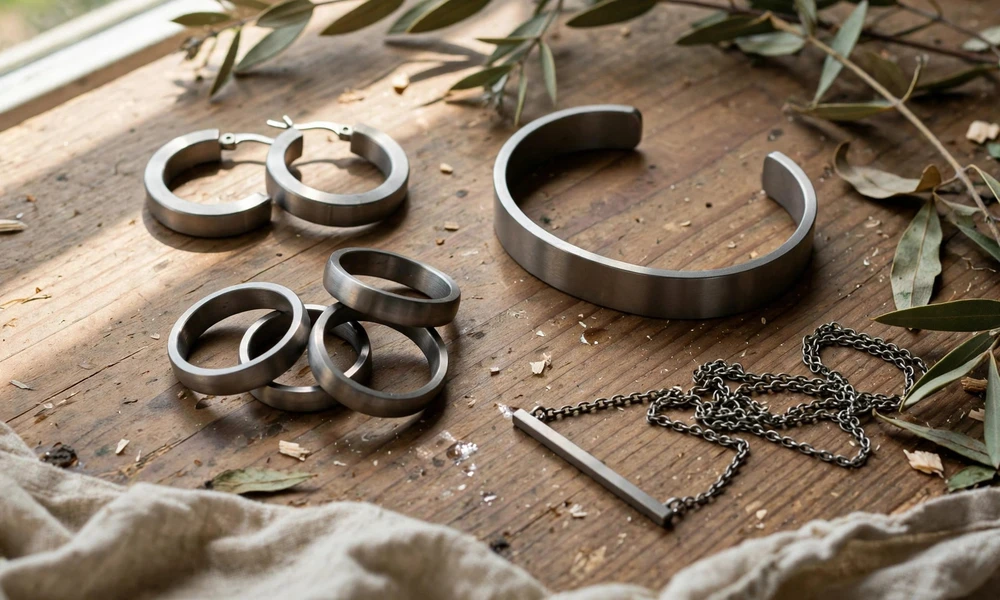
Look next at the finish and the fit. Titanium is often sold in brushed, polished or matte finishes, and each one ages differently. A brushed finish hides small scratches well, while a polished finish looks brighter but shows wear sooner. For rings, the comfort fit matters more than with gold, because a titanium ring cannot be resized later. Measure your finger at the end of the day, when it is warmest, and if you are between sizes, choose the larger one. Our guide to the best titanium nose rings shows the same principle at a smaller scale: the metal’s strength is a virtue only when the fit is right from the start.
Finally, look at how the piece is made. Good titanium jewellery has smooth, rounded edges, a secure setting for any stones, and a clasp or closure that has been tested for daily use. Stones in titanium are usually set in a bezel or a tension setting, because the metal is too hard for the fine prongs used in gold. Ask whether the seller offers a resizing exchange rather than a resize, and whether they will re-polish the piece if it dulls over time.
The 9 best titanium jewellery pieces of 2027
The Classic Titanium Wedding Band
What we like: A simple, comfort-fit band in grade five titanium, light enough to forget, hard enough to resist the scratches of daily work, and naturally hypoallergenic. What to consider: It cannot be resized, so the size must be exact, and it will not take a high polish the way platinum does. Best for: Everyday wear, active jobs, sensitive skin. Material: Grade five titanium, comfort fit. Price range: £80 to £300. Standout feature: Feather-light with a brushed finish that hides wear.
This is the piece that made titanium famous in jewellery. It is the sensible, honest choice for a ring that will be worn every day for decades, and its low price leaves room for a matching band or an engraved inner surface.
The Slim Titanium Tennis Bracelet
What we like: A line of small diamonds or white stones set in slim titanium links, far lighter than a gold tennis bracelet and comfortable enough to wear all day. What to consider: The links are fixed, so a broken link needs a specialist repair, and the clasp must be checked regularly. Best for: Everyday sparkle, occasions, sensitive skin. Material: Commercially pure titanium with cubic zirconia or diamonds. Price range: £120 to £600. Standout feature: A full line of sparkle at a fraction of the weight of gold.
The Titanium Solitaire Ring
What we like: A single stone held in a clean bezel setting, with the cool grey of titanium making a diamond or white sapphire look brighter by contrast. What to consider: Bezel settings suit round and oval stones best, and the ring cannot be resized if your finger changes. Best for: Engagements, everyday wear, minimal style. Material: Grade five titanium, bezel-set stone. Price range: £150 to £800. Standout feature: A modern, low-profile setting that protects the stone.
For anyone who wants a solitaire without the weight or the price of a gold setting, this is the most convincing option. The bezel also makes it one of the most practical rings for daily wear.
The Minimal Titanium Pendant Necklace
What we like: A small disc, bar or geometric pendant on a fine titanium chain, with a matte or brushed finish that suits both casual and smarter outfits. What to consider: Fine titanium chains can kink if stored carelessly, and the pendant’s finish will soften with wear. Best for: Everyday layering, minimal style, gifts. Material: Commercially pure titanium, fine link chain. Price range: £60 to £200. Standout feature: A clean, architectural shape in a metal that never tarnishes.
This is the easiest titanium piece to live with. It goes with almost everything, needs no polishing, and is light enough to layer with a gold or silver chain without feeling heavy.
The Titanium Diamond Stud Earrings
What we like: Small diamond or cubic zirconia studs in titanium settings, with hypoallergenic posts that suit even very reactive ears. What to consider: Titanium posts are slightly thicker than gold ones, so they suit healed piercings best, and the settings are usually simple bezels rather than fine prongs. Best for: Sensitive ears, everyday wear, new piercings that have fully healed. Material: Commercially pure titanium, bezel-set stones. Price range: £40 to £250. Standout feature: Nickel-free posts that rarely cause irritation.
For people who have given up on earrings because every pair irritated them, titanium studs are often the answer. They are the most skin-friendly studs a jeweller can offer.
The Titanium Hoop Earrings
What we like: Lightweight hoops in polished or anodised titanium, large enough to make a statement without pulling on the ear. What to consider: Very large hoops can still catch on clothing, and anodised colour will fade slowly with hard wear. Best for: Everyday statements, sensitive ears, bold minimal style. Material: Commercially pure titanium, anodised or polished. Price range: £50 to £180. Standout feature: Big hoops at a weight that gold could never match.
Hoops are where titanium’s lightness is most obvious. A pair that would be heavy and uncomfortable in gold feels like nothing in titanium, which is why it is the best metal for oversized hoops.
The Titanium Signet Ring
What we like: A flat-topped signet in brushed titanium, with an engraved initial or a plain polished face, in a style that suits both men and women. What to consider: Engraving on titanium is shallow and best done by laser, and the ring cannot be resized. Best for: Personal style, gifts, everyday wear. Material: Grade five titanium, brushed finish. Price range: £70 to £220. Standout feature: A modern take on a classic, with a matte finish that ages well.
The Titanium Chain Necklace
What we like: A solid curb, rope or figaro chain in titanium, with a satisfying weight in the hand but almost none on the neck, and a clasp that holds securely. What to consider: Titanium chains cannot be shortened or repaired by every jeweller, so buy the length you actually want. Best for: Everyday wear, layering, men and women. Material: Grade five titanium, curb or rope link. Price range: £90 to £350. Standout feature: A substantial-looking chain that feels weightless.
A titanium chain is the practical answer to a gold chain that feels too heavy or too precious to wear daily. It looks just as good, costs far less, and survives being worn every day.
The Titanium Cuff Bracelet
What we like: An open cuff in brushed titanium, sometimes anodised in blue or teal, that slips on easily and holds its shape without bending. What to consider: A cuff cannot be adjusted much once made, so the size must suit your wrist, and anodised colour fades with hard wear. Best for: Everyday wear, statement minimalism, gifts. Material: Grade five titanium, open cuff. Price range: £80 to £250. Standout feature: A rigid cuff that keeps its shape for years.
Which titanium piece is right for you
If you have sensitive skin, start with studs or a ring, because those sit closest to the skin for the longest time. Titanium’s nickel-free composition is the reason it is used in medical implants, and that same quality is what makes it so comfortable as jewellery. People who react to gold, silver and even some stainless steels often wear titanium without any trouble at all.
If you work with your hands, a wedding band or a cuff is the natural choice. Titanium’s scratch resistance and lightness mean it will not slow you down or show its age quickly, and it will not bend out of shape the way a soft gold band can. Our roundup of the best platinum jewellery covers the heavier, more traditional alternative, and the comparison is instructive: platinum is denser and more precious, but titanium is lighter, tougher and far cheaper.
If you want colour without plating, look at anodised titanium. The colour is created by an electrical process that thickens the oxide layer on the surface, so it cannot flake off the way plating can, though it will fade slowly with hard wear. Blue, purple and teal are the most reliable colours, and they pair well with the metal’s natural grey.
The caveats that matter
Titanium’s biggest limitation is that it cannot be resized. A gold ring can be cut, stretched and soldered by almost any jeweller. A titanium ring cannot. That means the size must be right when you buy it, and if your finger changes size over the years, the ring will need to be replaced rather than adjusted. Buy from a seller who offers a free size exchange, and measure your finger carefully before ordering.
| Detail | What is known |
|---|---|
| Best grade for rings | Grade five titanium, the strongest and most scratch-resistant jewellery grade |
| Best grade for earrings and pendants | Commercially pure titanium, softer and easier to finish beautifully |
| Skin safety | Naturally nickel-free and hypoallergenic, used in medical implants |
| Weight | About 45 percent lighter than steel and far lighter than gold or platinum |
| Tarnish and corrosion | Resistant to tarnish, sweat and salt water thanks to a protective oxide layer |
| Resizing | Not possible in the usual way; buy the right size or use a free exchange |
| Repairs | Needs a specialist jeweller; not every high street jeweller works with titanium |
| Resale value | Modest; titanium is valued for wear, not as an investment metal |
Repairs are the other practical limitation. Because titanium is so hard, many high street jewellers will not work on it, and a broken chain or a loose stone may need to go back to the maker or to a specialist. Check before you buy whether the seller offers repairs, and keep the receipt and any guarantee safe.
Checklist: buying titanium jewellery honestly
Use these checks before you buy, and again when the piece arrives.
- Check the grade: grade five for rings, commercially pure for earrings and pendants, and a named grade on the listing.
- Check the size: measure your finger at the end of the day, and confirm the seller offers a free size exchange.
- Check the finish: brushed hides scratches, polished looks brighter but shows wear sooner.
- Check the setting: stones should sit in a bezel or tension setting, not fine prongs.
- Check the clasp and closure: test it several times before wearing the piece out.
- Check the guarantee: ask who repairs titanium and whether the seller covers it.
Frequently asked questions
Is titanium jewellery hypoallergenic?
Yes, in almost all cases. Titanium is naturally nickel-free and is the metal used in medical implants for exactly that reason. People who react to gold, silver or stainless steel very often wear titanium without any irritation.
Can a titanium ring be resized?
No, not in the usual way. Titanium is too hard to cut and solder like gold, so a ring that no longer fits needs to be replaced rather than adjusted. Buy the right size first, and choose a seller who offers a free exchange.
Does titanium tarnish?
No. Titanium forms a protective oxide layer that resists tarnish, sweat and salt water. It will not darken or stain the way silver does, and it needs almost no cleaning beyond warm water and mild soap.
Is titanium jewellery durable?
Yes. Grade five titanium is one of the strongest jewellery metals by weight, and it resists scratches far better than gold or silver. It can still be scratched by harder materials such as diamonds, and a brushed finish will show wear over time.
How should I store titanium jewellery?
Store it the same way you would any good jewellery: clean, dry and separate, so pieces do not scratch each other. Our guide to storing jewellery properly explains the simple habits that keep every metal, including titanium, looking its best.
Is titanium jewellery a good investment?
Not as an investment, no. Titanium is valued for how it wears, not for its resale price, which is modest compared with gold or platinum. Buy it because it suits your skin and your life, not because you expect it to hold its value.
The bottom line
The best titanium jewellery in 2027 is not the flashiest or the most expensive. It is the piece that suits your skin, your hands and your daily life: a comfort-fit band for work, a pair of studs for reactive ears, a chain light enough to wear every day. Titanium’s strength is practical rather than precious, and that is exactly why it has earned its place.
Choose the right grade, get the size right before you buy, and buy from a seller who offers an exchange and a repair route. Do that, and a titanium piece will do what it promises: stay light, stay clean, and stay comfortable for years.