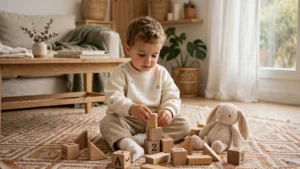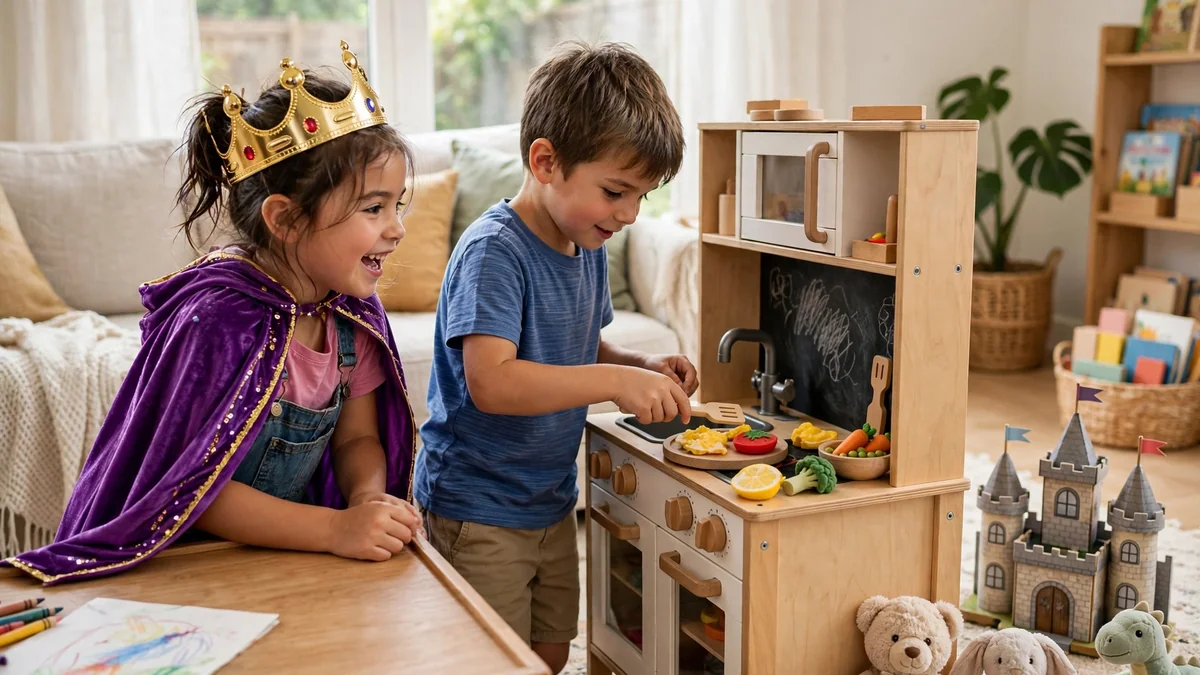

The best toys for imaginative play are the ones that let a child invent the story, not the ones that tell it for them. So which ten should you bring home in 2027? A play kitchen, dressing-up set, building bricks, dolls, animals and a train set, each chosen because it invites hours of make-believe.
Imaginative play is how children practise language, empathy and problem-solving. A cardboard box can do it, yet a well-chosen toy gives the game a stage and a reason to return tomorrow. The ten picks below all do that.
Key takeaways
- Choose open-ended toys with no single right way to play.
- Match the toy to your child’s age, and check the age guidance first.
- Simple, sturdy toys outlast noisy ones and invite more inventing.
- A small set of versatile toys beats a large pile that does one thing.
- Rotate toys in and out of reach to keep favourites feeling fresh.
How to choose a toy for imaginative play
Start with your child’s age and stage. A toddler needs chunky, easy-to-hold pieces, while a four-year-old wants props for a role, such as a shop till or a doctor’s kit.
A six-year-old may prefer a doll’s house or a building set. Check the maker’s age guidance on the box before you buy.
Next, look for open-ended play. A toy that can be a castle one day and a shop the next will be played with far longer than one with a single scripted game. Building bricks, dolls and play food all pass this test, because the child decides what happens next.
Think about the story your child likes to tell. Some love caring for a doll, others love building worlds or dressing up as a hero or a chef. A toy that matches that interest will be reached for daily.
Consider size and storage. A play kitchen needs a corner of its own, while a tea set or a box of figures fits in a basket. Choose toys that fit your home, and that your child can reach and tidy away.
Finally, think about durability. Imaginative play is physical: kitchens get cooked in, dolls get carried everywhere, and train tracks get rebuilt daily.
Wooden toys and well-made plastic ones survive this, and can be handed down. For outdoor adventures, see our guide to the best outdoor toys for kids.
What a Good Imaginative Play Toy Feels Like

A good imaginative play toy feels inviting the moment a child picks it up: the right weight for small hands, smooth to hold, and doing something satisfying, such as a teapot that pours.
It also leaves room for the child. A wooden tea set does not play music or speak; it waits for the child to decide who is coming to tea. The toy supplies the props, and the child supplies the plot, the voices and the ending.
Watch how long a toy holds attention. A good one is still in play after twenty minutes, and the game has changed shape at least once. If it is abandoned after five minutes, it was doing the imagining for the child.
The 10 Best Toys for Imaginative Play in 2027
These ten toys cover the main kinds of make-believe, from cooking and dressing up to building, caring and storytelling. Each earns its place for a clear reason.
1. Melissa & Doug Wooden Chef’s Kitchen
The Melissa & Doug Wooden Chef’s Kitchen is a sturdy wooden kitchen with an oven, hob, sink and shelves. The maker says it suits children from three years, and it is built to survive daily cooking.
It turns an afternoon into a restaurant or a bakery, as children chop play food and serve imaginary guests.
Best for: cooking games, role play and a first play kitchen.
2. LEGO Classic Medium Creative Brick Box
The LEGO Classic Medium Creative Brick Box holds 484 bricks in 35 colours, with windows, wheels and eyes for building. The maker says it suits children from four years.
It is the most open-ended toy on this list: a child can build a castle, a spaceship or a zoo, then take it apart and start again.
Best for: building worlds and endless rebuilding.
3. Le Toy Van Honeybake Tea Set
The Le Toy Van Honeybake Tea Set is a wooden tea set with a teapot, cups, saucers and a tray. The maker says it suits children from two years.
It is the classic tea-party prop, teaching sharing and manners without a lesson, as a child pours for a teddy, a doll or a parent.
Best for: tea parties, sharing and gentle role play.
4. Melissa & Doug Deluxe Dress-Up Trunk
The Melissa & Doug Deluxe Dress-Up Trunk holds costumes including a cape, a crown, a pirate hat and a chef’s apron. The maker says it suits children from three years, and the pieces are easy to put on and take off.
Dressing up is the fastest route into a new character: a cape turns a child into a hero, an apron into a chef.
Best for: dressing up and becoming a new character.
5. Schleich Farm World Barn with Animals
The Schleich Farm World Barn with Animals is a detailed barn with fences, stalls and hand-painted figures. The maker says it suits children from three years, and the figures are sturdy enough for daily play.
It invites farmyard stories: feeding time, a vet visit or a harvest festival. The animals have no batteries, so the child gives them names and personalities.
Best for: animal stories and farmyard role play.
6. Playmobil City Life Dollhouse
The Playmobil City Life Dollhouse is a large doll’s house with rooms, furniture and figures for a whole family. The maker says it suits children from four years, and it can be rebuilt in different layouts.
It is a stage for family life, as children arrange the rooms and move the figures through school runs, birthdays and bedtime.
Best for: family stories and a doll’s house that grows with your child.
7. BRIO World Railway Starter Set
The BRIO World Railway Starter Set is a wooden train set with track, a train, a station and a level crossing. The maker says it suits children from three years.
It is a world in miniature, and the child is in charge: the train carries passengers, stops at the station and crosses the bridge.
Best for: train journeys and building a small world.
8. Baby Annabell Doll
The Baby Annabell doll is a soft-bodied baby doll with realistic features and accessories. The maker says it suits children from three years, and it is made to be cuddled, dressed and carried.
It is the classic caring toy: a child feeds the doll, puts it to bed and takes it on outings. Younger children may prefer one of the best baby toys for little hands.
Best for: caring play, cuddles and looking after a baby.
9. Little Tikes Cozy Coupe
The Little Tikes Cozy Coupe is a ride-on car with a steering wheel, a horn and a handle for parents to push. The maker says it suits children from 18 months to five years.
It turns the garden or the pavement into a road, as a child drives to the shops, visits friends or delivers the post.
Best for: driving games and outdoor adventures.
10. Toniebox Starter Set
The Toniebox Starter Set is a soft, cube-shaped audio player that plays stories and songs when a Tonie figure is placed on top. The maker says it suits children from three years.
It is a storyteller that leaves the pictures to the child. A Tonie figure starts a tale, and the child acts it out with toys or simply listens. For younger storytellers, the best educational toys for 3-year-olds offer a gentler start.
Best for: screen-free stories and listening adventures.
Best Toys for Imaginative Play Compared
| Toy | Kind of play | Age guidance | Why it stands out |
|---|---|---|---|
| Melissa & Doug Wooden Chef’s Kitchen | Cooking and role play | 3 years and over | Sturdy kitchen for daily use |
| LEGO Classic Medium Creative Brick Box | Building and inventing | 4 years and over | Endless combinations from one box |
| Le Toy Van Honeybake Tea Set | Tea parties and sharing | 2 years and over | Classic set for gentle play |
| Melissa & Doug Deluxe Dress-Up Trunk | Dressing up and characters | 3 years and over | Quick changes, many roles |
| Schleich Farm World Barn with Animals | Animal and farm stories | 3 years and over | Detailed figures with no batteries |
| Playmobil City Life Dollhouse | Family and home stories | 4 years and over | Full house, rooms and figures |
| BRIO World Railway Starter Set | Trains and small worlds | 3 years and over | Track rebuilds into new layouts |
| Baby Annabell Doll | Caring and cuddles | 3 years and over | Soft doll for feeding, bedtime |
| Little Tikes Cozy Coupe | Driving and outdoor play | 18 months to 5 years | Classic ride-on for journeys |
| Toniebox Starter Set | Stories and listening | 3 years and over | Screen-free tales spark imagining |
Imaginative Play Checklist
Use this checklist before you buy, and again when you tidy the toy box. It keeps the collection small, useful and loved.
- Check the age guidance, and avoid small parts for children under three.
- Choose open-ended toys that can be played with in more than one way.
- Pick sturdy materials, such as wood, that survive daily play.
- Match the toy to your child’s current interests, not to a trend.
- Leave space for the child’s ideas: the toy should not do all the talking.
- Store toys where your child can reach them and tidy them away alone.
- Rotate toys every few weeks so familiar favourites feel new again.
Frequently Asked Questions
What age is best for imaginative play toys?
Imaginative play begins in toddlerhood and grows through the early school years. Toddlers enjoy simple props, such as a tea set, while children from three to seven invent longer stories with kitchens, dolls and building sets. The maker’s age guidance is the best starting point.
Are wooden toys better than plastic ones for imaginative play?
Wooden toys are often simpler and sturdier, which suits open-ended play, yet well-made plastic toys can be just as good. What matters is whether the toy leaves room for the child to invent.
How many imaginative play toys does a child need?
A small set is usually enough. A kitchen or a tea set, a dressing-up box, building bricks and a doll or animal set cover most kinds of make-believe. Too many toys can overwhelm a child, while a few well-chosen ones are played with daily.
Do screen-free toys really help imagination?
Screen-free toys ask the child to supply the pictures, voices and plot, which is the heart of imaginative play. A toy that talks and sings can still be fun, yet it does some of the inventing for the child. The best imaginative toys are often the quietest ones.
How can I encourage my child to play imaginatively?
Join in for a few minutes, then step back and let the child lead. Offer simple props, such as a blanket for a den or a box for a shop, and accept the story as your child tells it. Regular, unhurried playtime matters more than any toy.
The right toy need not be the newest or the loudest. It needs to be the one your child reaches for, day after day, to tell a story only they could invent. Choose one that fits their age, their interests and your home, and the play will take care of itself.
Please check the maker’s age guidance and safety warnings before giving any toy to a child, and supervise play with small parts. Toys with small pieces are not suitable for children under three. Keep the instructions and the maker’s contact details with the toy box.