A fennel perfume is a perfume that lists fennel among its notes, and that simple definition hides a surprising amount of confusion. Fennel smells like liquorice without being liquorice, and like aniseed without being aniseed.
The confusion starts in the kitchen. Fennel is a vegetable, a seed and a spice all at once, and the oil a perfumer uses comes from the seeds, not from the bulb you slice into a salad. This guide explains what fennel actually is and what it does inside a bottle.
Key takeaways
- A fennel perfume lists fennel as a named note, usually in the top or the heart, where it adds a green, sweet and faintly camphorous lift.
- The oil comes from fennel seeds, not the bulb, and sweet fennel oil is the variety perfumers use most often.
- Most of fennel oil is a single molecule, trans-anethole, which it shares with aniseed and star anise.
- Fennel is a supporting note far more often than a leading one, because it is very intense in small doses.
- No fennel perfume smells exactly like the kitchen herb.
What a fennel perfume actually is
A fennel perfume is a perfume in which fennel is a named note, and that is the whole definition. It does not have to smell of fennel above all else, and most of the time it does not. The note usually works in the background, lifting citrus or softening florals.
That is what separates a fennel perfume from a fennel-scented product. A kitchen spray tries to smell of fennel and nothing else. A perfume uses the note as one colour in a larger picture, and fennel is a bridge: green enough to sit with the herbs and sweet enough to sit with the florals.
How to read a fennel note list
Read the position first, because position tells you how long the fennel will last. A fennel top note will be obvious for the first twenty minutes and then mostly gone. A fennel heart note will stay with you for hours.
Read the neighbours next. Beside bergamot and lemon it reads as fresh and herbal. Beside rose and violet leaf it reads as powdery and vintage. Beside pepper and tobacco it reads as dark and spicy.
Read the concentration last, because it tells you how loud the fennel will be. In an eau de toilette the note is bright and fleeting, and in an eau de parfum it is warmer and longer-lasting. Our guide to what a cardamom perfume is uses the same reading method.
Nine things worth knowing about fennel in perfume
Fennel is a tall herb, and the oil comes from its seeds, not its bulb
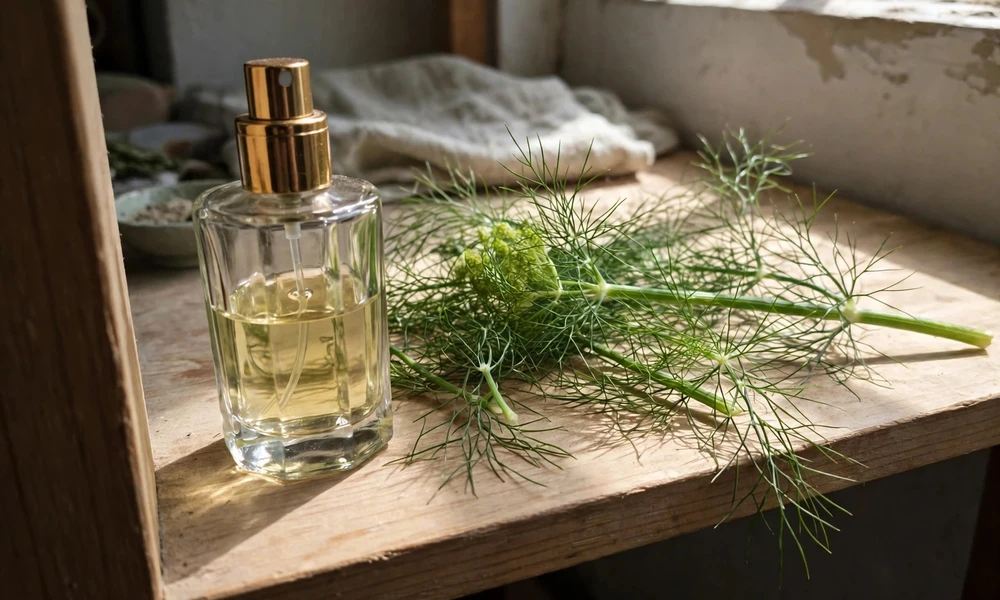
Fennel is a tall, feathery herb in the carrot family, and it grows wild around the Mediterranean as well as in gardens all over the world. The oil comes from the seeds, small green-brown ridged things that are left behind when the yellow umbrella-like flowers fade, and those seeds are steam-distilled into an oil far more intense than the plant.
What It Shows: The note is a seed oil, not a vegetable, which is why it smells dry and concentrated rather than watery and green. What to Consider: A perfume that promises fresh fennel bulb will still smell of the seed oil, because that is the only fennel material perfumers actually use. Best For: Anyone who wants to understand why a green note can smell so dry. Material: Steam-distilled oil from fennel seeds. Price Range: The raw oil is inexpensive, which is why fennel appears in affordable bottles as well as niche ones. Standout Feature: The oil is far more intense than the plant, and a single drop can dominate a blend.
Sweet fennel and bitter fennel smell nothing alike, and perfumers choose between them
Fennel produces two kinds of oil, and they are different materials with different characters. Sweet fennel oil is the one most perfumers use, and it smells green, powdery and anise-like, with warm, woody undertones.
What It Shows: The variety matters as much as the note itself, and two fennel perfumes can smell different because they use different oils. What to Consider: A bottle that smells medicinal is probably leaning on bitter fennel, while a bottle that smells powdery is almost certainly using the sweet variety. Best For: Anyone choosing between a fresh fennel and a sharp one. Material: Sweet fennel oil from Foeniculum vulgare, or bitter fennel oil from Foeniculum officinale. Price Range: Both oils are affordable, so the choice is about character, not cost. Standout Feature: The same note name can hide two completely different smells.
A single sweet molecule carries most of fennel’s smell
Fennel oil is a mixture, and most of it is one molecule called trans-anethole, about sixty percent of the essential oil. The remaining forty percent is what makes fennel different: fenchone, which adds the camphor edge, and a handful of green, woody compounds that aniseed and star anise do not have.
What It Shows: The shared molecule explains the family resemblance, and the remaining compounds explain why fennel is greener and drier than its cousins. What to Consider: A synthetic anethole can imitate the sweetness, but it cannot imitate the green, woody character that comes from the whole oil. Best For: Anyone who keeps mistaking fennel for aniseed. Material: Trans-anethole, fenchone and green woody compounds. Price Range: Natural fennel oil is inexpensive, so a real oil is no guarantee of a luxury price. Standout Feature: One molecule does most of the work, and the rest of the oil does the rest.
Fennel is what makes absinthe smell like absinthe
Absinthe, the green French spirit banned for decades and then unbanned, owes its character to a trio of herbs: wormwood, anise and fennel. The fennel is the quietest of the three, but it gives absinthe its green, herbal freshness, and without it the drink would smell only of wormwood bitterness and anise sweetness.
What It Shows: Fennel has a long history as a green, herbal material, and its role in absinthe is the same role it plays in perfume. What to Consider: A perfume that promises absinthe will usually contain fennel even if the note list does not say so, because the accord is not complete without it. Best For: Anyone who loves green, herbal, slightly dangerous-smelling scents. Material: Fennel with wormwood and anise in the classic absinthe trio. Price Range: Absinthe accords appear at every price, from affordable masculines to niche bottles. Standout Feature: The note that makes absinthe smell green rather than merely sweet.
The seeds were chewed as a breath freshener for centuries before they were distilled
Long before anyone distilled fennel oil, people chewed the seeds. In India and Pakistan they are still offered after a meal as a mouth freshener. Perfumers inherited that association, and it is one reason fennel reads as clean and fresh even when it sits in a dark, heavy composition.
What It Shows: The note carries a cultural memory of freshness, and that memory shapes how we perceive it in a bottle. What to Consider: The freshness is real, but it is a herbal freshness, not a soapy one, and it will not make a heavy perfume smell light. Best For: Anyone who wants a fresh note that is not citrus. Material: Whole fennel seeds, chewed fresh or distilled into oil. Price Range: The seeds cost almost nothing, which is why the note appears in bottles at every price. Standout Feature: A mouth freshener that became a perfume material without ever changing its character.
Fennel lifts rose in a way few other notes can
A small dose of fennel oil beside a rose accord adds a green, powdery lift that makes the rose smell lighter and more modern. The perfumer Andy Tauer has described exactly this use, saying that fennel adds a distinctive green vintage powdery effect to a rose accord, and that it works wonderfully in combination with violet leaf and rose.
What It Shows: Fennel is a tool for fixing florals, not just a scent in its own right. What to Consider: A rose perfume that smells powdery and green is very likely using fennel, even if the note list hides it behind a vaguer term. Best For: Anyone who loves rose but finds most rose perfumes too sweet. Material: Sweet fennel oil with rose absolute and violet leaf. Price Range: Rose and fennel appear together at every price, from affordable florals to niche bottles. Standout Feature: The note that makes a rose smell vintage without making it smell old.
Fennel sits in the top and the heart, and it fades faster than it promises
Fennel oil is light and volatile, and it evaporates faster than the woods and musks underneath it. In the opening minutes it is bright and green, and after an hour it has softened into something powdery and faintly woody. After three hours it is mostly gone, and what remains is the drydown underneath it.
What It Shows: The note is a visitor, not a resident, and it leaves the composition long before the base notes do. What to Consider: A bottle that promises all-day fennel is promising something the material cannot deliver, and the drydown will always belong to the woods and musks. Best For: Anyone who judges a perfume on the first hour rather than the last. Material: Volatile fennel oil over longer-lasting woods and musks. Price Range: The fading is the same at every price, because it is a property of the oil itself. Standout Feature: A note that arrives loudly and leaves quietly.
Fennel turns green and powdery as it dries down
Fresh from the bottle it is bright and green, with a cool herbal edge. As it dries down it softens, the greenness recedes, and a powdery, faintly woody sweetness takes its place.
What It Shows: The note has two faces, green and powdery, and the second face is the one that lasts. What to Consider: A fennel perfume that smells only green after an hour is using a different material, because real fennel always turns powdery as it settles. Best For: Anyone who loves powdery vintage scents but wants a green opening. Material: Sweet fennel oil, which turns powdery as its volatile top notes evaporate. Price Range: The powdery drydown appears at every price, because it is a property of the oil. Standout Feature: A green note that ends up smelling powdery, which is the opposite of what most green notes do.
Fennel and aniseed share a molecule, not a plant
Fennel and aniseed come from different plants, but they share a molecule. Aniseed is warmer and sweeter, and it is the note that makes a perfume smell like a sweet shop. Fennel is greener and drier, with a camphor edge and a woody undertone, and it is the note that makes a perfume smell like a herb garden.
What It Shows: The family resemblance is real, but the differences are what matter, and fennel is the greener, drier cousin. What to Consider: A bottle that lists aniseed but smells green is probably using fennel as well, because aniseed alone cannot produce that greenness. Best For: Anyone who keeps buying aniseed perfumes and wondering why they smell too sweet. Material: Fennel oil beside aniseed oil, both built on trans-anethole. Price Range: Both notes appear at every price, so the choice is about character, not cost. Standout Feature: Two notes that share a molecule and smell like different plants.
How fennel behaves on skin
Fennel behaves differently on skin than it does on paper, and the difference is worth knowing before you buy. On a paper strip the note stays bright and green for longer, because there is no warmth to push it through its changes. On skin it moves faster: the green opening lasts twenty minutes, the powdery heart lasts two hours, and after that the base notes take over.
Skin chemistry changes the note too: on warm skin the sweetness comes forward, and on cool skin the greenness stays longer. Always test on skin, never on paper alone, and give it a full hour before you decide. Our guide to what a saffron perfume is makes a similar point about spice notes and skin.
The caveats that matter
Fennel is a safe note for most people, but it is a polarising one. The aniseed character divides opinion: some find it fresh and green, others medicinal, and there is very little middle ground. If you have never worn an anisic scent before, sample it before you buy a full bottle.
| Detail | What is known |
|---|---|
| What fennel is | A seed oil from Foeniculum vulgare, not the bulb |
| What it smells like | Green, sweet and faintly camphorous |
| Where it sits | Usually the top or the heart, lifting citrus, herbs and florals |
| Sweet vs bitter | Sweet fennel oil is greener; bitter fennel oil is harsher and more camphorous |
| Key molecule | Trans-anethole, about sixty percent of the oil |
| How it changes | Bright and green at first, then powdery as it dries down |
| Who should sample first | Anyone who dislikes liquorice or aniseed |
| What it does not do | It does not anchor a perfume like woods do, and it does not last all day |
There is also a practical caveat about shortcuts. Because pure anethole is cheap, some perfumes that smell anisic contain no fennel oil at all, only the synthetic molecule. It delivers the sweetness without the green, woody complexity, so a bottle that lists fennel but smells only of sweet liquorice is probably taking that shortcut. Our guide to what a star anise perfume is carries a similar warning.
Checklist: reading a fennel perfume honestly
Use these checks before you buy, and again after a full day of wearing.
- Check the note list: fennel should be named, not just implied by an aniseed smell.
- Check the position: a top note fades fast, a heart note stays with you for hours.
- Check the neighbours: citrus and herbs make it fresh, rose and violet make it powdery, tobacco makes it dark.
- Test on skin, not paper: the green opening and the powdery drydown are two different scents.
- Wait an hour: judge the drydown, because the opening is the loudest and least representative part.
- Trust your nose: if the aniseed character bothers you in the first hour, it will not grow on you.
Frequently asked questions
Does a fennel perfume make me smell like liquorice?
Not quite. Fennel shares a molecule with liquorice, so the sweetness is familiar, but fennel is greener, drier and more herbal, with a camphor edge liquorice never has. If you dislike liquorice, sample first.
Is fennel the same as aniseed?
No. They are different plants with a shared molecule, trans-anethole, which is why they smell similar. Fennel is greener and woodier, aniseed is warmer and sweeter, and perfumers use them for different jobs.
Can I wear a fennel perfume in summer?
Yes, if you choose the right one. Citrus and marine fennel perfumes are built for heat, with fresh notes that keep the fennel from turning sharp. The heavier tobacco and leather bottles are better saved for cooler weather.
Why does fennel smell so strong in the bottle and so soft on skin?
Fennel oil is very intense in the bottle, and the first spray is always the loudest. On skin it settles within twenty minutes and the powdery drydown takes over. Judge it after an hour.
Will fennel make my perfume last all day?
Not on its own. Fennel is a top and heart note, so it fades within a few hours. What it does is make the opening memorable, and the woods and musks underneath are what carry the scent through the day.
What base works best under a fennel scent?
A plain unscented moisturiser is the safest base, because it holds the scent without adding its own character. A light musk or a soft vanilla can work too, but avoid layering another strong green or anisic scent underneath, or the fennel will turn sharp.
The bottom line
A fennel perfume lists fennel as a named note, and the note is a green, sweet and faintly camphorous seed oil that usually works in the top or the heart. It lifts citrus, softens rose and cools tobacco, in doses so small you will often smell its effect without smelling the note itself.
Sample it, wear it for a full day, and judge the drydown rather than the opening. Start with a bottle where the fennel is an accent, and if the green, powdery character suits you, move on to a fennel-forward bottle.