
Star anise is the spice that perfumers reach for when a scent needs sweetness without sugar.
That range is what makes star anise worth understanding. It is a single material, the dried fruit of one tree, yet it behaves like two different notes depending on what surrounds it.
Below are nine things worth knowing about star anise in perfume, from the molecule that gives it its smell to the flu drug made from the same fruit, and from the difference between star anise and aniseed to the reason it divides wearers more than most spice notes.
Key takeaways
- Star anise is the dried fruit of Illicium verum, a tree from southern China and Vietnam, and it is not related to aniseed.
- Most of its smell comes from one molecule, trans-anethole, which is why the note smells so direct and recognisable.
- It sits in the opening of most perfumes, but its sweetness can linger into the base long after the spice fades.
- The same fruit supplies the shikimic acid used to make the flu drug Tamiflu.
- No star anise perfume suits everyone, because the licorice character is the first thing people notice and the first thing that puts some wearers off, so always test on skin first.
What a star anise perfume actually is
A star anise perfume is a perfume in which star anise is a named note, usually in the opening, where its sweet, cool spice is most noticeable. It is not a family of perfumes. Star anise appears in gourmands, fougères, orientals and florals, and the family tells you more about the bottle than the note does. The note is the same. The perfume is not.
Vanilla is warm and soft. Tonka is warm and sweet. Star anise is sweet and sharp at the same time, and that sharpness is the giveaway.
The note is also one of the most honest in perfumery. Our guide to what a cardamom perfume is covers a spice that works in a similar way, cool on the surface and warm underneath, and the two are often confused on a first sniff.
How to read a star anise note list
Look first at the position. Star anise appears in the top of a perfume more often than anywhere else, in roughly six out of ten cases, because its brightness suits an opening. A top-note star anise will be obvious in the first spray and mostly gone within the hour. A heart-note star anise arrives later, usually wrapped in vanilla or amber, and stays longer.
Look next at the neighbours. Star anise beside vanilla, tonka and praline means a sweet perfume. Beside lavender, citrus and cedarwood it means a dry perfume. Beside tobacco, leather and incense it means a dark perfume. Beside rose and orange blossom it means a floral with a spicy lift.
Finally, look at what is not listed. A coriander perfume guide is a useful comparison here, because coriander is another spice that often works unnamed inside a citrus opening.
Nine things worth knowing about star anise in perfume
Star anise is the fruit of a Chinese evergreen, and it is no relation to aniseed
Star anise is the dried fruit of Illicium verum, an evergreen tree native to southern China and Vietnam.
What It Shows: A note list that says star anise means the fruit, not the herb, and the two materials are not interchangeable in a formula.
What to Consider: A perfume that lists aniseed rather than star anise will smell warmer and softer, with less of the cool sharpness.
Best For: Telling the two anise materials apart before you buy.
Material: Star anise oil, steam-distilled from the dried fruit of Illicium verum.
Price Range: Star anise oil is inexpensive for a natural material, which is why it appears at every price point.
Standout Feature: Two unrelated plants, one shared molecule, and two different smells.
Most of star anise oil is one molecule, trans-anethole
Trans-anethole makes up roughly eighty to ninety percent of star anise essential oil, which is an unusually high share for a natural material.
What It Shows: The cleanliness of the note is not an accident. A single molecule dominates the oil, so the smell has a single, clear character.
What to Consider: Because the note is so direct, a little goes a long way, and a heavy dose can smell medicinal rather than spicy.
Best For: Understanding why star anise is instantly recognisable on a blotter.
Material: Trans-anethole, the main constituent of star anise oil.
Price Range: Synthetic anethole is cheap, which is why many affordable perfumes use it instead of the natural oil.
Standout Feature: One molecule, eighty percent of the oil, and the whole character of the note.
The same fruit supplies the raw material for the flu drug Tamiflu
Star anise is the main commercial source of shikimic acid, the starting material for oseltamivir, sold as Tamiflu.
What It Shows: Star anise is not a minor crop. It is a material with uses far beyond perfumery, and its price can move for reasons that have nothing to do with perfume.
What to Consider: A shortage driven by medicine can push perfumers towards synthetic anethole, which smells close but not identical.
Best For: Understanding why a natural star anise note can vary from year to year.
Material: Shikimic acid, extracted from the same dried fruit as the perfume oil.
Price Range: The fruit itself is a commodity, and its price moves with harvests and drug demand.
Standout Feature: One fruit, two industries, and a price that medicine can move.
The fruit is picked green and dried in the sun until it turns russet brown
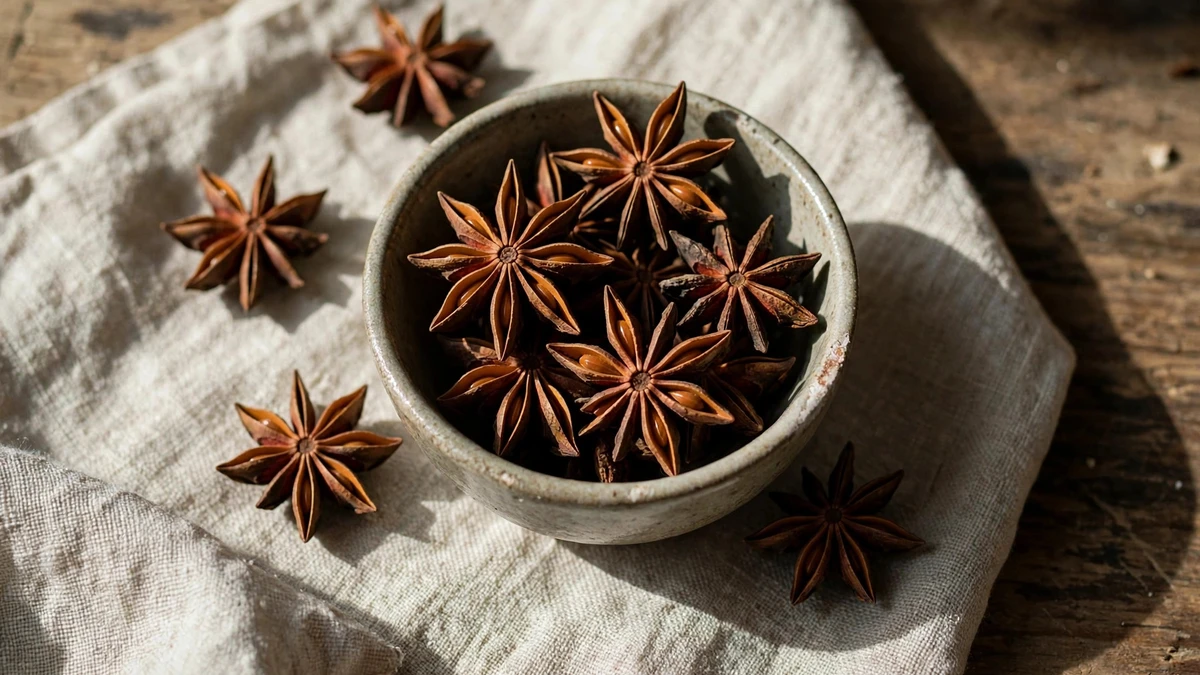
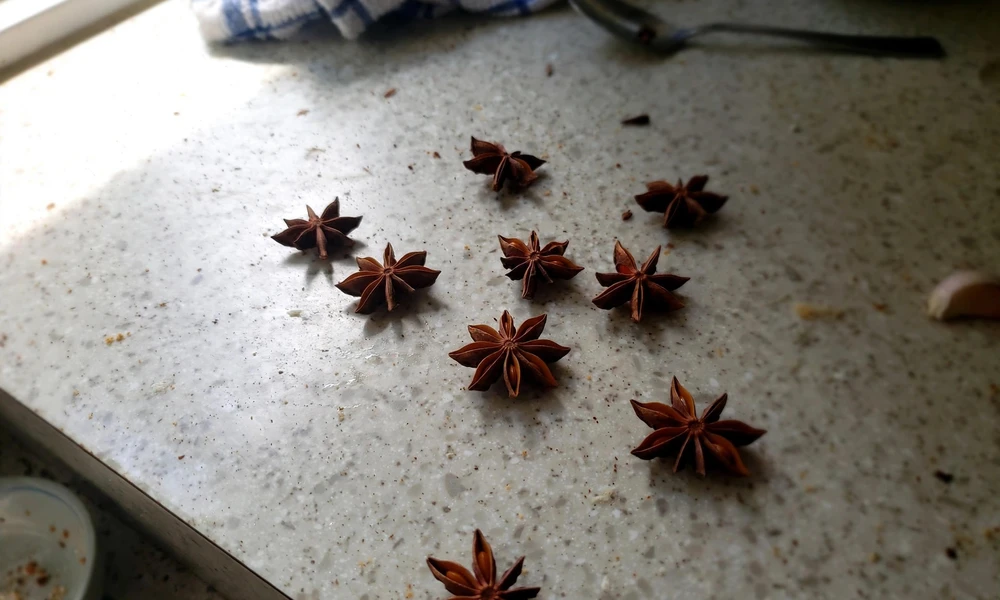
Star anise is harvested before it ripens, while the fruit is still green and soft, and then dried in the sun until it hardens and turns a deep russet brown.
What It Shows: The star shape is not decoration. It is the fruit itself, dried whole, and its colour tells you how it was handled.
What to Consider: The oil is distilled from the dried fruit, not the fresh one, so the drying step is part of the smell.
Best For: Recognising good star anise, whole or as an oil, by its colour and shape.
Material: Whole dried star anise fruit, sun-dried from green to russet brown.
Price Range: Whole stars are cheap and widely sold as a spice, which makes them easy to smell before buying a perfume.
Standout Feature: Green to russet in the sun, and the drying is part of the scent.
Each star has eight points, and each point holds a single seed
A star anise fruit is a star of usually eight follicles arranged around a central stalk, and each follicle holds one seed.
What It Shows: The name is literal. The star is the fruit, and the count of its points is part of how it is graded.
What to Consider: Broken stars and powder are cheaper but harder to judge, so whole stars are the better reference.
Best For: Knowing what to look for when you buy the spice to train your nose.
Material: The whole dried fruit, eight follicles around a central stem.
Price Range: Whole stars cost little, and a small bag is enough to learn the smell.
Standout Feature: Eight points, eight seeds, and the oil lives in the walls, not the seeds.
Star anise smells cooler and sharper than green anise, which is warmer and softer
Star anise smells cooler, sharper and more peppery, like licorice kept in a cold room.
What It Shows: Two materials that share a molecule can still smell different, because the rest of the oil matters as much as the main note.
What to Consider: If a perfume smells warm and biscuity, it is probably aniseed. If it smells cool and sharp, it is probably star anise.
Best For: Telling the two apart on a blotter without a note list.
Material: Star anise oil, dominated by trans-anethole with a peppery edge.
Price Range: Both oils are inexpensive, so the choice is about smell, not cost.
Standout Feature: Same family smell, opposite temperatures, and the edge gives it away.
In a fougère it turns dry and herbal, and in a gourmand it turns candied and sweet
Star anise has two opposite careers in perfumery.
What It Shows: A note is not a smell on its own. It is a smell in context, and the same material can play two roles.
What to Consider: Do not judge star anise from one perfume. Try one dry and one sweet version before deciding whether you like the note.
Best For: Understanding why two star anise perfumes can smell nothing alike.
Material: Star anise oil, used in both fougères and gourmands at very different doses.
Price Range: Both styles appear at every price point, from drugstore to niche.
Standout Feature: One material, two opposite perfumes, and the neighbours choose.
Star anise opens a perfume and then hides in the base as sweetness
Star anise is usually listed as a top note, and it behaves like one in the first minutes, bright, spicy and obvious.
What It Shows: A top note can leave a trace. The spice fades, but the sweetness it added to the base does not.
What to Consider: Judge the drydown, not the opening. The perfume you live with is the base, and star anise shapes it quietly.
Best For: Understanding why a star anise perfume stays sweet after the spice fades.
Material: Trans-anethole in the opening, with the base notes carrying the sweetness forward.
Price Range: The effect is the same at every price, because it comes from the chemistry, not the brand.
Standout Feature: The spice leaves early, and its sweetness stays behind.
Star anise sweetens vanilla and tonka, and it darkens tobacco
Star anise has two favourite partnerships. With tobacco it does the opposite, pulling the leaf darker and drier, and giving a sweet tobacco a spicy edge.
What It Shows: Star anise is a modifier as much as a note. It changes what it touches, in either direction.
What to Consider: A star anise and vanilla perfume will smell sweeter than its vanilla alone, and a star anise and tobacco perfume will smell darker than its tobacco alone.
Best For: Predicting a perfume from its note list before you spray it.
Material: Star anise oil paired with vanilla, tonka or tobacco leaf.
Price Range: Both partnerships appear in affordable and niche bottles alike.
Standout Feature: One note that sweetens vanilla and darkens tobacco.
How star anise behaves on skin
On skin, star anise is at its brightest in the first fifteen minutes, when the trans-anethole is at its strongest and the cool, peppery edge is most obvious.
Warm skin speeds the process up. On cool skin the opening lasts longer and stays drier, which is why the same bottle often smells better in winter.
Layering changes it too. Sprayed over a plain musk or a vanilla body lotion, star anise lasts longer, because the base gives it something to hold onto. A cumin perfume behaves in a similar way, fading fast on its own and lasting longer over a warm base, which is why the two spices are often compared by people learning to read note lists.
The caveats that matter
Star anise is not a subtle note, and it is not one to buy blind. The licorice character is the first thing most people notice, and it is the first thing that puts some wearers off. If you dislike licorice sweets, aniseed biscuits, pastis or cough syrup, a star anise perfume will probably not change your mind, because the molecule behind all of those smells is the same one in the bottle.
| Detail | What is known |
|---|---|
| What star anise is | The dried fruit of Illicium verum, an evergreen tree from southern China and Vietnam |
| Where it sits | Usually a top note, strongest in the first 15 to 30 minutes |
| What makes it smell of licorice | Trans-anethole, which makes up most of the essential oil |
| Two opposite styles | Dry and herbal in fougères, candied and sweet in gourmands |
| Best season | Autumn and winter, when cool air keeps the sweetness in check |
| Who should patch-test first | Sensitive skin, or anyone who has reacted to a spicy perfume |
| What to avoid | Judging it by the opening alone, or buying a full bottle untested |
| What star anise does not do | It does not last all day on its own — the base carries the longevity |
If you are pregnant, breastfeeding, or using prescription skincare, check with your clinician before wearing a heavily spiced perfume on skin, especially at high strength. That is not a formality. Strong spice oils can upset sensitive skin, so a quick check first saves trouble later.
Checklist: reading a star anise perfume honestly
Use these checks before you buy, and again after a full day of wear.
- Check the position: star anise in the top means a bright opening that fades, in the heart means a longer, warmer presence.
- Check the neighbours: vanilla and tonka mean sweet, lavender and woods mean dry, tobacco and leather mean dark.
- Smell the spice first: buy a few whole stars from a grocer and learn the smell before you shop for a bottle.
- Always try it on your wrist first: skin warms the licorice, and the opening is the sweetest part of the wear.
- Give it sixty minutes: the spice calms fast, and the drydown is what you will live with.
- Check for synthetic anethole: a very cheap star anise perfume may use the synthetic molecule, which smells close but flatter.
Frequently asked questions
Will a star anise perfume make me smell like cough syrup?
It can, if the dose is heavy and the base is thin. The molecule behind star anise is the same one that flavours many cough syrups, so a strong, simple star anise can smell medicinal. A well-composed perfume avoids this by wrapping the note in vanilla, woods or amber.
Do star anise and aniseed come from the same plant?
No. Star anise is the fruit of Illicium verum, a tree. Aniseed is the seed of Pimpinella anisum, a herb in the parsley family. They share the molecule trans-anethole, which is why they smell related, but star anise is cooler and sharper, and aniseed is warmer and softer. A note list that says star anise means the fruit.
How do I know if the star anise in a bottle is real or synthetic?
You usually cannot tell from the note list, because brands rarely say. The practical test is the smell: natural star anise oil has a slight woody warmth and variation, while synthetic anethole smells cleaner, flatter and more one-dimensional. The difference is subtle, and for most wearers it does not matter. Price is a weak guide, because both are cheap.
Should I buy a star anise bottle without smelling it first?
Usually not. The licorice character divides wearers, and the note changes a lot between the opening and the drydown. Buy a sample or a small decant first, wear it for a full day, and only then commit to a full bottle.
What should go under a star anise perfume to hold it in place?
Spray it over a plain musk, a vanilla body lotion or an unscented moisturiser. A warm, slightly sweet base gives the star anise something to hold onto, and it can add hours to the wear. Spraying it over citrus or a fresh scent does the opposite, because there is nothing warm for the note to grip.
Star anise or licorice — which one am I actually smelling?
They are closely related but not the same. Licorice as a note usually means a sweet, dark, slightly salty extract, often built as an accord. Star anise is a single spice with a cool, peppery edge. A perfume can list both, and when it does, the star anise supplies the brightness and the licorice supplies the depth. If a bottle smells only of sweet licorice, the accord is doing the work, not the spice.
The bottom line
A star anise perfume is a perfume built around one of the most direct notes in perfumery. It smells of sweet licorice with a cool, peppery edge, it sits in the opening and fades within the hour, and its sweetness lingers in the base long after the spice is gone.
Learn the smell first, from a few whole stars bought at a grocer, then try one dry version and one sweet version on skin, in the season you will actually wear them.