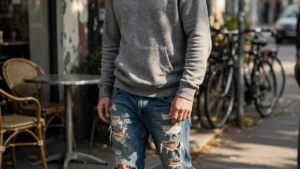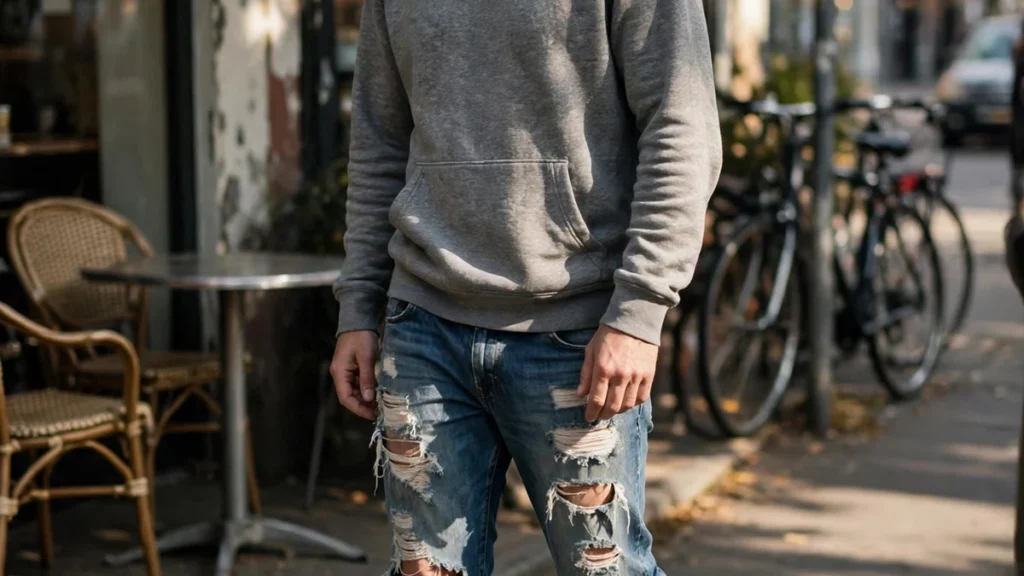
Ripped jeans are simple to buy and surprisingly hard to style well. The pair itself does half the work, but the rest of the outfit decides whether the rips look deliberate or accidental. A plain tee and clean trainers make the tears look like a choice.
The good news is that styling ripped jeans is mostly about restraint. The denim already has visual interest, so everything else should be simpler than usual. Keep one strong element at a time: the rips, or the jacket, or the shoes.
This guide walks through nine steps, from deciding where the tear sits to caring for the pair after you have worn it. Each step is practical, and each one is written for men who want to wear ripped jeans in real life, not just on a photo shoot.
Key takeaways
- The rips are the loudest part of the outfit, so keep the top, the shoes, and the accessories quieter than usual.
- Knee rips are the easiest to wear, and a straight leg keeps the tears sitting flat through the day.
- A dark wash and a leather jacket make ripped jeans work for evenings, while a pale wash and trainers keep them for weekends.
- Fit the pair over the shoes you wear most, and check how the rips look when you sit down, not just when you stand.
- No styling trick makes ripped jeans right for a formal office or a wedding, and a tear that keeps growing is a sign to retire the pair.
Why ripped jeans work for men
Ripped jeans work because they break the flat surface of denim. A plain pair of jeans can look safe and slightly dull, especially in a dark wash. A knee rip adds a point of interest without changing the colour, the silhouette, or the fit. That small disruption is enough to make an ordinary outfit look considered, which is why the style has lasted far longer than most trends.
They also work because they suit the way men actually dress. Most men build outfits from simple pieces: a tee, a shirt, a jacket, jeans, and one pair of shoes they trust. Ripped jeans slot into that formula without demanding anything new.
How to choose the right pair before you style it
Start with the denim, not the rips. Pick the pair up and feel the fabric. It should have weight to it, and the tear should feel finished rather than just slashed. Look at the back of the knee: if threads still cross the gap, the hole will hold its shape.

Next, check the fit with the shoes you actually wear. Put the pair on, sit down, stand up, and walk to the mirror. The knee rips should sit on your knees, not halfway down your shin. The leg should not pull open at the tear when you sit. If it does, the fit is too tight for the rips, and you need a straighter leg or more stretch. Our guide to styling straight-leg jeans for men covers the same fitting checks without the tears, if you want to compare the two shapes side by side.
Finally, choose the wash with your week in mind. A dark wash is the most versatile, because it works with boots and a jacket for evenings. A mid-blue wash is the everyday default. A pale wash is a summer option that shows wear faster.
How to style ripped jeans for men: 9 steps
Pick the tear placement first, then worry about the wash
What to do: Decide on knee rips first, because they are the easiest to wear and the hardest to get wrong. Try the pair on and look at where the holes land. What to avoid: Do not buy rips at the thigh or the back pocket for a first pair, because they are much harder to style. Best for: A first pair and daily wear. Time needed: Ten minutes in front of the fitting-room mirror. Standout tip: Bend your knee in the mirror; the rip should open a little and close again, not gape.
The placement of the tear decides everything else: a knee rip is a detail, a thigh rip is a statement, and most men want the detail.
Fit the pair over the shoes you wear most days
What to do: Wear the pair with your usual boots or trainers when you try it on, and check the hem length against them. What to avoid: Do not judge the length barefoot, because the hem will sit differently over a shoe. Best for: Getting the proportions right on the first try. Time needed: Five minutes. Standout tip: The hem should just touch the top of the shoe, with one small break at the front.
Shoes change the whole shape of a jean, so bring the ones you wear most and buy the length that works with your real life.
Balance torn denim with a plain crew-neck tee
What to do: Wear a plain white, black, or grey crew-neck tee, tucked in loosely or left out, with the rips as the only detail. What to avoid: Do not pair ripped jeans with a loud graphic tee, because the two details fight each other. Best for: Weekends, daytime, and a first outing in the pair. Time needed: No extra time at all. Standout tip: A slightly heavier tee, in a cotton that holds its shape, looks better than a thin, floppy one.
A plain tee is the natural partner for ripped jeans: it lets the denim carry the interest and keeps the outfit calm.
Keep the silhouette simple: straight leg, no extra hardware
What to do: Choose a straight leg and skip chains, oversized buckles, and heavy embellishment, so the rips stay the only feature. What to avoid: Do not add a wide belt with a large buckle, because it competes with the tears for attention. Best for: Men who want the look to feel grown-up rather than costumed. Time needed: No extra time at all. Standout tip: A slim, plain leather belt in black or brown is all the waist needs.
Every extra detail is a detail too many: the tears already make the outfit interesting, and hardware, logos, and loud accessories only turn a considered look into a noisy one.
Add a leather jacket when the rips need a harder edge
What to do: Throw a black leather jacket over a plain tee and ripped jeans for evenings, gigs, and nights out. What to avoid: Do not wear a leather jacket with a graphic tee as well, because the outfit becomes top-heavy. Best for: Evenings, concerts, and cooler weather. Time needed: Two minutes to layer up. Standout tip: A cropped jacket that ends at the waist keeps the leg line clean.
A leather jacket and ripped jeans share the same attitude — worn, confident, and a little rough around the edges — and together they look like they belong.
Mind the gap between rips so the leg does not shred
What to do: Check that there is solid denim between the rips, and that no two tears are close enough to join into one big hole. What to avoid: Do not buy a pair where the rips are stacked on top of each other, because they will merge after a few washes. Best for: Buying a pair that lasts more than one season. Time needed: Two minutes of inspection before you buy. Standout tip: If you can see the pocket lining through a rip, the tear is already too big.
Rips that are too close together are a structural problem, not a style choice: every wash pulls at the torn edges, and two nearby tears eventually become one long shred.
Take ripped jeans to a gig before you take them to dinner
What to do: Wear the pair first to a gig, a pub, or a casual weekend event, where the look is expected and easy. What to avoid: Do not make a smart dinner your first outing in ripped jeans, because you will spend the evening wondering if they are right. Best for: Building confidence in the style. Time needed: One evening out. Standout tip: Notice how the rips look in photographs, because that is how most people will see them.
Confidence is part of the outfit: a first wear in a relaxed setting shows you how the pair moves and whether you feel comfortable in it. Once you know it works, take it to smarter settings with a jacket and clean boots. Our guide to styling ripped jeans for women makes the same point from the other side.
Rotate the pair so the same rip does not take all the strain
What to do: Wear the ripped pair two or three times a week at most, and give it a rest day between wears so the denim recovers. What to avoid: Do not wear the same pair every day, because the knee rip takes the strain of every bend and will keep growing. Best for: Making a good pair last. Time needed: No extra time, just a second pair in rotation. Standout tip: A plain pair of jeans in the same fit makes the rotation invisible.
Denim recovers between wears, and ripped denim needs that recovery more: the knee takes every bend, every sit, and every step, and rotating the pair spreads that strain.
Give the pair a cold wash and a slow air-dry
What to do: Turn the jeans inside out, wash on cold with a gentle cycle, and hang them to dry. What to avoid: Do not use a tumble dryer, because the heat and tumbling pull at the torn edges and grow the rips. Best for: Keeping the pair wearable for years. Time needed: The same as a normal wash, plus drying time. Standout tip: Wash them as rarely as you can, and spot-clean small marks instead of running a full cycle.
Washing is where most ripped jeans die: the torn edges are the weakest part of the fabric, and hot water and tumbling attack them directly. Cold water and air drying are the difference between two seasons and two months.
Rips, washes and fits, explained
Not all rips are the same. A knee rip with threads left across the gap is the most wearable, because the threads hold the hole in place. A fully open hole will keep growing, and a rip with heavy fraying around it will look messy faster. When you are choosing a pair, look at the edges of the tear as closely as you look at the fit.
Washes change the mood of the pair. A dark wash makes ripped jeans look sharper and more deliberate, and it works with boots and a jacket for evenings. A mid-blue wash is the everyday default, good with trainers and a tee. A pale wash is a summer option, and it shows wear faster, so keep it for weekends. Our guide to styling boyfriend jeans for men covers the same wash logic for a looser shape, if you prefer more room in the leg.
Fit is the final piece. A straight leg is the safest shape for torn denim, because it leaves the tear room to lie flat. A slim leg works if the denim has stretch and the rip does not pull open when you sit. A wide leg with rips tends to look unfinished, and a skin-tight leg makes the rips gape.
The caveats that matter
Ripped jeans have real limits, and pretending otherwise is how men end up wearing them to the wrong place. They are wrong for a formal office, a wedding, and most smart restaurants, and no jacket or pair of boots will change that. They also need more care than plain jeans, because every wash pulls at the torn edges a little more.
| Detail | What is known |
|---|---|
| Easiest rip to wear | A knee rip with threads left across the gap |
| Best top to pair with them | A plain crew-neck tee in white, black, or grey |
| Best jacket for evenings | A black leather jacket that ends at the waist |
| Best shoes for most days | Clean trainers or boots, with the hem just touching the shoe |
| Where they do not belong | Formal offices, weddings, and smart restaurants |
| How to wash them | Inside out, cold water, gentle cycle, hang to dry |
| How often to wear them | Two or three times a week at most, with rest days between wears |
| When to retire a pair | When a rip reaches the thigh, the pocket, or the seat seam |
If you are unsure whether a setting suits ripped jeans, the answer is usually no. A plain dark jean is always the safer choice for a smart event, and nobody ever looked underdressed in one.
Checklist: styling ripped jeans honestly
Use these checks before you leave the house.
- Check the rips in the mirror: they should sit at the knee and look deliberate, not accidental.
- Check the top: plain and simple, with no graphic competing with the tears.
- Check the shoes: clean trainers or boots, with the hem just touching the top of the shoe.
- Check the jacket: one layer with structure, not three layers fighting each other.
- Check the setting: if the place is formal, change into plain jeans.
- Check the fit sitting down: the rips should stay flat, not pull open at the knee.
Frequently asked questions
Will ripped jeans look dated by the end of 2027?
No, not in the form described here. Knee rips on a straight leg have been part of menswear for decades, and they survive because they are a detail rather than a trend. The versions that date quickly are the extreme ones: thigh shreds, heavy fraying, and rips combined with logos and hardware.
Would torn denim ever belong at a wedding?
No, not even a casual one. A wedding is a formal occasion for the guests, whatever the dress code says, and ripped jeans signal that you did not take it seriously. Wear a plain dark jean or a suit, and save the rips for the day after.
My rip is getting bigger — what now?
Stop wearing the pair for a few days, then take it to a tailor or a denim repair shop. A tailor can reinforce the edges of the tear from the inside, which stops it growing without changing how it looks from the outside. If the tear has reached the thigh or the pocket, replace the pair.
Do trainers or boots suit a torn knee better?
Both work, for different days. Trainers keep the outfit casual and are the natural match for a mid-blue wash. Boots add weight and structure, and they suit a dark wash and a leather jacket for evenings.
Is there a way to wear ripped jeans on a cold day without freezing?
Yes, with layers underneath. Thermal leggings or long johns under the jeans keep your legs warm without changing the look, and a heavy coat on top covers the rest. The rips will still show at the knee, but the rest of you stays warm.
How much fraying is too much for a first pair?
If the fraying around the rip is longer than a centimetre, or if loose threads are hanging down the leg, the pair is too torn for a first buy. Look for rips with short, controlled fraying and threads that still cross the gap.
The bottom line
Styling ripped jeans for men comes down to one idea: the rips are the loudest part of the outfit, so everything else should be quieter. A plain tee, a straight leg, clean shoes, and one structured layer are all you need. Get the fit right, choose knee rips over thigh rips, and wear the pair where it belongs, and the style will look deliberate rather than accidental.
Start with a modest pair, wear it first to a relaxed setting, and let the denim earn its place in your wardrobe. If the rips start to grow, have them repaired or retire the pair.