Angora is the softest fibre most men will ever wear, and also the most misunderstood. It comes from the Angora rabbit, not the Angora goat. The problem is finding one made for men. Few houses cut angora for men today, the label rarely states a percentage, and a sweater that sheds on your coat in week one can put you off the fibre for good.
That is why this guide sorts sweaters by their fibre content, not by the name on the tag. Eight of the nine sweaters below are verified angora blends, with rabbit hair listed in the fibre content. The ninth is labelled clearly as a closest match: a mohair blend, made from the Angora goat, which gives the same halo without any rabbit hair. Most of the genuine blends here are found secondhand, because that is where men’s angora lives now.
Below are nine angora blend sweaters for men worth considering in 2027, each one described by what it is good at, what to watch for, and who it suits best.
Key takeaways
- Rabbit hair is hollow, which makes angora warmer than wool at the same weight and lighter than cashmere for the same warmth.
- Read the label before the price tag: angora on the name does not mean angora in the yarn.
- Pure angora cannot hold a shape on its own, so the wool or nylon beside it is doing real work, not just cutting costs.
- Expect some shedding at first, and plan for it: a lint roller by the door and a smooth coat over the top keep the fluff where it belongs.
- A blend that will not name its rabbit hair share is not a bargain at any price, because a trace of angora does nothing a wool sweater cannot do.
What an angora-blend sweater actually is
An angora blend sweater is a knit made from rabbit hair mixed with another fibre, usually wool, nylon, or cashmere. The hair comes from the Angora rabbit, a breed kept for its exceptionally long, fine coat, and it is gathered by combing during the moult, when the rabbit sheds naturally. The fibre is hollow, so it traps warmth without bulk, and its silky surface rarely itches the way coarse wool can.
The blend matters because pure angora, for all its softness, is a fragile yarn. It has almost no elasticity, so a pure angora sweater stretches at the elbows and sags at the hem, and the fibres slip out of the yarn. Adding wool gives the knit memory and shape. Adding nylon, usually around 30 percent, gives it the strength to survive being worn, washed, and stored without falling apart.
Price follows the percentage, the maker, and the route to market, not the colour. A genuine high-percentage blend from a designer house costs several hundred dollars at least, because each rabbit yields little usable hair each year and the fibre is sorted by hand. Most men’s angora today is vintage or resale, which is why several picks below are priced secondhand.
How we chose these sweaters and what to look for
Start with the label, and look for a number beside the fibre name. A listing that calls itself an angora blend without stating a percentage is asking you to trust the word, and the word is cheap. The listings worth trusting state the mix in numbers.
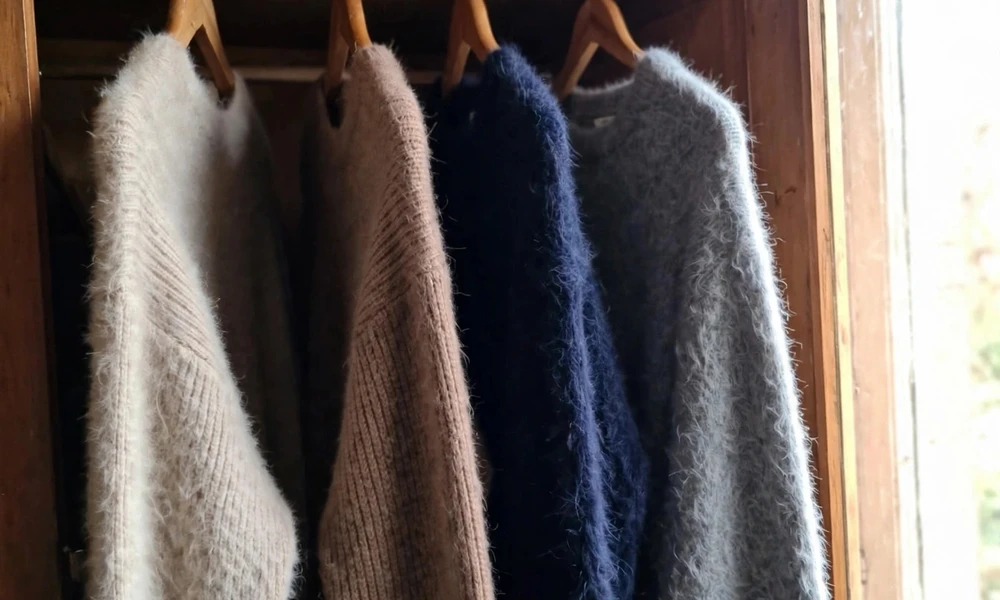
Next, look at the gauge and the fit. Angora blends are usually knitted at a fine to middle gauge, never chunky, because the fibre is too soft to hold a heavy cable and too warm to need one. Start with a crew neck, which is the easiest shape to get right. A quarter-zip is the easiest to wear on its own, and a V-neck is best kept for shirt-and-tie days. Our guide to the best camel hair blend sweaters for men covers a fibre with a similar warmth and a flatter hand, if you want the quiet option instead of the halo.
Last, weigh the price against the share. Under a fifth rabbit hair, pay wool money. Over half, expect a cashmere-level price. The best mohair blend sweaters for men follow the same rule, and the best alpaca blend sweaters for men are the closest comparison if you want a haloed knit from a different animal.
The 9 best angora blend sweaters for men of 2027
Acne Studios Ruth Angora Sweater
What we like: The highest rabbit hair share in this roundup, at 70 percent angora and 30 percent nylon, in a fine, even knit that shows exactly what the fibre can do. The halo is soft and even, the crew neck is clean, and the sweater feels weightless on, which is the whole point of angora.
What to consider: It is a designer knit, so it costs several hundred dollars new, and most pieces now change hands secondhand, where sizes and colours vary. The nylon in the mix keeps it strong, but it also means the hand is smoother and less lofty than a wool blend. Best for: A man who wants to feel what real angora is like. Material: 70% angora, 30% nylon. Price range: Around $450 new; $40 to $90 secondhand. Standout feature: A verified 70 percent angora knit with a soft, even halo.
Five Four Angora Blend Quarter-Zip Sweater
What we like: A men’s angora blend quarter-zip at the lowest price in this roundup, which makes it the cheapest way to try the fibre. The quarter-zip neckline is easy to layer over a T-shirt and easy to take off without messing up your hair, and the knit has a gentle halo without looking fluffy.
What to consider: The exact blend percentage is not published, so you are trusting the brand’s description rather than a number. The knit is lighter than the luxury picks, so it is a mild-weather sweater, and current stock is mostly resale. Best for: A first, low-risk try of angora. Material: Angora blend. Price range: Around $70. Standout feature: Quarter-zip neckline at the lowest price in the roundup.
Theory Wool Angora Blend V-Neck Sweater
What we like: A men’s V-neck in a wool and angora mix, knitted in a waffle texture that gives the soft fibre some structure. The grey colour is easy to wear, the V-neck layers neatly over a shirt and tie, and the wool in the mix means the sweater holds its shape through the day.
What to consider: The exact angora percentage is not published, and the waffle texture sheds a little at first, so keep a lint roller nearby for the first few wears. The V-neck shape is smarter than a crew, so it suits fewer casual outfits. Best for: A smart V-neck with a soft hand. Material: Wool and angora blend. Price range: Around $250. Standout feature: Waffle-knit texture that gives a soft fibre some backbone.
Banana Republic Luxury Blend Cashmere Angora V-Neck Sweater
What we like: A men’s V-neck that mixes cashmere with angora, which is the softest pairing in this roundup. The argyle version adds pattern to a fibre that is usually sold plain, and the knit is light enough to wear indoors all day without overheating.
What to consider: The exact angora share is not published, and the argyle pattern is a strong look, so it will not suit a man who wants a plain knit. Most pieces now change hands secondhand, where condition and sizing vary. Best for: A patterned knit with the softest hand here. Material: Cashmere and angora blend. Price range: Around $130 new; $27 secondhand. Standout feature: Cashmere and angora together in an argyle V-neck.
Wool & Co. Cashmere Wool Angora Blend Sweater
What we like: A men’s sweater that puts three soft fibres together, cashmere, wool, and angora, in a striped knit made in Italy. The stripes break up the halo so the sweater reads as a pattern first and a texture second, and the Italian make shows in the even tension of the knit.
What to consider: The exact percentages are not published, so you are buying the hand, not a number. The stripes are a strong look, and the sweater is mostly found secondhand, so sizes are limited. Best for: A striped knit with three soft fibres in it. Material: Cashmere, wool, and angora blend. Price range: Around $120. Standout feature: Three-fibre Italian knit with a striped pattern that tames the halo.
Paul Stuart Silk Angora Wool Sweater
What we like: A vintage sweater hand-knitted in England from silk, angora, and wool, which is a combination that almost no one makes today. The silk gives the knit a soft sheen, the angora gives it warmth, and the wool gives it enough structure to hold a shape. The purple colour is bold, and the hand knitting shows in the even, careful stitches.
What to consider: Labelled honestly: this is a vintage piece, so it is sold secondhand, and condition and sizing vary from one listing to the next. The silk in the mix means it needs gentle handling, and the colour will not suit a man who wants a plain neutral knit. Best for: A vintage knit with a fibre mix you cannot buy new. Material: Silk, angora, and wool blend. Price range: Around $59 secondhand. Standout feature: Hand-knitted in England from a silk, angora, and wool mix.
Mackenzie Country Wool Angora Blend Sweater
What we like: A vintage 1990s sweater from New Zealand, made from a wool and angora blend in a country that has knitted with both fibres for generations. The knit is warm, honest, and unfussy, and the price is the lowest in this roundup, which makes it the cheapest way to own a real angora blend.
What to consider: Labelled honestly: this is a vintage piece in men’s small, so it will not fit every man, and it is sold secondhand, so condition varies. The knit is a simple country style, not a fashion piece, and it will shed a little at first. Best for: The cheapest genuine angora blend here. Material: Wool and angora blend. Price range: Around $37 secondhand. Standout feature: A 1990s New Zealand knit at the lowest price in the roundup.
Youth Angora Wool Sweater
What we like: A contemporary sweater in ultra-plush angora wool, sold at SSENSE, in a rich burgundy that shows off the halo better than any neutral shade. The cut is relaxed and oversized, so it drapes rather than clings, and the fibre is the softest in this roundup after the Acne pick.
What to consider: The oversized cut will not suit a man who wants a neat, tailored fit, and the burgundy colour is a statement, so it needs plain trousers around it. The exact angora percentage is not published, so you are buying the hand, not a number. Best for: A relaxed, oversized angora layer in a rich colour. Material: Angora wool blend. Price range: Around $150. Standout feature: Ultra-plush angora wool in a deep burgundy with a relaxed cut.
Marni Striped Mohair Sweater
What we like: A fluffy sweater from Marni with the boldest design in this roundup, in a striped knit that uses the halo as part of the pattern. The mohair gives it the same cloud-soft feel as angora, and the Italian house knows how to cut a knit that looks intentional rather than accidental.
What to consider: Closest match, labelled honestly: mohair comes from the Angora goat, not the Angora rabbit, so there is no rabbit hair in this sweater at all. It is also the most expensive pick here, and much of the price is the design, not the fibre. Best for: The angora look from the Angora goat, with a designer stripe. Material: Mohair blend. Price range: Around $800. Standout feature: A bold striped mohair knit with the same halo as angora.
Which angora blend sweater is right for you
Judge the fibre first, and the shape second. For the fibre itself, the Acne Studios Ruth at 70 percent is the strongest choice, and the Youth sweater is the softest hand at a lower price. If you want the look without the fibre, the Marni mohair sweater gives you the halo from a different animal.
The cut decides how often you will reach for it. A quarter-zip, like the Five Four pick, is the easiest to wear on its own. A V-neck, like the Theory and Banana Republic picks, is for shirt-and-tie days. An oversized crew, like the Youth sweater, is for weekends and travel, not the office.
Price is the last check, and it only makes sense once you know the share. Under $100, the Mackenzie Country and Paul Stuart vintage picks are the only genuine blends. Between $100 and $300, the Theory V-neck and the Youth sweater are the real choice.
The caveats that matter
Angora is the softest fibre in this series, and also the most demanding. It sheds on dark coats, it felts if it gets wet, and it pills where a bag strap rubs.
| Detail | What is known |
|---|---|
| What counts as a blend | Rabbit hair mixed with wool, nylon, or cashmere, with a stated share |
| Best percentage to look for | A share over a fifth for the fibre to matter; over half for a luxury feel |
| Warmth vs weight | Warmer than wool at the same weight, and lighter than cashmere for the same warmth |
| Who should avoid it | Anyone in dark wool coats all day, or with a bag strap always on one shoulder |
| Shedding | Expect it at first; a lint roller and a smooth coat over the top keep it in check |
| Washing | Hand wash in cold water, or dry clean; never use a machine cycle |
| Storage | Folded in a cotton bag, with cedar, away from sun and moths; never in plastic |
| What it does not do | It does not keep its shape like wool, and wet handling ruins it fast |
Checklist: buying an angora blend sweater honestly
- Check the label for a rabbit hair number, not just the word angora.
- Check the price against the share: a low-percentage blend should cost wool money.
- Check the halo: an even, soft halo is a good sign; patchy fluff means a poor yarn.
- Check the seams: hand-linked joins and firm ribbed trims show the knit was made properly.
- Check the colour: soft, lightly dyed shades are the honest ones; a bright angora is dyed and may fade.
- Check returns before you order: a fibre you have never worn deserves a try-on at home.
Frequently asked questions
What percentage of angora makes a sweater worth the premium?
Enough to notice. Under a tenth rabbit hair, the sweater behaves like wool whatever the tag says. Between 20 and 50 percent you will feel the softness.
Which is warmer, angora or cashmere, weight for weight?
Angora, by a small margin. Both fibres are hollow, but angora is finer and traps more air. Cashmere holds its shape better, so the choice is warmth against durability.
Will angora fluff end up on my dark coat?
Some will, at first. New angora sheds loose fibres for the first few wears, and dark wool shows every one of them. A lint roller by the door keeps it in check, and the shedding slows once the loose fibres have worked out.
What happens if an angora sweater gets caught in the rain?
It will feel heavier and the halo will flatten, because the hollow fibres hold water. Press the water out gently, dry it flat on a towel away from heat, and never wring it, or the fibres will felt and the sweater will shrink.
Is an angora blend worth twice the price of a wool sweater?
Only if the percentage justifies it. A blend over 50 percent angora is a different garment from wool. A blend under 20 percent is mostly wool.
Can you tell angora from acrylic by touch alone?
Usually, yes. Angora feels warm the moment you touch it, and its halo is made of fine, uneven fibres. Acrylic feels cooler at first touch, and its fluff is even and springy, like a toy.
The bottom line
The best angora blend sweater for men in 2027 is the one you chose by its fibre content, not its name. The Acne Studios Ruth at 70 percent angora is the strongest blend here, and the Mackenzie Country vintage knit is the cheapest way to find out whether you like the fibre.
Read the label, keep the lint roller where you leave the house, and let a smooth coat take the friction.