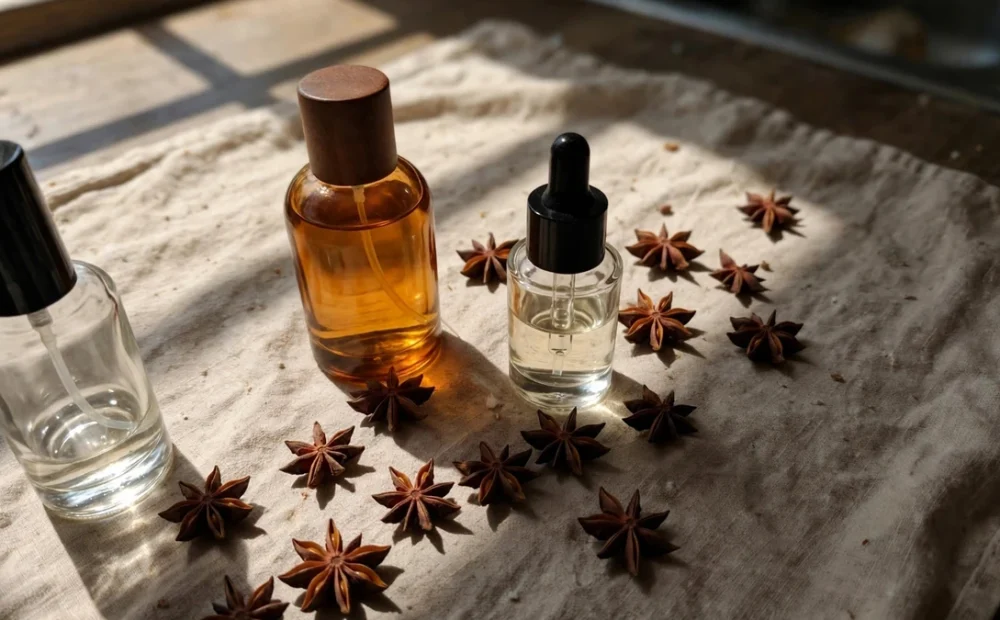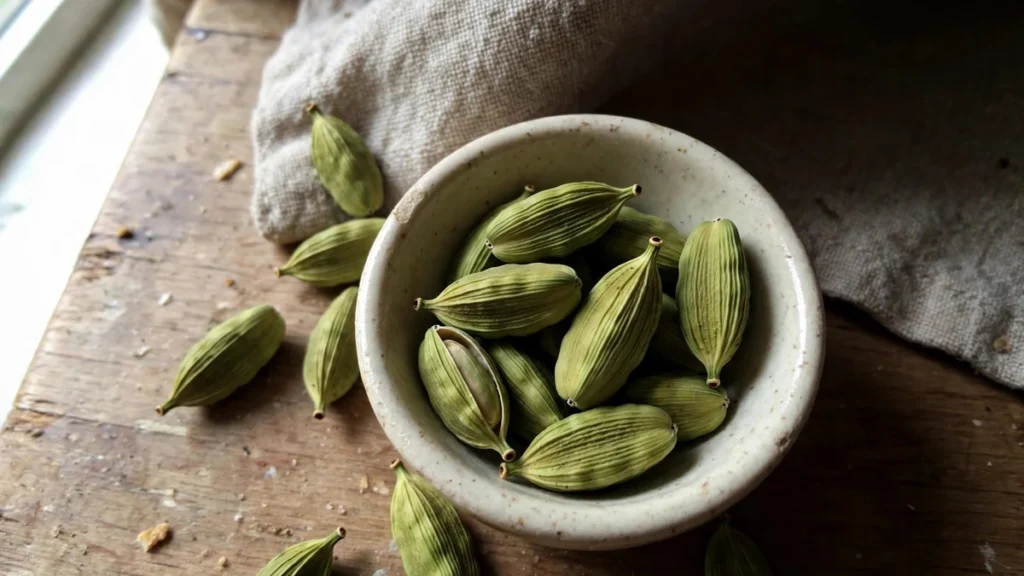
Cardamom is the spice that smells cool. It comes from the pods of a ginger-family plant, it has been traded for thousands of years, and it has a trick no other warm spice can manage: it lifts a perfume instead of weighing it down. Where cinnamon warms and clove darkens, cardamom opens a scent up, gives it air, and then quietly steps aside.
Cardamom is almost always a top note, which means it is strongest in the first few minutes and mostly gone within the hour.
This guide explains what cardamom actually is in a perfume, how perfumers use it, and how to tell a real cardamom from a note-list promise.
Key takeaways
- Cardamom in perfume is almost always green cardamom, the dried fruit of Elettaria cardamomum, a plant in the ginger family.
- The cool lift comes from 1,8-cineole, and the soft sweetness underneath from alpha-terpinyl acetate.
- Cardamom is usually a top note: strongest in the first 15 to 30 minutes, then gone, leaving warmth behind.
- The spice reads cool rather than hot, which is why it works in summer perfumes as well as winter ambers.
- A note list that promises cardamom does not guarantee you will smell it — the dose is often a fraction of a percent.
What a cardamom perfume actually is
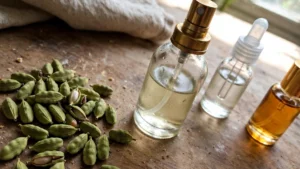
A cardamom perfume is a perfume in which cardamom — usually green cardamom oil, steam-distilled from the dried seeds — plays a recognisable part in the composition.
The plant itself is Elettaria cardamomum, a perennial in the ginger family that grows in the rainforests of southern India.
That small dose is the whole story of cardamom in perfumery. It is a note you add to change the shape of a perfume — to lift a citrus opening, to cool a vanilla base, to give a woody drydown a dry, green edge.
How perfumers use cardamom and what to look for
Perfumers use cardamom in two forms. The essential oil, steam-distilled from the seeds, is fresh, green and slightly camphoraceous — that is the form in most perfumes.
What to look for is where the cardamom sits in the note pyramid. A top-note cardamom will be brightest in the first minutes and gone within the hour. Coriander behaves the same way, and our guide to what a coriander perfume is explains how the closest cousin note is used in the same position.
The other thing to look for is the dose. The same dosing problem shows up with its warm cousin, as our explainer on what a cumin perfume is explains — cumin is the spice that divides wearers, where cardamom rarely does.
9 facts about cardamom perfume
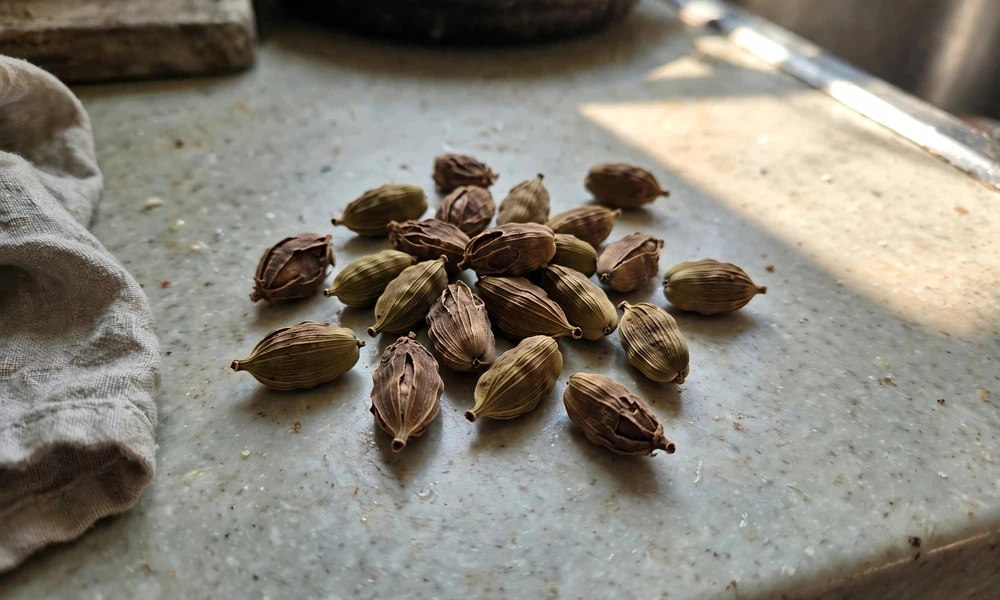
The cardamom in a bottle is almost always green, because the black pod is smoked over fire
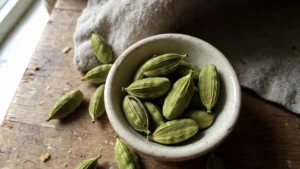
Green cardamom is the dried fruit of Elettaria cardamomum, small, pale and intensely aromatic. Perfumers use green cardamom, and when a note list says “cardamom” without qualifying it, green is what it means.
What It Shows: The name on a note list is not enough on its own — two different spices share it, and only one of them is a perfume material.
What to Consider: A cardamom perfume that smells smoky is probably using a smoky base, like incense or leather, rather than black cardamom itself.
Best For: Telling a green cardamom from a smoky base note.
Material: Green cardamom oil, steam-distilled from the seeds of Elettaria cardamomum.
Price Range: Green cardamom oil is moderately priced for a spice oil, which is why it appears at every price point.
Standout Feature: One name, two pods — and only the green one reaches a bottle.
Cardamom is a cousin of ginger and turmeric, and the family resemblance is in the warmth
Cardamom belongs to the ginger family, Zingiberaceae, alongside ginger, turmeric and galangal. That kinship is not just botanical trivia.
What It Shows: The warmth in a cardamom drydown is not an accident; it is the plant family showing through.
What to Consider: If you dislike ginger, you may find the warmth in a cardamom base familiar in a way you did not expect.
Best For: Understanding why cardamom smells warm as well as cool.
Material: The ginger family, Zingiberaceae — cardamom, ginger, turmeric and galangal.
Price Range: The family is widely grown, so the raw materials are not rare or expensive.
Standout Feature: A spice family that smells of warmth, with cardamom as its coolest member.
Two molecules do the work, and they pull in opposite directions
1,8-cineole, also called eucalyptol, gives the opening its cool, almost minty lift. Alpha-terpinyl acetate, the second major constituent, gives the soft, sweet, almost floral warmth underneath.
What It Shows: Cardamom is not one smell — it is a cool top and a warm base in the same drop, and the ratio between them changes with the origin of the pods.
What to Consider: An oil high in cineole will smell sharper and more camphor-like, which is why some cardamom perfumes smell medicinal for the first few minutes.
Best For: Understanding why two cardamom perfumes can smell so different from each other.
Material: 1,8-cineole and alpha-terpinyl acetate, the two dominant molecules in cardamom oil.
Price Range: Both molecules are also made synthetically, which keeps cardamom affordable as a note.
Standout Feature: One drop, two directions — cool on top, warm underneath.
Cardamom arrives in the first spray and leaves early, but the warmth stays
Cardamom oil is volatile, which means it evaporates quickly. In most perfumes it is a top note, strongest in the first 15 to 30 minutes, and largely gone within the hour.
What It Shows: Judging a cardamom perfume by its opening alone misses half the story; the note’s real job is what it leaves behind.
What to Consider: If you only smell the opening, you will think the cardamom has vanished. Wait an hour and smell your wrist again — the warmth is the cardamom’s echo.
Best For: Learning to judge a cardamom perfume after an hour, not after a minute.
Material: Cardamom essential oil, one of the more volatile spice oils in perfumery.
Price Range: The fade is the same at every price — even a $400 bottle loses its cardamom lift within the hour.
Standout Feature: The fastest-fading spice note, and the one whose echo matters most.
Guatemala grows more cardamom than India, the plant’s own home
Cardamom comes from the rainforests of southern India, but the world’s biggest producer today is Guatemala. The plant was introduced there in the early 1900s, and the volcanic soil and mountain climate suited it so well that Guatemala now grows more cardamom than any other country.
What It Shows: Origin matters less than grade — a Guatemalan pod and an Alleppey pod can smell different, and perfumers choose by the oil, not the flag.
What to Consider: A perfume that names its cardamom origin is usually selling a story; the oil’s chemistry matters more than the country on the label.
Best For: Understanding why cardamom appears in perfumes at every price point.
Material: Green cardamom pods, graded by size and colour, with Alleppey green at the top.
Price Range: Cardamom is one of the more expensive spices by weight, but perfume doses are so small that the cost barely registers.
Standout Feature: A plant that crossed the world and changed its home.
Cardamom travelled the spice routes for thousands of years before it reached a bottle
Cardamom was traded long before it was perfumed. Viking traders took them further north, to Scandinavia, where cardamom buns are still a bakery staple — the only place in Europe where the spice became a baking tradition rather than a luxury.
What It Shows: Cardamom is one of the oldest traded spices in the world, and its history is written into the cuisines of three continents.
What to Consider: The baking tradition is the reason cardamom smells familiar even to people who have never worn it as a perfume.
Best For: Understanding why cardamom smells both exotic and familiar at the same time.
Material: Dried green cardamom pods, traded whole for thousands of years.
Price Range: In the ancient world cardamom was worth a significant sum by weight; today it is affordable enough for everyday use.
Standout Feature: Three thousand years of trade, and the pods still look the same.
Cardamom is the spice that reads cool, and that is why it works in summer
Most warm spices heat a perfume up. Cinnamon, clove and nutmeg all make a composition feel heavier and warmer, which is why they belong in winter. Cardamom does the opposite. It is the only spice note that a perfumer reaches for when a perfume needs to feel lighter, not heavier.
What It Shows: Cardamom breaks the rule that spice means winter, and that is what makes it versatile.
What to Consider: A cardamom perfume bought for winter may surprise you in summer, when the cool lift is the part you notice most.
Best For: Choosing a spice perfume that works in hot weather.
Material: Green cardamom oil, used for lift rather than warmth.
Price Range: The cooling effect is the same in a $70 bottle and a $400 one — it is chemistry, not price.
Standout Feature: The only warm spice that cools a perfume down.
A fraction more cardamom than a formula needs changes the whole scent
Cardamom is dosed in fractions of a percent — often less than one part in a thousand of a perfume concentrate. That precision is not fussiness. A fraction more, and the fresh opening turns dry and camphor-like. A fraction less, and the lift disappears entirely, leaving a perfume that smells flat.
What It Shows: The smallest doses in perfumery are often the most powerful, and cardamom is the clearest example.
What to Consider: If a cardamom perfume smells sharp for the first ten minutes and then settles, the dose was at the edge — and the settling is the perfume finding its balance.
Best For: Understanding why two bottles of the same perfume can smell slightly different.
Material: Cardamom essential oil, dosed at a fraction of a percent.
Price Range: The dose is so small that the cost of the cardamom itself is almost irrelevant to the price of the bottle.
Standout Feature: A note measured in drops, where one drop changes everything.
The same note leads a masculine bestseller and a unisex vanilla, and neither smells like the other
Layton is one of the most popular men’s perfumes in the world, and its opening is cardamom, apple and bergamot. Ani is a unisex vanilla built on cardamom, bergamot and ginger. The same note leads both, and they smell nothing alike — one is fresh and crowd-pleasing, the other is warm and enveloping. That is cardamom’s real talent.
What It Shows: Cardamom has no fixed gender in perfumery — the company it keeps decides that, not the spice itself.
What to Consider: Do not assume a cardamom perfume is for men because the note skews masculine in marketing; the unisex bottles on this list prove otherwise.
Best For: Choosing a cardamom perfume without worrying about the label on the box.
Material: Green cardamom oil, used identically in a men’s bestseller and a unisex vanilla.
Price Range: The same note appears at $70 and at $395, in men’s and unisex bottles alike.
Standout Feature: One note, two audiences, and no contradiction.
How cardamom compares with the other warm spice notes
Cardamom’s closest neighbours are coriander, cumin and caraway, and the four are easy to confuse on a note list. Cumin is the warm, skin-like one, and it divides wearers more than any other spice.
The practical difference is temperature. Cardamom is the only one of the four that lifts a composition, and that is why perfumers use it when a perfume needs air. If you want to compare the family directly, our explainer on what a caraway perfume is covers the note most often confused with cardamom in the opening.
The other comparison is with black pepper and pink pepper, the two pepper notes that also sit in the top of a perfume. Both peppers are sharper and shorter-lived than cardamom, and neither leaves the warmth behind that cardamom does. A pepper opening is a spark; a cardamom opening is a lift.
The caveats that matter
Cardamom is generally well tolerated, but it is a spice oil, and spice oils are among the more likely fragrance materials to irritate sensitive skin.
| Detail | What is known |
|---|---|
| What cardamom is | Green cardamom oil, steam-distilled from the seeds of Elettaria cardamomum |
| Where it sits | Usually a top note — strongest in the first 15 to 30 minutes |
| What makes it smell cool | 1,8-cineole, the same molecule behind eucalyptus |
| What makes it smell warm | Alpha-terpinyl acetate, and the ginger family it belongs to |
| Which pod perfumers use | Green cardamom — black cardamom is smoked and stays in the kitchen |
| Who should patch-test first | Sensitive skin, or anyone who has reacted to a spicy perfume |
| What to avoid | Judging a cardamom perfume by its opening alone — wait an hour |
| What cardamom does not do | It does not last all day — the note fades and the base takes over |
One more caution. Cardamom oil can stain light fabrics if it is spilled undiluted, and a heavily dosed cardamom perfume can leave a faint mark on a white collar if it is sprayed at close range.
Checklist: understanding a cardamom perfume honestly
Use these checks before you buy a cardamom perfume, and again after a week of wear.
- Check which pod the note list means — green cardamom is the perfume material; black cardamom is a kitchen spice.
- Spray it on your wrist rather than a paper strip — the cardamom shows itself in the first five minutes, and paper makes it smell flat.
- Wait an hour before you judge — the cool lift will fade, and the warmth left behind is the real test.
- Compare it with a coriander perfume — the two notes are cousins, and the comparison will teach you what cardamom does differently.
- If your skin reacts easily, dab a little on your inner arm and leave it a full day before you wear the perfume on your neck.
- Spray from a distance and let it dry — undiluted spice oil can mark a white collar if it is sprayed too close.
Frequently asked questions
Why does cardamom smell cool when other spices smell warm?
Because of 1,8-cineole, the molecule that gives cardamom its lift. The same molecule is what makes eucalyptus smell cool and camphor-like.
Where does the smoke in a cardamom perfume come from?
Usually because of the base, not the cardamom. Incense, leather and smoked woods sit underneath the spice in perfumes like Dzongkha and African Leather, and the smoke comes from them.
How much cardamom is actually in a bottle?
Very little — often less than one part in a thousand of the perfume concentrate.
Why does cardamom turn up in so many summer fragrances?
Because it cools a composition instead of heating it.
I have never smelled cardamom in perfume — where do I start?
Start with Layton if you want the easiest wear, or Eau de Baux if you want the cheapest. Both give you a clear, likeable cardamom without asking you to learn the note first. Dzongkha is the third step, for when you want to smell the spice undiluted.
Can a cardamom perfume mark a white shirt?
Undiluted cardamom oil can stain light fabric, but the dose in a finished perfume is far too small to mark skin. Spray from a normal distance, let it dry before you dress, and there is no practical risk.
The bottom line
A cardamom perfume is a perfume that uses a cool, green spice to lift its opening and warm its heart.
The honest way to learn it is to smell it three ways: clear in Dzongkha, sweet in Ani, and warm in Eau de Baux. Start with one bottle, wait an hour before you judge it, and let the warmth — not the lift — make the decision.