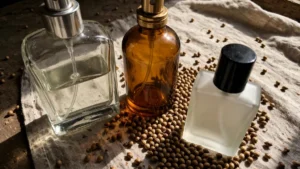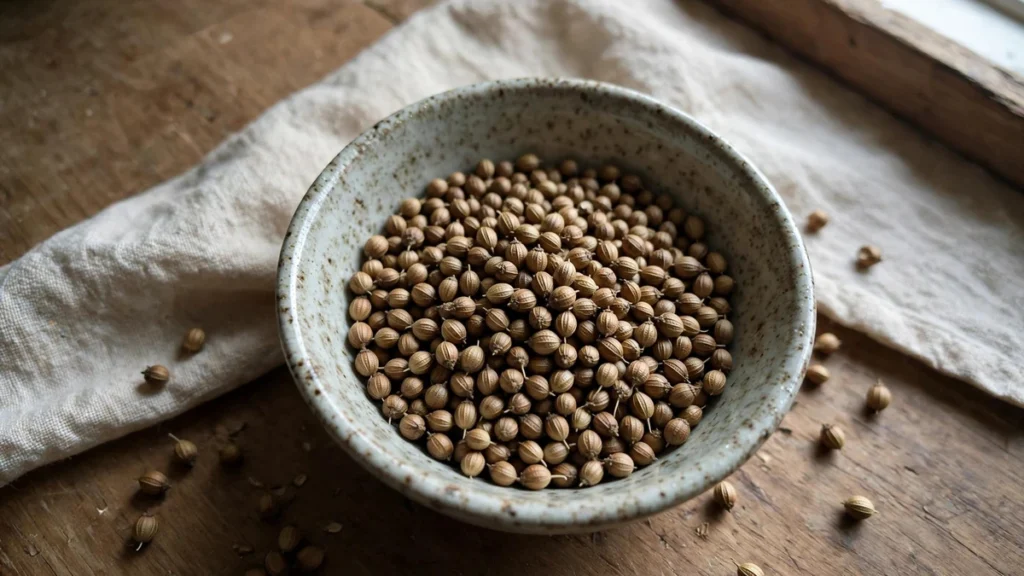
A coriander perfume is a fragrance built around the seed of Coriandrum sativum, an annual herb of the carrot family that has been cultivated for thousands of years. The seed oil smells warm, spicy and lightly citrus, with a dry woody-peppery body and a soft floral sweetness underneath.
The confusion around the note starts with the plant itself. Coriander gives perfumery two materials, and they smell nothing alike. The dried seed is warm spice. The fresh leaf, sold as cilantro, is sharp, green and soapy, and a genetic difference in smell receptors means a large minority of people find it actively unpleasant.
This guide explains what a coriander perfume is, how perfumers use the material, and how to tell it apart from its neighbours, cardamom, cumin and pepper. It covers the history of the note from Egyptian tombs to the first eaux de cologne, the chemistry that makes it smell floral as well as spicy, and the questions that matter when you are choosing a bottle.
- Key takeaway: A coriander perfume is built on seed oil from Coriandrum sativum, and it smells warm, spicy and lightly citrus.
- Key takeaway: The seed oil is mostly linalool, which is why the note smells floral as well as spicy.
- Key takeaway: Coriander usually sits in the top or the heart, where it warms citrus and hands the scent to the woods.
- Key takeaway: The leaf is a different material, sharp and soapy, and a genetic difference makes it repellent to a large minority.
- Caveat: Coriander fades quickly in light compositions, and a note list does not guarantee you will smell it clearly, so always test on skin first.
What a coriander perfume actually is
A coriander perfume is any fragrance in which coriander seed oil plays a named, perceptible role. The material is the essential oil obtained by steam distillation of the crushed, dried seeds, which are botanically the plant’s fruits.
The smell itself is worth describing precisely, because the note list alone does not do it. Blind, the oil reads first as a bright, green, lemony attack with a clear spicy lift, then opens into a floral, rosewood-like heart, and settles into a warm, mildly woody, lightly vanillic drydown that holds for two to five hours on skin.
Coriander is not a soliflore subject in the way rose or jasmine are. Only one mainstream perfume, Jean Couturier Coriandre from 1973, is named after the note, and even that is a chypre in which coriander shares the stage with angelica, rose and oakmoss.
How perfumers use coriander and what to look for

Perfumers reach for coriander when a composition needs warmth without weight. In a citrus eau, a small dose warms the opening and keeps the top from smelling thin. In a fougère, it gives the lavender and bergamot a spiced lift.
When you are reading a note list, look at where the coriander sits. In the top, it will greet you first and fade within the hour, as it does in Eau Sauvage, where Edmond Roudnitska placed it at the very top of the pyramid. In the heart, it will warm the middle of the wear, as it does in Ô de Lancôme and Eau de Rochas, where it sits among the herbs. Our tarragon perfume guide explains the same top-versus-heart distinction for another herb note, and the logic carries over.
Also look at the company it keeps. Citrus and basil around it mean a fresh eau; rose and oakmoss mean a chypre; lavender, leather or tobacco mean a masculine aromatic. And check the concentration: an eau de toilette will show the note more briefly than an eau de parfum of the same scent.
9 facts about coriander perfume
Coriander seed and coriander leaf are two materials that happen to share a plant
The plant produces two aromatic organs with sharply different chemistries.
What It Shows: The note list means the seed unless a perfume explicitly says otherwise, and the two materials should never be confused.
What to Consider: If a perfume smells soapy and green, you may be meeting the leaf, not the seed, and that reaction is common.
Best For: Knowing which material you are actually smelling before you judge the note.
Material: Coriander seed oil, steam-distilled from dried seed.
Price Range: Seed oil is inexpensive; the leaf is rarely used at all.
Standout Feature: One plant, two opposite smells, and only one of them belongs in most perfumes.
Most of the oil is linalool, so coriander smells floral as well as spicy
Coriander seed oil is typically 65 to 78 percent linalool, also called coriandrol, which is higher than in any other commercial seed distillate.
What It Shows: The floral side of coriander is not an accident; it is the chemistry of the oil itself.
What to Consider: Because linalool is so dominant, coriander can smell almost floral in a light composition, and the spice can be hard to find.
Best For: Understanding why coriander sits comfortably in florals as well as in spice blends.
Material: Linalool, the dominant constituent of coriander seed oil.
Price Range: Linalool is cheap and widely available, which keeps the oil affordable.
Standout Feature: The highest linalool content of any commercial seed oil.
Coriander was once a commercial source of linalool before cheaper routes took over
Before turpentine-derived synthesis made the route uneconomic, coriander seed oil was an industrial source of isolated linalool.
What It Shows: Coriander mattered to the fragrance industry long before it mattered to perfume lovers, as a raw material supplier.
What to Consider: The industrial history explains why the oil is inexpensive today, and why it appears in so many classic formulae.
Best For: Seeing the note as part of perfumery’s supply chain, not just as a smell.
Material: Coriander seed oil, historically distilled for linalool.
Price Range: Wholesale prices run roughly 80 to 240 euros per kilogram, depending on origin.
Standout Feature: A spice that once fed the industry’s linalool supply.
The oil comes from steam-distilling crushed dried seed, and the yield stays under one percent
The seeds are crushed immediately before distillation to maximise the oil yield, then steam-distilled for six to twelve hours depending on batch size.
What It Shows: The low yield is normal for a seed oil, and it is part of why the material is handled carefully.
What to Consider: Linalyl acetate in the oil can hydrolyse, and linalool can rearrange under weakly acidic conditions, so batches vary in quality.
Best For: Knowing why two bottles of the same perfume can smell slightly different.
Material: Steam-distilled coriander seed oil, pale yellow and clear.
Price Range: The oil is cheap per kilogram, so it rarely drives a bottle’s price.
Standout Feature: A long, slow distillation for a very small return of oil.
Coriander reached Western perfumery through the first eaux de cologne of the 1700s
Coriander is one of the oldest aromatic plants on record, with seeds recovered from the Nahal Hemar cave in Israel dated to around 6000 BCE, and a mention in the Egyptian Ebers Papyrus of about 1550 BCE as both a medicine and a perfumery ingredient.
What It Shows: The note is older than almost any other spice in the perfumer’s palette, and its first Western job was in cologne.
What to Consider: The cologne heritage is why coriander still reads as fresh and clean rather than as exotic or heavy.
Best For: Placing the note in the history of Western perfumery.
Material: Coriander seed oil in the classical eau de cologne accord.
Price Range: The heritage costs nothing extra; the oil has always been affordable.
Standout Feature: A spice with eight thousand years of recorded use.
Roudnitska put coriander at the top of Eau Sauvage, and it has stayed in masculine perfumery ever since
Edmond Roudnitska placed coriander at the very top of Eau Sauvage, the Dior citrus fougère of 1966, as part of the bright opening that announced a new masculine grammar.
What It Shows: Coriander helped define what a modern masculine perfume smells like, and it has never really left that register.
What to Consider: The masculine association is historical, not chemical; the same oil works in women’s chypres and citrus florals.
Best For: Understanding why the note feels classic rather than trendy.
Material: Coriander seed oil at the top of the Eau Sauvage pyramid.
Price Range: Eau Sauvage itself is a mid-priced designer classic.
Standout Feature: The note that opened the modern masculine fougère.
Coriander warms a citrus opening and hands it to the woods without taking the lead
In a citrus composition, coriander sits between the bright top and the warm base, and its job is to make the handover smooth.
What It Shows: Coriander is a bridge material, and its value is in the transition it makes, not in the smell it adds.
What to Consider: Because the work is structural, the note can be hard to pick out, and that is normal rather than a failure of the perfume.
Best For: Learning to listen for the note in the middle of a composition.
Material: Coriander seed oil as a bridge between citrus and woods.
Price Range: The bridge costs little; the rest of the composition sets the price.
Standout Feature: A note you feel in the transition more than you smell on its own.
A genetic difference makes the leaf smell of soap to a large minority of people
The leaf’s soapy character comes from aldehydes, and a well-documented variation in smell receptors means a substantial minority perceive it as soap or as actively unpleasant.
What It Shows: Hating cilantro is not a matter of taste or training; it is written into the nose.
What to Consider: If you are one of the people who find the leaf soapy, avoid the rare leaf-led perfumes, and stick to seed-based ones.
Best For: Explaining the cilantro divide to anyone who has ever argued about it.
Material: Coriander leaf aldehydes, chiefly decanal and dodecenal.
Price Range: Leaf oil is a flavour material, not a fine-fragrance one, and rarely priced as perfume.
Standout Feature: The clearest genetic split in all of perfumery.
Coriander is gentler than pepper or cumin, so it warms a scent instead of spicing it
Next to black pepper or cumin, coriander is a soft spice.
What It Shows: The note’s gentleness is its defining trait, and it is what separates it from the other warm spices.
What to Consider: If you want a real spice hit, coriander will disappoint; reach for pepper, cumin or cardamom instead.
Best For: Choosing between the warm spices when you are building a wardrobe.
Material: Coriander seed oil, gentler than pepper or cumin.
Price Range: Comparable to other spice oils, and inexpensive in context.
Standout Feature: Warmth without bite, the softest of the warm spices.
How coriander compares with the other warm spice notes
Cardamom is the closest neighbour, and the easiest to confuse with coriander. Both are warm spices, but cardamom is sharper, greener and more camphoraceous, with a colder, more medicinal edge, while coriander is lighter, more citrusy and more floral. In a blend, coriander warms and rounds, while cardamom cuts and brightens.
Cumin sits further away. It is sweaty, earthy and animalic, and it dominates a composition at doses where coriander would disappear. Black pepper is sharper still, pungent and dry, with a bite that coriander never has. Our oregano perfume guide makes a similar comparison for another herb, and the pattern holds: the warm spices form a spectrum from soft to sharp, and coriander sits at the soft end. The practical rule is simple. Want warmth without bite, choose coriander. Want a cold green cut, choose cardamom. Want a real spice hit, choose pepper or cumin.
The leaf deserves its own comparison, because it is the one coriander material that does not sit on this spectrum at all. Cilantro leaf is sharp, green and aldehydic, closer to a green note than to any spice, and it divides opinion in a way no seed spice does.
The caveats that matter
Coriander is a well-behaved material, but it has limits worth knowing before you buy. It is unrestricted in perfumery, and the seed oil is generally well tolerated, yet linalool, its main constituent, can sensitise a small number of people, especially when the oil has oxidised.
| Detail | What is known |
|---|---|
| The material | Steam-distilled oil from the dried seed of Coriandrum sativum |
| Main constituent | Linalool, roughly 65 to 78 percent of the seed oil |
| Smell | Warm, spicy and lightly citrus, with a woody-peppery body |
| Pyramid position | Usually top or heart, rarely the base |
| Leaf versus seed | Leaf is aldehydic and soapy; seed is warm spice; different materials |
| Best partners | Citrus, lavender, bergamot, vetiver, woods and amber |
| Watch out for | Fades fast in light citrus compositions; leaf note divides opinion |
| Price | Seed oil is inexpensive; the bottle price comes from the rest of the formula |
Longevity is the other honest caveat. Coriander is a top and heart note, and in light citrus compositions it can fade within an hour or two, leaving the woods and musk to carry the rest of the wear. That is not a flaw in the perfume; it is the nature of the material.
Checklist: understanding a coriander perfume honestly
- Confirm the note is the seed, not the leaf, by checking the note list and the house description.
- Look at where the note sits: top means a brief greeting, heart means a warm middle.
- Notice what sits around it: citrus and basil mean fresh, rose and oakmoss mean chypre, lavender and leather mean masculine aromatic.
- Test on skin, not paper, and wait an hour to judge the heart, where coriander usually sits.
- Ask how long it lasts on you, because coriander fades fast in light compositions.
- Remember the leaf is genetic: if cilantro tastes of soap to you, avoid leaf-led perfumes.
Frequently asked questions
Is the coriander in perfume the same as the spice in my kitchen?
Yes, in the sense that both come from the dried seed of Coriandrum sativum, and the oil is steam-distilled from the same crushed seed you grind into a curry. The difference is concentration and context: in a perfume the oil is dosed in fractions of a percent and blended with citrus, woods and musk, so it smells warm and floral rather than culinary.
Why does coriander disappear from my wrist so quickly?
Because it is a top and heart note with a light, volatile character, and in a citrus composition there is little base to hold it. The seed oil itself lasts around eight hours at full strength, but in a perfume the balance shifts as the top evaporates, and the woods and musk take over.
Can coriander work in a women’s perfume?
Yes, and it has done since the late 1960s. Jean Couturier Coriandre is a women’s chypre, Ô de Lancôme and Eau de Rochas are women’s citrus florals, and all three use the note openly.
What is the difference between coriander and cardamom?
Coriander is lighter, more citrusy and more floral, because it is dominated by linalool. Cardamom is sharper, greener and more camphoraceous, with a colder, more medicinal edge.
Does coriander seed oil cause skin reactions?
It is generally well tolerated and unrestricted in perfumery, but linalool, its main constituent, can sensitise a small number of people, especially when oxidised. If your skin reacts to fragranced products, patch test on the inner arm first, as our basil perfume guide also advises, and stop using the perfume if redness or itching appears.
Which coriander perfume should I try first?
Start with Jean Couturier Coriandre, where the note is unmistakable and the price is modest, then try Bigarade Concentrée to hear it doing structural work in a citrus perfume. The contrast between the two teaches you more about coriander than any description can, and both are easy to find.
The bottom line
A coriander perfume is a fragrance built on the warm, lightly citrus seed oil of Coriandrum sativum, a material with eight thousand years of recorded use and a central role in the history of Western perfumery. It is the softest of the warm spices, a bridge between citrus and woods, and a note that does its best work quietly, in the middle of a composition rather than at the front of it.
Learn to tell the seed from the leaf, test on skin and wait for the heart, and start with the classics before spending on niche. Once you can pick coriander out of a blend, you will hear it everywhere, from the colognes of the 1960s to the niche ambers of today, and you will understand a little more about how perfumers build a scent that lasts.