Tarragon is the sharpest green note in the perfumer’s herb garden, and one of the most misunderstood. It smells fresh, green and faintly aniseed, with a cool, slightly peppery lift.
Most people meet tarragon in the kitchen, where it seasons chicken, fish and sauces. In perfume it plays a different role, adding a green, aromatic brightness that keeps sweet or powdery compositions from turning flat, and giving classic fougères a lift that feels both old-fashioned and modern.
This guide explains what a tarragon perfume actually is, where the note comes from, how perfumers use it, and why it smells so different from its herb cousins. It is written for anyone who has smelled something green and faintly aniseed in a perfume and wanted a name for it.
Key takeaways
- Tarragon in a perfume means the published note list includes the herb, a green note with a faint aniseed edge.
- Estragole, a natural compound in the oil, is what makes tarragon smell anise-like.
- The note usually opens a perfume or sits in its middle, brightening the scent rather than anchoring it.
- It comes from the same plant family as anise and wormwood, yet its smell is cooler, greener and more herbal than either.
- A tarragon scent will not stay green and herbal all day, and one that smells harsh or bitter on skin will probably not improve with wear.
What a tarragon perfume actually is
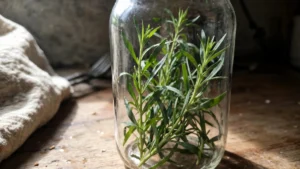
A tarragon perfume is any fragrance that includes tarragon, the essential oil of the Artemisia dracunculus plant, in its formula. The note is listed openly in the published breakdown, usually in the top or the heart, and it contributes a green, faintly aniseed character that is hard to mistake once you know it. It is not a marketing word. If tarragon is on the list, the perfumer used the real material, or a recreation of it, in the blend.
Perfumers make the note by passing steam through the leaves and flowering tops, then collecting the oil that comes off. The resulting oil is pale, potent and strongly aromatic, and it is used in very small amounts.
Tarragon perfumes are almost always unisex or masculine-leaning, not because the herb itself is gendered, but because the compositions around it tend to be aromatic, fougère or vetiver-based. Our guide to what an oregano perfume is shows the bolder, drier side of this herb family, and the contrast is the best way to understand what makes tarragon distinct.
How perfumers use tarragon and what to look for
In most compositions it sits in the top, where it gives the opening a clean, green lift, or in the heart, where it steadies the middle of the scent and keeps it from turning too sweet.

Look at the notes around it. Tarragon works best with vetiver, iris, rose, citrus and other herbs, and it is often found alongside lavender, sage, juniper and cedar in aromatic compositions. If you enjoy what a basil perfume is, you will recognise the same green, aromatic family, but tarragon is cooler and more aniseed, with a sharper green edge that basil does not have.
Look also at the concentration. An extrait de parfum will show tarragon more strongly and for longer than an eau de toilette.
9 facts about tarragon perfume
Tarragon is Artemisia dracunculus, and only French tarragon is used in perfume
What it shows: Tarragon belongs to the Artemisia genus, the same family as wormwood, and its botanical name is Artemisia dracunculus. French tarragon is the variety with the strong, aniseed smell that perfumers want, while Russian tarragon is a different plant with a much weaker, almost grassy smell. What to consider: The two are often confused, so check which variety a perfume actually means. Best for: Anyone choosing between herb notes and wondering why tarragon smells so different from other greens. Material: Artemisia dracunculus essential oil, French variety. Price range: The oil costs very little on its own; what the bottle sells for comes from everything else in the blend. Standout feature: A herb with two varieties, only one of which is good enough for perfume.
Estragole gives tarragon its anise-like character
What it shows: Tarragon oil is rich in estragole, also called methyl chavicol, a natural compound that gives the herb its sweet, anise-like smell. Estragole is responsible for the cool, faintly liquorice character that makes tarragon recognisable in a perfume. What to consider: The amount of estragole changes with the plant’s origin and harvest, so tarragon oil from France smells different from tarragon oil grown elsewhere. Best for: Seeing what makes this herb note smell unlike any other green. Material: Steam-distilled tarragon essential oil. Price range: A little bottle of the neat oil is cheap, yet perfumers never apply it undiluted. Standout feature: One molecule that explains the whole character of the note.
Tarragon is almost always a top note, unlike oregano which sits in the heart
What it shows: In most perfumes tarragon appears in the top, where it gives the opening a clean, green brightness, while oregano usually sits in the heart, where it adds warmth and depth. The difference is the weight of the materials: tarragon oil is light and volatile, so it evaporates quickly, while oregano oil is heavier and lasts longer. What to consider: A perfume that lists tarragon only in the top notes will show it briefly and then move on, which is a different experience from a heart or base placement. Best for: Working out from a note list how a perfume will change on skin. Material: Tarragon essential oil, dosed in fractions of a percent. Price range: Where the note sits in the composition leaves the price alone, but it decides how long the herbal character lingers. Standout feature: A top note that brightens a scent from the very first spray.
Tarragon gives L’Heure Bleue its green lift
What it shows: Guerlain’s L’Heure Bleue, a classic oriental from 1912, lists tarragon in its top notes, where it gives the opening a fresh, green lift before the iris, vanilla and benzoin take over. It is one of the earliest and most famous uses of the note in fine perfumery. What to consider: The tarragon is subtle here, and many wearers never notice it, which is exactly the point. Best for: Lovers of classic perfumes who want to understand how a top note shapes a whole composition. Material: Tarragon oil blended with bergamot, anise and coriander. Price range: L’Heure Bleue is widely available at a mid-range price for a classic. Standout feature: A century-old classic that still uses tarragon to open its most famous oriental.
Tarragon and anise are different materials with a similar family smell
What it shows: Tarragon, anise and star anise all smell faintly of liquorice, but they are different materials with different characters. Anise and star anise are sweeter, warmer and more obviously liquorice-like, while tarragon is greener, cooler and more herbal. They share a family resemblance because their key molecules are related, but they are not interchangeable. What to consider: A perfume that lists anise is not a tarragon perfume, and a perfume that lists tarragon is not an anise perfume, even though the two can smell similar in the opening. Best for: Anyone confused by the anise family on a note list. Material: Tarragon oil, anise oil and star anise oil, each with its own profile. Price range: The materials are all inexpensive; the difference is in the character, not the cost. Standout feature: Three materials that smell like cousins but behave like strangers.
Tarragon gives citrus perfumes a cool herbal edge
What it shows: In citrus-led perfumes, bergamot and neroli can smell simply fresh, and a touch of tarragon gives the opening a green, herbal edge that stops it turning sugary. The aniseed coolness of the herb sits alongside the citrus rather than under it, so the first spray smells bright and leafy instead of fruity. It is one of the reasons tarragon turns up in fresh aromatic compositions built for warm weather. What to consider: Too much tarragon tips the opening from green to medicinal, so perfumers keep it at a whisper. Best for: Lovers of fresh citrus scents who want a herbal twist rather than a sweet one. Material: Tarragon oil blended with bergamot, neroli and petitgrain. Price range: Citrus perfumes with tarragon sit mostly in the mid-range, with niche houses charging more. Standout feature: A herbal edge that keeps citrus bright instead of sweet.
Tarragon keeps florals from turning sweet
What it shows: Floral compositions can become heavy and sweet, and a small amount of tarragon stops that from happening. It adds a green, herbal freshness that cuts through the flowers and keeps the scent balanced, which is why it appears in rose perfumes like Chloé Roses de Chloé. What to consider: Without the herbal lift, a rich rose can feel cloying, especially in warm weather, so the tarragon is doing structural work, not decoration. Best for: Lovers of rose and other florals who find sweet scents too heavy. Material: Tarragon oil blended with rose, magnolia and blackcurrant. Price range: Floral perfumes with tarragon range from affordable to niche, depending on the house. Standout feature: A green counterweight that keeps florals fresh instead of sweet.
Tarragon gives green chypres their herbal spine
What it shows: A chypre is built on a bright citrus opening, a floral or fruity heart and a dark, mossy base of oakmoss and patchouli, and tarragon fits that structure neatly. It sits with the bergamot at the top, adding a green, aniseed edge that stops the citrus from smelling simply fresh, and it bridges the gap to the mossy base below. What to consider: A green chypre with tarragon smells drier and more herbal than a floral chypre, so it suits people who like their scents crisp rather than soft. Best for: Lovers of classic, dry green perfumes with a mossy drydown. Material: Tarragon oil blended with bergamot, oakmoss and patchouli. Price range: Green chypres are usually mid-priced classics, with niche houses charging more for oakmoss-rich versions. Standout feature: A green thread that ties a bright opening to a dark, mossy base.
French tarragon never sets seed, so every plant is a cutting
What it shows: French tarragon is sterile: it flowers, but it almost never produces viable seed, so growers multiply it by dividing the roots or taking cuttings. Every French tarragon plant is effectively a clone of an older one, which is why the oil smells so consistent from one harvest to the next. What to consider: Seed packets sold as tarragon usually grow Russian tarragon, which smells grassy and weak, so a perfumer’s supply depends on specialist growers and their cuttings, not on seed. Best for: Understanding why the note smells the same year after year. Material: French tarragon, propagated by cuttings and root division. Price range: The propagation method keeps supply small, but the oil is used in such tiny amounts that it barely moves the price of a perfume. Standout feature: A perfume note that comes from a plant that cannot reproduce itself.
How tarragon compares with the other green herb notes
Tarragon sits in a family of green herb notes that includes basil, rosemary, sage, marjoram and oregano, and each one has a distinct character. Basil is the sweetest and most peppery, rosemary the most camphorous, sage the most earthy, marjoram the softest, and oregano the boldest and driest. Tarragon is the coolest and most aniseed of the group, with a sharp green edge the others do not share.
If you are building a collection of herb perfumes, tarragon is a good later addition rather than a first step. Start with what a rosemary perfume is or the marjoram and basil explainers, which are gentler introductions to the family.
The caveats that matter
Tarragon is a strong note, and strong notes demand honest testing. It can read as fresh and green on one person and sharp or bitter on another.
| Detail | What is known |
|---|---|
| What the note is | The essential oil of Artemisia dracunculus, French tarragon, steam-distilled from leaves and flowering tops |
| What it smells like | Green, fresh and faintly aniseed, with a cool, slightly peppery lift |
| Key molecule | Estragole, also called methyl chavicol, which gives the oil its anise-like character |
| Where it sits | Usually the top notes, sometimes the heart; rarely the base |
| Best pairings | Vetiver, iris, rose, citrus, and other green herbs |
| How it differs from oregano | Tarragon is cooler, greener and more aniseed; oregano is bolder, drier and more savoury |
| How long it lasts | An hour or two as an opening note, longer in fougère and vetiver bases |
| What to watch for | A sharp or bitter opening that does not soften within an hour |
The essential oil on its own is far stronger than any finished perfume, so a scent that leaves your skin red or itchy should be stopped, and a sample worn for a full day tells you more than a paper strip ever will.
Checklist: understanding a tarragon perfume honestly
Use these checks before you buy, and again after a full day of wear.
- Look for tarragon named on the note list itself, not just a general herbal description.
- Check where it sits: the top means it will fade quickly, the heart means it will stay longer.
- Smell it next to basil, since basil’s sweetness makes tarragon’s cool, aniseed edge stand out.
- Spray it on skin, because the herb changes more with skin chemistry than most notes do.
- Wait a full hour before deciding, since the sharp first minutes settle into a warmer drydown.
- Buy a sample first: the strongest tarragon scents are niche and costly, so a small bottle is the sensible start.
Frequently asked questions
How is tarragon oil made for perfume?
The leaves and flowering tops are steam-distilled, usually just before the plant comes into full bloom, when the oil content is at its highest. The resulting oil is pale and very potent, so perfumers use it in tiny amounts, often a fraction of a percent of the whole formula.
Which tarragon goes into perfume, French or Russian?
French tarragon, which has the strong, aniseed smell perfumers want. Russian tarragon is a different plant with a much weaker, almost grassy smell, and it is not used in fine fragrance. A perfume that lists tarragon is using the French variety, or a recreation of it.
Can tarragon work in a women’s perfume?
Yes, and it often does its best work there. In Chloé Roses de Chloé the herb keeps a rose fresh and green instead of sweet, and in Guerlain’s L’Heure Bleue it lifts a classic oriental. Tarragon is not a masculine note; it is a green note, and it suits any composition that needs brightness.
What is the difference between tarragon and wormwood?
They are cousins in the same genus, Artemisia, but they smell quite different. Wormwood is bitter, dry and herbal, and it gives absinthe its character. Tarragon is greener, cooler and faintly aniseed, and it is used to brighten a perfume rather than to make it bitter.
How long does the tarragon note itself last?
Usually an hour or two, because tarragon is a top note and top notes evaporate quickly. In a fougère or vetiver base the herbal character can last several hours, but the sharp green opening is always strongest in the first minutes and softens as the heart and base take over.
Is tarragon safe to wear every day?
Finished perfumes use the material at very low, safe doses, so most people can wear a tarragon scent daily without any problem. Test it on your inner arm first, and stop using it if redness or itching appears. The undiluted essential oil should never go on skin.
The bottom line
A tarragon perfume is a fragrance that puts one of the sharpest green notes in perfumery to work, and it suits people who enjoy a scent with a clear, herbal opening. The note is green, fresh and faintly aniseed, it usually opens a composition or sits in its middle, and it brings brightness to vetiver, iris, rose and fougère scents that might otherwise feel too sweet or too heavy.
If the herb family is new to you, begin with a gentler note and move to tarragon later. Test any bold tarragon scent on skin, wear it for a full day before deciding, and remember that the best tarragon perfumes let the herb add sparkle without letting it dominate.