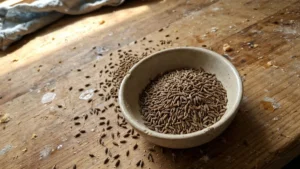
A cumin perfume is a fragrance built around the seed of Cuminum cyminum, a small annual plant of the parsley family that has been cultivated for thousands of years. The seed oil smells warm, earthy and faintly animalic, with a dry, sweaty edge and a dark, resinous warmth underneath.
The confusion around the note starts with the kitchen. Cumin is the defining smell of chilli powder, curries and the taco stand, and most people meet it as food before they ever meet it as perfume.
This guide explains what a cumin perfume is, how perfumers use the material, and how to tell it apart from its neighbours, caraway, coriander and cardamom.
- Key takeaway: A cumin perfume is built on seed oil from Cuminum cyminum, and it smells warm, earthy and faintly animalic.
- Key takeaway: The smell comes down to cuminaldehyde, a molecule that also explains why cumin can read as sweat on some skin.
- Key takeaway: Cumin usually sits at the top, where it opens loudly and then sinks into the heart of the wear.
- Key takeaway: The note is most at home in ambers, leathers and oriental fougères, where it keeps sweetness and woods from turning soft.
- Caveat: Cumin divides wearers more than any other spice, and a note list does not guarantee you will enjoy it, so always test on skin first.
What a cumin perfume actually is
A cumin perfume is any fragrance in which cumin seed oil plays a named, perceptible role. The material is the oil drawn from the crushed, dried seed by steam distillation; botanically, that seed is the plant’s fruit.
The smell deserves a precise description, because a note list alone cannot carry it.
Cumin is not a soliflore subject in the way rose or jasmine are. No mainstream perfume is named after the note, and it almost never leads a composition.
How perfumers use cumin and what to look for

Perfumers reach for cumin when a composition needs warmth with an edge. In an amber, a small dose dries the resins and keeps them from turning sweet. In a leather, it gives the hide a worn, broken-in character.
When you are reading a note list, look at where the cumin sits. At the top, it will greet you loudly and fade within the hour, as it does in Danger Pour Homme, where Roja Dove placed it at the very top of the pyramid. In the heart, it will warm the middle of the wear, as it does in Le Male, where it sits among the cinnamon and orange blossom. Our coriander perfume guide explains the same top-versus-heart distinction for another spice note, and the logic carries over.
Also look at the company it keeps. Saffron and incense around it mean a dark amber; leather and tobacco mean a worn masculine drydown; lavender and vanilla mean a classic fougère.
9 facts about cumin perfume
The smell of cumin comes down to one aldehyde, and it is also the smell of warm skin
Cumin seed oil is typically a third to a half cuminaldehyde, also called p-cumenal, and that single molecule carries most of the note’s character.
What It Shows: The warmth and the animalic edge of cumin are not two separate traits; they are the same molecule doing two jobs at once.
What to Consider: Because cuminaldehyde is so dominant, cumin can smell almost like skin in a light composition, and the spice can be hard to find.
Best For: Understanding why cumin makes a perfume smell like a person rather than a product.
Material: Cuminaldehyde, the dominant constituent of cumin seed oil.
Price Range: Cuminaldehyde is cheap and widely available, which keeps the oil affordable.
Standout Feature: One molecule, two readings, warm spice and warm skin at the same time.
Cumin smells like skin, which is why a little of it makes a perfume feel worn rather than sprayed
The animalic character of cumin comes from the way cuminaldehyde overlaps with the smell of warm skin, and perfumers use that overlap deliberately.
What It Shows: Cumin is the note perfumers reach for when a scent needs to feel lived-in, and its value is in the effect, not in the smell itself.
What to Consider: Because the effect is about skin, the note reads differently on different people, and that is normal rather than a failure of the perfume.
Best For: Training your nose to catch the note mid-wear.
Material: Cumin seed oil as a skin-like warmth in the heart of a perfume.
Price Range: The effect costs little; the rest of the composition sets the price.
Standout Feature: A spice that makes a perfume smell worn, not sprayed.
The cumin on a spice rack is often caraway in disguise
Cooks confuse cumin with caraway, and the confusion is understandable: both are dried fruits of the parsley family, both are warm spices, and both turn up in rye bread and sauerkraut.
What It Shows: The two spices are not interchangeable, and a perfume that lists caraway is not a cumin perfume.
What to Consider: Caraway smells cooler, greener and more anise-like, because it is dominated by carvone, while cumin is warmer and earthier.
Best For: Knowing which spice you are actually smelling before you judge the note.
Material: Cumin seed oil, distinct from caraway seed oil.
Price Range: Both oils are inexpensive; the confusion costs nothing extra.
Standout Feature: Two kitchen spices, two different perfume materials.
Cumin seeds were buried with Tutankhamun, and the Bible lists cumin among the tithes
Cumin is one of the oldest spices on record, with seeds recovered from the tomb of Tutankhamun, and a mention in the Gospel of Matthew as one of the herbs the Pharisees tithed, alongside mint and dill.
What It Shows: The note is older than almost any other spice in the perfumer’s palette, and its first job was in the kitchen and the temple, not the perfume bottle.
What to Consider: The ancient history is why cumin still reads as earthy and elemental rather than as exotic or modern.
Best For: Placing the note in the history of scent.
Material: Cumin seed, used as a spice and a medicine for thousands of years.
Price Range: History adds nothing to the price; the oil stays cheap.
Standout Feature: A spice with a tomb, a tithe and three thousand years of recorded use.
Cumin belongs to the parsley family, the same family that gives perfumery coriander and angelica
Cuminum cyminum is a member of the Apiaceae, the parsley family, which also gives perfumery coriander seed oil, caraway and angelica root.
What It Shows: The warm spices of perfumery are mostly cousins, and the family resemblance explains why they blend so well together.
What to Consider: Because the family is so large, a note list that names one member does not guarantee the others are absent; houses often blend several.
Best For: Seeing the note as part of a family, not as a lone spice.
Material: Cumin seed oil from the parsley family.
Price Range: Family oils are all inexpensive, which keeps the note affordable.
Standout Feature: One family, four perfume materials, and a shared warm character.
Cumin keeps an amber dry, dark and unsweet
In an amber composition, cumin sits under the resins and gives them a dry, animalic edge, so the benzoin and vanilla never turn into dessert.
What It Shows: Cumin is a structural spice in amber, and its value is in the sweetness it removes, not in the smell it adds.
What to Consider: Because the work is structural, the note can be hard to pick out, and that is how the material behaves rather than a failure of the perfume.
Best For: Understanding why some ambers smell dark and dry while others smell sweet and golden.
Material: Cumin seed oil as a drying agent in amber accords.
Price Range: The drying work costs little; the resins set the price.
Standout Feature: The spice that stops amber from smelling like dessert.
Cumin and leather are regular partners, because both smell warm, worn and faintly animalic
Cumin turns up in leather perfumes more than in any other family, from Wanted by Night to Tobacco Mandarin, because the two materials share a warm, worn, faintly animalic character.
What It Shows: The pairing is not an accident; it is two materials with the same smell profile reinforcing each other.
What to Consider: Because both materials are animalic, the combination can read as sweaty on some skin, and that is part of the style.
Best For: Choosing between the warm spices when you are building a leather wardrobe.
Material: Cumin seed oil alongside leather accords.
Price Range: The pairing costs nothing extra; the leather sets the price.
Standout Feature: Two warm, worn materials that smell like each other.
Cumin treated digestion in Ayurveda long before it scented a bottle
Cumin was a digestive medicine in Ayurveda and in Unani medicine centuries before perfumers used it, prescribed for bloating and sluggish digestion, and the warming reputation it earned there is the same warmth perfumers borrow today.
What It Shows: The note’s warmth is not a perfume invention; it is the same property healers valued for centuries.
What to Consider: The medicinal history explains why cumin still reads as warm and grounding rather than as sharp or medicinal.
Best For: Seeing the note as part of a longer story than perfumery alone.
Material: Cumin seed, used as a digestive remedy in Ayurveda and Unani medicine.
Price Range: The history costs nothing extra; the oil has always been affordable.
Standout Feature: A medicine for centuries before it was a perfume note.
Cumin divides wearers more than any other spice note, and the split is about association, not genetics
Some wearers love the warmth of cumin and some read it as sweat, and the split runs through every review thread of every cumin perfume.
What It Shows: Hating cumin is not a matter of a broken nose; it is a matter of association, and associations can change with exposure.
What to Consider: If you are one of the people who find cumin sweaty, try it in a leather or an amber first, where the resins soften the edge.
Best For: Explaining the cumin divide to anyone who has ever argued about it.
Material: Cumin seed oil, the most divisive spice in perfumery.
Price Range: The divide costs nothing; the cheapest cumin perfumes divide opinion just as sharply as the dearest.
Standout Feature: The clearest split in all of perfumery, and it is about memory, not biology.
How cumin compares with the other warm spice notes
Caraway is the closest neighbour, and the easiest to confuse with cumin. Both are warm spices from the parsley family, but caraway is cooler, greener and more anise-like, with a minty lift, while cumin is warmer, earthier and more animalic. In a blend, cumin warms and darkens, while caraway cuts and freshens.
Coriander sits further away. It is lighter, more citrusy and more floral, because it is dominated by linalool, and it warms a scent without ever smelling of skin. Black pepper is sharper still, pungent and dry, with a bite that cumin never has. Our oregano perfume guide compares another warm herb along the same spectrum, from soft to sharp.
The food connection deserves its own comparison, because it is the one thing cumin does that no other warm spice does. No other spice note carries a kitchen association as strong as cumin’s, and that association is why a first-time wearer can smell dinner where a regular wearer smells amber.
The caveats that matter
Cumin is a well-behaved material, but it has limits worth knowing before you buy. It is unrestricted in perfumery, and the seed oil is generally well tolerated, yet cuminaldehyde can irritate sensitive skin, especially at high doses.
| Detail | What is known |
|---|---|
| The material | Steam-distilled oil from the dried seed of Cuminum cyminum |
| Main constituent | Cuminaldehyde, roughly a third to a half of the seed oil |
| Smell | Warm, earthy and faintly animalic, with a dry, sweaty edge |
| Pyramid position | Usually top, sometimes heart, rarely the base |
| Cumin versus caraway | Caraway is cooler and more anise-like; cumin is warmer and earthier |
| Best partners | Amber, leather, tobacco, saffron, incense and vanilla |
| Watch out for | Can read as sweat on some skin; divides opinion more than any other spice |
| Price | Seed oil is inexpensive; the bottle price comes from the rest of the formula |
Longevity is the other honest caveat. Cumin is a top note, and in most compositions it can fade within an hour or two, leaving the amber, leather and woods to carry the rest of the wear. That is the material behaving as it always does, not a fault in the bottle.
Checklist: understanding a cumin perfume honestly
- Confirm the note is cumin, not caraway, by checking the note list and the house description.
- Look at where the note sits: top means a loud greeting, heart means a warm middle.
- Notice what sits around it: amber and incense mean dark and resinous, leather and tobacco mean worn and masculine, lavender and vanilla mean a classic fougère.
- Test on skin, not paper, and wait an hour to judge the heart, where cumin usually settles.
- Ask how long it lasts on you, because cumin fades fast in most compositions.
- Remember the divide is about association: if cumin smells of sweat to you, try it in a leather or an amber first.
Frequently asked questions
Does cumin in perfume really smell like sweat?
Sometimes, and honestly so. Cumin shares part of its smell with warm skin, because cuminaldehyde is close in character to the compounds skin produces. On some people it reads as body odour, and on others it reads as warm spice. The only way to know which camp you fall into is to test it on your own skin.
If cumin is so strong, why does it fade within the hour?
Because it is a top note with a light, volatile character, and in most compositions there is little base to hold it. The seed oil itself lasts several hours at full strength, but in a perfume the balance shifts as the top evaporates, and the amber and woods take over.
Is a cumin perfume too much for a first date?
It can be, if the cumin is loud. A fougère like Le Male, where the cumin sits in the heart under vanilla, is a safer first-date choice than a cumin-led amber like Fate Man. Wear it once at home first, and see how it reads on your skin before taking it out.
How do I tell cumin from caraway in a perfume?
Cumin is warmer, earthier and more animalic, because it is dominated by cuminaldehyde. Caraway is cooler, greener and more anise-like, because it is dominated by carvone. If the spice smells like skin, it is cumin; if it smells like rye bread, it is caraway.
My skin reacted to a spicy perfume — was it the cumin?
Possibly. Cuminaldehyde can irritate sensitive skin, especially at high doses, though it is generally well tolerated and unrestricted in perfumery. If your skin reacts to fragranced products, patch test on the inner arm first, as our tarragon perfume guide also advises, and stop using the perfume if redness or itching appears.
What is the best cumin perfume for a beginner?
Start with Le Male, where the note is warm and gentle under vanilla, then try Brit Rhythm for Him Intense to hear it doing darker work in a leather. The contrast between the two teaches you more about cumin than any description can, and both are easy to find.
The bottom line
A cumin perfume is a fragrance built on the warm, earthy seed oil of Cuminum cyminum, a material with three thousand years of recorded use and a central role in the history of the warm spices.
Once you can pick cumin out of a blend, you will hear it everywhere, from the fougères of the 1990s to the niche ambers of today, and you will understand a little more about how perfumers use a difficult material to make a scent smell alive.