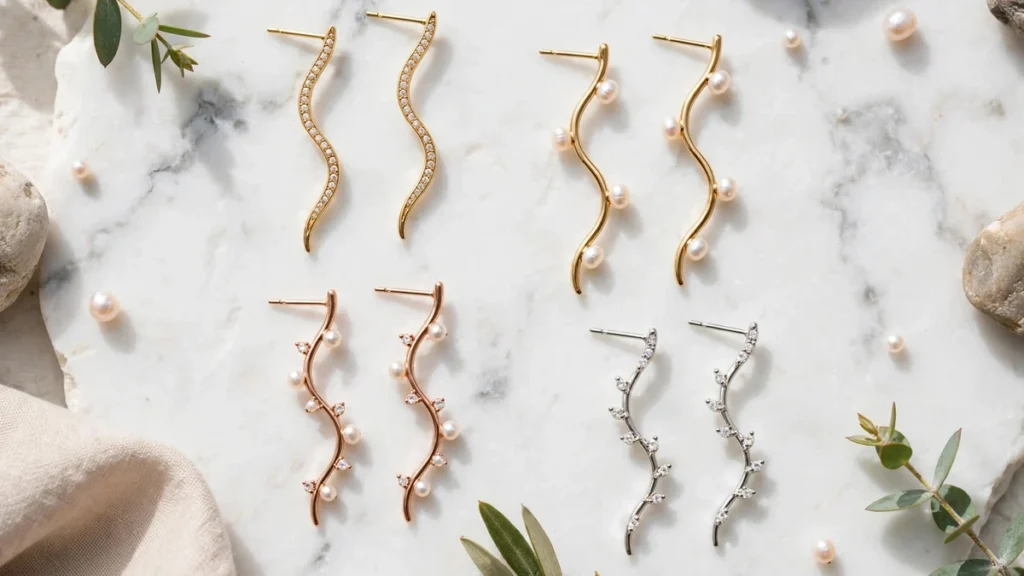
Climber earrings are the quiet overachievers of the jewellery box. Instead of dangling from the lobe, they sweep upward along the ear, following its curve with a line of stones or a sculpted band of metal, and they give the look of a full ear cuff without the pinch or the piercing. They sit somewhere between a stud and a statement earring, which is exactly why they have become a favourite for people who want their ears to look considered without wearing anything heavy.
The problem is that not all climbers are made equal. A good one follows the natural curve of the ear, sits flat against the skin, and stays put through a long day. A bad one pokes, slides, or catches on hair and scarves, and the stones that looked delicate in a product photo turn out to be stiff and uncomfortable. The difference usually comes down to the curve, the weight, and the quality of the post and backing, not the price tag alone.
Below are nine climber earrings worth considering in 2027, from a classic diamond line to sculptural gold and affordable crystal versions. Each one is described by what it is good at, what to watch for, and who it suits best, so you can choose a pair that climbs gracefully rather than fights your ear.
Key takeaways
- Climber earrings sweep up along the ear from the lobe, giving the look of a cuff without extra piercings or pressure.
- The curve matters more than the stones: a climber that follows your ear’s natural shape sits flat, stays comfortable, and looks intentional.
- Solid 14k gold and sterling silver are the practical choices for daily wear, while vermeil and plated finishes wear through fastest where the earring touches skin.
- Look for a secure post and a sturdy backing, and try them on with your hair down as well as up, since climbers catch on loose hair more than studs do.
- No climber earring is an investment, and a pair that pinches, slides, or leaves a mark after an hour is the wrong shape for your ear, however pretty it looks.
What climber earrings actually are
A climber earring, sometimes called a crawler or an ear climber, is a single piece that starts at the piercing in the lobe and extends upward along the outer edge of the ear. The lower end is anchored by a post through the lobe, and the upper end rests against the cartilage, held in place by the curve of the metal and, in some designs, a small hook or a second post. The effect is a line of light that follows the ear, which reads as more deliberate than a stud and less dramatic than a full drop earring.
They became popular because they solve a real problem. Many people want the layered, styled look of multiple piercings without committing to more holes in their ears, and a climber gives that impression from a single piercing. They also suit people whose lobes are stretched or sensitive, since the weight is spread along the ear rather than pulling down from one point, although a heavy climber can still be uncomfortable if the curve does not match the ear.
There are two main kinds. A graduated climber uses stones that get smaller as they rise, which is the most flattering and the easiest to wear. A sculptural climber uses a continuous band of metal, sometimes with a single stone at the base, which is bolder and depends entirely on the quality of the curve. Both kinds work, but the graduated style is the safer first buy, and the sculptural style is the one to try once you know your ear’s shape.
How we chose these climbers and what to look for
Look first at the curve. A climber should follow the natural sweep of your ear without pressing into the cartilage or standing away from the skin. If you can, try it on before buying, and check it from the side as well as the front. A climber that looks straight from the front but gaps at the top will catch on everything and will not stay in place. Our guide to the best diamond earrings explains why fit matters as much as the stones, because an earring that does not sit well is one you will stop wearing.

Look next at the metal and the weight. Solid 14k gold is the most practical daily-wear choice, because it is light, hypoallergenic, and holds its finish. Sterling silver is a good, affordable alternative, but it tarnishes and needs regular cleaning. Vermeil and gold-plated climbers look identical at first, but the plating wears through fastest where the earring rubs against the ear, usually within one to three years of regular wear.
Finally, look at the post and the backing. A climber needs a sturdy post and a backing that grips, because the upper end of the earring acts as a lever and can work a loose backing off over the course of a day. Screw backs and large butterfly backs are the most secure. If the climber comes with a tiny, flimsy backing, replace it before you wear the earrings out, and keep a spare pair of backs in your jewellery box.
The 9 best climber earrings of 2027
Tiffany & Co. Diamond Climber Earrings
What we like: A graduated line of round brilliant diamonds in 18k gold that follows the ear beautifully, with excellent stone quality and a secure screw-back fitting.
What to consider: Premium price, and the smallest stones are delicate, so handle them gently when cleaning. Stone: Round brilliant diamonds, graduated. Setting: Prong, 18k gold. Best for: Evenings and special occasions. Price range: £2,500 to £4,000.
This is the benchmark climber. The curve is generous and well judged, the stones are bright and well matched, and the earrings sit flat without pressing. If you want one pair to wear for years, this is the one to save for.
Cartier Gold Climber Earrings
What we like: A smooth 18k gold sweep with no stones at all, which is elegant, lightweight, and impossible to date, with Cartier’s usual precision in the curve.
What to consider: No stones means no sparkle, so it is a quieter look, and the price reflects the name. Stone: None. Setting: Solid 18k gold band. Best for: Everyday polish and work. Price range: £1,200 to £2,000.
David Yurman Cable Climber Earrings
What we like: The signature twisted cable in sterling silver with a small diamond at the base, comfortable to wear, and instantly recognisable without being loud.
What to consider: Silver tarnishes and needs regular polishing, and the cable texture can catch on fine hair. Stone: Pavé diamonds at the base. Setting: Cable, sterling silver. Best for: Everyday wear with character. Price range: £450 to £800.
The cable gives these climbers a texture that plain gold cannot match. They are a good middle ground between a simple stud and a full statement earring, and they work with both casual and formal outfits.
Mejuri Lab Diamond Climber Earrings
What we like: Lab-grown diamonds in a graduated line on solid 14k gold, bright and well made, at a fraction of the price of mined diamonds.
What to consider: Lab-grown diamonds hold almost no resale value, and the smallest stones need gentle cleaning. Stone: Lab-grown diamonds, graduated. Setting: Prong, 14k gold. Best for: Daily sparkle on a sensible budget. Price range: £250 to £450.
This is the best value in the roundup for anyone who wants real diamonds and solid gold without the luxury markup. The curve is comfortable, the stones are lively, and the earrings look far more expensive than they are.
Monica Vinader Pearl Climber Earrings
What we like: Small freshwater pearls climbing the ear on 18k gold vermeil, soft and romantic, with a gentle lustre that suits daytime wear.
What to consider: Vermeil wears through in one to three years with daily use, and pearls must never go in an ultrasonic cleaner. Stone: Freshwater pearls, graduated. Setting: Bezel, 18k gold vermeil. Best for: Daytime, weddings, and soft outfits. Price range: £120 to £200.
Pearls soften the climber look in a way diamonds cannot. These are a lovely choice for a wedding or a daytime event, and they are light enough to wear all day without noticing them.
Missoma Gold Climber Earrings
What we like: A slim 18k gold vermeil sweep with tiny cubic zirconia stones, light, affordable, and easy to layer with other earrings.
What to consider: Vermeil and cubic zirconia are not forever materials, and the stones are small, so the sparkle is subtle. Stone: Cubic zirconia, graduated. Setting: Prong, 18k gold vermeil. Best for: Trying the climber style for the first time. Price range: £85 to £140.
Maria Black Sculptural Climber Earrings
What we like: A bold, sculptural sterling silver sweep with an organic, hand-finished shape that looks like modern art on the ear.
What to consider: The sculptural shape suits some ears better than others, so try them on first, and silver needs regular cleaning. Stone: None. Setting: Solid sterling silver band. Best for: Fashion-forward outfits and evenings. Price range: £150 to £280.
Astrid & Miyu Crystal Climber Earrings
What we like: A graduated line of clear crystals on gold-plated brass, bright and cheerful, with a comfortable curve and a very friendly price.
What to consider: Gold-plated brass wears through fastest of all the finishes here, and crystals are not diamonds. Stone: Clear crystals, graduated. Setting: Prong, gold-plated brass. Best for: Evenings out and trying the trend. Price range: £45 to £75.
Thomas Sabo Silver Climber Earrings
What we like: Sterling silver climbers with small white zirconia stones, well made, comfortable, and a sensible price for solid silver.
What to consider: Silver tarnishes, and the zirconia stones are bright but not as lively as diamonds. Stone: White zirconia, graduated. Setting: Prong, sterling silver. Best for: Everyday wear and gifting. Price range: £90 to £160.
A reliable, everyday pair in solid silver. They are light, they sit well, and they are a good gift for someone who is new to climber earrings.
Which climber earring is right for you
Start with your ear. If your ear is small or close to your head, a short climber with five or six stones will fit better than a long, dramatic sweep. If your ear is larger, a longer climber will look balanced rather than lost. The best test is simple: put the earring on, look from the side, and check that the top of the climber follows the ear without standing away or pressing in.
Then think about your hair. Climbers catch on loose hair more than studs do, especially long, fine hair and styles that fall over the ears. If you wear your hair down most of the time, choose a smooth, low-profile climber with no sharp edges or protruding prongs. If you wear your hair up, you can be bolder, because the earring will be visible and will not be fighting your hair all day.
Finally, match the metal to your other jewellery. A gold climber looks best with gold chains and rings, and a silver climber with silver. Mixing metals can work, but it is harder to make it look deliberate with a climber, because the earring is so visible. A statement necklace can compete with a climber, so keep the neckline simple when the earrings are doing the work, and let one piece lead.
The caveats that matter
Climbers are comfortable when they fit, and miserable when they do not. The most common problem is a curve that does not match the ear, which causes pinching at the top or a gap that catches on hair. The second most common problem is weight. A climber with large stones at the top pulls forward and works the backing loose, so the heaviest stones should always sit at the base, near the lobe.
| Detail | What is known |
|---|---|
| What they are | Earrings that sweep up along the ear from a single lobe piercing, with no extra piercings needed |
| Best metal for daily wear | Solid 14k gold, then sterling silver; vermeil and plating wear through in 1 to 3 years |
| Most important fit check | The curve should follow the ear without pressing in or standing away from the skin |
| Who should avoid them | People with very sensitive cartilage, or anyone whose ears are irritated by pressure on the upper ear |
| Biggest practical problem | Catching on loose hair, scarves, and high collars, especially with prong-set stones |
| Backing | Use a sturdy screw back or large butterfly back, and keep spares, because the lever effect loosens small backs |
| Cleaning | Warm water and mild soap, soft brush, dry fully; never put pearls in an ultrasonic cleaner |
| What they are not | They are not an investment, and they do not suit every ear shape, however pretty they look in a photo |
If your ears are sensitive, choose solid gold or implant-grade titanium posts, and avoid nickel-plated brass. If a climber leaves a red mark or an ache after an hour, it is the wrong shape for your ear, not a sign that you need to get used to it. Earrings should be comfortable from the first wear, and a good climber is one you forget you are wearing.
Checklist: choosing climber earrings honestly
Use these checks before you buy, and again after a full day of wearing them.
- Check the curve: it should follow your ear without pressing in or standing away from the skin.
- Check the weight: the heaviest stones should sit at the base, near the lobe, not at the top.
- Check the metal: solid 14k gold or sterling silver for daily wear; vermeil only for occasional use.
- Check the backing: a sturdy screw back or large butterfly back, with spares in your jewellery box.
- Check with your hair down: wear them with loose hair and a scarf before deciding they are comfortable.
- Check the price honestly: a climber is a fashion piece, not an investment, so buy the best metal you can afford and enjoy it.
Frequently asked questions
Do climber earrings need extra piercings?
No. A climber is worn through a single standard lobe piercing, and the upper end rests against the ear without a hole. That is the whole point: the look of multiple piercings from one piercing.
Are climber earrings comfortable all day?
They are when the curve matches your ear and the weight is reasonable. If a climber pinches, slides, or aches after an hour, the shape is wrong for your ear, and no amount of getting used to it will fix that.
Can I wear climber earrings with long hair?
Yes, but choose a smooth, low-profile pair with no sharp prongs, and be ready to tuck your hair behind your ears. Prong-set stones catch on fine hair more than bezel-set stones or smooth metal bands.
Do climber earrings suit small ears?
Yes, with a shorter climber. Look for five or six stones rather than a long sweep, and check the length against your ear before buying. A climber that is too long will stand away from the top of a small ear.
Are gold or silver climbers better?
Solid 14k gold is the most practical for daily wear, because it is light, hypoallergenic, and holds its finish. Sterling silver is a good, affordable alternative, but it tarnishes and needs regular cleaning. Both are better than vermeil for a pair you plan to wear often.
How do I clean climber earrings?
Warm water, mild soap, and a soft brush, then dry them fully before storing. Do not use an ultrasonic cleaner on pearls or on earrings with glued stones, and store climbers flat so the curve does not get bent out of shape. Our guide to gold jewellery for everyday wear has more on keeping fine jewellery looking new.
The bottom line
The best climber earrings in 2027 are the ones that follow your ear, not the ones with the biggest stones. A graduated diamond line in solid gold is the classic choice, a sculptural silver sweep is the most interesting, and an affordable crystal pair is the smartest way to try the style before committing. Whichever you choose, fit comes first, metal second, and stones third.
Try them on with your hair down, check the curve from the side, and wear them for a full day before deciding. A climber that sits flat, stays put, and feels like nothing is the right one, and it will earn its place in your jewellery box far longer than a prettier pair that pinches.