A cashew farm retreat is a different kind of luxury. There is no lobby chandelier, no spa menu the length of a novel, and no view staged for a photograph. Instead there is a working orchard, a house with wide verandas, and a day shaped by the trees.
What makes these stays worth seeking out is how close they put you to the crop. A cashew grows at the end of a bright, fleshy apple, inside a shell that must be roasted before it can be opened safely, and on a good farm stay you see every stage of that journey, from the flowering branches to the drying yard.
Below are nine cashew farm retreats worth considering in 2027, from a riverside farmhouse in Vietnam to a hillside eco-villa in the Philippines. Each pick below notes its strengths, its limits, and the traveller it suits best.
Key takeaways
- A cashew farm retreat is a working farm stay, not a resort with a few trees planted for decoration, so expect early mornings and mud on your shoes.
- Visit during harvest season to see shelling, roasting, and drying in action; outside those months the farm is quieter.
- Never eat a cashew straight from the tree. The raw shell contains an irritating oil, and the nuts must be roasted or steamed before they are safe to shell and eat.
- Book the room on the farm itself, because the dawn walk and the evening roast happen before and after day visitors leave.
- No farm stay can guarantee a harvest, a sunny week, or a particular crop, and a retreat that promises all three is selling a brochure, not a farm.
What a cashew farm retreat actually is
A cashew farm retreat is a stay built around a working cashew orchard. The farm grows the crop, processes at least some of it on site, and hosts a small number of guests in rooms, cottages, or a converted farmhouse on the land. The stay is organised around the farm day rather than a hotel schedule, so meals are served when the kitchen is ready and walks follow the orchard paths.
That is the appeal, and also the thing to understand before you book. A cashew orchard is a farm, not a garden. The ground is uneven, the trees drop fruit and leaves, the drying yard smells of warm nuts, and the work goes on whether guests are watching or not. If you want to learn how a cashew gets from a tree to a table, it is hard to beat.
The nine stays below were chosen for the quality of the farm experience, not the thread count. Each one is in a real cashew-growing region, lets guests see the crop being worked, and feeds guests from its own land or farms nearby. Prices are indicative nightly bands for a double room in 2027, and they move with the season.
How we chose these nine stays
We started with the crop. A stay only made the list if it sits inside a genuine cashew-growing region, grows or processes cashews on the property or with a named neighbouring farm, and lets guests watch or join at least one stage of the work. A farmhouse near an orchard you cannot enter did not qualify.

We then looked at the stay itself: a comfortable bed, food cooked on the farm, a host who knows the crop, and a price that matches what is offered. The cheapest stay here is a simple riverside farmhouse and the most expensive is a full-service eco-villa, and both earn their place. Our guide to luxury pecan farm retreats follows the same rule, judging the farm first and the fittings second.
The 9 best luxury cashew farm retreats of 2027
Bình Phước, Vietnam
What we like: Vietnam’s cashew heartland, with a riverside farmhouse, a host family that has grown cashews for three generations, and a drying yard you can walk through at dawn. What to consider: The harvest season is short, the farmhouse is simple, and the nearest town is a forty-minute drive.
Best For: First-time farm travellers who want a gentle introduction. Style: Riverside farmhouse. Price Range: $180–$320 per night. Standout Feature: A dawn walk through the drying yard while the nuts are still warm from the sun.
The farm sits on a bend of a slow river, and the orchard runs right down to the water.
Kollam, Kerala, India
What we like: A historic cashew town, an orchard lodge run by a processing family, and a kitchen that cooks with cashew in ways most visitors have never tasted. What to consider: The heat is real from March onwards, and the lodge is small and books up early.
Best For: Food lovers who want to taste the whole cashew. Style: Orchard lodge. Price Range: $220–$360 per night. Standout Feature: A cooking session that uses the cashew apple as well as the nut.
Kollam has processed cashews for generations, and the lodge leans into that history.
Korhogo, Ivory Coast
What we like: The heart of the world’s largest cashew-growing country, a savanna estate with wide orchards, and a harvest season that fills the whole farm with work. What to consider: Flights and roads take planning, French helps a great deal, and the estate is remote.
Best For: Travellers who want the real scale of the crop. Style: Savanna estate. Price Range: $260–$420 per night. Standout Feature: Standing in an orchard that stretches to the horizon in every direction.
Ivory Coast grows more cashews than any other country, and Korhogo is where much of that crop begins.
Mtwara, Tanzania
What we like: A coastal plantation house near the southern cashew belt, warm Indian Ocean air, and an orchard that meets the bush at the edge of the farm. What to consider: The coast is hot and humid, the plantation house is old and full of character, and the drive from the nearest city is long.
Best For: Couples who like slow mornings by the sea. Style: Coastal plantation house. Price Range: $300–$470 per night. Standout Feature: Breakfast under the cashew trees with the ocean breeze coming through the orchard.
Mtwara is where Tanzania’s cashew country meets the coast, and the plantation house sits in the middle of that meeting point.
Ceará, Brazil
What we like: The cashew’s home country, a hillside eco-villa above the orchards, and a farm that presses its own cashew apple juice. What to consider: The harvest falls in the southern spring, and the villa is up a steep track that needs a sturdy car.
Best For: Photographers chasing golden light. Style: Hillside eco-villa. Price Range: $340–$520 per night. Standout Feature: Sunset over the orchard from the villa terrace, with cashew apple juice in hand.
The cashew tree is native to Brazil, and Ceará is one of the places where that origin is still visible, in the wild-looking trees and the bright apples.
Ogbomosho, Nigeria
What we like: A colonial-era farmhouse in the Oyo cashew belt, a working orchard with a hand-shelling shed, and hosts who treat guests like family. What to consider: The farmhouse is old, the roads can be rough after rain, and the stay is best arranged through the farm directly.
Best For: Travellers who want to see real farm work. Style: Colonial-era farmhouse. Price Range: $390–$570 per night. Standout Feature: Watching hand-shelling up close and trying it yourself under supervision.
Ogbomosho sits in one of Nigeria’s main cashew belts, and the farmhouse here has been in the same family for decades.
Nampula, Mozambique
What we like: A garden bungalow stay in the northern cashew region, quiet orchards, and a farm that sells its nuts through a local cooperative. What to consider: The region is off the usual tourist route, the bungalows are simple, and the farm’s English is limited.
Best For: Families with older children who like the outdoors. Style: Garden bungalow. Price Range: $440–$620 per night. Standout Feature: A garden where children can pick fallen cashew apples and taste them fresh.
Nampula is Mozambique’s cashew country, and the bungalows here sit in a garden that blends into the orchard without a fence between them.
Banteay Meanchey, Cambodia
What we like: A lakeside retreat house near Cambodia’s growing cashew belt, calm water, and a farm that is still young enough to feel like a discovery. What to consider: The farm is new to hosting, the rooms are few, and the lake is seasonal.
Best For: Solo travellers who want quiet and space. Style: Lakeside retreat house. Price Range: $490–$670 per night. Standout Feature: A private lakeside deck where the orchard meets the water at dusk.
Cambodia’s cashew belt is younger than most on this list, and the retreat house has the feel of a place still finding its shape, in a good way.
Quezon, Philippines
What we like: A jungle-edge lodge in a province where cashew grows alongside coconut and banana, with a kitchen that cooks farm food three times a day. What to consider: The lodge is at the end of a rough track, and the jungle is loud at night.
Best For: Small groups who travel together. Style: Jungle-edge lodge. Price Range: $540–$720 per night. Standout Feature: A communal table where the whole lodge eats together under the trees.
Quezon’s cashew grows in mixed orchards, and the lodge here sits at the edge of the jungle with the trees pressing in on three sides.
Cashew country, explained
The cashew tree is native to the dry northeast of Brazil, and it travelled from there to Africa and Asia in the sixteenth century, carried by Portuguese traders. Today the largest growers are Ivory Coast, India, Vietnam, and Tanzania, and the largest processor is Vietnam, which buys raw nuts from across Africa and Asia. That journey, from a smallholder orchard to a roasting plant to a packet on a shelf, is the reason a farm stay matters: it is the only way most travellers see the start of the chain.
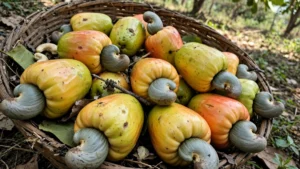
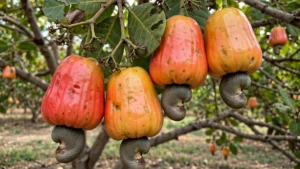
The tree itself is unusual. The nut grows outside the fruit, at the end of a fleshy, pear-shaped apple that is sweet, sharp, and quick to spoil. The apple is eaten fresh, pressed into juice, or fermented into drinks, while the nut sits inside a hard shell that contains an irritating oil related to the one in poison ivy. That oil is why raw cashews are never sold raw: the nuts must be steamed or roasted before shelling, and the shelling itself is skilled work that is still often done by hand.
Harvest seasons move with the climate, and they are the key to timing a visit. In Vietnam, India, and West Africa the main harvest runs from February to May, in Tanzania from October to January, and in Brazil from September to December. If you want to see picking, drying, and roasting, travel inside those windows. Outside them the orchards are still beautiful, but the work is pruning, planting, and waiting, and the drying yard will be quiet. Our guide to luxury macadamia farm retreats makes the same point about its own crop.
The caveats that matter
A cashew farm retreat is a farm first and a hotel second, and the caveats all follow from that. The work is seasonal, the weather is part of the experience, and the farm cannot control either. A retreat that promises a harvest on a fixed date is either lucky or dishonest. Read the booking terms, ask what is included, and check how far the farm really is from the nearest town.
| Detail | What is known |
|---|---|
| Best time to visit | During harvest: February to May in Asia and West Africa, October to January in Tanzania, September to December in Brazil |
| How long to stay | Three to four nights is enough to see the farm work and settle in |
| Getting there | Most farms need a car or farm transfer, and the last stretch is often unpaved |
| What to pack | Sturdy closed shoes, layers, sun protection, and clothes you do not mind getting dusty |
| Allergies | Tell the farm about nut allergies before you book; cashew dust and shells are present across the property |
| Raw cashews | Never eat one straight from the tree; the raw shell holds an irritating oil and the nut must be roasted or steamed first |
| What the price covers | Usually the room and breakfast, sometimes full board; activities and transfers are often extra |
| What it does not do | It does not guarantee a harvest, dry weather, or a particular crop |
Allergies deserve a special note. Cashew is a tree nut, and a cashew farm is full of cashew dust, shells, and oil in the air during processing. If you or anyone travelling with you has a nut allergy, tell the farm before you book and ask honestly whether the stay is suitable.
Checklist: booking a cashew farm retreat honestly
Use these checks before you pay, and again the week before you travel.
- Check the harvest dates for your region and book inside them to see the work.
- Check what is included: room, meals, activities, and transfers are often priced separately.
- Check the journey: ask how long the last stretch takes and whether you need a car or transfer.
- Check the room is on the farm itself, not in a nearby town.
- Check the cancellation terms, especially for a harvest that could move with the weather.
- Check allergies and dietary needs with the farm in writing before you book.
Frequently asked questions
Which stay suits a first farm trip?
Bình Phước in Vietnam or Kollam in Kerala are the gentlest introductions on this list. Both have hosts used to first-time farm guests and orchards that are easy to walk. Save the more remote stays, such as Korhogo or Nampula, for a second trip.
Can children enjoy a cashew farm retreat?
Yes, for families with older children who can walk orchard paths and follow safety rules around the shelling shed. Younger children will enjoy the fallen apples and the animals, but the farm is a working place with tools, heat, and dust. Ask the farm about ages before you book.
Which months do cashew trees fruit?
It depends on the region. In Vietnam, India, and West Africa the main harvest is roughly February to May. In Tanzania it is October to January, and in Brazil it is September to December. The apples ripen over several weeks, so even inside harvest season the orchard changes day by day.
Is a cashew farm retreat a good couples trip?
They can be, in a quiet, unpolished way. A cottage in an orchard, dinner under the trees, and a morning walk before anyone else is awake suits couples who like slow days. Couples who want spas, cocktails, and room service will be happier at a resort, and our guide to luxury pistachio farm retreats makes the same distinction.
How much should I budget per night?
On this list, from around $180 a night for a simple riverside farmhouse to around $720 for a full-service jungle-edge lodge. Most stays fall between $260 and $570, and the price usually covers the room and breakfast, so check what is included before you compare two stays.
When is the right moment to lock in my booking?
For harvest season, two to three months ahead is sensible, because the small farm stays on this list have few rooms and harvest is the busiest time. Outside harvest, a few weeks is usually enough. If you are travelling for a specific harvest week, confirm the dates with the farm a week before you travel, because the season can move.
The bottom line
The best cashew farm retreat in 2027 is not the most expensive or the most polished. It is the one in a real cashew region, at harvest time, with a room on the farm itself and a host who knows the crop. Bình Phước and Kollam are the easiest places to start, Korhogo and Ceará are the most rewarding for travellers who want scale and origin, and Quezon is the best for a group that wants to share the table.
Choose one region, travel inside its harvest season, pack sturdy shoes and patience, and let the farm set the pace. That is the honest way to see how a cashew gets from a tree to a table, and it is an experience no packet of nuts will ever give you.