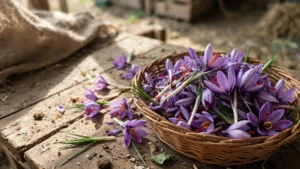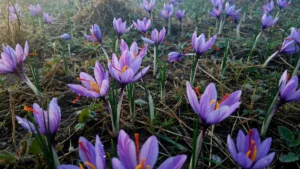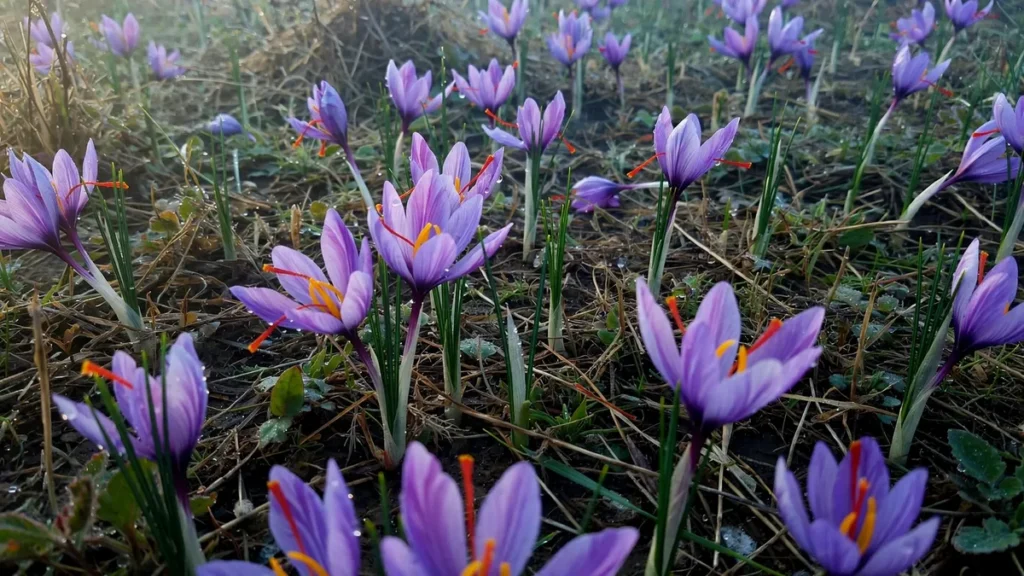
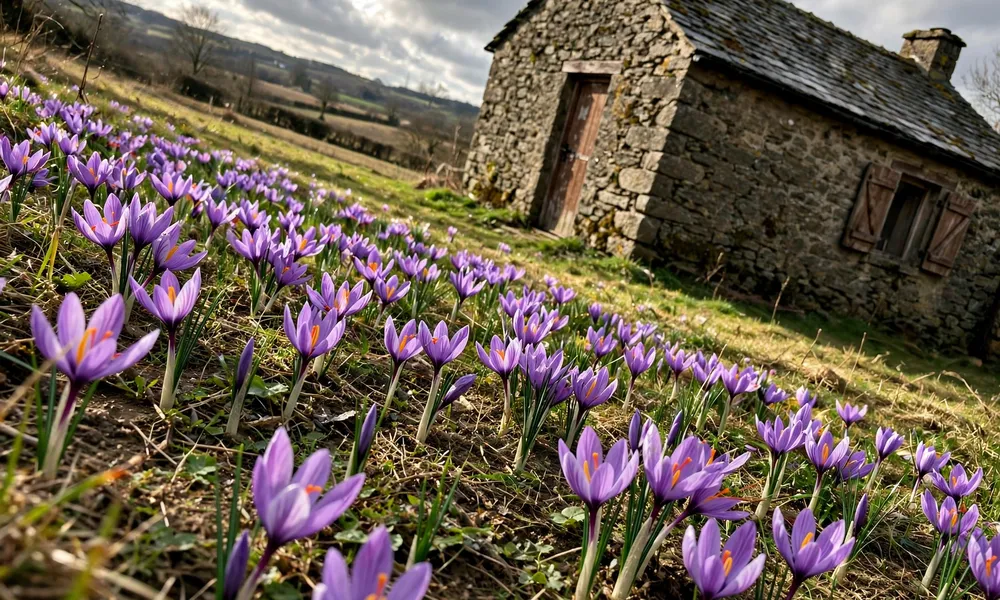
Saffron is the dearest crop a farm grows, and the briefest. A purple crocus flower opens for a single autumn morning, and before the sun warms it, a picker kneels in the row, lifts the bloom, and pulls three red stigmas from its heart. The flower is spent by noon. The stigmas dry to a thread the colour of rust, and a kilogram of them takes the flowers of a whole field, picked one by one.
A saffron farm retreat is a few nights on a working farm in the bloom weeks, when the rows turn purple at dawn and the kitchen cooks with the threads the fields gave that morning. You sleep in a farmhouse room, eat saffron folded into paella, risotto and tagines, walk the rows while the blooms are still closed, and watch the threads dried over a low fire. The farms stretch from the Ottoman hills of Turkey to the island farms of Tasmania, and the purple bloom ties them together.
Here are nine saffron farm retreats to weigh for 2027, from the cheapest Safranbolu stay to the dearest Glengarry farm, spanning Spanish, Moroccan, Greek, Italian, Kashmiri, French, English, New Zealand and Tasmanian saffron, so the choice turns on how you travel rather than the place on the map.
Key takeaways
- Saffron comes from the purple crocus flower: three red stigmas per bloom, picked by hand at dawn before the sun opens the petals.
- The bloom lasts two to three weeks in autumn, and the farm names its picking week rather than a month, so fix the week before the flights.
- A kilogram of dried saffron takes the stigmas of around 150,000 flowers, which is why no spice on earth costs more per gram.
- Saffron farms run small, with a few rooms and meals shared at one table, so expect plain comfort and cold mornings among the rows.
- Saffron carries no gluten, but the bread and pastry served beside it are usually wheat, so settle the kitchen and the calendar before you pay.
What a saffron farm retreat actually is
A saffron farm retreat is three to five nights on a working farm that grows saffron, with the bloom weeks as the reason for the trip. Guests sleep in a farmhouse room or a converted barn, eat what the farm kitchen cooks, and join the harvest, walking the rows at dawn to see the purple blooms open, the stigmas pulled by hand, and the threads dried and weighed for the table.
Saffron has been grown in warm, dry country for thousands of years, and the great saffron regions took shape around the dishes they served. Spain stirred its saffron into paella, Italy into risotto, Kashmir into kahwa and rice, Morocco into tagines, and Greece into teas and breads. The crop needs cold winters, hot dry summers and poor soil, so the farms sit on hills and high plains, where the ground drains fast and the autumn air stays clear.
Days on these farms follow the bloom’s timetable rather than a hotel’s, with supper at one shared table and real work offered to guests who ask for it.
How we picked these stays, and what to ask first
We began with where saffron truly grows, not where it sells best. A genuine saffron farm offers rows to walk through, blooms to stand among at dawn, and a kitchen working with its own threads. A farm that buys its saffron in is not a saffron farm, whatever the website says.
The best farms keep guest numbers small, so the picking stays real work rather than a show put on for visitors. They also spell out in the first email what the nightly rate covers, with supper, the drive in from the nearest town and walks among the rows counted in the price rather than billed on arrival. Plain talk about blooms, threads and drying is usually a sign the farm looks after its guests well too.
The 9 best luxury saffron farm retreats of 2027
Safranbolu, Turkey — Saffron in the Ottoman Hills
What we like: Saffron in Safranbolu grows on the terraced hills of the old Ottoman town, and the farm dries its threads over charcoal for pilaf and sweets. The hills are steep, the timber houses lean over the lanes, and the kitchen serves saffron pilaf, lamb with saffron, and warm lokum.
What to consider: The autumn mornings are cold at picking time, and the farm sits above the old town, so the walk down is steep.
Style: Turkish hill town farm stay. Best for: Travellers who want saffron where the town is named for it. Price range: $65–$95 per night. Standout feature: Threads dried over charcoal from the hill rows that morning.
Taliouine, Morocco — Saffron on the Atlas Slopes
What we like: Saffron in Taliouine grows on the dry slopes below the Anti-Atlas, and the farm folds its threads into tagines and mint tea. The slopes are bare, the villages keep their mud-brick walls, and the kitchen serves saffron tagine, couscous and warm bread.
What to consider: The sun is fierce by midday at picking time, and the farm sits far from the nearest city, so travel early in the day.
Style: Moroccan mountain farm stay. Best for: Travellers who want saffron from North Africa’s spice hills. Price range: $100–$130 per night. Standout feature: Threads from the Atlas slopes stirred into tagine the same day.
Kozani, Greece — Saffron on the Macedonian Plain
What we like: Saffron in Kozani grows on the wide plain of western Macedonia, and the farm brews its threads into tea and folds them into bread. The plain is open, the mountains stand beyond the fields, and the kitchen serves saffron tea, lamb with saffron, and warm village bread.
What to consider: The autumn wind is sharp at picking time, and the farm sits outside the town, so arrange the lift in advance.
Style: Greek plain farm stay. Best for: Travellers who want saffron from Greece’s oldest crocus ground. Price range: $135–$165 per night. Standout feature: Saffron tea brewed from the plain’s own threads at dawn.
Navelli, Abruzzo, Italy — Saffron on the High Plateau
What we like: Saffron in Navelli grows on the high plateau of the Abruzzo mountains, and the farm folds its threads into risotto and pasta. The plateau is wide, the peaks rise beyond the rows, and the kitchen serves saffron risotto, roast lamb and warm bread.
What to consider: The plateau nights are cold at picking time, and the farm sits far from the railway, so the drive in is long.
Style: Italian mountain plateau farm stay. Best for: Travellers who want saffron from Italy’s highest crocus fields. Price range: $170–$200 per night. Standout feature: Threads from the high plateau folded into risotto the same evening.
Pampora, Kashmir, India — Saffron in the Valley of Flowers
What we like: Saffron in Pampora grows on the karewa terraces of the Kashmir valley, and the farm brews its threads into kahwa and folds them into rice. The valley is wide, the mountains stand on every side, and the kitchen serves saffron kahwa, wazwan dishes and warm naan.
What to consider: The bloom is short and the farm books its rooms early, so write well ahead, and the valley roads are slow at picking time.
Style: Kashmiri valley farm stay. Best for: Travellers who want saffron where India grows it best. Price range: $205–$235 per night. Standout feature: Kahwa brewed from the valley’s own threads at first light.
Gâtinais, Loiret, France — Saffron in the Old Crocus Fields
What we like: Saffron in Gâtinais grows in the old crocus fields south of Paris, and the farm folds its threads into bouillabaisse and cream sauces. The fields are flat, the villages keep their stone barns, and the kitchen serves saffron bouillabaisse, roast chicken and warm bread.
What to consider: The autumn rain falls often at picking time, and the farm sits outside the village, so the walk back is muddy.
Style: French country farm stay. Best for: Travellers who want saffron from France’s revived crocus fields. Price range: $240–$270 per night. Standout feature: Threads from the old fields stirred into bouillabaisse at supper.
Saffron Walden, Essex, England — Saffron in the Market Town
What we like: Saffron in Saffron Walden grows in the small fields around the old market town, and the farm folds its threads into buns and puddings. The town is old, the church stands over the market square, and the kitchen serves saffron buns, roast pork and warm custard.
What to consider: The crop is small and the bloom is brief, so the farm takes few guests, and the English autumn is wet at picking time.
Style: English market town farm stay. Best for: Travellers who want saffron where England once grew it for trade. Price range: $275–$305 per night. Standout feature: Saffron buns baked from the town’s own small crop.
Mackenzie Country, New Zealand — Saffron on the High Plains
What we like: Saffron in Mackenzie Country grows on the high plains of the South Island, and the farm dries its threads for paella and baking. The plains are wide, the mountains stand beyond the rows, and the kitchen serves saffron paella, roast lamb and warm bread.
What to consider: The southern spring is changeable at picking time, and the farm sits far from the nearest town, so the drive in is long.
Style: New Zealand high country farm stay. Best for: Travellers who want saffron from the southern hemisphere’s newest crocus fields. Price range: $310–$340 per night. Standout feature: Threads dried from the high plains and stirred into paella the same night.
Glengarry, Tasmania, Australia — Saffron on the Northern Farms
What we like: Saffron in Glengarry grows on the small farms of northern Tasmania, and the farm folds its threads into risotto and cakes. The island air is clean, the fields run to the hills, and the kitchen serves saffron risotto, roast duck and warm scones.
What to consider: The farm is the dearest stay here, and the island weather turns fast at picking time, so plan a year ahead.
Style: Tasmanian island farm stay. Best for: Travellers who want saffron from Australia’s island farms. Price range: $345–$380 per night. Standout feature: Threads from the island rows folded into risotto at the farm table.
Which saffron region fits your trip
If you want saffron where the spice is treated as a feast, start with Safranbolu or Pampora, where the threads are picked, dried and served the same day they were lifted. Both suit a first visit, with gentle walks and long suppers at the farm table.
If you want scenery with your saffron, Glengarry puts the rows beside Tasmanian hills, Navelli on a high Italian plateau, and Mackenzie Country on the wide plains of the South Island.
If you want the crop that grows beside the saffron, our guide to the asparagus farm retreats covers a spring crop altogether, with green spears and butter instead of purple blooms and threads, and the tomato farm retreats offer a summer fruit for the warm months, with sauces and salads instead of dawn picking and drying.
The caveats that matter
Saffron farming answers to the weather: farms give a best guess, never a promise, and a trip pinned to one picking day gambles on rain. The real warning is the bloom itself, easy to miss when the stay is sold as gentle country.
| Detail | What is known |
|---|---|
| Best time to visit | Two to three weeks in autumn, when the purple blooms open at dawn and the stigmas are picked by hand, with the season shifting by region |
| What the work involves | Walking the rows at dawn, watching the blooms open and the stigmas pulled, and seeing the threads dried, weighed and cooked in the farm kitchen |
| How long a stay runs | Three to five nights, set around the picking weeks |
| Who should take care | Guests with a strong sensitivity to saffron or pollen, and anyone unused to cold dawns, steep muddy paths or thin mountain air |
| What the kitchen serves | Saffron paella, risotto, tagines, kahwa and saffron buns, with fresh bread and farm butter beside the plate |
| Gluten note | Saffron carries no gluten, but the bread and pastry served beside it are usually wheat, so ask the kitchen what it can safely serve |
| What to pack | Warm layers for cold dawns, closed walking shoes, a rain layer for sudden showers, and clothes that wash easily by hand |
| What it does not do | No promised picking day, no fixed menu, and no hotel-style service on a working farm |
Anyone with a strict gluten-free diet should ring the farm before booking. A single question about the kitchen and the saffron can save you a difficult stay, and a farm that answers honestly is usually worth the visit. The same caution appears in our ginger farm retreats, where the loaves on those tables are wheat as well.
Checklist: booking a saffron farm stay honestly
Run through this list before you pay, and go over it again in the week before you travel.
- Get the picking window in writing, and ask what happens if the blooms are still closed when you arrive.
- Confirm the nightly rate covers supper, the drive in from the nearest town and the walks among the rows.
- Ask whether the picking and drying happen on the farm, and whether the kitchen can serve a meal without saffron.
- Before you pay, ask to see the room itself, and test the taps, the bed and the heater, because farm rooms are simple.
- Pack for cold dawns and damp ground: warm layers, sturdy shoes, a hat, a rain layer for sudden showers, and clothes you can wash in a basin.
- Leave a day free for the nearest town, so a picking week that shifts still leaves you a good trip.
Frequently asked questions
Why is saffron the most expensive spice in the world?
Each crocus flower yields only three red stigmas, and every one is pulled by hand at dawn. It takes the blooms of around 150,000 flowers to make a kilogram of dried saffron, and that labour is what the price pays for, not the weight of the threads.
When do the farms pick their saffron?
Saffron blooms for two to three weeks in autumn, with the precise week shifting with the cold and the rain, so ask the farm for its picking window instead of a single date, and hold off booking flights until that window is fixed.
How can you tell real saffron from fake?
Real saffron threads are deep red with a paler orange tip, they smell of hay and honey, and they colour warm water a slow golden yellow. Threads that are uniformly orange, smell of nothing, or turn the water red at once are usually dyed, often safflower or turmeric, so buy only from the farm or a seller you trust.
Can guests join the picking in the rows?
Most farms let guests walk the rows, join the picking and sit at the kitchen table, and some invite you to pull the stigmas with the pickers. Picking is gentle work, so ask the farm what guests may do before you book, and expect purple-stained fingers either way.
Which saffron farm region should a first-timer pick?
Safranbolu is the easiest first trip: the rows are widest there, the farms are used to guests, and the saffron pilaf best shows what the crop can do. If you want the story as well as the plate, Pampora is the valley where saffron has been grown for generations.
Can you eat well gluten-free on a saffron farm?
Mostly. The fields, the picking and the harvest are worth the trip alone, and saffron carries no gluten, but the bread and pastry served beside it are usually wheat. Ask the farm what it can make without wheat for a gluten-free guest, and settle on the picking week before any week the kitchen bakes bread.
The bottom line
A saffron farm retreat suits travellers who prefer purple blooms, farm kitchens and saffron cooked the farm’s own way to a hotel. The threads come fresh and fragrant, the dishes run from paella to kahwa, and the finest stays feed you from ground they worked themselves.
Settle the picking week before the travel dates, and leave a spare day at the end. When the bloom opens on time you will eat threads picked that morning, and when it does not, the hills, the valleys and the old towns will still carry the trip.