


What’s the one pan in your kitchen that gets used every single morning, washed a dozen times a week, and quietly takes the blame when your eggs stick? For most people, it’s the non-stick skillet. And yet, few purchases are more confusing. Shelves are crowded with pans that all promise “easy release” and “durable coating,” and the price tags swing from fifteen dollars to over two hundred.
The truth is that the “best” non-stick pan doesn’t exist in the abstract. It depends on what you cook, how you treat your cookware, and how much you care about the chemistry hiding in that slick surface. This guide cuts through the marketing and focuses on what genuinely separates a great pan from a frustrating one.
Why Non-Stick Pans Are Worth Getting Right
Non-stick cookware earns its place for a simple reason: it does things other pans can’t. Delicate foods like eggs, fish, crepes, and omelets glide out intact. You can cook with far less oil, which matters if you’re watching fat intake. And cleanup takes seconds rather than a scrub-fest.
But a cheap non-stick pan is a false economy. Coatings wear out, and when they do, food starts sticking in patches and the pan ends up in the trash. Understanding what makes a coating last is the single best way to avoid buying the same pan twice in two years.
The Coating Question: PTFE, Ceramic, and What “PFOA-Free” Really Means
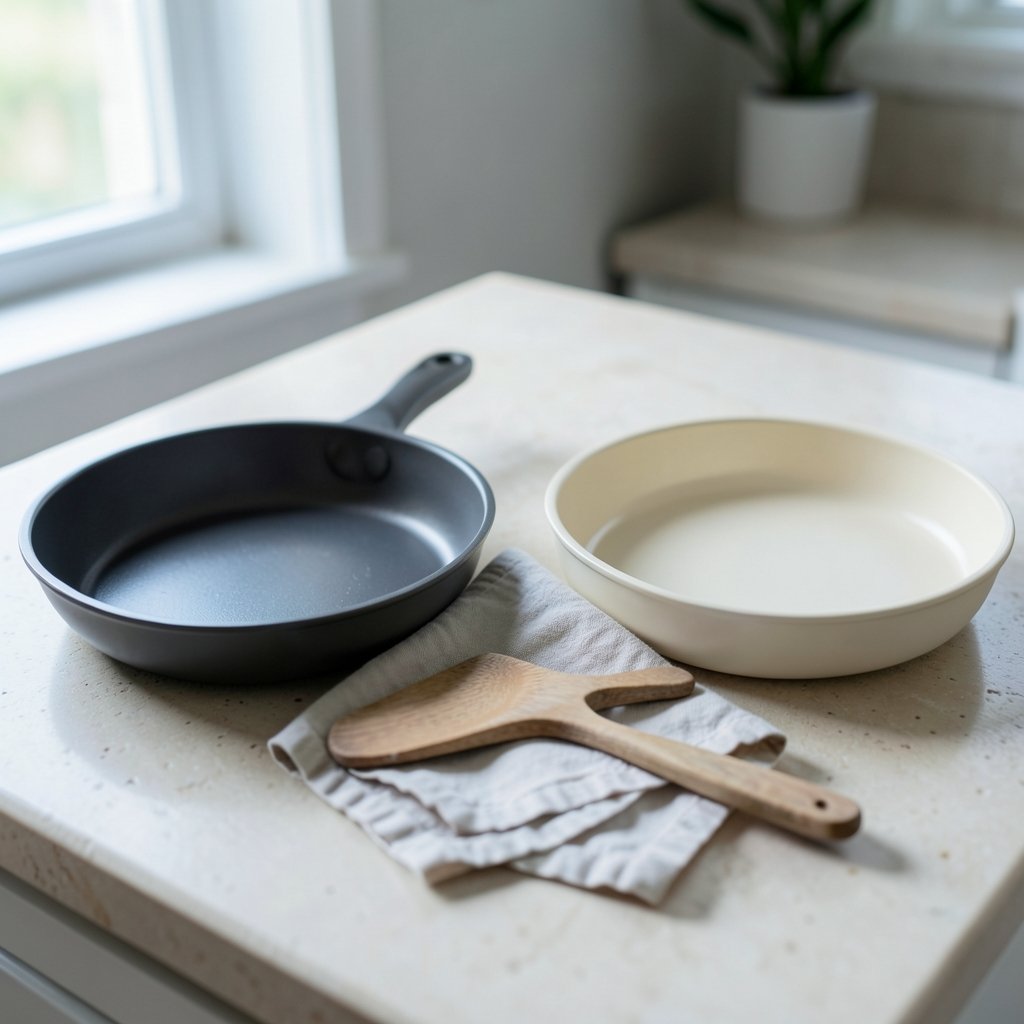
Most non-stick pans on the market use polytetrafluoroethylene (PTFE), the chemistry behind the Teflon brand. PTFE itself is inert and stable, and it delivers the slickest, longest-lasting release of any coating available. The concerns people hear about usually center on two things: processing aids and heat.
PFOA, a chemical once used in making PTFE, was phased out of US manufacturing under a voluntary program that aimed to eliminate it from emissions and products by 2015. That’s a genuine improvement. But here’s the catch that trips up a lot of shoppers: a “PFOA-free” label does not mean “PFAS-free.” Other fluorinated processing aids may still be involved, and the phase-out was voluntary and US-focused, so imported goods can vary. If chemical exposure is a priority for you, treat “PFOA-free” as one data point, not a clean bill of health.
Ceramic coatings take a different route. They’re PTFE-free, typically tolerate higher temperatures, and appeal to people who want to avoid fluoropolymers entirely. The trade-off is durability. Ceramic non-stick tends to lose its release performance faster than PTFE, and how fast varies wildly by brand. A ceramic pan can be wonderful for a year and disappointing by year two.
| Coating Type | Release Performance | Heat Tolerance | Typical Lifespan | Best For |
|---|---|---|---|---|
| PTFE (Teflon-type) | Excellent, longest-lasting | Degrades above roughly 260 °C / 500 °F | 2–5 years with care | Eggs, fish, everyday delicate cooking |
| Ceramic (sol-gel) | Very good when new | Higher, more heat-tolerant | 1–2 years typical | Low-oil cooking, PTFE-free households |
| Hard-anodized with coating | Good | Moderate | 2–4 years | Daily all-purpose use |
The Overheating Problem Nobody Talks About Enough
This is the practical safety issue that matters most, and it’s entirely within your control. Above roughly 260 °C (500 °F), PTFE coatings can begin to degrade. Push higher and they can release fumes that cause polymer fume fever in people and are lethal to pet birds. Exact thresholds vary by source, so treat that number as approximate and err on the side of caution.
What does that mean in practice? Never preheat an empty non-stick pan on high heat. Never leave one on a hot burner unattended. If you want a screaming-hot sear, reach for cast iron or stainless steel instead. Non-stick is a specialist, not a workhorse for high-heat cooking.
A common mistake: people crank the burner to maximum, walk away to chop onions, and come back to a pan that’s quietly cooking itself. Medium heat is almost always enough for non-stick. If you’re learning to build better habits around heat and timing, the same principle of deliberate practice applies here as anywhere: learn effectively with techniques that actually stick and the skills carry over.
What Separates a Good Pan From a Great One
Walk past the marketing copy and look at construction. These are the features that actually predict whether you’ll still like a pan in three years.
Base thickness and weight
A thin pan heats unevenly and warps. A heavier base distributes heat better and resists the dreaded “spinner” — a pan whose bottom has bowed so it wobbles on the burner. Pick up the pan before buying. If it feels flimsy, it probably is.
Handle comfort and attachment
The handle is where pans fail. Look for a riveted or welded connection that feels solid, and a grip that stays cool on the stovetop. A handle that’s too short or too slick is a burn waiting to happen, especially with a full pan of hot oil.
Induction compatibility
If you cook on induction, check the label. Compatibility depends on the base, not the coating — many non-stick pans include a magnetic base layer specifically for this. Don’t assume; verify.
Coating quality and reinforcement
Better pans use reinforced coating systems, sometimes with a textured surface or mineral particles mixed in to resist scratching. You can’t always see the difference on the shelf, but you’ll feel it after a year of daily use.
Matching the Pan to Your Actual Cooking
The best pan for a steak lover is not the best pan for someone who makes omelets every morning. Here’s how to think about it.
If eggs, fish, and delicate sauces dominate your cooking, invest in a quality PTFE skillet in the 24–28 cm range and treat it gently. If you want one pan for everything, a hard-anodized non-stick with a sturdy base handles most tasks reasonably well. If you sear, roast, or stir-fry at high heat, keep a cast iron or stainless pan alongside your non-stick — they’re partners, not competitors.
And if you’re assembling a broader kitchen setup, the same logic of matching gear to use case applies to other equipment too. The thinking behind choosing a VKB Gladiator mid-range flight stick that punches above its price mirrors what you want in cookware: solid build, honest value, no gimmicks.
Care Habits That Double a Pan’s Life
Manufacturers have recommended the same care basics for decades, and they work. None of this is exotic — it’s just consistency.
- Hand-wash with a soft sponge and mild soap. Dishwashers degrade coatings faster than anything else.
- Skip metal utensils. Silicone, wood, or plastic only. A single scrape with a fork can start a peel.
- Cook on medium heat. High heat is the enemy of every non-stick surface.
- Don’t stack pans unprotected. A felt pad or paper towel between pans prevents scratches.
- Let the pan cool before washing. Thermal shock warps bases and stresses coatings.
- Replace when the coating flakes. A scratched pan no longer does its job, and continuing to use it is a false savings.
One subtle point worth knowing: studies on PFAS migration from coated cookware generally indicate low migration under normal use, but the data are limited and research is ongoing. Damaged coatings are one more reason not to push a worn pan past its retirement date.
Buying Smart: Price, Disposal, and the Long View
Non-stick pans are consumables. Accept that going in and the whole experience gets less frustrating. Spending more buys you a better base, a better handle, and a coating that lasts longer — but no non-stick pan lasts forever, no matter what the box claims.
There’s also an end-of-life reality most buyers never consider. Non-stick pans are generally not recyclable in curbside programs because of their mixed materials and coatings. Check your local rules before you toss one, and consider whether a slightly more expensive pan that lasts four years beats three cheap ones that last one year each. It usually does, on both cost and waste.
If you’re the type who researches purchases thoroughly, you already know the drill: compare coatings, read the care instructions before buying, and ignore superlatives. That same instinct shows up in all kinds of buying decisions, from cookware to the surprisingly detailed world of what’s actually inside a Drumstick ice cream cone. Curiosity pays off.
A quick note on kitchen safety beyond the pan itself: burns and slips happen most often during the chaotic moments around the stove. Keeping your workspace clear and your movements deliberate — the same awareness that helps with something like a rib flare where your lower ribs stick out and posture habits — makes cooking safer and more comfortable.
Conclusion
The best non-stick pan isn’t the most expensive one or the one with the loudest claims. It’s the one whose coating matches your cooking style, whose base feels solid in your hand, and whose care routine you’ll actually follow. Choose PTFE if you want the longest-lasting release and you’re careful with heat. Choose ceramic if avoiding fluoropolymers matters more to you than longevity. Either way, cook on medium, wash by hand, and retire the pan the moment the coating starts to fail.
Buy one good pan instead of three mediocre ones. Your eggs, your wallet, and your patience will all thank you.
Frequently Asked Questions
Is a more expensive non-stick pan actually worth it?
Often, yes — but not for the reason people assume. The extra money usually goes into a thicker base, a sturdier handle, and a better coating system, all of which extend usable life. A thirty-dollar pan that lasts four years beats a fifteen-dollar pan that lasts one. That said, price isn’t a guarantee; check construction and care instructions rather than trusting the tag.
How often should I replace a non-stick pan?
Most non-stick pans last two to five years with good care. Ceramic coatings often fall at the shorter end. Replace yours when the coating scratches, flakes, or develops sticky patches that no amount of oil fixes. Continuing to cook on a damaged coating defeats the purpose of owning a non-stick pan at all.
Is “PFOA-free” the same as safe?
Not exactly. PFOA was phased out of US PTFE manufacturing under a voluntary program targeting 2015, which is a real improvement. But “PFOA-free” doesn’t mean “PFAS-free” — other processing aids may still be used, and imported products can vary. If avoiding fluoropolymers entirely is your goal, a ceramic coating is the more direct choice.
Can I use a non-stick pan for high-heat searing?
It’s not the right tool. Above roughly 260 °C (500 °F), PTFE coatings can begin to degrade, and at higher temperatures they can release fumes harmful to people and deadly to pet birds. For searing, use cast iron or stainless steel. Keep non-stick for eggs, fish, and gentle cooking.
Do non-stick pans work on induction cooktops?
Many do, but it depends on the base, not the coating. Induction-compatible pans include a magnetic layer in the base. Check the packaging or the pan’s underside for an induction symbol before buying. Never assume compatibility just because a pan is labeled non-stick.
What’s the single biggest mistake people make with non-stick pans?
Preheating an empty pan on high heat. It’s the fastest way to damage the coating and the most common cause of overheating incidents. Medium heat, a little oil or butter, and a few seconds of patience will outperform a blazing burner every time — and your pan will last years longer.














