Ruby is the most romantic of the coloured stones, and also one of the most misunderstood. Its deep red reads as confident and warm, and on a bracelet it adds colour without needing a lot of size. The problem is not finding a ruby bracelet. It is finding one where the stone is what it claims to be, because most rubies on the market are treated, some are filled with glass, and a few are entirely lab-created, and the price difference between those is enormous.
That is why this guide is organised by what actually matters: the stone, the treatment, and the setting. Heat treatment is standard and stable. Glass filling is a much bigger deal, and it should always be disclosed, because it changes both the value and the care the bracelet needs. And a bracelet that looks beautiful in a photograph can still be a poor choice if the stones are set high, the clasp is weak, or the metal is too soft for everyday wear.
Below are nine ruby bracelets worth considering in 2027, from a classic tennis bracelet to a slim everyday bangle. Each one is described by what it is good at, what to watch for, and who it suits best, so you can choose with the stone in mind, not just the colour.
Key takeaways
- Ruby is red corundum, rated 9 on the Mohs scale, which makes it one of the most durable coloured stones for a bracelet worn daily.
- Most rubies are heat-treated to improve colour and clarity. That is standard and stable, but it should always be disclosed.
- Glass-filled rubies look similar at a glance but are worth far less, need gentle care, and must never go in an ultrasonic or steam cleaner.
- A bezel or channel setting protects the stones better than tall prongs on a bracelet that will knock against desks and door frames.
- Ruby is a beautiful, hard-wearing stone, but it is not an investment, and it has no proven healing properties.
What ruby actually is
Ruby is the red variety of corundum, the same mineral family as sapphire. Its colour comes from chromium, and the most valued reds are a rich, slightly pinkish red, often described as pigeon blood, with strong saturation and no brown or orange cast. Ruby comes mainly from Myanmar, Thailand and Mozambique, and the origin can affect the price, but for most buyers the colour and the treatment matter far more than where the stone was mined.
Hardness is the main reason ruby suits bracelets. At 9 on the Mohs scale, it is second only to diamond, which means it resists the scratches that a bracelet inevitably picks up. That matters more on the wrist than on a necklace, because a bracelet is constantly in contact with surfaces. A softer stone would show wear within a year. Ruby, properly set, will not.
What ruby does not offer is investment value in the way marketing sometimes suggests. Fine, untreated stones of exceptional colour are rare and very expensive, but most commercial rubies are abundant, treated, and sold for their beauty rather than their resale value. Buy a ruby bracelet because you love wearing it, not because you expect it to appreciate.
How we chose these bracelets and what to look for
Look first at the stone and its treatment. Ask whether the ruby is natural or lab-created, and whether it has been heat-treated or glass-filled. Heat treatment is routine and permanent, and it is nothing to worry about, but it should be stated plainly. Glass filling, by contrast, is a much more significant treatment: it fills fractures with lead glass, it can be damaged by heat, chemicals and ultrasonic cleaning, and it reduces the value sharply. A reputable seller will disclose it. If a price looks far too low for the size and colour, treatment is usually the reason.
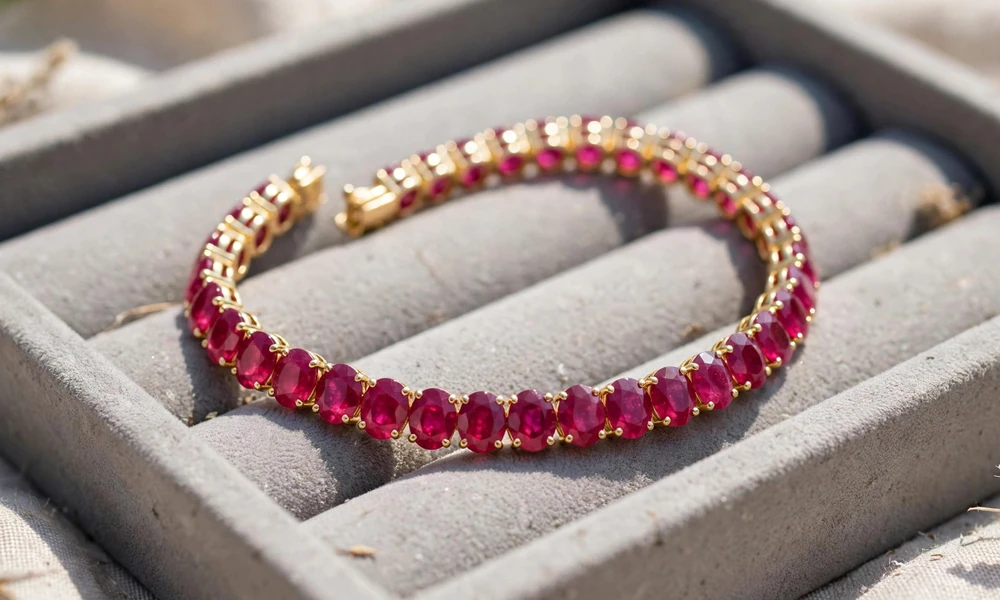
Look next at the setting and the clasp. A tennis bracelet with shared prongs is elegant, but the stones sit exposed, so check that the prongs are even and the stones do not wobble. A channel or bezel setting protects the stones better and is a sensible choice for daily wear. The clasp matters as much as the stones: a box clasp with a safety latch, or a secure lobster clasp on a bangle, is worth more than a pretty design that opens on its own. Our guide to the best diamond bracelets covers clasp types in the same way, because a bracelet that falls off is a bracelet you lose, whatever the stone.
Finally, look at the metal and the fit. Yellow gold warms ruby’s red beautifully and gives a classic, vintage feel. White gold and platinum give a cooler, more modern look. Measure your wrist properly and leave a little room: a bracelet that is too tight will feel uncomfortable by the afternoon, and one that is too loose will slide and knock. A good bracelet sits close to the wrist bone and moves a little, but not so much that it spins.
The 9 best ruby bracelets of 2027
Tiffany & Co. Ruby Tennis Bracelet
What we like: A classic line of round rubies in platinum or gold, evenly matched for colour, with a secure box clasp and a safety latch.
What to consider: Premium price, and the stones are heat-treated, as is standard. Stone: Natural ruby. Setting: Platinum or 18k gold, shared prongs. Best for: Formal occasions and milestone gifts. Price range: High.
This is the bracelet other ruby tennis bracelets are measured against. It is not the cheapest, and it is not the most adventurous, but for a classic, well-made line of matched red stones, it remains a strong first choice.
Cartier Ruby Line Bracelet
What we like: Clean, architectural lines, carefully matched stones, and Cartier’s reliable finishing, with a clasp that closes with a reassuring click.
What to consider: A slim profile, so it suits a smaller wrist best, and it is premium-priced. Stone: Natural ruby. Setting: 18k gold, shared prongs. Best for: Evening wear and understated luxury. Price range: High.
A refined, quiet piece for people who want ruby without a lot of ornament. It layers well with a watch or a plain gold bangle.
David Yurman Ruby Cable Bracelet
What we like: The signature twisted cable in sterling silver or gold, with a single ruby cabochon or pavé accent that feels modern rather than traditional.
What to consider: The cable design is a statement, so it is less suited to very formal outfits. Stone: Ruby, cabochon or pavé. Setting: Sterling silver or 18k gold, cable. Best for: Everyday wear with a designer feel. Price range: Mid to high.
For anyone who finds a tennis bracelet too formal, this is a good middle ground: recognisably designed, comfortable, and easy to wear most days.
Mejuri Ruby Tennis Bracelet
What we like: A fine, everyday tennis bracelet in 14k gold vermeil or solid gold, with small, well-matched rubies and a fair price for the quality.
What to consider: The stones are small, so the effect is delicate rather than dramatic, and vermeil needs gentler care than solid gold. Stone: Lab-created or natural ruby, depending on the option. Setting: 14k gold, shared prongs. Best for: Daily wear and first ruby jewellery. Price range: Affordable to mid.
A practical, modern entry point. It gives you the look of a ruby line bracelet at a price that makes daily wear feel easy rather than precious.
Monica Vinader Ruby Tennis Bracelet
What we like: A slim, elegant line bracelet in 18k gold vermeil over sterling silver, with rubies that are evenly coloured and well set.
What to consider: Vermeil will wear over time with heavy daily use, so it needs care and occasional re-plating. Stone: Ruby. Setting: Gold vermeil, shared prongs. Best for: Occasion wear and gifting. Price range: Mid.
A good choice if you want a polished, gift-ready bracelet without a luxury price. Keep it for occasions rather than every single day and it will last well.
Missoma Ruby Bracelet
What we like: A contemporary design with a single ruby or a small cluster on a fine gold chain, light on the wrist and easy to layer.
What to consider: A delicate piece, so it is not built for rough daily wear, and the stone is small. Stone: Ruby. Setting: 18k gold vermeil, chain. Best for: Layering and everyday styling. Price range: Affordable to mid.
For layering, this is one of the easiest ruby bracelets to live with. It sits neatly beside a watch or a plain chain bracelet without competing.
Maria Black Ruby Bracelet
What we like: A sculptural, slightly edgy design, with rubies set into a modern, architectural form that feels very different from a classic tennis bracelet.
What to consider: A distinctive style, so it will not suit everyone, and it is best tried on first. Stone: Ruby. Setting: Sterling silver or gold, sculptural. Best for: Modern, minimal styling. Price range: Mid.
If classic jewellery feels too safe, this is the ruby bracelet to look at. It is a design-led piece, and the stone is part of the design rather than the whole point.
Astrid & Miyu Ruby Tennis Bracelet
What we like: A slim, wearable tennis bracelet in gold vermeil with rubies, priced for everyday luxury and finished with a neat, secure clasp.
What to consider: Vermeil needs care, and the stones are small, so the effect is subtle. Stone: Ruby. Setting: Gold vermeil, shared prongs. Best for: Daily wear and stacking. Price range: Affordable to mid.
A reliable, pretty bracelet for people who want ruby as part of a stack rather than a single statement piece. It stacks well with plain gold bangles.
Thomas Sabo Ruby Bracelet
What we like: A bold, well-made bracelet with rubies set into sterling silver, often with a charm or link detail that gives it personality.
What to consider: A heavier, more casual design, so it suits relaxed styling better than formal outfits. Stone: Ruby. Setting: Sterling silver, link or charm. Best for: Casual wear and gifting. Price range: Affordable to mid.
A good, characterful option if you want ruby in a bracelet that feels fun rather than formal. It is sturdy, wearable, and easy to gift.
Which ruby bracelet is right for you
For a first ruby bracelet, a slim tennis bracelet in yellow gold is the safest choice. It warms the red beautifully, it suits most wrists, and it works with both everyday and evening outfits. If you want something you can wear every day without thinking about it, choose a channel or bezel setting rather than tall prongs, and make sure the clasp has a safety latch.
For layering, a fine chain bracelet with a single ruby or a small cluster is easier than a full tennis bracelet. It sits flat, it does not compete with a watch, and it adds colour without weight. A ruby necklace in the same red can complete the set, but it is better to start with the bracelet and add the necklace later, once you know you love the colour on you.
For a milestone gift, a matched line bracelet from a house with a clear treatment disclosure is worth the premium. Ask for the stone’s origin and treatment in writing, check the clasp yourself, and keep the receipt and any certificate. A gift that comes with clear paperwork is a gift that can be serviced, resized and insured without arguments later.
The caveats that matter
Ruby is hard and durable, but it is not indestructible. A hard knock can chip a stone, especially at the girdle, and a bracelet is the piece most likely to take that knock. Glass-filled rubies need extra care: they should never go in an ultrasonic cleaner or a steam cleaner, they should be kept away from strong heat and harsh chemicals, and any repair work should be done by a jeweller who knows the stone is filled. If you are unsure whether your ruby is filled, ask a jeweller to check it before any cleaning or repair.
| Detail | What is known |
|---|---|
| Stone | Red corundum, Mohs 9, one of the hardest coloured stones for daily wear |
| Most common treatment | Heat treatment, standard and stable, should always be disclosed |
| Treatment to watch for | Glass filling, which lowers value and needs gentle care, no ultrasonic or steam cleaning |
| Lab-created ruby | Chemically the same stone, but worth far less than a natural one |
| Best setting for daily wear | Channel or bezel, which protects the stones better than tall prongs |
| Best metals | Yellow gold warms ruby’s red; white gold and platinum give a cooler, modern look |
| Cleaning | Warm soapy water and a soft brush; avoid ultrasonic cleaning for filled stones |
| What it does not do | It is not an investment, and it has no proven healing properties |
If you are buying a ruby bracelet as a gift, check the return policy and the warranty before you pay. A reputable seller will offer both, and will put the stone’s treatment and origin in writing. That paperwork matters more than any sales claim about rarity or value.
Checklist: choosing a ruby bracelet honestly
Use these checks before you buy, and again when the bracelet arrives.
- Check the treatment: ask whether the ruby is natural or lab-created, and whether it is heat-treated or glass-filled.
- Check the colour: it should be a rich, even red, with no brown or orange cast, and the colour should match across the stones.
- Check the setting: stones should sit firmly, with even prongs and no wobble, and the setting should sit low on the wrist.
- Check the clasp: a box clasp with a safety latch, or a secure lobster clasp, that closes firmly and does not open on its own.
- Check the fit: measure your wrist and leave a little room, so the bracelet moves slightly but does not spin or slide.
- Check the paperwork: keep the receipt, the treatment disclosure, and any certificate, so the bracelet can be serviced and insured.
Frequently asked questions
Are ruby bracelets good for everyday wear?
Yes. Ruby is rated 9 on the Mohs scale, so it resists scratches well, and a channel or bezel setting protects the stones further. Choose a secure clasp and a low setting for the most comfortable daily wear.
What does heat-treated ruby mean?
It means the stone was heated to improve its colour and clarity. It is standard practice, it is permanent, and it is nothing to worry about, but it should be disclosed, because an untreated stone of the same colour is rarer and more expensive.
How can I tell if a ruby is glass-filled?
You usually cannot tell by looking. Glass-filled rubies are much cheaper than untreated or heat-treated stones of the same size, and a seller should disclose the treatment. If the price looks far too low, ask directly, and get the answer in writing.
Can I wear a ruby bracelet in the shower or swimming?
It is better not to. Water, soap and chlorine can dull the metal and loosen settings over time, and a bracelet is easy to lose in water. Take it off before swimming or showering, and clean it with warm soapy water and a soft brush instead.
Do ruby bracelets hold their value?
Most do not, in the investment sense. Fine, untreated stones of exceptional colour can hold value, but most commercial ruby bracelets are bought for beauty and wear, not resale. Buy one because you love it, and treat any resale value as a bonus.
What goes well with a ruby bracelet?
Yellow gold suits ruby best, and it pairs well with a simple watch or a plain gold bangle. For a bolder look, our guide to statement necklaces shows how to balance one strong colour piece without the outfit looking busy.
The bottom line
The best ruby bracelet in 2027 is not the most expensive or the one with the biggest stones. It is the one with a stone you understand, a setting that protects it, and a clasp you trust. For most people, that means a slim tennis bracelet in yellow gold, with heat-treated natural rubies, even colour, and a box clasp with a safety latch.
Ask for the treatment disclosure, check the clasp, measure your wrist, and keep the paperwork. Do that, and a ruby bracelet will be a piece you wear for years, not a purchase you second-guess.