Tanzanite is the most dramatic blue-violet stone you can buy for a fraction of the price of a fine sapphire, and that is exactly why it is so tempting. A deep, velvety tanzanite ring can look extraordinary on the hand, shifting from blue to violet to a hint of burgundy as the light changes. The problem is that tanzanite is also one of the softest stones commonly set in rings, and a stone bought for its colour alone can end up scratched, chipped, or dulled within a year of daily wear.
That is why this guide is organised around durability as much as beauty. A tanzanite ring is a wonderful choice for occasional wear, for an evening ring, or for a right-hand ring you do not knock about all day. It is a poor choice for a ring you will wear while gardening, lifting weights, or working with your hands. The setting matters just as much as the stone: a bezel or halo protects the edges where tanzanite is most vulnerable, while a high, exposed prong setting leaves it at risk.
Below are nine tanzanite rings worth considering in 2027, from a classic solitaire to sculptural and stacking styles. Each one is described by what it is good at, what to watch for, and who it suits best, so you can choose with your eyes open, not just your heart.
Key takeaways
- Tanzanite is a blue-violet variety of zoisite (Mohs 6.5 to 7), mined only in the Merelani Hills of Tanzania, and it changes colour from blue to violet to burgundy as the light shifts.
- Almost all tanzanite is heat treated to remove its natural brown tint; the treatment is standard and stable, but it must be disclosed.
- Tanzanite is soft for a ring stone, so bezel and halo settings protect it best, and it should never go in an ultrasonic or steam cleaner.
- Colour matters more than size: a smaller, deeply saturated violet-blue stone looks better than a large, pale, greyish one.
- Tanzanite has no proven healing properties, it is not an investment stone, and glass and synthetic spinel are common imitations.
What tanzanite actually is
Tanzanite is the blue-violet variety of the mineral zoisite, and it comes from a single place on earth: a small mining area in the Merelani Hills of northern Tanzania. It was only discovered in the late 1960s, which makes it a very young gemstone compared with sapphire or ruby, and its single source is part of its appeal. When the mine eventually runs out, there is no second source to turn to.
What makes tanzanite special is pleochroism: the stone shows different colours from different angles. A good stone looks blue from one direction, violet from another, and sometimes a flash of burgundy in warm light. Rough tanzanite is usually brownish, and almost all of it is gently heated to bring out the blue-violet colour. That treatment is standard, stable, and permanent, but a seller should always disclose it, and a certificate from a reputable laboratory should state it plainly.
The stone is also notably soft for jewellery that takes daily knocks. At Mohs 6.5 to 7, it is harder than opal or pearl, but softer than sapphire, ruby, or spinel, and it has a distinct cleavage, which means a sharp blow in the wrong direction can split it. That is not a reason to avoid tanzanite. It is a reason to choose the setting carefully and to treat the ring as a piece for considered wear, not for rough daily use.
Tanzanite is graded mainly on colour, and the grading is simpler than it looks. Stones are described by their hue, tone, and saturation, and the most valuable show a strong violet-blue with no grey or brown. Larger stones tend to show deeper colour, which is why a two-carat tanzanite often looks richer than a half-carat one of the same quality. Because the mine is small and the stone is found nowhere else, supply is limited, but that scarcity has never made tanzanite a reliable investment, and it should not be bought as one.
How we chose these rings and what to look for
Look first at the colour. The best tanzanite is a saturated violet-blue, vivid in daylight and still rich indoors. Pale, greyish stones look washed out, and very dark stones can read almost black in low light. Ask to see the stone in daylight and in warm indoor light before you buy, because tanzanite changes more between light sources than almost any other gemstone.

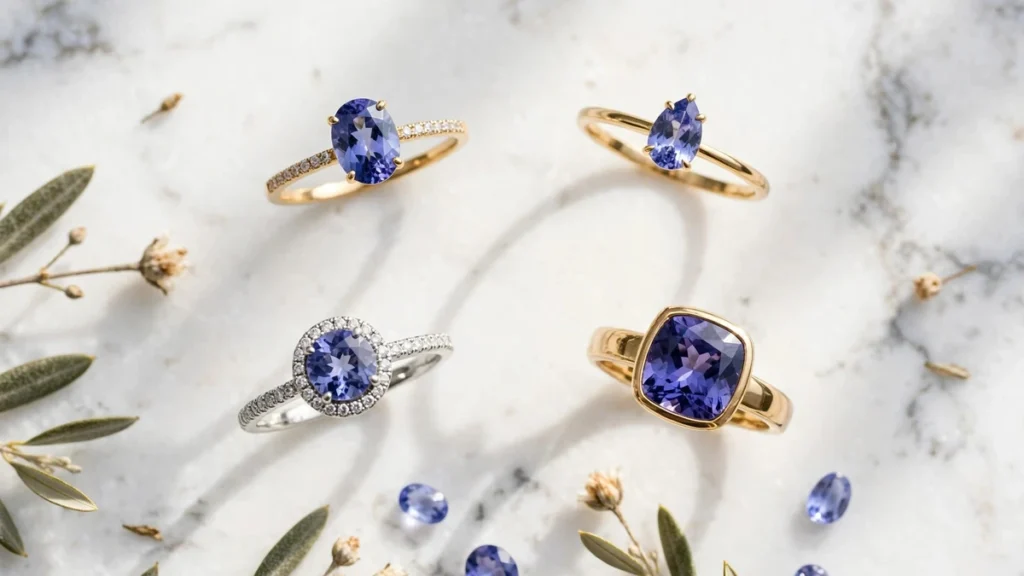
Look next at the setting. A bezel setting wraps the stone in metal and protects its edges and corners, which is where tanzanite is most vulnerable. A halo of small diamonds adds protection and makes the centre stone look larger. High prong settings look elegant but leave the stone exposed, so they suit occasional wear rather than everyday use. Our guide to tanzanite bracelets explains the same trade-off, because the stone needs the same care wherever it is set.
Finally, look at the paperwork and the price. A reputable laboratory certificate should confirm the stone is natural tanzanite, note the heat treatment, and state the carat weight. Prices rise steeply with colour saturation and size, so a smaller stone with vivid colour is usually better value than a large, pale one. Be wary of very cheap stones sold as tanzanite: glass and synthetic spinel are common imitations, and they lack the pleochroism that makes real tanzanite change colour.
The 9 best tanzanite rings of 2027
Tiffany & Co. Tanzanite Solitaire
What we like: A classic solitaire with a vivid violet-blue stone in a clean four-prong setting, beautifully finished, with a certificate confirming natural tanzanite and heat treatment. What to consider: Premium price, and the exposed prongs suit occasional wear rather than rough daily use. Stone: Natural tanzanite, vivid violet-blue. Setting: Four-prong solitaire in platinum or 18-karat gold. Best For: A special-occasion ring or a statement right-hand ring. Price Range: Premium.
Cartier Tanzanite and Diamond Ring
What we like: A deep blue tanzanite framed by small diamonds that add sparkle and protect the centre stone, with Cartier’s precise, understated craftsmanship. What to consider: A high price for the carat weight, and the stone still needs gentle care despite the halo. Stone: Natural tanzanite with diamond accents. Setting: Diamond halo in 18-karat gold or platinum. Best For: An evening ring or a milestone gift. Price Range: Premium.
David Yurman Tanzanite Cable Ring
What we like: A sculptural cable band that gives the ring a distinctive look, with a well-saturated oval tanzanite set low enough to sit comfortably for daily wear. What to consider: The cable design adds weight, and the stone should still be removed for hands-on work. Stone: Natural oval tanzanite, violet-blue. Setting: Cable band in sterling silver or 18-karat gold. Best For: Everyday elegance with a designer signature. Price Range: Mid to premium.
Mejuri Tanzanite Bezel Ring
What we like: A modern bezel setting that wraps the stone in gold and protects its edges, at a far more accessible price than the heritage houses, with clear treatment disclosure. What to consider: Smaller stones than the luxury options, and the bezel can make the stone look slightly smaller. Stone: Natural tanzanite, medium violet-blue. Setting: Bezel in 14-karat gold. Best For: A first tanzanite ring or everyday wear. Price Range: Mid-range.
Monica Vinader Tanzanite Signet Ring
What we like: A bold signet shape that suits tanzanite well, because the low, flush setting protects the stone and the wide band suits a larger stone. What to consider: A signet is a strong look, so it suits confident styling rather than a delicate stack. Stone: Natural tanzanite, violet-blue. Setting: Flush signet in 18-karat gold vermeil or solid gold. Best For: A statement ring with built-in protection. Price Range: Mid-range.
Missoma Tanzanite Cocktail Ring
What we like: A generous, deep-coloured stone in a gold cocktail setting that shows off tanzanite’s colour change, at a price that makes the stone accessible. What to consider: A large stone in a high setting is best saved for evenings and events, not daily wear. Stone: Natural tanzanite, deep violet-blue. Setting: Cocktail setting in gold vermeil. Best For: Evenings, events, and special occasions. Price Range: Affordable to mid-range.
Maria Black Tanzanite Sculptural Ring
What we like: An architectural, sculptural design that treats the tanzanite as part of a modern piece of jewellery rather than a traditional solitaire, with a good colour stone. What to consider: The sculptural style is distinctive and may not suit a classic jewellery wardrobe. Stone: Natural tanzanite, violet-blue. Setting: Sculptural setting in sterling silver or gold. Best For: A modern, fashion-led ring. Price Range: Mid-range.
Astrid & Miyu Tanzanite Stacking Ring
What we like: A slim stacking ring with a small, vivid tanzanite that layers well with plain gold bands, making the stone easy to wear every day. What to consider: The stone is small, so the colour change is subtle, and stacking rings can rub against each other. Stone: Natural tanzanite, violet-blue. Setting: Slim band in gold vermeil or solid gold. Best For: Stacking and everyday wear. Price Range: Affordable.
Thomas Sabo Tanzanite Charm Ring
What we like: A playful charm-style ring with a bright tanzanite accent, good colour for the price, and an easy entry point into the stone. What to consider: A fashion ring rather than a fine jewellery piece, and the stone is small. Stone: Natural tanzanite, bright violet-blue. Setting: Charm setting in sterling silver. Best For: A first tanzanite piece or a gift. Price Range: Affordable.
Which tanzanite ring is right for you
If you want a ring to wear every day, choose a bezel or low halo setting with a medium-sized stone, and take it off for the gym, the garden, and any hands-on work. The Mejuri bezel and the David Yurman cable are the most practical shapes in this guide, because the stone sits low and its edges are protected. A stacking ring also works well for daily wear, because the stone is small and the band is slim.
If you want a ring for evenings and occasions, a solitaire or cocktail ring shows off the colour change at its best. The Tiffany solitaire and the Missoma cocktail ring are the strongest choices here, because their stones are deeply saturated and they catch the light beautifully. Save them for times when the ring will be seen and admired, not knocked about.
Colour should drive the decision more than size. A one-carat stone with vivid violet-blue colour will look better on the hand than a three-carat stone that is pale and greyish, and it will usually hold its appeal longer. Our guide to tanzanite necklaces makes the same point, because the stone’s colour is what makes it worth buying in the first place.
Metal choice matters too. Yellow gold warms the stone and brings out its violet side, while white gold and platinum emphasise the blue. Rose gold can clash with the cool tones of tanzanite, so try the stone against the metal in daylight before committing. A ring you will wear often should also be comfortable: a smooth, rounded band with no sharp edges will sit better on the finger through a long day than a wide, flat one.
The caveats that matter
Tanzanite is a beautiful stone with real limits, and the limits are what most buyers learn too late. It is softer than sapphire and it cleaves, so a hard knock on a doorframe or a worktop can chip or split it. It should never be cleaned in an ultrasonic cleaner or a steam cleaner, because vibration and heat can damage the stone, and it should be cleaned only with warm water, mild soap, and a soft brush.
| Detail | What is known |
|---|---|
| What it is | Blue-violet zoisite, mined only in the Merelani Hills of Tanzania |
| Hardness | Mohs 6.5 to 7, softer than sapphire and ruby, with a distinct cleavage |
| Treatment | Almost all tanzanite is heat treated to remove brown tint; standard, stable, must be disclosed |
| Best setting | Bezel or halo, which protect the edges; high prongs suit occasional wear only |
| Colour | Saturated violet-blue is best; pale or greyish stones look washed out |
| Cleaning | Warm water, mild soap, soft brush only; never ultrasonic or steam cleaning |
| Common imitations | Glass and synthetic spinel, which do not show tanzanite’s colour change |
| What it is not | It has no proven healing properties and is not an investment stone |
Tanzanite is sometimes sold with claims about energy, healing, or spiritual benefits. There is no scientific evidence for any of those claims, and they should not influence what you pay. Buy the stone for its colour and its beauty, and judge it on those terms alone. A certificate from a reputable laboratory is the only reliable proof of what you are buying.
Checklist: choosing a tanzanite ring honestly
Use these checks before you buy, and again before you wear the ring for the first time.
- Check the colour in daylight and in warm indoor light: it should be vivid violet-blue in both, not grey or black.
- Check the setting: a bezel or halo protects the stone best; a high prong setting suits occasional wear.
- Check the certificate: it should confirm natural tanzanite, state the heat treatment, and give the carat weight.
- Check the price against the colour, not the size: vivid colour is worth more than a large, pale stone.
- Check the care rules: warm water and mild soap only, never ultrasonic or steam cleaning, and remove it for hands-on work.
- Check the seller: buy from a reputable jeweller who discloses treatment and offers a laboratory certificate.
Frequently asked questions
Is tanzanite good for an everyday ring?
It can be, if the setting protects it. A bezel or low halo setting with a medium stone works well for daily wear, as long as you remove the ring for the gym, gardening, and hands-on work. A high prong solitaire is better kept for occasions.
Is all tanzanite heat treated?
Almost all of it, yes. Rough tanzanite is usually brownish, and gentle heating brings out the blue-violet colour. The treatment is standard, stable, and permanent, and a reputable seller will always disclose it on the certificate.
Can I wear a tanzanite ring every day?
You can, with care. Remove it before exercise, housework, and anything that risks a hard knock, and clean it only with warm water and mild soap. With that care, a well-set tanzanite ring can be worn daily for years.
How do I know my tanzanite is real?
Look for pleochroism: real tanzanite shifts from blue to violet to burgundy as you turn it in the light. Glass and synthetic spinel imitations do not do this. A certificate from a reputable laboratory is the surest check.
Is tanzanite a good investment?
No. Tanzanite comes from a single mine, which sounds promising, but gemstones rarely appreciate reliably, and resale values are usually well below retail. Buy it because you love the colour, not as a financial investment. A guide to engagement rings is a useful comparison, because it shows how durability and resale shape a ring’s long-term value.
Can tanzanite go in an ultrasonic cleaner?
No. Ultrasonic and steam cleaning can damage tanzanite, and they can loosen the setting. Clean it only with warm water, mild soap, and a soft brush, and have a jeweller check the setting once a year.
The bottom line
The best tanzanite ring in 2027 is the one whose colour you love and whose setting you trust. A vivid violet-blue stone in a bezel or halo setting, bought with a laboratory certificate and worn with a little care, is a beautiful and distinctive piece of jewellery. The stone’s colour change is genuinely unlike anything else at this price, and that is the honest reason to buy it.
Choose for colour first, setting second, and size third. Take the ring off for rough work, clean it gently, and it will reward you for years. That is the practical way to enjoy one of the most beautiful blue stones in the world without learning its limits the expensive way.