
You know the feeling: a wardrobe full of clothes and nothing to wear. The rail is crowded and the drawers are stuffed, yet every morning brings the same small crisis — too many pieces that almost work, too few that actually go together.
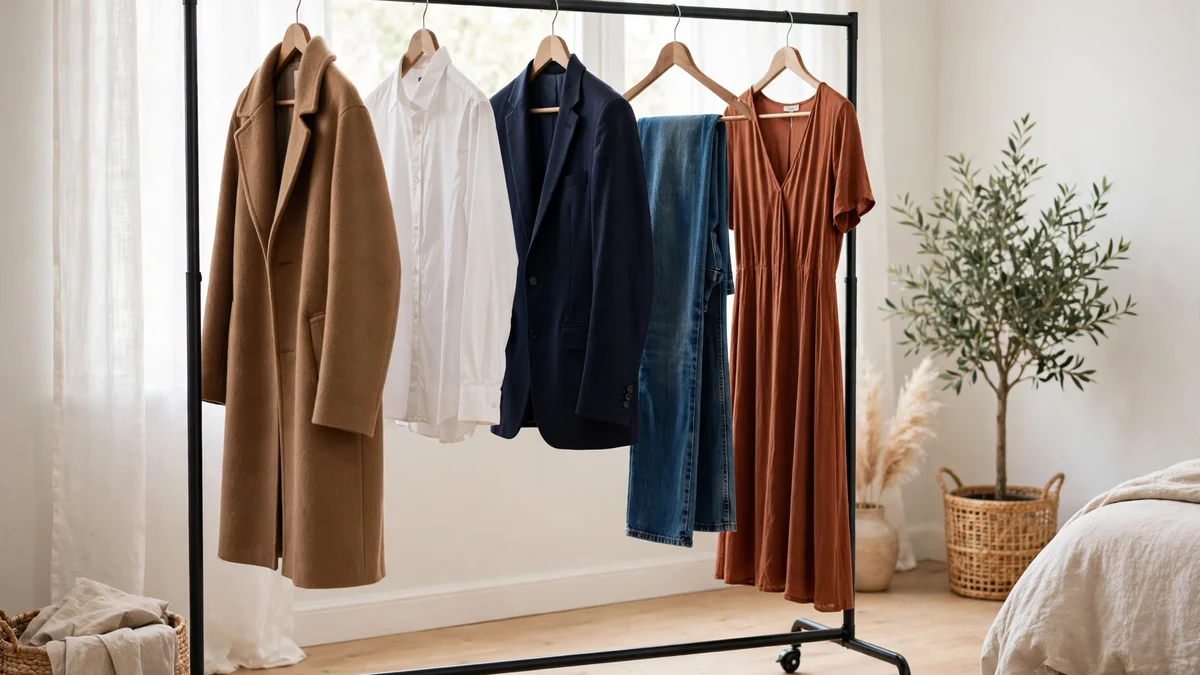
A capsule wardrobe is the opposite of that crowded rail: a small, deliberate collection of versatile pieces — usually twenty-five to forty items, not counting underwear, sleepwear and workout gear — chosen so that almost everything works with almost everything else. It is about building a wardrobe where getting dressed takes five minutes instead of twenty-five.
This guide covers the whole thing for 2027: the nine pieces that form the backbone of a working capsule, how to choose them, the colour and fabric rules that make pieces mix, and a practical checklist for building yours without buying everything at once.
Key takeaways
- A capsule wardrobe is a small set of versatile, mixable pieces — typically 25 to 40 items — built around a colour palette and your real daily life, not an idealised one.
- The backbone is nine core pieces: a white shirt, a tailored blazer, a trench coat, straight-leg denim, a knit jumper, wide-leg trousers, a simple dress, leather shoes and one great bag.
- Neutral colours plus one or two accent shades make the most outfits from the fewest pieces, and fabrics matter as much as fit — natural fibres tend to look better for longer.
- Build in stages rather than buying everything at once, starting with the pieces you reach for most and filling gaps only when a real outfit needs them.
- A capsule wardrobe does not suit every lifestyle or body the same way, and the popular “33 items for three months” version is a guideline, not a rule — adapt it to your climate, work and life.
What a capsule wardrobe actually covers
A capsule wardrobe covers the clothes you wear most days, in the life you actually live. That sounds obvious, but it is where most capsules go wrong: people build the wardrobe of a person they wish they were, instead of the person who goes to the office, does the school run and meets friends for dinner. Spend a week noticing what you actually reach for.
The nine pieces below are the backbone, not a shopping list to buy in one weekend. Each one pairs with the others, works across seasons with small changes, and has earned its reputation over decades rather than one trend cycle. Get these nine right and the rest falls into place around them.
1. The white shirt
The white shirt is the hardest-working piece in any capsule. The right one is crisp without being stiff, opaque enough that you need no strategy underneath it, and cut to tuck, half-tuck and hang loose with equal ease.
What we like: It pairs with everything here — under a blazer, over denim, tucked into wide-leg trousers — and makes any outfit look considered.
What to consider: Fit matters more than brand: too tight and it gapes, too oversized and it swamps a tailored look. Try it with the trousers and jeans you own.
2. The tailored blazer
A blazer is the piece that turns an outfit into a look. The best capsule blazer is single-breasted, in a neutral shade — black, navy or charcoal — with a shoulder line that follows your own shoulders. It should close comfortably over a shirt and a fine knit.
What we like: It sharpens denim, smartens a dress and finishes wide-leg trousers without any effort. One good blazer carries you through work meetings, dinners and travel days. Our guide to the best blazers for women in 2027 covers nine tailored picks for work and weekend.
What to consider: Cheap blazers announce themselves through shiny fabric, puckered seams and limp lapels. Spend more here than on almost anything else, and get the sleeves and hem tailored.
3. The trench coat
Every capsule needs one proper outer layer, and the trench coat has held that job for over a century. The classic is a knee-length, double-breasted coat in stone or camel, with a belt. It works over everything from a dress to denim.
What we like: A trench adds instant polish to the simplest outfit underneath — jeans and a white shirt become a look the moment the coat goes on. For the current season, see our roundup of the best trench coats for 2027, with classic and modern picks for every season.
What to consider: Length matters most. Knee-length suits most heights and outfits; a longer coat can overwhelm a petite frame, while a short trench loses the elegance that makes the piece worth owning.
4. Straight-leg denim
Jeans are the foundation of most real-life wardrobes, and the capsule version is a straight-leg pair in a mid-blue or dark indigo wash, with no rips, no heavy fading and no trend-driven detailing. The straight leg balances hips, lengthens the leg, and works with trainers, boots, loafers and heels.
What we like: Straight-leg denim dresses up with a blazer and heels and dresses down with a knit and trainers — exactly the range a capsule piece needs. A dark wash reads as smart enough for most casual workplaces, and the cut has stayed in style for decades.
What to consider: Denim with a little stretch — around one to two percent elastane — holds its shape through the day without bagging at the knees. Get the length right for the shoes you wear most, and hem them if needed.
5. The knit jumper
A capsule needs at least one knit that feels like a comfort and looks like a choice. The classic is a crew-neck or slightly relaxed jumper in a soft neutral — cream, camel, grey or navy — in a fine to medium gauge that layers under a blazer and over a shirt without bulk. Wool blends hold their shape better than acrylic, and a good merino gives most of cashmere’s softness for less.
What we like: A good knit is the piece you will reach for on cold mornings, long flights and quiet weekends, and it softens the tailored pieces so the whole wardrobe does not feel like a uniform.
What to consider: Check the care label, and store knits folded, never hung.
6. Wide-leg trousers
Wide-leg trousers are the capsule’s elegant alternative to jeans: comfortable, flattering and far more versatile than they look. The best version is high-waisted with a clean, flat front, in a fabric with enough weight to drape rather than cling.
What we like: They make a white shirt and loafers look like a deliberate outfit, pair beautifully with a tucked-in knit, and are genuinely comfortable for long days. They bridge the gap between casual and formal better than almost any other trouser.
What to consider: The hem is everything. Wide-leg trousers need to skim the top of the shoe — too long and they drag and fray, too short and the proportions collapse. Buy them with your usual shoes in mind and budget for a hem.
7. The simple dress
A capsule dress works for work, lunch and holidays with a change of shoes and accessories. That means a simple silhouette — a shirt dress, a slip dress or a clean A-line — in a solid colour or quiet print, in a fabric that does not crease when you sit.
What we like: A dress is a complete outfit in one piece, which is a gift on busy mornings. It layers under a blazer in cooler weather and stands alone in summer. If you are building a warm-weather capsule, our roundup of the best summer dresses for 2027 has light, breezy picks that work as capsule dresses too.
What to consider: Fit around the waist and shoulders matters more than the label size, and a dress that needs constant adjusting is a dress you will stop wearing. Scrunch a corner of the fabric in your hand — if it stays wrinkled, it will look tired by lunchtime.
8. Leather shoes that go with everything
Shoes can quietly double or halve a capsule, so own one pair that works with almost everything, then one more for the opposite weather. For most people that means a leather loafer or clean white trainer for every day, plus a simple ankle boot for colder months.
What we like: Good leather shoes improve with wear, moulding to your feet and developing a patina that cheap shoes never achieve. A loafer works with wide-leg trousers, denim and dresses alike, which makes it one of the hardest-working pieces in the whole capsule.
What to consider: Comfort is not negotiable — a beautiful shoe you cannot walk in is a decoration, not a wardrobe piece. Walk around the shop in them, on a hard floor, for longer than feels polite. A quick polish and a shoe tree will double the life of a good pair.
9. The everyday bag
The final backbone piece is a bag that holds your actual life — phone, keys, wallet, a book, a water bottle — without looking like luggage. A medium structured tote or crossbody in neutral leather is the classic choice: big enough for the day, small enough not to dominate the outfit.
What we like: A good bag pulls the whole capsule together and is the piece other people notice first. Structured leather holds its shape, ages gracefully, and makes even the simplest outfit look finished and intentional.
What to consider: Weight matters: an empty heavy bag becomes a burden once it is full, so hold it in your hand before you buy and imagine it loaded. Check the strap drop and the handles, and make sure the zips run smoothly on the first try.
How to choose capsule pieces that actually work together

Choosing capsule pieces is less about taste and more about method. Start with colour: pick three neutrals — black, navy, charcoal, cream, camel or grey are the usual choices — and add one or two accent colours you love. Every new piece must work with at least three things you already own.
Think in outfits, not items. Before buying, picture three outfits a piece makes with clothes you already own. A blazer that works with denim, wide-leg trousers and a dress is a capsule piece; a statement top that only works with one skirt is not.
Fabric and fit deserve the same attention as colour. Natural fibres — cotton, wool, linen, silk — generally look better for longer, and fit matters more than size: a piece that fits well at the shoulders and waist looks more expensive than a designer piece that does not.
The background: where the capsule idea came from
The capsule wardrobe is not a social media invention. The term was coined in the 1970s by Susannah York, a London boutique owner, describing a small wardrobe of essential, timeless pieces. It was popularised in the 1980s by Donna Karan, whose “Seven Easy Pieces” collection showed that a handful of well-designed pieces could create a full working wardrobe.
The idea returned in the 2010s, when wardrobe challenges — most famously the “Project 333” experiment, dressing from just 33 items for three months — made it mainstream. What has changed for 2027 is the emphasis: the early movement could feel rigid, while today’s approach leaves room for colour, print and personality on top of a solid base.
The caveats that matter
A capsule wardrobe is a genuinely useful idea, but not a universal solution. The promise that it saves money is only true if you stop buying other clothes, and a capsule built for a mild climate will not survive a cold winter without additions. Classic pieces like the white shirt need careful fitting on different shapes rather than blind trust in the template.
| Caveat | What it means for you |
|---|---|
| One size does not fit all | Adjust the 25 to 40 piece count to your climate, work and lifestyle; do not force your life into the number. |
| Capsules can cost more upfront | Fewer, better pieces often cost more per item, so spread the build over months. |
| Climate limits the formula | One capsule rarely covers deep winter and high summer; plan a small seasonal swap. |
| Fit varies by body shape | Try classic pieces on in your size and shape; do not trust the template blindly. |
| Work dress codes differ | Build around your actual dress code, not an ideal one. |
| Trends still tempt | A small seasonal allowance for one or two trend pieces keeps it enjoyable. |
| Quality claims need checking | Check fabric, seams and hardware before paying a premium for an “investment piece”. |
| Laundry and wear add up | Each piece is worn and washed more often, so choose fabrics that survive frequent wear. |
Checklist: building your capsule wardrobe
- Audit what you own first: try everything on, keep what you love and wear often, and set aside the rest.
- Define your colour palette — three neutrals plus one or two accent shades — and write it down.
- List the gaps honestly: which outfits do you keep failing to make, and which piece would fix the most of them?
- Buy the most-worn pieces first — usually the shirt, the denim and the shoes — and leave the statement pieces until the base is solid.
- Apply the three-outfit test to every purchase: if a piece does not make three outfits with clothes you own, do not buy it.
- Review seasonally: swap out what no longer fits the weather, repair what needs it, and replace only what is worn out.
Frequently asked questions
How many items should a capsule wardrobe have?
There is no official number. The most quoted figure is 33 items for three months, from the Project 333 challenge, but working capsules commonly run from 25 to 40 pieces, excluding underwear, sleepwear, workout gear and accessories. The right number is the one that covers your week without daily repeats you dislike.
How much does it cost to build a capsule wardrobe?
It depends where you shop and how fast you build it. A mid-range capsule might cost a few hundred pounds or dollars spread over a season; a luxury version can run into the thousands. Spread the cost over three to six months, buying the most-worn pieces first — most people spend less over time, because they stop buying clothes that do not get worn.
Can a capsule wardrobe work for all seasons?
One fixed set of clothes rarely covers a full year in a climate with real seasons. Keep a core capsule that stays constant — shirt, blazer, denim, trousers — plus a small seasonal rotation: heavier knits and a coat in winter, lighter fabrics in summer.
Do I have to wear only neutral colours?
No. Neutrals make the mixing and matching easier, which is why they form the base, but a capsule without colour is a uniform, and uniforms get boring. The usual advice is three neutrals plus one or two accent colours you love — deep green, burgundy, cobalt — in pieces that work with your neutrals.
How do I start a capsule wardrobe if my wardrobe is a mess?
Start with an audit, not a shopping trip. Take everything out, try it on, and sort it into three groups: love and wear often, like but rarely wear, and never wear. The first group is the start of your capsule, the second tells you what is missing, and the third group can go. Only then list the gaps, and buy them one at a time.
Is a capsule wardrobe suitable for work?
Yes, for most workplaces, with adjustments. A capsule built around a blazer, a white shirt, tailored trousers and leather shoes covers most office dress codes comfortably, and the same pieces dress down for casual workplaces. Very formal workplaces may need more tailoring, while uniformed or manual jobs need work-specific clothing instead.
The bottom line
A capsule wardrobe is not about owning less for the sake of it. It is about owning the right things — pieces that fit well, work together, suit your life and last longer than a season. The nine pieces here are a proven starting point, but the wardrobe that works is built around your actual days: your job, your climate, your body and the colours you reach for without thinking.
Done well, the reward is practical rather than dramatic: easier mornings, fewer wasted purchases, and a wardrobe where everything you own is something you actually like wearing — provided you build it for your life, not for someone else’s template.
Note: This guide is general style advice, not a personal styling service. Sizing and fit vary by brand and body shape, so try pieces on where possible.
Meet Our Experts
This guide was written by the BrassSmile style editors, who cover fashion, wardrobe building and seasonal trends. Our editors research each guide from brand specifications, fabric information and published style guidance.
Why Trust BrassSmile
BrassSmile covers fashion and lifestyle with an emphasis on practical, wearable advice rather than fast trends. Our guides focus on pieces that last, fabrics that perform, and wardrobes that work in real life.