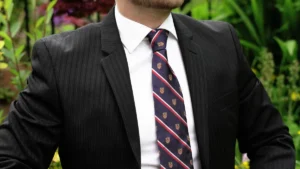
A silk tie is the smallest tailored thing a man wears, and it is the one everyone looks at first. It sits at the centre of the chest, right under the chin, framing the face and setting the tone for the whole outfit. A good one makes a plain suit look considered, while a wrong one makes an expensive suit look like an accident.
The trouble is that ties are easy to buy badly. They all look much the same on a screen, yet the differences that matter are invisible in a product photo: the width against your lapels, the length against your torso, the weight of the silk, and whether the pattern fights your shirt.
This guide takes the choices in the order that matters: occasion first, then size, then silk, then colour and pattern, then the knot. Three or four well-chosen silk ties will cover nearly every situation a suit is worn in, from a job interview to a wedding.
Key takeaways
- Choose for the occasion first: a matte twill for the office, something softer for a wedding, and satin only after dark.
- Match the width to your lapels, 7 to 8.5 centimetres for most men, and the length so the tip reaches the middle of the belt buckle.
- Twilled silk is the safest all-rounder, grenadine is the most elegant understated choice, and printed silk is the easiest way to add pattern.
- Pick a tie darker than your shirt, and keep its pattern a different scale from any pattern in the shirt.
- A well-made tie is cut on the bias with a proper lining and a loose slip stitch, and it knots cleanly and hangs straight.
Start with the occasion, not the tie
Every tie decision gets easier once you know where the tie is going. A tie for a job interview has a different job from a tie for a summer wedding, and a tie for a funeral has a different job again. The occasion sets the rules for colour, sheen, and pattern.
For work, keep it restrained: a matte or lightly textured silk in navy, burgundy, dark green, or a muted stripe, with small, neat patterns such as dots or a fine pinstripe. Loud prints draw the eye away from your face, which is the opposite of what a work tie should do. Weddings allow more freedom, which is where a lighter colour, a bolder pattern, or a textured grenadine comes into its own. For the most formal moments, remember that semi-formal dress codes still expect restraint, so let the suit and the shirt carry the outfit and keep the tie quiet.
Get the width right
Width is the single most visible choice you will make, and it is the one most men get wrong. A tie that is too wide against narrow lapels looks like it belongs to a different decade, and a tie that is too narrow against wide, classic lapels looks like a shoelace. The rule is simple: the widest part of the tie should roughly match the widest part of your jacket lapels.
For most men in 2027, a width of 7 to 8.5 centimetres at the widest point is the sweet spot, sitting comfortably with the medium-width lapels on most modern suits. Slimmer men, or men wearing narrow-lapel tailoring, can go down to 6 or 6.5 centimetres, while broader men, or men wearing classic wide-lapel suits, will look better at 8.5 to 9.5 centimetres.

Length and the belt-buckle rule
A tie has one correct length when it is worn: the tip should reach the middle of the belt buckle. Not the top of the trousers, not halfway down the belt, and definitely not flapping above it. This is the oldest rule in menswear and the easiest to check in a mirror, and a tie that ends too short or too long makes the whole outfit look careless.
Most ready-made ties are around 145 to 150 centimetres long, which suits most men of average height. If you are tall or broad, look for a long length, usually 155 to 160 centimetres. The knot also eats length: a full Windsor uses noticeably more tie than a four-in-hand, so try the tie on with the knot you actually wear. Our guide to how to wear a necktie covers the fit in more detail.
Know your silk: the weaves that matter
Not all silk is the same, and the weave changes how a tie looks, feels, and behaves: its sheen, its weight, how it wrinkles, and how it knots. Twill is the workhorse, with a fine diagonal rib, a soft sheen, and a good weight, so it knots cleanly, resists wrinkles, and works with almost any suit.
Grenadine is the connoisseur’s choice: a loosely woven silk with a slightly open, textured surface, traditionally woven in Italy. It has almost no shine, so it looks understated and expensive, and it suits both business and formal occasions. Satin is the smoothest and shiniest of the three, wonderful in the evening and too glossy for most offices. Printed silk is lighter and softer, and the easiest way to wear bold patterns, while woven jacquard has a subtle texture and a more formal feel.
| Silk weave | Best occasion | Look and feel |
|---|---|---|
| Twill | Office and everyday | Fine diagonal rib, soft sheen, knots cleanly and resists wrinkles |
| Grenadine | Business and weddings | Loosely woven texture, almost no shine, understated and elegant |
| Satin | Evening and formal events | Smooth and highly reflective, best after dark, too glossy for the office |
| Printed silk | Summer and celebrations | Light and soft, bold patterns, drapes well in warm weather |
| Jacquard (woven pattern) | Formal and business | Pattern woven into the cloth, subtle texture, more formal than printed |
| Knit silk | Relaxed and smart-casual | Soft, slightly stretchy texture with a square tip, never for black tie |
| Matte silk | Creative offices and daytime | No shine at all, modern and quiet, pairs well with textured jackets |
Colour and pattern: build from what you own
The most useful tie is not the most beautiful tie in the shop. It is the one that works with the suits and shirts you already own. Start with navy, burgundy, and dark green, which work with navy, grey, and charcoal suits, and with white, pale blue, and pale pink shirts. A man who owns those three in a good twill is covered for most of his life.
Two colour rules will save you from most mistakes. First, the tie should be darker than the shirt, because a pale tie on a dark shirt looks washed out. Second, it should pick up at least one colour already present in the outfit, whether that is the suit, the shirt, or the pocket square. On pattern, the rule is straightforward: only one loud pattern per outfit, and patterns in different scales. If your shirt is striped, your tie should be a solid or a small dot, and if your shirt is plain, the tie can carry the pattern. When in doubt, simplify: plain shirt, patterned tie, or patterned shirt, plain tie.
The knot, the dimple, and the collar
A good tie is only as good as its knot. The knot should be neat, centred under the collar, and in proportion to both the collar and the tie. Most men, most of the time, should tie a four-in-hand: a slim, slightly asymmetric knot that suits nearly every collar and every tie, and uses the least length. The half-Windsor is the next step up, a symmetrical, triangular knot for spread collars and wider ties.
The full Windsor is the biggest of the three and the one most men should use least, since it needs a wide collar, a long tie, and a formal occasion. Two details separate a good knot from a great one. The first is the dimple, a small fold just below the knot, made by pinching the tie as you tighten it. The second is the collar: it should sit neatly over the tie, with no gap between the collar and the knot, and the tie should fill the space under the collar without bulging.
What to pay and how to spot quality
Price is a poor guide to ties on its own. Some of the best ties are mid-priced, and some of the most expensive are the hardest to wear every day. What matters is construction, and it can be checked in your hands in about thirty seconds, before you pay anything. First, feel the weight: a good silk tie has some substance to it, draping rather than flopping, and feeling smooth without feeling slippery.
Look inside. A proper lining, usually wool or a wool blend, gives the tie body and helps the knot hold its shape. Turn the tie over and look for the slip stitch, the loose thread running down the back that lets the two halves move against each other. A well-made tie is also cut on the bias, at 45 degrees to the weave, which lets it drape and recover its shape. On price, buy fewer, better ties: one well-made silk tie worn fifty times costs less per wear than five cheap ties that knot badly and sit unworn. Treating a good tie as a small luxury investment rather than a disposable accessory is the right frame, since the cost is modest and the lifespan is years.
Checklist: before you buy
- Occasion: is this tie right for where you will wear it, or just beautiful on the rack?
- Width: does the widest part roughly match your lapels, in the 7 to 8.5 centimetre range?
- Length: with your usual knot, does the tip reach the middle of the belt buckle?
- Silk: is the weave right for the occasion, and does the tie drape straight and knot cleanly?
- Colour and pattern: is it darker than your shirt, with a pattern in a different scale?
- Construction: is there a proper lining, a loose slip stitch at the back, and neatly finished edges?
Frequently asked questions
How many silk ties does a man actually need?
Three or four good ones cover nearly everything. Start with a solid navy, a solid burgundy, and one small-pattern tie in a muted colour, then add a dark green or a grenadine.
Should a silk tie match the pocket square?
No, it should complement it, not match it. A pocket square in exactly the same fabric and pattern as the tie looks like a set from a gift box. Choose one that picks up a colour from the tie or the shirt instead.
Can you wear a silk tie without a jacket?
Yes, and it often looks better that way in warm weather or a relaxed office. A silk tie with a well-fitted shirt, sleeves rolled to the forearm, is a classic smart-casual look.
What is the difference between a silk tie and a polyester tie?
Silk takes dye more richly, so its colours look deeper and less flat. It drapes better, knots more cleanly, and breathes. Polyester is shinier, stiffer, and more prone to static and creasing.
How do you remove a stain from a silk tie?
Blot it immediately with a clean, dry cloth. Do not rub, do not add water, and do not use stain remover, all of which can mark silk permanently. For anything beyond a light mark, see a specialist dry cleaner.
Is a black silk tie only for funerals?
Mostly, yes. A black silk tie is the correct choice for a funeral and for the most formal evening occasions, but it looks severe anywhere else. For everyday wear, navy or charcoal reads as serious without that association.
The bottom line
Choosing a silk tie is not about finding the most expensive or the most fashionable one. It is about matching five things: the occasion, the width, the length, the silk, and the pattern. Get the occasion right and the rest narrows itself down. Get the size right and the tie will sit properly all day.
Start with the basics, buy slowly, and check the construction before you pay. A navy twill, a burgundy twill, and one small-pattern tie will carry you through interviews, weddings, and ordinary working days alike. Add a grenadine when you want something quieter, and a satin only when the evening calls for it.
Note: Tie widths, lengths, and weaves are general guidance for standard tailoring; if your suits have unusually narrow or wide lapels, match the tie to the lapel first and treat the centimetre ranges above as a starting point, not a rule.