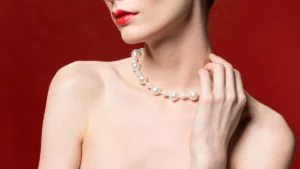
A pearl choker is a strand of pearls that sits high on the neck, close against the skin at the base of the throat. It is the shortest of the classic pearl necklace lengths, and that short length is the whole point: instead of draping down the chest, the pearls frame the face.
It is easy to confuse a pearl choker with any short pearl necklace, but the fit is what defines it. A true choker measures roughly 14 to 16 inches, or about 35 to 40 centimetres, and rests on the neck itself rather than on the collarbone. A strand that slips down onto the collarbone is a princess-length necklace, not a choker.
This guide explains what a pearl choker is, how it should fit, which pearl types are used in one, and how to choose, style, and care for one. It is a small purchase that is easy to get wrong: a strand half an inch too tight feels uncomfortable all evening.
Key takeaways
- A strand of pearls about 14 to 16 inches long that fits snugly at the base of the neck, above the collarbone.
- Fit matters more than price: it should sit flat, never pinch or ride up.
- Freshwater pearls are the most common choice, Akoya pearls give the brightest finish, and South Sea and Tahitian pearls are larger and costlier.
- It suits open necklines best, from scoop and V-necks to strapless styles, and pairs poorly with high collars.
- Pearls are soft and need gentle care: keep them away from perfume and hairspray, wipe them after wearing, and store them flat in a soft pouch.
What a pearl choker actually is
A pearl choker is a necklace made of pearls strung in a single strand, sometimes two or three, that is short enough to encircle the neck closely. The classic version is a single row of matched, round white pearls, knotted on silk thread with a small clasp at the back. Knots between each pearl stop them scattering if the thread breaks, and stop them rubbing together.
The style has been worn for centuries, from the pearl chokers of the Edwardian era to the single strand made famous by Coco Chanel in the 1920s and Audrey Hepburn in the 1960s. It faded when long necklaces took over, returned in the 1990s, and is back again now, worn with evening dresses and with a plain white shirt and jeans. A velvet choker is a fashion accent; a pearl choker is judged by the quality of its pearls.
How a pearl choker fits

Length is the defining measurement of a pearl choker. The standard choker length is 14 to 16 inches, and most pearl chokers fall in the middle of that range, around 15 inches. A 14-inch strand fits closely, while a 16-inch strand sits a little lower, just touching the collarbone. Anything over 17 inches is princess length, and will hang rather than hug the neck.
To find your size, measure around the base of your neck, then add half an inch to one inch. If you are between sizes, choose the longer one: a choker that is too tight is unwearable, while one that is slightly loose still reads as a choker. Some pearl chokers come with a short extender chain at the clasp, which lets you adjust the fit. Test it by turning your head: the strand should move a little and stay in place, not twist or climb towards your chin.
The pearl types you will see in a choker
Freshwater pearls are the most common pearls in a choker, and for most people they are the best starting point. They are grown in freshwater mussels, usually in China, and they come in a wide range of shapes, from nearly round to oval and baroque. They are more affordable than saltwater pearls, they are durable, and their soft, slightly warm lustre suits everyday wear. A 6 to 7 millimetre freshwater choker is the classic everyday choice.
Akoya pearls are the traditional saltwater pearl of the classic white strand. They are grown in Japan and China, they are almost always round, and they have the sharpest, brightest lustre of any pearl, with a mirror-like shine. An Akoya choker is usually made of smaller pearls, around 6 to 8 millimetres, and it is the version most people picture when they think of a pearl choker. It costs more, but the roundness and shine are visibly different.
South Sea pearls are the largest and most expensive white pearls, usually 9 millimetres and larger, with a soft, satiny glow, so a South Sea choker is a statement piece. Tahitian pearls are the dark counterpart, in shades of grey, green, and peacock black. Baroque pearls, irregular rather than round, give a relaxed, contemporary feel, while shell pearls are the cheapest option but lack the depth of a real pearl.
Pearl choker vs other necklace lengths
The differences between necklace lengths are all about where the strand sits. A collar, at 12 to 14 inches, sits high on the neck. A princess length, at 17 to 19 inches, rests on the collarbone, and a matinee, at 20 to 24 inches, falls to the centre of the chest. A choker is the one that frames the face most closely.
| Necklace length | Typical length | Where it sits |
|---|---|---|
| Collar | 12 to 14 inches | High on the neck, above the choker |
| Pearl choker | 14 to 16 inches | At the base of the neck, above the collarbone |
| Princess | 17 to 19 inches | On the collarbone |
| Matinee | 20 to 24 inches | Centre of the chest |
| Opera | 28 to 34 inches | Below the bust, can be doubled |
| Rope | Over 35 inches | Below the bust, often layered or knotted |
| Lariat | 30 to 40 inches, open | Long chain with ends hanging down the front |
| Bib | Varies, wide and deep | Across the upper chest like a bib |
A pearl choker also differs in shape: a collar is a rigid band, a bib is wide, and a lariat is a long open chain. The pearl choker is the quietest of these, a single line of pearls close to the skin, which is why it works with outfits that a bib or a lariat would overwhelm.
How to choose and style a pearl choker
Start with pearl size, because it changes the look more than anything else. Small pearls, around 5 to 6 millimetres, look delicate and suit a slim neck and a fine-boned frame. Medium pearls, around 7 to 8 millimetres, are the classic choker size and suit most people. Large pearls, 9 millimetres and above, make a bold statement and suit a taller frame or an evening outfit, but they can look heavy for daytime. A 7-millimetre strand is the safest middle ground if you are unsure.
Next, look at lustre, the shine and depth of the pearl’s surface. Hold the strand under a light and look for a bright, clear reflection, not a dull or chalky surface. Lustre matters more than perfect roundness: a slightly oval pearl with strong lustre looks better on the neck than a perfectly round pearl with a dull surface. Pearl necklaces are firmly back in style, and the strands that look best now are the ones with a bright, clean lustre rather than a cloudy finish. For colour, white pearls with a pink or silver overtone suit cool skin tones, cream pearls suit warm skin tones, and grey or black Tahitian pearls suit anyone who wants a modern choker.
Check the construction, too: the pearls should be knotted on silk thread, the clasp should close firmly, and the strand should be evenly matched in size and colour. If the pearls rattle loosely or the clasp feels flimsy, the strand will not last.
The pearl choker loves an open neckline: a scoop neck, a V-neck, a strapless top, or an off-the-shoulder dress all leave the neck bare, which is what a choker needs to be seen. For daytime, keep the rest simple: a pearl choker with a white shirt, a plain knit, or a simple black dress is a complete look, with small pearl studs as the natural match. Learning how to style pearl jewellery helps here: one pearl piece should lead, and everything else should stay quiet. For evening, a double strand or a choker with a small diamond clasp pairs beautifully with a dark velvet dress or a silk slip dress. Layering is possible, but the choker should be the shortest piece, with the longer necklace at least two inches longer so the strands do not tangle.
How to care for a pearl choker
Pearls are softer than most gemstones, and a pearl choker needs gentler care than a gold chain. The surface of a pearl is a thin layer of nacre, easily scratched by harder jewellery, damaged by perfume and hairspray, and dulled by sweat and skin oils. Put your choker on last, after perfume and hairspray, and take it off first when you come home.
After wearing, wipe the strand with a soft, damp cloth, then let it dry flat before putting it away. Never use an ultrasonic or steam cleaner on pearls, and never soak the strand, because water can weaken the silk thread and dull the nacre. Store it flat in a soft pouch, away from other jewellery that could scratch it. The thread will eventually stretch, so have it restrung every few years if you wear it often.
- Measure your neck, add half an inch to one inch, and check the length includes any extender chain.
- Look for strong lustre: a bright, clear reflection, not a dull or chalky finish.
- Check that the pearls are evenly matched in size, shape, and colour along the whole strand.
- Confirm the pearls are knotted on silk thread, with a secure clasp.
- Choose a size that suits your frame: 6 to 7 millimetres for a delicate look, 7 to 8 for a classic choker.
- Ask the pearl type, freshwater, Akoya, South Sea, or Tahitian, and whether they are dyed.
Frequently asked questions
What is a pearl choker?
A strand of pearls about 14 to 16 inches long that fits closely at the base of the neck, above the collarbone. It is the shortest classic pearl necklace length, defined by that close fit.
How long should a pearl choker be?
Most are 14 to 16 inches, with 15 inches the most common. Measure around the base of your neck and add half an inch to one inch. If you are between sizes, choose the longer length.
Are pearl chokers in style?
Yes, worn both as a single classic strand and as a modern double or baroque version. They suit evening outfits and simple daytime looks alike.
What is the difference between a pearl choker and a pearl necklace?
A pearl choker is a type of pearl necklace, defined by its short length and close fit. A pearl necklace is the general term, and it includes longer lengths such as princess, matinee, and opera.
Can you wear a pearl choker every day?
Yes, a freshwater pearl choker in a medium size suits everyday wear, pairing easily with a shirt, a knit, or a simple dress. Wipe it after wearing and store it in a soft pouch. The best pearl necklaces for everyday wear include choker-length strands.
How do you keep a pearl choker from flipping or twisting?
A choker flips when it is too loose, too heavy at the front, or strung on a thread that has stretched. Choose the right length, keep the pearls a moderate size, and have the strand restrung if it starts to twist.
The bottom line
A pearl choker is a strand of pearls, 14 to 16 inches long, sitting at the base of the neck and framing the face. Its appeal is its simplicity: one clean line of pearls, close to the skin, that needs no other necklace to finish an outfit. Choose the length by measuring your neck, and check the lustre and the knotting before you buy.
Wear it with open necklines, keep the rest of your jewellery quiet, and look after the pearls gently, and it will earn its place as one of the most useful pieces in your jewellery box. It keeps coming back because it makes the wearer, not the necklace, the focus.
Note: Pearl sizes, lengths, and prices vary between makers, and dyed pearls are common at lower prices, so ask the seller about the pearl type and any treatments before you buy.