A pearl necklace is the rare piece that works with a white shirt, a work blazer, and a floor-length dress, all in the same week. It does not sparkle or shout — it glows, quietly, and that softness is why it suits so many settings. The trick is not owning pearls, but knowing which length to choose, which neckline to pair it with, and when to stop adding more.
Most pearl necklaces go wrong in small, fixable ways: the strand is too long for the neckline and disappears under a collar, the pearls are too perfect for a casual outfit, or the necklace is layered with chains at the same length and tangles by lunchtime. None of these are problems with pearls themselves — they are styling decisions, and once you know the rules, they take seconds.
This guide covers the wearing, not the buying: the five classic lengths, matching a strand to your neckline and occasion, everyday wear, layering with gold, and looking after them. If you wonder whether pearls still suit a modern wardrobe, the short answer is yes — and our guide to whether pearl necklaces are in style explains why they have come back so strongly.
Key takeaways
- Length decides everything: a choker (14–16 inches) suits open necklines, a princess length (17–19 inches) suits almost everything, and longer strands suit high necklines and evenings.
- Match the necklace to the neckline — it should sit on skin or plain fabric, never half-hidden under a collar.
- One pearl strand is the statement; keep earrings small and let one metal do the supporting work.
- Freshwater pearls are the relaxed everyday choice, Akoya pearls the classic polished strand, and baroque pearls the modern, imperfect option.
- Pearls are delicate: on last, off first, and away from perfume and hairspray.
Start with length: the five lengths that matter
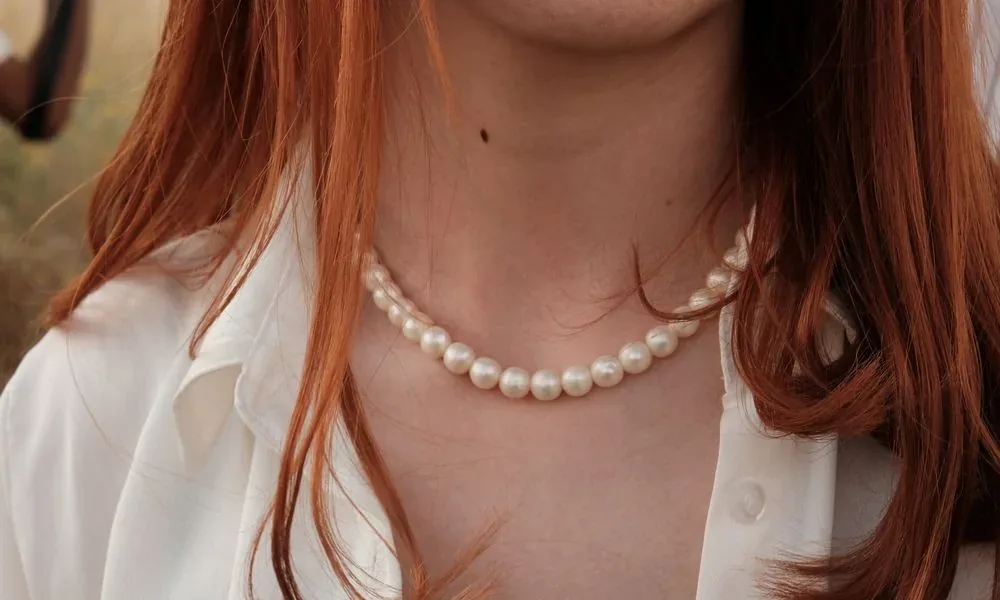
Pearl necklaces come in five classic lengths. A choker measures 14 to 16 inches and sits at the base of the throat. A princess length measures 17 to 19 inches and falls just below the collarbone — 18 inches is the classic gift length. A matinee measures 20 to 24 inches and falls between the collarbone and the top of the bust. An opera length measures 26 to 36 inches and falls at or below the bustline. A rope is 36 inches and more, and can be doubled, tripled, or knotted.
The number is the full loop around your neck, including the clasp, not how far the strand hangs down. Roughly half the length goes around the back of your neck, so a 36-inch rope falls about 14 inches from the base of your throat. If you are unsure, choose the princess length: the most versatile starting point for most necklines. Length also changes the mood — shorter strands read modern, longer strands read softer, and an opera length doubled gives a layered look from one piece.
| Length | Inches | Where it sits | Best with |
|---|---|---|---|
| Choker | 14–16 | Base of the throat | Strapless, off-shoulder, square necklines |
| Princess | 17–19 | Just below the collarbone | Almost everything; the everyday default |
| Matinee | 20–24 | Upper chest | Crew necks, shirts, workwear |
| Opera | 26–36 | At or below the bust | High necklines, evening dresses |
| Rope | 36+ | Below the bust | Knotting and doubling |
| Pendant pearl | 16–18 | Collarbone | Minimal outfits, layered stacks |
| Double strand | 16–18 | Collarbone, upper chest | Formal occasions, bridal looks |
| Baroque strand | 16–20 | Collarbone to upper chest | Casual outfits, denim, knitwear |
Match the necklace to your neckline
The neckline decides the length, and getting this pairing right is most of the job. A strapless or off-shoulder neckline leaves the neck and collarbone bare, so a choker or princess length suits it beautifully. A V-neck works best with a princess length or a single pearl pendant, which follows the line of the neckline. A square neckline suits a choker, which echoes the straight edge of the fabric.
High necklines need the opposite approach. A crew neck, polo neck, or turtleneck covers the base of the throat, so a short strand will sit awkwardly on fabric or vanish under the collar — wear a matinee or opera length over the top instead. A collared shirt is the trickiest case: a princess length tucked under the collar looks neat, while the same strand over an open collar looks messy. One rule covers most mistakes: the necklace should sit on skin or plain fabric, never half-hidden. If you keep adjusting it, the length is wrong for that neckline.
Choose the right pearl for the look
Not all pearls look the same, and the type you choose sets the tone of the outfit. Akoya pearls are the classic: small, round, white, with a sharp, mirror-like lustre — a matched Akoya strand is the most formal option. Freshwater pearls are softer in look and gentler in price, with more shapes and pastel shades — the easiest everyday strand.
South Sea pearls are larger, usually 9 to 15 millimetres, with a satiny lustre in white, silver, or gold — the most luxurious option, and one strand is enough for an evening. Tahitian pearls are naturally dark — grey, green, and black — and suit evening wear against black, navy, or charcoal. Baroque pearls are irregular and deliberately imperfect, and they are the modern choice: no two are alike, so the strand feels personal. Size matters too: small pearls (6–7 mm) suit daytime, medium (7–8 mm) are the all-rounder, and large pearls (9 mm and above) are a statement — wear them alone with simple clothes.
How to wear a pearl necklace every day — and to work
Wear pearls every day like any other favourite necklace, not an heirloom. A short freshwater strand with a white shirt and jeans is the classic casual combination: the shirt keeps it clean, the denim keeps it relaxed, and the pearls add the one polished note. A baroque strand works even better, because its irregular shapes already look undone — try it with a linen shirt, a knit jumper, or a T-shirt. Pearls sit best against plain colours — white, cream, navy, black, camel, soft grey — while busy prints and loud logos compete with the necklace and usually win.
For daytime, small pearl studs are the only earrings you need — skip the matching bracelet and ring set, which reads as formal and slightly costumey. At work, a princess-length strand with a blazer and silk blouse is the most reliable combination, and a matinee length works over a crew-neck knit. Keep to one metal — gold suits camel, cream, and navy; silver suits grey, black, and white — and avoid a long opera strand at a desk, which swings forward every time you lean over a keyboard.
Evening, weddings, and formal occasions
Evenings are where pearls are most at home. A long opera strand with a black evening dress is the classic formal combination: the length gives a vertical line a short strand cannot. Double it for a two-layer look, or knot it once at the front for a softer version. A double strand of matched pearls is the traditional wedding choice, whether you are the bride, a bridesmaid, or a guest.
For a wedding, let the dress set the rules. A strapless gown takes a choker or short princess strand, so the pearls frame the neckline. A high-necked gown needs a longer strand over the fabric, or no necklace at all with pearl drop earrings instead. Evening is also the time to pair pearls with diamonds: a pearl strand with small diamond studs never looks overdone, because the diamonds add light and the pearls add warmth. Keep the diamonds small and the pearls the main event — our guide to the best diamond necklaces is a useful companion if you are building an evening jewellery wardrobe.
Layering pearls — and looking after them
Layering works when the pearl strand is the anchor. The simplest combination is a pearl choker with one fine gold chain a few inches longer, so the gold catches the light below the pearls. A single pearl pendant on a gold chain, worn with a longer pearl strand, is another easy pairing. For more ideas, see our round-up of the best statement necklaces.
Space is what makes a stack work: give each necklace at least two inches of difference in length, so every strand hangs in its own space. Two necklaces at the same length will drift together and tangle, however good they look in the mirror. Mix weights as well as lengths — a heavier chain sits lower and steadies the stack — and put the longest on first, working up to the shortest. Keep the stack to two or three necklaces, and keep the rest of the jewellery quiet: small studs, no statement earrings.
Pearls are softer than most gemstones — around 2.5 to 4.5 on the Mohs scale, against 10 for diamond — so they scratch easily and dislike chemicals. The old rule holds: pearls go on last and come off first. Put make-up, perfume, and hairspray on before the necklace, and let everything dry first. After wearing, wipe the strand with a soft, damp cloth. Store pearls in a soft pouch or lined box, away from harder jewellery, and never sealed in plastic: pearls hold a little moisture and need air to keep their lustre. Have a strand restrung every year or two if you wear it often — the knots between pearls stop the whole strand scattering if the thread breaks.
Your pearl necklace checklist
- Length first: princess (17–19 inches) if unsure, choker for open necklines, matinee or opera for high necklines and evenings.
- The strand should sit on skin or plain fabric, never half-hidden under a collar.
- One pearl piece at a time during the day, with small studs instead of a matching set.
- Layer two or three necklaces at most, spaced at least two inches apart, pearls as the anchor.
- On last, off first — away from perfume, hairspray, and make-up.
- Wipe the strand after wearing, store it in a silk pouch, and restring it every year or two.
Frequently asked questions
Can you wear a pearl necklace every day?
Yes — a freshwater or baroque strand is best. Keep the pearls small to medium, put them on last, keep them away from perfume and hairspray, and wipe them after wearing.
What length pearl necklace should I buy first?
Buy an 18-inch princess length. It sits just below the collarbone, suits the widest range of necklines, and works for daytime, work, and evenings.
Are pearl necklaces too formal for jeans?
No, if the pearls are the right kind. A baroque or freshwater strand with jeans and a white shirt is a classic casual look; a perfectly matched Akoya strand can look overdressed — save that for smarter outfits.
Can you wear pearls with gold?
Yes — gold is the most flattering metal with pearls for most skin tones. Keep to one metal throughout the outfit so the combination looks deliberate.
Do pearl necklaces suit older women only?
No — that idea comes from the matched-set styling of the past. A baroque strand with denim or a pearl choker with a T-shirt suits every age, and younger wearers are driving the current revival.
How do I stop my pearl necklace from tangling when layered?
Space each necklace at least two inches apart, mix weights so one heavier piece anchors the stack, and put the longest on first. Spacing matters more than any clasp.
The bottom line
A pearl necklace is easy to wear well once length comes first. Choose the princess length if unsure, match it to an open neckline, keep the rest of the outfit plain, and let a single strand do the work. The pearls do not need a matching set, a loud print, or three more necklaces — just clean skin, one supporting metal, and nothing competing.
The other half is looking after them: put them on last, keep them away from perfume and hairspray, wipe them after wearing, and store them where nothing harder can scratch them. Do that, and a strand you buy this year will still glow in ten years. That is the real case for pearls — not that they are fashionable again, but that they never really stop being wearable.
Note: Pearl lengths and types vary slightly between jewellers, so check the stated inches and pearl type on the piece you are buying rather than the name alone. This guide describes general styling, not advice about any specific piece.