A silk scarf is easy to love and surprisingly hard to wear well. Knotted, it can slip, bunch, or crease the very print you bought it for. A scarf ring solves both problems: a small loop of metal, horn, or resin that holds folded silk in place and turns the fastening into jewellery.
The best luxury scarf rings do two jobs quietly. They grip firmly enough that the scarf stays put all day, and they are finished so smoothly that they never catch or snag fine silk. That second job separates luxury from cheap: a rough edge can damage a costly scarf in one afternoon.
This list covers the eight scarf ring styles worth buying in 2027, plus a sizing guide, a comparison table, and five ways to wear a ring.
Key takeaways
- A scarf ring holds folded silk without a knot and doubles as neckline jewellery.
- Match the opening to the fold: 2 to 3 cm suits most 90 cm silk squares; cashmere needs 4 to 5 cm.
- Run a fingertip over every edge before buying: a luxury ring must be perfectly smooth.
- Round rings are easiest to use, slides with a centre bar grip best, and twilly rings suit narrow strips.
- Match the metal to your jewellery, and keep the ring off perfume and hairspray.
What a scarf ring is — and what it is not
A scarf ring, also called a scarf slide, is a small loop that the ends of a folded scarf pass through. Fold the scarf into a strip, thread both ends through the ring, and slide it where you want it: high at the throat, or lower on the chest. Friction holds it in place — no knot to press into the silk.
It is not a brooch, and it is not a belt buckle. A brooch pins through fabric; a scarf ring never pierces it, which matters because silk twill is woven tightly and a pin leaves a hole that does not close. It also differs from a toothed clip or spring: those grip by pressure and can mark fabric, while a good ring grips by friction alone.
The tradition is strongest in Paris, where the great silk houses have made scarf rings for decades. The 90 cm square, the 70 cm square, the twilly, and the 140 cm shawl each behave differently in a ring, so choose for the scarves you own — starting with choosing the perfect silk scarf if you are still building a collection.
How we chose the eight rings on this list
Every pick passes four tests: finish, grip, versatility, and longevity. The finish must be smooth all over, including the inside edge; the grip must hold a folded 90 cm square all day; the ring should suit at least two scarf formats; and the plating must survive daily wear without flaking or losing stones.

The 8 best luxury scarf rings of 2027
1. The gold horsebit ring. The most recognisable luxury scarf ring, built around two interlinked rings in the shape of a horsebit. Thread both ends of a bias-folded 90 cm square through it; the metal’s weight keeps the drape steady. Best for: everyday wear.
2. The silver circular ring. A plain, polished circle in silver tone or palladium, with no decoration. It is the quietest pick here: it disappears against the scarf and lets the print do the talking. Best for: fine silk and workwear.
3. The enamel slide ring. A slide is a frame divided by a centre bar into two openings. One scarf end goes one way and the other goes the other way, so the fabric crosses inside the frame and grips far more firmly. Enamel versions add colour at the neckline. Best for: slippery charmeuse.
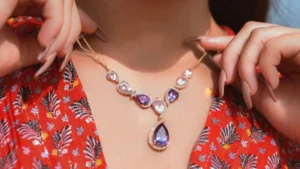
4. The crystal pavé statement ring. A larger ring set with pavé crystals or a single bold coloured stone, made to be seen. It turns a plain scarf into evening jewellery and works best with solid-coloured silk, where the ring is the star. Keep it for occasions: stones add weight. Best for: evenings and weddings.
5. The sculptural chain-link ring. A ring formed from chunky interlinked chains. It reads as jewellery in its own right, suiting scarves worn as a belt or bag accent. Run a silk thread across each join before buying: every link must be smooth. Best for: bold styling.
6. The slim twilly ring. A small, neat ring made for narrow strips: twillies, slim scarves, and scarves folded into a thin band. A full-size ring swallows a twilly and lets it slide about; a twilly ring, with an opening of around 2 cm, holds it exactly. Best for: twillies and wrist wraps.
7. The horn and resin ring. A warm, organic ring in polished horn, lacquered wood, or marbled resin. It is lighter than metal, so it suits large, heavy shawls that a metal ring would drag down, and its matte surface grips wool and cashmere better than polished metal. Best for: cashmere and shawls.
8. The pearl-accent ring. A refined circle or slide finished with one or more pearls, set into the metal or threaded through the design. It pairs beautifully with pearl earrings, a silk blouse, or a bridal outfit. Pearls scratch easily, so store it in its own pouch and keep it away from perfume. Best for: weddings.
| Pick | Style | Best scarf | Opening | Grip | Weight | Best for | Watch out for |
|---|---|---|---|---|---|---|---|
| Gold horsebit ring | Interlinked rings | 90 cm silk square | 2–3 cm | Good | Medium | Everyday elegance | Loose joins |
| Silver circular ring | Plain circle | Fine silk, 70–90 cm | 2–3 cm | Good | Light | Workwear | Too large an opening |
| Enamel slide ring | Centre-bar frame | Charmeuse, silk | 2–3 cm | Excellent | Medium | Slippery fabrics | Chipped enamel |
| Crystal pavé ring | Statement stone | Solid-colour silk | 2–3 cm | Good | Heavy | Evenings, weddings | Dragging light silk |
| Chain-link ring | Sculptural links | 90–140 cm scarves | 3–4 cm | Good | Medium-heavy | Bold styling | Rough link joins |
| Slim twilly ring | Small circle | Twilly, narrow strip | About 2 cm | Excellent | Light | Twilly, wrist | Too small for squares |
| Horn and resin ring | Organic, matte | Cashmere, wool shawl | 3–5 cm | Excellent | Light | Heavy shawls | Visible seams |
| Pearl-accent ring | Pearl detail | Silk square, 70–90 cm | 2–3 cm | Good | Light-medium | Weddings | Scratched pearls |
Ring shapes compared: round, slide, twilly and sculptural
The round ring is the easiest place to start. It has a single opening, both scarf ends pass through together, and adjusting the drape means sliding it up or down. It suits almost every scarf. Its only weakness is grip: on very slippery silk it can slide down during the day.
The slide solves that with a centre bar. Because the two ends cross inside the frame, the fabric grips itself as well as the metal, and the ring stays put. Slides take practice to thread and suit a flat fold, but for charmeuse they are the most reliable shape. Twilly rings are small round rings; sculptural rings trade practicality for presence.
Sizing: matching the ring to your scarf
Ring size means the inside diameter, usually 2.5 to 5 cm. Fold your scarf as you will wear it and choose a ring whose opening is just a little larger than the fold. Too small and the fabric bunches and creases; too large and the ring slides freely and holds nothing.
A medium ring of 2 to 3 cm works best with a 90 cm square; a 50 to 70 cm square suits small to medium, a 100 to 140 cm shawl medium to large, and anything larger calls for oversized. Folded cashmere or chunky knit needs 4 to 5 cm.
Five ways to wear a scarf ring
The classic slide. Bias-fold a 90 cm square into a strip, wrap it once around your neck, thread both ends through a round ring, and slide it above the collarbone. Pull the ends even.
The asymmetric drape. Thread both ends through unevenly, so one end is long and one is short, then bring the long end around behind your neck and pull it to the front. The long end drapes like a tie, showing more of a bold print.
The choker. Fold the scarf into a narrow band, wrap it snugly around the neck, and secure it at the front with a small ring. The ring becomes the clasp of a silk necklace.
The belt. Thread a large square or long scarf through a chain-link or horn ring at the waist, over a dress or a coat. The ring gathers the fabric and adds a jewellery detail where a buckle would sit. Use a larger opening for the bulkier waist fold.
The bag accent. Wrap a twilly around a handbag handle and secure it with a twilly ring, or hang a small square from the handle as a charm. It is a good test: if it holds a twilly on a moving bag all day, it will hold a scarf at your neck.
Materials, finishes and care
Gold-tone and silver-tone metal rings are the workhorses: durable and easy to clean. Solid precious metal can be polished and repaired for decades; plated rings show wear at the edges. Enamel chips if dropped. Horn, wood, and resin dislike water and heat. Crystal and pearl are the most delicate: best kept for occasions.
Care rules are the same for every material. Check the ring with your fingertips before it touches silk, and again after any knock. Keep it away from perfume, hairspray, and hand cream. Store it in a soft pouch, not loose in a jewellery box. And look after the scarf too: our guide to how to care for silk scarves covers washing, drying, and storage.
Checklist: before you buy
- Run a fingertip, then a silk thread, over every edge: both must glide without catching.
- Fold your scarf as you will wear it and check the opening is just larger than the fold.
- Match the metal finish to the jewellery you wear most: gold with gold, silver with silver.
- Check enamel for chips, stones for secure settings, and pearls for scratches.
- Buy from a maker you trust on plating, returns, and repairs.
- For a gift, choose a classic round ring: it suits the most scarves.
Frequently asked questions
What size scarf ring should I buy?
For most 90 cm silk squares, a medium ring with an inside diameter of 2 to 3 cm works best. Thin silk suits the smaller end of that range, while thick cashmere or a folded shawl needs 4 to 5 cm. Measure the fold before choosing.
Will a scarf ring damage my silk scarf?
A well-made ring should not. It must be perfectly smooth, with no burrs, sharp joins, or rough plating. Check it with your fingertips first, and avoid rings with teeth or springs.
Can I use a scarf ring with a cashmere scarf?
Yes, but choose a larger, lighter one. Cashmere folds are bulkier than silk, so a 4 to 5 cm opening in horn, resin, or a large metal ring works best. Horn and resin also grip wool better than polished metal.
How do I stop a scarf ring from slipping?
Choose a slide ring with a centre bar, which grips far better than a plain circle, or thread the scarf through a round ring twice for more friction.
Are luxury scarf rings worth the price?
They are worth it when the finish is genuinely better. A luxury ring is polished inside and out, its stones set securely, and it will not snag a costly scarf. Judge by finish, not label.
Can I wear a scarf ring with a twilly?
Yes, with a twilly ring. A full-size ring is too large for a narrow twilly and will let it slide around. A slim ring of around 2 cm holds a twilly neatly at the neck, wrist, or bag handle.
The bottom line
Start with a classic round ring in the metal you wear most: gold tone for warm jewellery, silver tone for cool jewellery and minimal looks. Add a slide ring for slippery silk and a twilly ring for narrow scarves.
Whatever you buy, let the finish decide. A smooth, well-weighted ring sized to your scarf will make a silk square look intentional, and keep it safe for years. Explore the best luxury silk scarf brands for scarves worthy of your ring.
Note: Prices change often and vary by retailer and condition, so treat any price band here as a rough indication, not a current price. Buy from a trusted seller.