Titanium jewellery has a quiet reputation: it is light on the finger, strong enough for daily wear, and kind to skin that reacts to other metals. That reputation is deserved, but it has a side effect. Because titanium rarely tarnishes and almost never turns skin green, many people assume it never needs cleaning at all. It does. Sweat, sunscreen, moisturiser, soap residue and ordinary dust build up on every piece you wear, and that film is what makes a titanium ring look dull and a chain feel slightly sticky by the end of the week.
The good news is that titanium is one of the easiest jewellery metals to clean at home. It does not need a special polish or an ultrasonic machine. Warm water, a drop of mild soap and a soft cloth will handle almost everything. What matters is knowing the few things that can damage it: harsh abrasives that scratch a brushed finish, strong chemicals that can affect an anodised colour, and rough handling around stones and settings.
Below are nine steps that take you from a quick wipe after wearing to a deeper monthly clean, plus the care notes for anodised pieces, stones and chains. Follow them in order, and a titanium piece you wear every day will keep the cool grey shine it had on the day you bought it.
Key takeaways
- Titanium does not tarnish like silver, but it still collects sweat, sunscreen and lotion, and that film is what dulls it.
- Warm water, mild soap and a soft cloth handle almost every cleaning job; no special polish is needed for plain titanium.
- Always remove jewellery before swimming in a chlorinated pool, and rinse it after the gym, the beach or a long hot day.
- Anodised titanium needs a gentler touch than plain titanium, because its colour is a thin surface layer, not a dye through the metal.
- No home cleaning method restores a deep scratch, a damaged setting or a loose stone, and those jobs belong to a jeweller.
What titanium jewellery is and why it gets dirty
Titanium is a pure element, not a blend, and jewellery-grade titanium is usually commercially pure titanium or a grade 5 alloy with a small amount of aluminium and vanadium for extra strength. It is roughly half the weight of steel at a similar strength, it resists corrosion even in salt water, and it contains no nickel, which is why it suits sensitive skin. Its natural colour is a cool, mid-grey, and it can be anodised into blues, purples, greens and golds by changing the thickness of the oxide layer on its surface.
None of that makes it immune to dirt. A ring sits against skin all day, collecting sweat, skin oils and hand cream. A necklace rests on sunscreen in summer and on foundation and perfume at the neckline. A bracelet catches soap and shampoo in the shower. Titanium does not react with these things the way silver tarnishes or copper turns green, but the residue still sits on the surface, scattering light and making the metal look flat and grey rather than clean and bright.
Chains and textured pieces collect the most grime, because residue settles into links, grooves and engraving. Smooth rings and plain bands are the easiest to keep clean, and they usually need nothing more than a rinse. Knowing where dirt hides tells you how much cleaning each piece needs.
What you need before you start
You need very little, and you probably already have all of it. A small bowl of warm water, a drop of mild, fragrance-free washing-up liquid or hand soap, a soft-bristled toothbrush you keep only for jewellery, a lint-free cloth or a microfibre cloth, and a clean towel for drying. That is the whole kit. If you want a polishing step, add a plain jeweller’s polishing cloth, the soft kind without any chemical coating, which is safe for plain titanium.

What you do not need is also worth knowing. Avoid toothpaste, baking soda used as a dry scrub, metal polishes, silver dip, ultrasonic cleaners with harsh solutions, and any cleaner that mentions ammonia or chlorine. Toothpaste is mildly abrasive and will leave fine scratches on a brushed or polished finish over time. Silver dip is made for silver and does nothing useful for titanium. A jeweller can use an ultrasonic cleaner safely, but a home machine with the wrong solution can loosen a stone or damage an anodised finish.
Set up on a clean towel over a sink with the plug in, or over a bowl, so a dropped ring cannot disappear down a drain. A guide to cleaning gold jewellery follows the same gentle-soap approach, because the safest cleaning habits are the same across metals, and the differences are in what to avoid, not in the basics.
How to clean titanium jewellery in 9 steps
Step 1: Give it a quick wipe after every wear
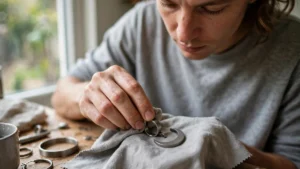
What to do: When you take a piece off, wipe it with a soft, dry cloth for a few seconds, paying attention to the inside of a ring and the links of a chain. What to avoid: Do not use a tissue or paper towel, which can leave lint and fine scratches over time. Best for: Rings, chains and bracelets worn daily. Time needed: 30 seconds. Standout tip: Keep a small cloth in your jewellery box so the wipe becomes part of taking the piece off.
Step 2: Soak it in warm water with a drop of mild soap
What to do: Fill a small bowl with warm, not hot, water, add one drop of mild soap, and soak the piece for five to ten minutes. What to avoid: Do not use hot water, which can loosen some glues used in settings, and do not add bleach, vinegar or a strong detergent. Best for: Any titanium piece that looks dull or feels sticky. Time needed: 10 minutes. Standout tip: Soak chains in a small mesh bag or a tea strainer so they do not tangle.
Step 3: Brush gently with a soft toothbrush
What to do: After soaking, brush the piece lightly with a soft-bristled toothbrush, using small circular motions around settings, grooves and engraving. What to avoid: Do not press hard, do not use a stiff brush, and never use a wire brush or a scouring pad. Best for: Chains, textured bands, engraved pieces and anything with a setting. Time needed: 2 minutes. Standout tip: Brush under running water for the final pass so loosened dirt washes away instead of settling back.
Step 4: Rinse under clean running water
What to do: Rinse the piece under lukewarm running water, turning it so every side is flushed, and check that no soap remains in links or under a setting. What to avoid: Do not rinse over an open drain, and do not use very hot water. Best for: Every piece, after every wash. Time needed: 1 minute. Standout tip: Hold a chain flat across your palm while rinsing so you can see whether soap is trapped between links.
Step 5: Dry it fully before you put it away
What to do: Pat the piece dry with a lint-free cloth, then leave it on a clean towel for a few minutes so any water in links or settings evaporates. What to avoid: Do not put a damp piece straight into a closed box or pouch, and do not use a hairdryer on it. Best for: Chains, bracelets and any piece with a setting. Time needed: 5 minutes. Standout tip: Give a chain a gentle shake over the towel before drying, so water drops out of the links.
Step 6: Remove stubborn marks with a baking soda paste
What to do: Mix a small amount of baking soda with a few drops of water to make a soft paste, rub it very lightly over the mark with a soft cloth, then rinse and dry as normal. What to avoid: Do not use the paste on anodised titanium, on a brushed finish, or on any piece with a soft stone, and do not scrub. Best for: Plain polished titanium with a stubborn mark or a dull patch. Time needed: 5 minutes. Standout tip: Test the paste on the inside of a ring first, where any change will not show.
Step 7: Clean around stones and settings with care
What to do: Brush around a stone with a soft toothbrush and soapy water, check the stone is still secure by touching it gently, and dry the setting thoroughly. What to avoid: Do not poke at a stone with a pin, do not soak a piece with a soft stone such as opal, pearl or turquoise, and do not use an ultrasonic cleaner at home. Best for: Titanium rings and pendants with diamonds, sapphires or other set stones. Time needed: 3 minutes. Standout tip: If a stone moves at all when you touch it, stop cleaning it and take it to a jeweller.
Step 8: Restore the shine with a soft polishing cloth
What to do: Once the piece is clean and dry, buff a polished titanium surface with a plain, dry jeweller’s polishing cloth, using long, even strokes. What to avoid: Do not use a chemically treated silver cloth, and do not buff a brushed or matte finish, which will become uneven. Best for: Plain polished rings, bands and pendants. Time needed: 2 minutes. Standout tip: Buff in one direction on a brushed finish if you must touch it up, and leave matte finishes alone.
Step 9: Give anodised titanium a gentler routine
What to do: Clean anodised pieces with warm water and a drop of mild soap only, wipe with a soft cloth, rinse, and dry fully. What to avoid: No baking soda paste, no polishing cloth, no abrasive brush, and no chemical cleaner of any kind. Best for: Blue, purple, green or gold anodised rings, bands and pendants. Time needed: 5 minutes. Standout tip: If the colour looks faded after cleaning, it is usually residue dulling it, so a second gentle wash is worth trying before assuming damage.
Which titanium pieces need extra care
Chains need the most attention, because every link is a small trap for lotion, sweat and dust. A chain that is worn daily deserves a soak every two to four weeks, and a quick rinse after the gym or the beach. Plain bands and simple pendants are the easiest pieces you own, and a wipe and an occasional soak will keep them looking new for years.
Anodised pieces deserve their own rule. The colour is the point of the piece, and it is also the most fragile part, so keep them away from anything abrasive, including the inside of a pocket with keys, and clean them only with soap and water. Titanium wedding bands with inlays, such as wood, carbon fibre or a coloured resin, need the same gentleness, because the inlay is far softer than the metal around it. Our guide to storing jewellery properly explains how to keep pieces separate in a box, which matters most for anodised and inlaid pieces that scratch easily.
Finally, remember that titanium is strong but not indestructible. It resists dents better than gold, but a hard knock on a stone floor can still mark it, and a deep scratch will not wash out. Cleaning keeps the surface honest: it shows you the real condition of the piece, so you can decide whether a mark is dirt, which washes off, or damage, which needs a jeweller.
The caveats that matter
Titanium is forgiving, but a few habits cause real damage. Chlorine is the one to remember: remove titanium jewellery before swimming in a chlorinated pool, because chlorine can affect some alloys and settings over time. Salt water is kinder to titanium itself, but rinse after the beach anyway, because dried salt and sand can scratch a finish.
| Detail | What is known |
|---|---|
| Best routine clean | Warm water, a drop of mild soap, a soft cloth, rinse and dry |
| How often to wash | A wipe after every wear; a soak every two to four weeks for daily pieces |
| Safe for plain titanium | Mild soap, soft toothbrush, plain polishing cloth, light baking soda paste on polished metal only |
| Safe for anodised titanium | Warm water and mild soap only; no paste, no polishing cloth, no abrasives |
| What to avoid | Toothpaste, silver dip, ammonia, chlorine, metal polish, stiff brushes, scouring pads |
| Stones and settings | Brush gently, check the stone is secure, never soak soft stones such as opal or pearl |
| After the gym or beach | Rinse with clean water the same day; dried salt and sweat leave a film and can scratch |
| What cleaning cannot fix | Deep scratches, a loose stone, a bent setting, or a faded anodised layer |
One more caution: if a piece has a coating, a plating, or an inlay, treat it as the most delicate part of the piece, not as titanium. The metal underneath may be tough, but the surface you can see is what cleaning touches. When in doubt, use only warm water and mild soap, and ask a jeweller before trying anything stronger.
Checklist: cleaning titanium jewellery honestly
Use these checks before you clean.
- Gather the kit: warm water, mild soap, a soft toothbrush, a lint-free cloth and a towel.
- Work over a plugged sink or a bowl, so a dropped ring cannot disappear down a drain.
- Soak for five to ten minutes, brush lightly, rinse well, and dry fully before storing.
- Check stones and settings while you clean, and stop if anything moves or feels loose.
- Keep anodised and inlaid pieces to soap and water only, with no paste or polishing cloth.
- Remove jewellery before swimming in a chlorinated pool, and rinse it after the gym or the beach.
Frequently asked questions
How often should I clean titanium jewellery?
Wipe it after every wear, and give daily pieces a proper wash every two to four weeks. Pieces worn occasionally need a wash only when they look dull or feel sticky.
Can I clean titanium jewellery with toothpaste?
No. Toothpaste is mildly abrasive and will leave fine scratches on a brushed or polished finish if used regularly. Warm water and mild soap clean just as well without damaging the surface, so there is no reason to use toothpaste.
Is it safe to shower with titanium jewellery on?
Yes, in most cases, but it is not ideal. Soap and shampoo leave a film that dulls the metal, and a ring can trap moisture against the skin. Rinse the piece with clean water after a shower and dry it, or take it off and wipe it when you get out.
Can I use an ultrasonic cleaner on titanium jewellery?
A jeweller can, with the right solution and settings, but a home ultrasonic cleaner is risky for pieces with stones, an anodised finish, or an inlay. Soap, water and a soft brush are safer at home and are enough for routine cleaning.
Why does my titanium ring look dull even after washing?
It is usually soap residue left behind, a film of sunscreen, or fine surface scratches that scatter light. Rinse more thoroughly, dry it fully, and buff a polished surface with a plain cloth. If it still looks dull, the finish may be scratched, and a jeweller can advise on refinishing. The best titanium jewellery pieces are chosen partly for finishes that age well, and a plain polished or brushed finish is the easiest to keep looking good.
Does titanium jewellery need professional cleaning?
Not often. A home routine handles almost everything. A professional clean is worth it once a year for pieces with stones, because a jeweller will also check the setting, or if a piece has damage, a deep scratch, or a stone that feels loose.
The bottom line
Cleaning titanium jewellery is simple, and that is the point. Warm water, a drop of mild soap, a soft brush and a proper dry will keep a plain piece looking new for years, and the same gentle routine is the only safe one for anodised colour. The habits that matter most are the small ones: a wipe after wearing, a rinse after the gym or the beach, and jewellery off before a chlorinated pool.
Start with the gentlest method and only move to something stronger when you know the finish can take it. Clean first, polish second. That routine costs nothing, takes ten minutes, and it is the difference between titanium that looks tired after a year and titanium that looks the way it did on the day you bought it.