Gold filled jewellery sits in a confusing middle ground. It is not solid gold, and it is not gold plated, but the names sound similar enough that many shoppers treat them as the same thing. They are not. Gold filled jewellery has a thick layer of real gold bonded to a core of jeweller’s brass, and that layer is many times thicker than the thin coating on a gold plated piece. The result is jewellery that looks and wears like gold, costs far less than solid gold, and lasts years rather than months with ordinary care.
The confusion is understandable, because the terms are rarely explained at the point of sale. A piece labelled “gold filled” and a piece labelled “gold plated” can look identical in a photograph, The difference shows up over time: a plated piece wears through at the edges and the base metal shows beneath, while a gold filled piece keeps its colour through daily wear.
Below are nine facts that explain what gold filled jewellery actually is, how it is made, how it compares with vermeil, plated and solid gold, and how to buy and care for it.
Key takeaways
- Gold filled jewellery is a thick layer of real gold bonded to a brass core, and it must contain at least 5 percent gold by weight.
- The gold layer is far thicker than gold plating, which is why gold filled pieces keep their colour through years of daily wear.
- It is usually safe for sensitive skin, because the surface touching your skin is real gold, not a thin coating over a reactive metal.
- It can be cleaned at home with warm water and mild soap, but it should never be polished with an abrasive or dipped in a harsh cleaner.
- Gold filled is not solid gold, and it will not hold its value like solid gold, so buy it for wearing, not as an investment.
What gold filled jewellery actually is
Gold filled jewellery is made by bonding a sheet of gold to a core of jeweller’s brass, a copper and zinc alloy, using heat and pressure. The gold layer is then rolled out with the core, so the finished piece has gold on the outside and brass on the inside, fused together rather than painted on. The legal standard in the United States, and the one most reputable sellers follow, is that gold must make up at least 5 percent of the total weight of the piece, or one twentieth, which is why you will also see it described as “1/20 gold filled”.
The gold used is usually 14 karat, which means it is 58.3 percent pure gold mixed with other metals for strength, though 12 karat gold filled is also common. The karat matters less than the thickness of the layer: a 14 karat gold filled piece has a layer of 14 karat gold that is roughly 100 times thicker than the coating on a typical gold plated piece.
You will most often find gold filled jewellery in chains, bracelets, earrings, rings and pendants. A guide to white gold jewellery explains how gold alloys change colour and hardness, and the same idea applies here: the gold on the outside is a real alloy, with a real karat, and that is what your skin touches.
How gold filled jewellery is made and what to look for
The making starts with a sheet of gold and a block of jeweller’s brass. The two are cleaned, stacked, heated, and pressed together until they bond, and the bonded block is then rolled into sheets, wire and tube, which a jeweller shapes into finished pieces. Because the gold is fused to the core rather than coated onto it, the layer stays even and cannot flake off in the way a thin plating can.

When you buy, look for the hallmark. A genuine gold filled piece is usually stamped “1/20 14K GF”, “14K GF”, “1/20 12K GF” or “12K GF”. The “GF” stands for gold filled, and the fraction tells you the gold content by weight. A piece marked only “gold” or “gold plated” is not gold filled, and a piece with no mark at all should be treated with suspicion.
Also check the weight and the feel. Gold filled pieces feel substantial for their size, because the brass core is a real metal, not a light base. If one part looks brassier or duller than the rest, the piece may be plated rather than filled, or it may be worn.
9 facts about gold filled jewellery
Fact 1: Gold filled is a legal standard, not a marketing word
What it shows: The term “gold filled” has a legal meaning in the United States, set by the Federal Trade Commission, requiring at least 5 percent gold by weight. What to consider: The standard is American, and sellers in other countries may use the term more loosely, so check the hallmark and the seller’s description. Best for: Anyone buying online, where the hallmark is the main proof. Material: 14K or 12K gold over jeweller’s brass. Price range: Mid-range, well below solid gold. Standout feature: A regulated definition you can verify.
Fact 2: The gold layer is far thicker than gold plating
What it shows: The gold layer on a gold filled piece is typically 100 times thicker than on a gold plated piece, and that thickness is what makes it last. What to consider: Thickness varies between makers, and a cheaper gold filled piece may be at the thin end of the standard. Best for: Daily wear pieces such as chains, bracelets and rings. Material: A bonded sheet of 14K or 12K gold. Price range: Higher than plated, lower than solid gold. Standout feature: Durability you can feel over years, not weeks.
Fact 3: The core is usually jeweller’s brass
What it shows: The inside of a gold filled piece is jeweller’s brass, a copper and zinc alloy chosen for strength, weight and workability. What to consider: Brass contains copper, so if the gold layer ever wears through, the exposed core can tarnish and may irritate very sensitive skin. Best for: Pieces that are worn often but not abused. Material: Jeweller’s brass core with a bonded gold layer. Price range: The core keeps the price well below solid gold. Standout feature: A strong, substantial feel for the price.
Fact 4: It can be worn every day without wearing through quickly
What it shows: With normal care, a gold filled piece can be worn daily for years, and many people wear the same chain or bracelet for five to ten years. What to consider: It will still wear eventually, especially on rings, which rub against everything, and on clasps, which are handled constantly. Best for: Everyday chains, stud earrings, pendants and bracelets. Material: 14K gold filled, which is the most common for daily pieces. Price range: A daily chain typically costs a fraction of its solid gold equivalent. Standout feature: Everyday durability at a non-luxury price.
Fact 5: It is usually safe for sensitive skin
What it shows: The surface touching your skin is real gold, which is hypoallergenic, so most people with metal sensitivities can wear gold filled jewellery comfortably. What to consider: A small number of people react to the alloy metals in 14 karat gold, and a worn or damaged piece can expose the brass core. Best for: Sensitive skin, new piercings that have fully healed, and people who react to plated jewellery. Material: 14K gold surface, nickel-free in most reputable pieces. Price range: No premium for the skin-friendliness; it is part of the material. Standout feature: A gold surface without a solid gold price.
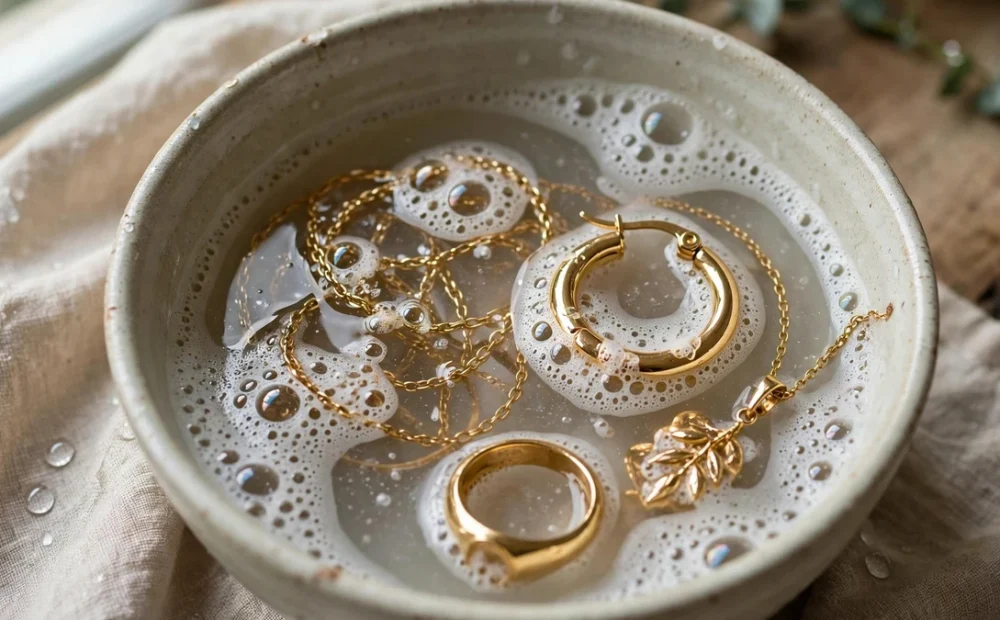
Fact 6: It can be cleaned at home, gently
What it shows: Warm water, a drop of mild soap and a soft cloth are enough to clean gold filled jewellery, and that routine keeps it bright. What to consider: Never use an abrasive polish, a silver dip, or a chemical cleaner, because they can thin the gold layer or damage the surface. Best for: All gold filled pieces, cleaned every few weeks. Material: The same gentle routine used for gold jewellery. Price range: Cleaning costs nothing. Standout feature: No special products needed.
Fact 7: It ages differently from solid gold
What it shows: Gold filled jewellery keeps its colour for years, but it will slowly show wear at the edges and on high-contact points, and it cannot be refinished the way solid gold can. What to consider: Once the gold layer wears through, the piece cannot be replated in the same way, and a jeweller may advise replacing it rather than repairing it. Best for: Pieces you love and wear, rather than pieces you expect to pass on. Material: A bonded gold layer over brass. Price range: The lower price reflects the shorter life. Standout feature: A long, graceful life rather than a permanent one.
Fact 8: The hallmark tells you what you are buying
What it shows: A genuine piece is stamped “1/20 14K GF” or “14K GF”, and that mark is your best protection when buying. What to consider: Very small pieces, such as tiny earring posts, may be too small to stamp, so buy those from a seller you trust. Best for: Anyone buying gold filled jewellery for the first time. Material: The stamp refers to the gold layer and its karat. Price range: A hallmarked piece may cost slightly more, and it is worth it. Standout feature: A mark you can check before you pay.
Fact 9: It holds its value better than plated jewellery
What it shows: A gold filled piece contains real gold, so it has some scrap value, and it keeps its wearable value far longer than a plated piece. What to consider: The resale value is still small compared with solid gold, because most of the weight is brass. Best for: Buyers who want a piece that lasts, rather than a piece to resell. Material: At least 5 percent gold by weight. Price range: Better value over time than repeatedly replacing plated pieces. Standout feature: Real gold content, even if modest.
Gold filled vs gold vermeil, gold plated and solid gold
Gold vermeil is sterling silver coated with a layer of gold, usually at least 2.5 microns thick, and it sits between plating and gold filled in durability. It is more expensive than plated, because the base is silver rather than brass, and it is a good choice for earrings and pendants. Gold filled is usually more durable than vermeil for daily wear, because its gold layer is thicker, and it is usually cheaper, because the core is brass rather than silver. A comparison of gold vermeil and gold plated jewellery explains the plated end of the scale in detail.
Gold plated jewellery has a very thin coating of gold over a base metal, often less than one micron, and it is the cheapest option. It looks good when new, but it wears through quickly on rings and bracelets. Solid gold is the other end: the whole piece is gold alloy, it lasts indefinitely, it can be repaired and resized, and it costs many times more than gold filled. For most everyday jewellery, gold filled is the practical middle ground: real gold on the surface, a price that suits daily pieces, and a life measured in years.
The choice depends on how you will wear the piece. For a chain or bracelet you plan to wear every day, gold filled is the sensible choice. For earrings or a pendant worn occasionally, vermeil is also fine. For a ring you will wear for decades, solid gold is worth saving for.
The caveats that matter
Gold filled jewellery is durable, but it is not solid gold, and a few habits will shorten its life. Chlorine is the main one: remove gold filled jewellery before swimming in a chlorinated pool, because chlorine can damage the gold surface and the brass beneath it. Perfume and hairspray should go on before jewellery, not after. And never clean a gold filled piece with a silver dip, a cleaner meant for solid gold, or a home ultrasonic cleaner, because all of them can damage the bonded layer.
| Detail | What is known |
|---|---|
| What it is | A thick layer of real gold bonded to a jeweller’s brass core |
| Gold content | At least 5 percent of the total weight, usually 14K or 12K gold |
| How it compares | Far thicker than gold plating, more durable than vermeil, cheaper than solid gold |
| Sensitive skin | Usually safe, because the surface touching skin is real gold |
| How long it lasts | Years of daily wear with normal care; rings and clasps wear first |
| Cleaning | Warm water and mild soap only; no abrasives, no silver dip, no harsh chemicals |
| What to avoid | Chlorine, perfume and hairspray on the piece, and heavy manual work while wearing it |
| What it is not | Not solid gold, not an investment, and not re-finishable once the layer wears through |
If you are buying gold filled jewellery as a gift, the same rules apply, and the hallmark is even more important, because the person receiving it cannot check the listing. Buy from a seller who states the fraction and karat plainly.
Checklist: buying gold filled jewellery honestly
Use these checks before you buy.
- Check the hallmark: look for “1/20 14K GF” or “14K GF”, and avoid pieces marked “GP” or “GEP”.
- Check the listing: the fraction, the karat and the core metal should all be stated plainly.
- Check the weight and feel: a gold filled piece should feel substantial, with an even colour across the whole piece.
- Check the seller: buy from a jeweller or a maker who explains the material, not one who only says “gold”.
- Check the returns policy: a reputable seller will accept a return if the piece is not as described.
- Plan the care: warm water and mild soap only, jewellery off before swimming, perfume on before jewellery.
Frequently asked questions
Is gold filled jewellery real gold?
Yes, the outer layer is real gold, usually 14 karat, and it must make up at least 5 percent of the total weight. The core is jeweller’s brass, so the piece is not solid gold, but the surface you see and touch is genuine gold.
How long does gold filled jewellery last?
With normal care, years. A chain or bracelet worn daily can last five to ten years, and earrings and pendants often last longer, because they are handled less. Rings wear fastest, because they rub against everything, and a ring worn every day will show wear sooner than a necklace.
Can I wear gold filled jewellery in the shower?
Yes, occasionally, but it is better to take it off. Soap and shampoo leave a film, and the piece will need cleaning more often.
Does gold filled jewellery tarnish?
The gold surface does not tarnish the way silver does, but it can dull from soap, lotion and skin oils, and if the gold layer wears through, the brass core beneath can tarnish. A gentle wash with warm soapy water usually restores the shine, and that is the only cleaning it needs.
Can gold filled jewellery be resized or repaired?
It depends on the piece. A simple chain can usually be repaired, but resizing a gold filled ring is difficult, because heating it can damage the bonded layer and expose the brass core. Ask a jeweller before assuming a repair is possible, and buy the right size in the first place.
Is gold filled better than gold vermeil?
For durability, usually yes, because the gold layer is thicker. For earrings and pendants, where wear is light, vermeil is also a good choice, and some people prefer it because the base is sterling silver. For daily chains, bracelets and rings, gold filled is the more durable and usually the cheaper option.
The bottom line
Gold filled jewellery is the practical middle ground in gold jewellery: a thick layer of real gold, bonded to a brass core, at a price that suits pieces you actually wear every day. It is not solid gold, and it will not hold its value like solid gold, but it looks like gold and feels like gold against the skin.
Buy on the hallmark, not on the title. Look for “1/20 14K GF”, check that the seller states the fraction and karat plainly, and clean it gently with warm water and mild soap. Do that, and a gold filled piece will give you the gold you wanted, at a price you can live with, for far longer than a plated piece ever would.