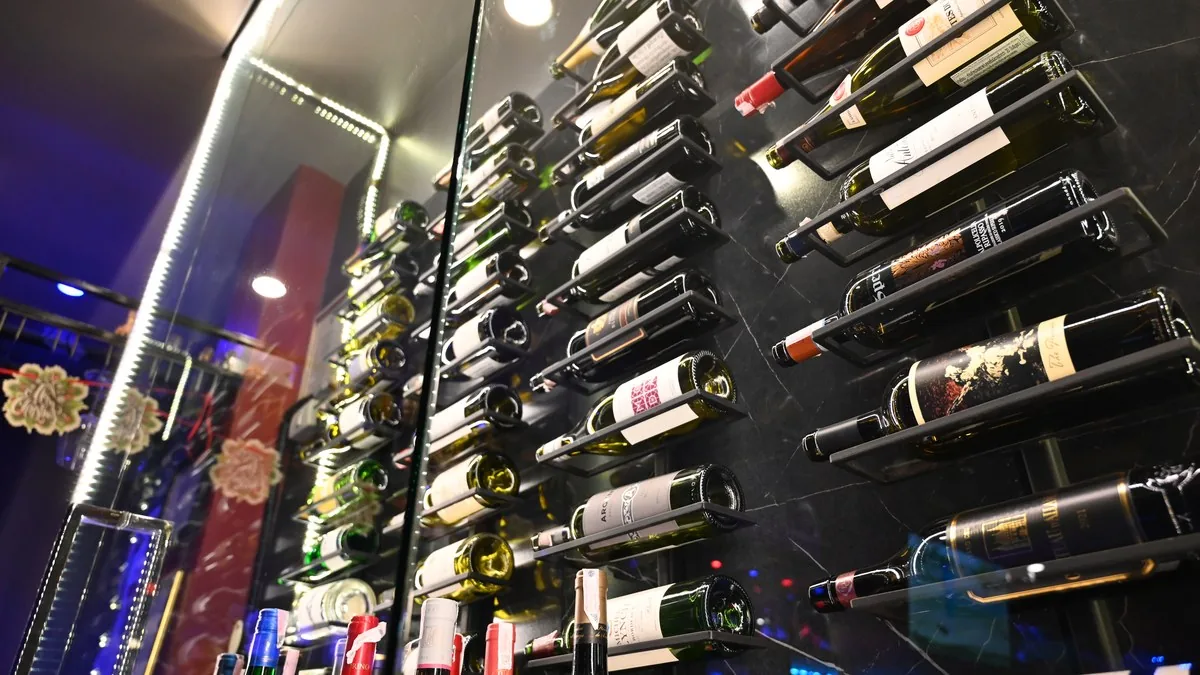

A luxury wine cellar is not a wall of bottles and a hopeful attitude. It is a small room built like a refrigerator and finished like a private club: cool, dark, quiet, and calm enough that a bottle can sit undisturbed for a decade.
The difference between a cellar that looks expensive and one that works comes down to decisions made before a single rack is ordered: climate, insulation, and the seal decide whether the wine survives; wood, stone, glass, and light decide how the room feels.
The most common mistake is to buy the racking first. A beautiful rack in a warm, damp, sunlit room is a display cabinet, not a cellar. This guide follows the right order: room, climate, insulation, cooling, racking, lighting, tasting corner, and cost.
Key takeaways
- Hold the room at about 55°F (13°C) and 60 to 70 percent humidity; steadiness matters more than the exact number.
- Build the envelope first: full insulation, a continuous vapour barrier, and an exterior-grade insulated door.
- Plan capacity by bottle shape and buying habit: Bordeaux, Burgundy, Champagne, and magnums need different slots.
- Store bottles horizontally, keep light low and warm, and keep vibration out: LED only, no sunlight on bottles.
- A cellar is not a bar: it stores wine for years and pours it slowly, so the tasting corner should be small and calm.
Start with the room: location, size and layout
The best cellar sites are the ones nature already keeps cool: a basement, a north-facing ground-floor room, or a windowless interior space away from boilers, ovens, and sun. A basement wins because the earth steadies the temperature. An above-grade room can still work, but the insulation and cooling budgets both go up.
Size follows the collection. A workable small cellar starts at about 6 by 8 feet, holding roughly 500 to 800 bottles in floor-to-ceiling racking. A comfortable room is 8 by 10 feet or larger, with a tasting table. Anything under 5 feet wide becomes a corridor with racks. Everyday bottles go at hand height; ageing stock goes higher and deeper, where it will not be disturbed.
Climate first: temperature, humidity and stillness
Temperature is the single most important factor in wine storage, and the widely cited target is about 55°F (13°C), inside a safe band of roughly 50 to 59°F. The precise figure matters less than steadiness: a cellar held at a constant 58°F treats wine better than one swinging between 55°F and 67°F. Above 70°F, wine ages too fast and the change cannot be undone.
Humidity protects the cork. Aim for 60 to 70 percent relative humidity, which keeps natural corks pliable and the seal tight. Below 50 percent for years, corks dry and shrink; above 80 percent, mould grows on labels and woodwork. Vibration disturbs sediment, so keep the cellar away from washing machines and boilers, and choose a low-vibration cooling unit. The room should be dark when nobody is in it.
The envelope: insulation, vapour barrier and the door
Think of the cellar as a refrigerator you build, not a room you decorate. Walls are commonly insulated to at least R-19, with R-25 or better in hot climates or above-grade rooms. Closed-cell spray foam is popular because it insulates, air-seals, and controls vapour in one pass. Insulate the ceiling too, and do not forget the floor.
The vapour barrier belongs on the warm side of the insulation — the outside of the envelope in most homes — so moisture cannot condense inside the studs. A barrier on the cold side traps moisture where it rots timber and feeds mould. The door is the weakest point: use an exterior-grade insulated door with a full weather seal. Plan a condensate drain before the walls close.
Cooling systems: through-wall, split and ducted
A wine cooling unit is not an air conditioner. A standard air conditioner cools air and dries it, which is the opposite of what wine needs. A dedicated wine cooling system is sized for the room’s heat load — its volume, insulation, glass area, and the temperature of the rooms around it. Through-wall units suit small closets; split systems keep the cellar quiet by putting the condenser elsewhere; ducted systems hide the equipment entirely. Never mount a unit directly above the racking.
| Decision | What works | What to avoid |
|---|---|---|
| Temperature | About 55°F (13°C), steady within 2°F a day | Swings above 65°F, or any long spell over 70°F |
| Humidity | 60 to 70 percent relative humidity | Below 50 percent for years, or above 80 percent with mould |
| Insulation | R-19 walls minimum, R-25 or better above grade | Uninsulated walls, gaps at the ceiling and floor |
| Vapour barrier | Continuous, on the warm side of the insulation | Barrier on the cold side, trapping moisture in studs |
| Cooling unit | Dedicated wine unit, sized to heat load | A standard air conditioner, or an undersized unit |
| Racking | Horizontal storage, sized by bottle shape | Upright long-term storage, or one slot size for all |
| Lighting | Low-UV LED, dimmable, on a timer or sensor | Sunlight on bottles, halogen or fluorescent heat |
| Door | Exterior-grade, insulated, fully sealed | A hollow interior door with gaps at the edges |
Racking and capacity: plan by bottle, not by count
Capacity planning starts with an honest count of what you own and what you buy. Count the bottles by shape before choosing a single rack: standard Bordeaux bottles fit almost any slot, Burgundy bottles are wider, Champagne bottles are wider still, and magnums and half-bottles need their own spaces. The same count-first discipline works across the house — it is the approach behind How to Create a Luxury Pantry, where the storage follows the stock.
Individual bottle racks are the classic choice for long-term ageing, with each bottle cradled on its side so the wine stays in contact with the cork. Diamond bins suit bulk and mixed cases; modular racks grow with the collection; metal wall-mounted racks show labels forward. Redwood and mahogany age gracefully in a humid room, while metal should be powder-coated or stainless. Leave 10 percent of the racking empty for the case that arrives next month.
Lighting: low, warm and out of the way
Lighting must let you read a label and find a bottle, and it must not harm the wine while doing it. The answer is low, warm, indirect LED light, on a dimmer or a motion sensor so the room is dark when nobody is in it. Strip lights under racks give a soft glow without shining into the bottles. Aim for 2700K or below — the warm amber of a good restaurant, not the cold white of a warehouse. Avoid halogen and fluorescent bulbs, which throw heat and ultraviolet light into the room.
The tasting corner: turning storage into a room to use
A cellar without a place to taste is a warehouse with nice shelves. The tasting corner needs only a small table, two stools, a decanter, and a spit bucket. Keep it close to the racks but out of the cooling unit’s airflow, with its own soft light. A stone or hardwood top wipes clean and stays cool.
Keep the tasting corner deliberately different from a bar. A bar is built for mixing, serving, and standing around with a crowd; a cellar tasting corner is built for sitting down with one or two people and paying attention to a single bottle. If the house already has an entertaining space, let it do the entertaining — the thinking behind How to Create a Luxury Home Bar 2027 covers the counter, the stools, and the crowd, while the cellar stays quiet and cool.
Materials, security and the details that last
Materials should be chosen for a room that is cool and damp for decades. Stone floors — limestone, slate, or large-format tile — suit the climate and stay cool underfoot. Walls take lime plaster, stone cladding, or sealed timber; avoid standard painted drywall without a vapour barrier behind it, because it will feed mould in the dark. One metal and one stone carried through the room will age more gracefully than four competing finishes.
Security is part of luxury, not an afterthought. A cellar holds real value, and a good lock on a solid door is the minimum. A keypad lock keeps the room accessible without keys floating around, and a sensor that alerts a phone when the door opens is sensible for a serious collection. Record the collection’s value for insurance, and tell the insurer the cellar exists.
What a luxury wine cellar costs in 2027
Costs split into three buckets — the envelope, the cooling, and the racking — and the envelope is the one people underestimate. A small basement conversion, with insulation, a vapour barrier, a cooling unit, and modular racking, commonly runs from $8,000 to $15,000. A mid-range built-in cellar with custom joinery and a split cooling system commonly runs from $20,000 to $50,000. A large bespoke cellar with glass walls and a ducted system can run from $75,000 to well over $150,000.
Spend first on the envelope and the cooling, because those decide whether the wine survives; spend second on racking that fits the bottles you own; spend last on display. A phased build keeps control: envelope and cooling first, racking second, tasting furniture third.
Checklist
- Choose a cool, dark, low-vibration room, ideally a basement or a north-facing interior space, away from boilers and sun.
- Hold 55°F and 60 to 70 percent humidity with a dedicated wine cooling unit, and check both readings weekly.
- Insulate every surface to at least R-19, fit a continuous vapour barrier on the warm side, and hang an exterior-grade sealed door.
- Count bottles by shape before ordering racking, store them horizontally, and leave 10 percent empty for growth.
- Light with warm, dimmable, low-UV LED only, on a sensor or timer, and keep sunlight off every bottle.
- Fit a lock, keep an inventory list, and declare the collection to your insurer before the first case goes in.
Frequently asked questions
What temperature should a wine cellar be?
About 55°F (13°C), inside a band of roughly 50 to 59°F. Steadiness matters more than the exact figure: a cellar holding 58°F all year beats one swinging between 55°F and 67°F.
What humidity does a wine cellar need?
About 60 to 70 percent relative humidity, which keeps natural corks pliable and the seal tight. Below 50 percent for years, corks dry and shrink; above 80 percent, mould damages labels.
Can I build a wine cellar in a small space?
Yes. About 6 by 8 feet holds roughly 500 to 800 bottles in floor-to-ceiling racking, and under-stair conversions work with a through-wall cooling unit. Anything under 5 feet wide becomes a corridor.
Do wine bottles need to be stored on their sides?
For long-term ageing under natural cork, yes: horizontal storage keeps the wine in contact with the cork, keeping it moist and the seal tight. Screw-cap bottles do not need it, and a bottle opened within a few weeks can stand upright.
How is a wine cellar different from a home bar?
A cellar stores wine for months or years at 55°F in the dark and pours it slowly in a quiet tasting corner, while a bar serves drinks to a crowd at room temperature. The joinery discipline is shared — How to Create a Luxury Walk-in Closet shows the same measure-first approach — but the rooms serve different rituals.
How much does a luxury wine cellar cost?
A small basement conversion commonly runs $8,000 to $15,000, a mid-range built-in cellar $20,000 to $50,000, and a large bespoke cellar $75,000 to well over $150,000.
The bottom line
A luxury wine cellar is a room built backwards from the wine: climate first, envelope second, racking third, and decoration last. Get the temperature steady at about 55°F, the humidity in its band, the light low and warm, and the door sealed, and the room will look after the collection for decades.
Start small if you must — one insulated wall, a proper cooling unit, racking that fits the bottles you own — and let the room grow with the collection. The best cellars are not the biggest or most expensive; they are the ones used quietly, often, one bottle at a time.
Note: Temperatures, humidity ranges, insulation values, and cost ranges in this guide are general planning figures for a home cellar in 2027, not a substitute for a builder or cooling specialist’s advice on your specific room. Check local building rules before cutting into walls, and confirm insurance cover before the collection grows.