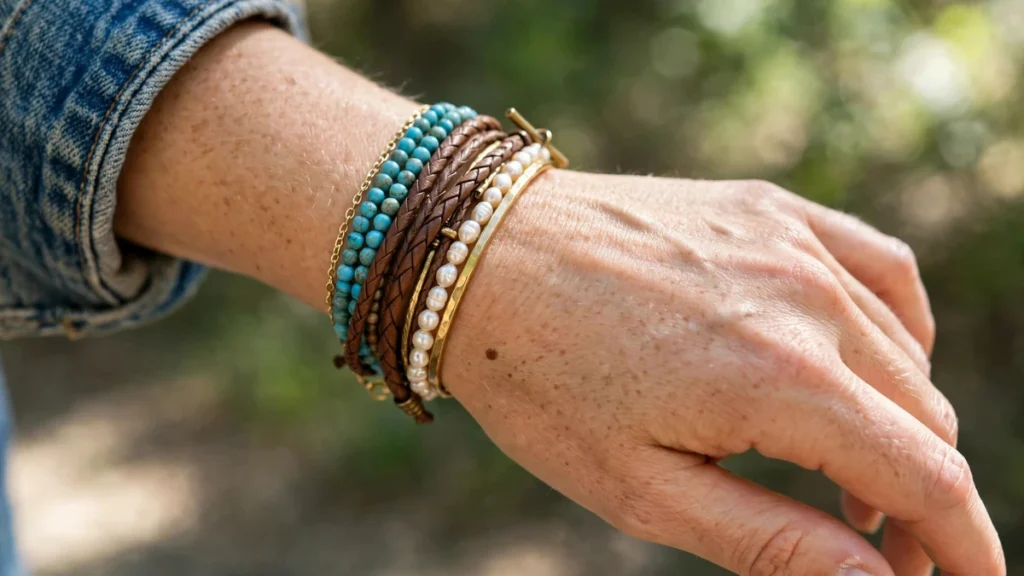
A single bracelet can finish an outfit. A stack of them can change it completely. Layered bracelets add texture, movement and personality to a wrist in a way one piece rarely manages, whether the look is a quiet mix of thin gold chains for the office or a fuller, bolder stack for an evening out. The trouble is that layering is easy to get wrong. Too many pieces and the wrist looks cluttered. Pieces that fight each other in weight, colour or texture end up looking accidental rather than considered.
The good news is that bracelet layering follows a few simple rules, and once you know them, you can build a stack that looks intentional every time. It starts with one anchor piece, usually the bracelet you like most, and builds outwards with pieces that vary in width, texture and finish without competing for attention. Colour matters less than balance, and the number of bracelets matters less than how they sit together on the wrist.
This guide walks through nine steps for layering bracelets in 2027, from choosing an anchor piece to keeping a stack comfortable all day. Each step explains what to do, what to avoid, and how long it takes, so you can practise the routine at home and build a stack that suits your wrist, your wardrobe and your day.
Key takeaways
- Start every stack with one anchor bracelet, then add two to four supporting pieces that vary in width, texture and finish.
- Mix metals and materials deliberately, but keep one repeated element, such as a shared metal tone or a single colour, so the stack looks connected.
- Balance the weight across the wrist: heavy pieces sit better near the hand, lighter chains and bangles above them.
- A stack of three to five bracelets suits most wrists and most days; more than seven usually looks crowded and feels uncomfortable.
- No stack suits every wrist or every occasion, and a bracelet that catches, pinches or slides constantly is the wrong piece for layering, however good it looks on its own.
What bracelet layering actually is
Bracelet layering means wearing several bracelets on the same wrist at once, chosen so they work as one look rather than as separate pieces that happen to share a wrist. It is different from simply piling on jewellery. A layered stack has a shape: an anchor piece that sets the tone, supporting pieces that add texture or colour, and enough space between pieces for each one to be seen. When it works, the eye reads the stack as a single, deliberate arrangement.
The idea is not new. People have stacked bangles, cuffs and chains for centuries, and the look comes back into fashion every few years with a new twist. In 2027 the emphasis is on mixing rather than matching: a slim gold chain next to a beaded bracelet, a leather wrap beside a slim cuff, a pearl strand softening a stack of metal. The mix is what makes it feel current, but the mix only works when the pieces share something, a metal tone, a colour, a texture, or a mood.
Layering also has practical limits. Bracelets move, catch on sleeves, and knock against each other. A stack that looks beautiful in a photograph can be irritating by lunchtime if the pieces are too heavy, too loose, or too sharp-edged. A stack you keep adjusting is not a good stack, however well it photographs.
How to plan a stack before you put it on
Plan the stack on a flat surface before you put anything on your wrist. Lay the pieces out in a row, anchor first, then the supporting pieces in the order you intend to wear them. This takes a minute and saves the trial and error of putting bracelets on and taking them off one by one. You can see at a glance whether the widths, colours and textures balance, and whether one piece dominates the rest.

Start with the anchor. This is the piece you want people to notice first, usually the most interesting bracelet you own: a cuff with a distinctive shape, a chain with a charm, a beaded bracelet in a colour you love. Everything else in the stack supports it. If two pieces both demand attention, one of them belongs on the other wrist, or saved for another day.
Then choose the supporting pieces by contrast. If the anchor is wide, add slim pieces. If it is smooth, add texture, a beaded bracelet, a twisted chain, a leather wrap. If it is gold, a silver or mixed-metal piece can add depth, and our guide to layering gold jewellery explains how a shared warm tone keeps mixed pieces looking connected rather than random. Three to five pieces is the sweet spot for most wrists. Fewer can look unfinished, more can look crowded, and the weight adds up faster than you expect.
The 9 steps to layer bracelets
Start with a clean, bare wrist
What to do: Put the stack on a bare wrist, with no watch, hair tie or sleeve in the way, so you can see how the pieces actually sit. What to avoid: Building a stack over a watch or a tight cuff, which pushes the bracelets up and makes them bunch. Best for: Every stack, every day. Time needed: One minute. Standout tip: If you wear a watch, layer the stack on the opposite wrist, or keep the watch and one slim bracelet together and put the rest of the stack on the other arm.
Choose one anchor bracelet
What to do: Pick the piece with the most presence, the widest cuff, the boldest chain, the bracelet with the charm or the colour you want to feature, and place it in the middle of the stack. What to avoid: Two anchors in one stack, which split the eye and make the wrist look busy. Best for: Stacks that need a clear focal point. Time needed: One minute. Standout tip: The anchor does not have to be the most expensive piece, just the most interesting one; a simple beaded bracelet in a strong colour can anchor better than a plain gold bangle.
Add slim chains for lightness
What to do: Add one or two slim chains, in a matching or complementary metal, to lighten the stack and add movement. What to avoid: Chains so fine they tangle with each other or catch on the anchor piece. Best for: Stacks that feel heavy or flat. Time needed: One minute. Standout tip: Vary the chain lengths slightly, even by a few millimetres, so they sit at different points on the wrist and do not lie exactly on top of each other.
Mix textures, not just colours
What to do: Combine at least two textures, such as smooth metal with beads, leather with chain, or a hammered cuff with a polished bangle. What to avoid: A stack of five identical smooth bangles, which reads as one thick band rather than a layered look. Best for: Anyone whose stack looks flat in the mirror. Time needed: Two minutes. Standout tip: Texture is more forgiving than colour; a stack in one metal tone can still look rich if the finishes vary between polished, brushed and hammered.
Balance heavy pieces near the hand
What to do: Place the heaviest bracelet closest to your hand, with lighter pieces above it towards the elbow. What to avoid: A heavy cuff sitting on top of a light chain, which pushes the chain down and bunches the stack. Best for: Stacks with a chunky cuff or a heavy beaded bracelet. Time needed: One minute. Standout tip: If a piece keeps sliding down over your hand, it is too loose for the stack, however well it fits on its own.
Leave a little space between pieces
What to do: Leave small gaps between bracelets so each one is visible and can move a little without grinding against its neighbours. What to avoid: Packing bracelets so tightly they cannot move, which scratches metal and makes the stack feel stiff. Best for: Metal stacks, where pieces rub and mark each other. Time needed: One minute. Standout tip: If you can slide a fingernail between two bracelets, there is enough space; if you cannot, take one piece out.
Repeat one element to tie the stack together
What to do: Repeat one thing across the stack, a metal tone, a colour, a bead size, or a shape, so the pieces feel like a set even when they are different. What to avoid: Five completely unrelated bracelets with no shared element, which looks like a random collection. Best for: Mixed-metal and mixed-material stacks. Time needed: Two minutes. Standout tip: A single repeated bead colour, picked up in two or three pieces, is often enough to tie a whole stack together.
Check the stack in movement, not just in the mirror
What to do: Once the stack is on, move your arm, type, reach for something, and check that the pieces stay comfortable and do not catch on each other or on your clothes. What to avoid: Judging a stack only while your arm is still, which hides the catching and sliding that shows up within an hour. Best for: Stacks you will wear all day. Time needed: Two minutes. Standout tip: If a bracelet catches on a sleeve, swap it for a smoother piece, or move the stack to the wrist that does less work.
Take one piece away before you leave
What to do: Before you go out, remove the least essential bracelet from the stack and look again. What to avoid: Adding one more piece at the last minute because the wrist feels empty. Best for: Anyone who tends to over-layer. Time needed: One minute. Standout tip: The piece you remove is usually the right one to leave behind; if the stack still looks finished without it, it did not belong.
Which bracelets work best together
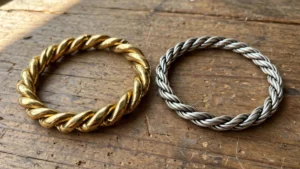
The easiest combinations pair contrast with connection. A slim gold chain with a beaded bracelet works because the chain is smooth and the beads are textured, while the shared warm tone connects them. A leather wrap with a silver cuff works because the leather is soft and matte and the cuff is hard and polished, while a similar width keeps them balanced. A pearl strand with a thin gold bangle works because the pearls are soft and round and the bangle is hard and straight, while the gold tone warms the pearls.
Width is the other thing to watch. Stacks look best when the pieces vary in width, a wide cuff with slim chains, a medium beaded bracelet with a fine chain and a slim bangle. When every piece is the same width, the stack flattens into a band. When the widths vary, each piece has its own line, and the eye can follow the stack from piece to piece.
For a first stack, three pieces are enough: an anchor, a slim chain, and a textured piece such as beads or leather. That combination covers the three things a stack needs, a focal point, lightness, and texture, and it is easy to build on. Add a fourth piece once the three-piece stack feels natural, and stop there until you know how the stack wears over a full day. A roundup of gold vermeil bracelets is a good place to look for an anchor piece, because vermeil offers the look of gold at a lower price, and a single strong bracelet can carry a whole stack.
The caveats that matter
Layering is forgiving, but it is not free of problems. The most common is damage: bracelets that rub against each other all day will scratch, and soft stones and pearls are the first to show it. Keep pearls and soft stones away from hard metal edges, and check the stack after a day of wear for new marks. The second problem is comfort. A stack that is too tight restricts the wrist, and a stack that is too loose slides and catches. The fit of each bracelet matters more in a stack than on its own, because the pieces interact.
| Detail | What is known |
|---|---|
| Ideal stack size | Three to five bracelets for most wrists; more than seven usually looks crowded |
| Where to put the anchor | In the middle of the stack, with supporting pieces above and below it |
| Where heavy pieces sit best | Closest to the hand, with lighter pieces above them |
| What ties a stack together | One repeated element: a metal tone, a colour, a bead size, or a shape |
| Biggest cause of damage | Pieces rubbing against each other; keep pearls and soft stones away from hard metal edges |
| What to avoid | Two anchor pieces in one stack, and bracelets packed so tightly they cannot move |
| Comfort check | Move, type and reach before leaving; remove any piece that catches, pinches or slides |
| What layering does not do | It does not suit every wrist or occasion; a formal event may call for a single bracelet |
If your skin is sensitive to metal, layering can make it worse, because more pieces mean more contact and more friction. Nickel is the usual culprit. If a bracelet leaves a mark or an itch, take it out of the stack and check what it is made of before wearing it again. Hypoallergenic options exist for most bracelet styles, and they are worth choosing for pieces that sit against the skin all day.
Checklist: building a bracelet stack
Use these checks each time you build a stack, until the routine becomes habit.
- Start with a bare wrist and lay the pieces out flat before putting them on.
- Choose one anchor bracelet and place it in the middle of the stack.
- Add one or two slim chains for lightness and movement.
- Mix at least two textures, and repeat one element to tie the stack together.
- Put heavy pieces nearest the hand and leave a little space between pieces.
- Move, type and reach before leaving, and take one piece away if the stack feels crowded.
Frequently asked questions
How many bracelets should I layer at once?
Three to five suits most wrists and most days. Three is a good starting point, five is a full stack, and more than seven usually looks crowded and feels uncomfortable. Start with three and add one at a time.
Can I mix gold and silver bracelets in one stack?
Yes, and mixed-metal stacks are one of the most current looks, as our guide to layering silver jewellery shows. Keep one repeated element, such as a shared texture or a single colour, so the metals feel deliberate rather than random, and avoid mixing more than two metal tones in a small stack.
Should bracelets on a stack all be the same size?
No. Varying the widths makes the stack look layered, while identical widths flatten it into a band. Mix a wider anchor with slimmer supporting pieces, and vary the fit slightly so each bracelet sits at its own point on the wrist.
How do I stop bracelets from tangling?
Keep fine chains apart with a wider piece between them, and avoid stacking two very fine chains next to each other. A slim bangle or a beaded bracelet between two chains acts as a spacer and stops them wrapping around each other.
Can I layer bracelets with a watch?
Yes, but keep the watch and one slim bracelet on one wrist and the rest of the stack on the other, or wear the watch alone and stack the opposite wrist. A watch plus a full stack on the same wrist usually bunches and feels heavy.
Do layered bracelets damage each other?
They can, especially when hard metal rubs against soft stones or pearls all day. Leave a little space between pieces, keep pearls away from sharp metal edges, and check the stack for new scratches after a long day of wear.
The bottom line
Bracelet layering is a small skill with a large payoff. One anchor, a few supporting pieces, a repeated element to tie them together, and a comfort check before you leave are enough to build a stack that looks deliberate and feels good all day. Start with three pieces, practise the routine at home, and add to it slowly rather than all at once.
The best stack is the one you forget you are wearing. If the bracelets sit comfortably, move freely, and still look arranged at the end of the day, the layering has worked. If they do not, change one piece, not the whole stack, and try again tomorrow.