

A nose hoop that fits well feels like nothing at all. It sits close to the nostril, moves a little when you smile, and never catches, pinches, or pulls. A nose hoop that fits badly is impossible to ignore. It hangs too low, presses into the skin, snags on everything, or spins around so the clasp sits where you can feel it all day. The difference between the two is rarely the hoop itself. It is the size.
Hoop sizing comes down to two numbers, and most people only know one of them. The gauge is the thickness of the wire, and the diameter is the width of the circle. Get the gauge wrong and the hoop will not fit the piercing at all. Get the diameter wrong and it will fit, but it will look and feel wrong, sitting too tight against the nostril or dangling too far below it.
This guide explains the nine sizing facts that matter, from gauge and diameter to how to measure a hoop you already own, so you can buy a nose hoop that fits the first time. It also covers the difference between sizing for a new piercing and a healed one, and what to change when a hoop feels wrong.
Key takeaways
- Hoop sizing has two numbers: gauge, the thickness of the wire, and diameter, the width of the circle, and both must match your piercing.
- Most nostril piercings take 20 or 18 gauge; a hoop in the wrong gauge will either not fit or sit loose and irritate the piercing.
- Diameter is measured across the inside of the hoop, and the right size depends on how high your piercing sits and how close you want the hoop to hug the nostril.
- Measure a hoop you already own before buying a new one, because sizes are easier to copy than to guess.
- Sizing guidance is general information, not medical advice, and a sore, swollen, or weeping piercing should be seen by a piercer or clinician before you change jewellery.
What nose hoop sizing actually means
Nose hoop sizing is the match between the hoop and the piercing it sits in. A hoop has to pass through the channel in your nostril, sit comfortably against the skin, and stay put without pressing or pulling. Three things decide that: the thickness of the wire, the width of the circle, and the way the hoop closes. Change any one of them and the fit changes with it.
It helps to think of gauge and diameter separately, because they solve different problems. Gauge is about the piercing itself. A piercing made with an 18 gauge needle has a channel that fits an 18 gauge hoop, and a 20 gauge hoop will feel loose in it while a 16 gauge hoop will not fit at all. Diameter is about the look and the comfort. A small diameter hugs the nostril closely, a larger one hangs lower and moves more, and the right choice depends on where your piercing sits and how much movement you want.
The third factor, the closure, matters more than people expect. A seamless hoop has no visible join and slides through the piercing smoothly, while a hinged hoop clicks open and shut and is easier to put in and take out. Both come in the same gauges and diameters, but the closure changes how the hoop feels when you change it, and how likely it is to catch on clothing or a towel.
What you need and what to look for
You need very little to size a hoop: the gauge of your piercing, a ruler or a piece of string, and a hoop you already own if you have one. If you do not know your gauge, a piercer can measure it in a minute, and it is worth knowing before you buy anything. Guessing is the most common reason a new hoop does not fit, and it is entirely avoidable.
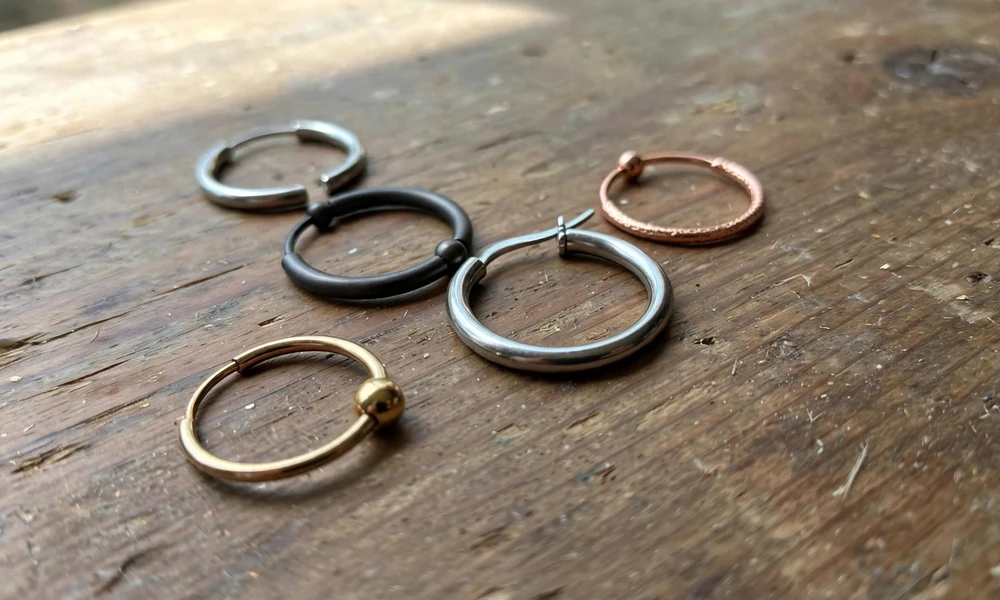
Look first at the gauge, then at the diameter. A hoop listed as 18 gauge and 8 mm tells you both numbers, and both should match what you need. Be careful with listings that only give one number, or that describe size in vague terms such as small, medium, or large, because those words mean different things to different sellers. Our guide to the best nose hoops for women compares hoop styles side by side, which helps when you are deciding between a close-fitting seamless hoop and a hinged one.
Also check the material before you check the size. Implant-grade titanium, solid gold, and surgical steel are the usual choices for a healed piercing, and nickel-free matters if your skin is sensitive. A hoop in the right size but the wrong material will still irritate a piercing, so size and material have to be right together.
The 9 nose hoop sizing facts that matter
The gauge
What it shows: The gauge is the thickness of the hoop wire, and it must match the gauge of your piercing. Most nostril piercings are 20 or 18 gauge, with 18 slightly thicker than 20.
What to consider: A hoop in a thinner gauge than your piercing will sit loose and can irritate the channel, while a thicker gauge simply will not go through. Never force a thicker hoop into a piercing.
Best for: Anyone buying a first hoop. Material: Implant-grade titanium, solid gold, or surgical steel. Price range: Budget to mid-range for standard gauges. Standout feature: Getting the gauge right is the single most important sizing decision.
The diameter
What it shows: The diameter is the width of the hoop measured across its inside edge, usually 6, 8, or 10 mm for a nostril hoop, and it decides how closely the hoop hugs your nostril.
What to consider: A diameter that is too small presses into the skin and can distort the piercing, while one that is too large hangs low, catches on things, and looks loose.
Best for: Matching the hoop to where your piercing sits. Material: Any, though thinner wire suits smaller diameters. Price range: Budget to mid-range. Standout feature: An 8 mm diameter suits most nostril piercings as a starting point.
The seamless vs hinged fit
What it shows: A seamless hoop has no visible join and must be gently twisted open, while a hinged hoop has a small hinge that clicks open and shut.
What to consider: Seamless hoops sit smoother and catch less, but they are harder to open and close. Hinged hoops are easier to change, but the hinge adds a small bump that some people can feel.
Best for: Seamless for everyday wear, hinged for frequent changes. Material: Implant-grade titanium or solid gold for smooth hinges. Price range: Hinged hoops usually cost a little more. Standout feature: The closure changes how easy the hoop is to change, not how it looks once it is in.
The fit for your nostril thickness
What it shows: The thickness of your nostril, from the piercing to the edge of the nose, decides how much room the hoop needs to sit comfortably without pressing.
What to consider: A hoop with too small a diameter on a thicker nostril will press into the skin, while a larger diameter gives the hoop room to sit naturally.
Best for: Anyone whose first hoop felt tight or pinched. Material: Any, though a smooth finish matters more on thicker skin. Price range: Budget to mid-range. Standout feature: Nostril thickness varies more than people expect, so copy a hoop that already fits.
Sizing for a new piercing vs a healed one
What it shows: A new piercing is usually fitted with a slightly larger hoop or stud to allow for swelling, while a healed piercing can take a closer-fitting hoop.
What to consider: Do not size down to a snug hoop until the piercing is fully healed, usually after four to six months, because swelling can make a close hoop press and irritate.
Best for: Anyone changing jewellery for the first time. Material: Implant-grade titanium for a new piercing. Price range: Budget for a first hoop. Standout feature: Healing piercings need room, and room looks like a slightly larger hoop.
How to measure what you already own
What it shows: Measuring a hoop that already fits is the most reliable way to buy the next one, because it removes all guesswork from diameter and gauge.
What to consider: Measure the inside diameter with a ruler, across the widest point of the inside edge, and check the gauge against the piercing it came from rather than guessing from how it looks.
Best for: Anyone buying a second or third hoop. Material: Any. Price range: Free, with a ruler and a steady hand. Standout feature: A hoop that fits is a better sizing guide than any chart.
The end and clasp style
What it shows: The way a hoop closes, whether a plain join, a hinge, or a small ball end, affects how it sits, how it feels, and how likely it is to catch.
What to consider: A ball end adds a small amount of weight and a point that can catch on fabric, while a plain seamless join is the smoothest option for everyday wear.
Best for: Everyday wear and sleeping. Material: Solid gold or titanium for smooth joins. Price range: Budget to mid-range. Standout feature: The smoothest closure is the one you forget is there.
Hoop vs ring sizing differences
What it shows: A hoop and a ring are not sized the same way. A hoop is sized by its inside diameter, while a ring or stud is often described by its overall size, and the two do not translate directly.
What to consider: Do not buy a hoop using the size of a ring or stud you own. Measure the hoop itself, or ask the seller for the inside diameter in millimetres.
Best for: Anyone switching from a stud or ring to a hoop. Material: Any. Price range: Budget to mid-range. Standout feature: Inside diameter is the only number that transfers between hoops.
When a size feels wrong and what to change
What it shows: A hoop that presses, pulls, spins constantly, or catches on everything is telling you the size is wrong, and the fix depends on which way it is wrong.
What to consider: If it presses, go up a diameter. If it hangs low and catches, go down a diameter. If it feels loose in the piercing itself, the gauge is wrong, not the diameter.
Best for: Anyone whose hoop never quite felt right. Material: Keep the same material when testing a new size, so only one thing changes. Price range: Budget for a test hoop. Standout feature: Change one number at a time, so you know which change fixed the problem.
Which nose hoop size is right for you
Start with the gauge you already wear, then choose a diameter by copying a hoop that fits or by starting at 8 mm, which suits most nostril piercings. If your piercing sits high on the nostril, a 6 mm hoop may hug it better. If it sits lower, or your nostril is thicker, a 10 mm hoop will usually sit more comfortably. A guide to buying a nose hoop is useful here, because it covers materials and closures alongside size, and the three decisions are best made together.
For a first hoop after healing, a seamless hoop in implant-grade titanium at your usual gauge and 8 mm diameter is a safe, comfortable starting point. It is smooth, light, and unlikely to irritate, and once you know how 8 mm feels, you can move up or down with confidence. For everyday wear after that, choose the diameter that disappears on your face, the one you stop noticing by lunchtime.
The caveats that matter
Hoop sizing is straightforward, but two mistakes cause most problems. The first is buying a hoop in the wrong gauge because the listing did not state it clearly, or because gauge was confused with diameter. The second is sizing down too soon, while the piercing is still healing, and then blaming the hoop when the piercing becomes sore. Both are avoidable with a ruler, a minute of measuring, and a little patience.
| Detail | What is known |
|---|---|
| Most common gauge | 20 or 18 gauge for a nostril piercing; match the gauge you already wear |
| Most common diameter | 8 mm suits most nostril piercings as a starting point |
| How diameter is measured | Across the inside edge of the hoop, in millimetres |
| Smallest comfortable fit | 6 mm for a high piercing or a close, hugging fit |
| Largest usual fit | 10 mm for a lower piercing, a thicker nostril, or a looser look |
| When to size down | Only once fully healed, usually after four to six months |
| Best way to choose | Measure a hoop that already fits and copy its gauge and diameter |
| When to see a professional | If a hoop will not fit, or the piercing is sore, swollen, or weeping |
If a hoop will not go through at all, do not force it. The gauge is probably wrong, and forcing a thicker wire through a piercing can tear the channel. Put the old jewellery back in and see a piercer, who can measure the piercing and confirm the right size in a minute.
Checklist: sizing a nose hoop honestly
Run through these checks before you buy, and again when the hoop arrives.
- Check the gauge: it matches the gauge of the jewellery you already wear, usually 20 or 18.
- Check the diameter: measured across the inside edge, in millimetres, not described as small or large.
- Check your piercing: fully healed, with no tenderness or discharge, before sizing down to a snug hoop.
- Check the closure: seamless for the smoothest fit, hinged for the easiest change.
- Check the material: implant-grade titanium, solid gold, or surgical steel, and nickel-free if your skin is sensitive.
- Check the fit after: no pressing, pulling, or constant spinning, and the hoop is forgotten within a day.
Frequently asked questions
What size nose hoop should I get?
Match the gauge you already wear, usually 20 or 18, and start with an 8 mm diameter, which suits most nostril piercings. Go down to 6 mm for a closer fit on a high piercing, or up to 10 mm for a lower piercing or a thicker nostril.
How is nose hoop diameter measured?
Across the inside edge of the hoop, in millimetres, at its widest point. Measure a hoop you already own with a ruler, and use that number when you buy the next one.
Can I wear a thicker gauge hoop in my piercing?
No, not without stretching the piercing, which should only be done slowly and with professional advice. A hoop in a thicker gauge than your piercing simply will not fit, and forcing it can tear the channel. A guide to gold vs silver nose hoops also covers materials, which matter as much as size when you are choosing between metals.
Should I size down as soon as my piercing feels better?
Wait until it is fully healed, usually four to six months, with no tenderness, crust, or discharge. Feeling better is not the same as being healed, and a snug hoop on a healing piercing can press and set healing back.
Why does my hoop keep spinning?
Usually because the diameter is slightly too large, so the hoop has room to move, or because the closure is not fully shut. Try a diameter 2 mm smaller, and check that a hinged hoop clicks fully closed.
Does hoop size affect healing?
Yes. A hoop that is too tight presses on the piercing and can cause irritation and bumps, while a hoop that is too large moves constantly and disturbs the channel. A correctly sized hoop, in the right gauge, moves a little without pressing or pulling.
The bottom line
The right nose hoop size is two numbers: the gauge you already wear, usually 20 or 18, and a diameter measured across the inside of the hoop, with 8 mm as the usual starting point. Copy a hoop that already fits, measure before you buy, and change one number at a time if something feels wrong.
Size is not a detail to guess at. A hoop that fits disappears on your face, and a hoop that does not will remind you of it every time you smile, change a jumper, or catch it on a towel. Get the gauge right, pick a diameter that suits where your piercing sits, and wait until the piercing is fully healed before going snug.