What if the most radical thing a woman could wear in the early 1800s was a thin white dress with almost no structure at all? After centuries of stiff bodices, heavy brocades, and skirts wide enough to require their own doorway strategy, British women swapped it all for something that looked, at first glance, like a nightgown. That swap is the heart of Regency era fashion, and it remains one of the strangest, most elegant pivots in dress history.
The Regency itself was short. George, Prince of Wales, became Prince Regent in 1811 and king in 1820. But fashion historians usually stretch the period from about 1795 to 1820, because the style shift started before the politics did and kept going after. What happened in those twenty-five years reshaped silhouettes, fabrics, underwear, and even ideas about cleanliness and masculinity.
Why the Empire Waist Took Over
The defining garment of the period was the Empire line dress: gathered just under the bust, falling in a narrow column to the hem. No waist seam at the natural waist. No hoops. No heavy padding. Just a long, clean line that borrowed openly from Greco-Roman statues and neoclassical painting.
This was not a small tweak. It was a rejection. Eighteenth-century court dress had been about width and display. The new look was about verticality and lightness. A woman in 1805 could dress herself in a way her grandmother would have found almost indecent, and many people did find it indecent. Critics complained about damp climates, thin fabric, and the abandonment of sturdy stays.
The style was popularised in France from the late 1790s and crossed the Channel quickly, helped along by fashion plates, portrait prints, and the simple fact that wealthy people traveled and copied each other. If you want to see how quickly silhouettes can flip when culture shifts underneath them, the Regency is a great case study, and it sits comfortably alongside other turning points covered in this 2026 fashion trends guide that traces how and why styles rise and fall.
Fabric, Colour, and the White Muslin Myth
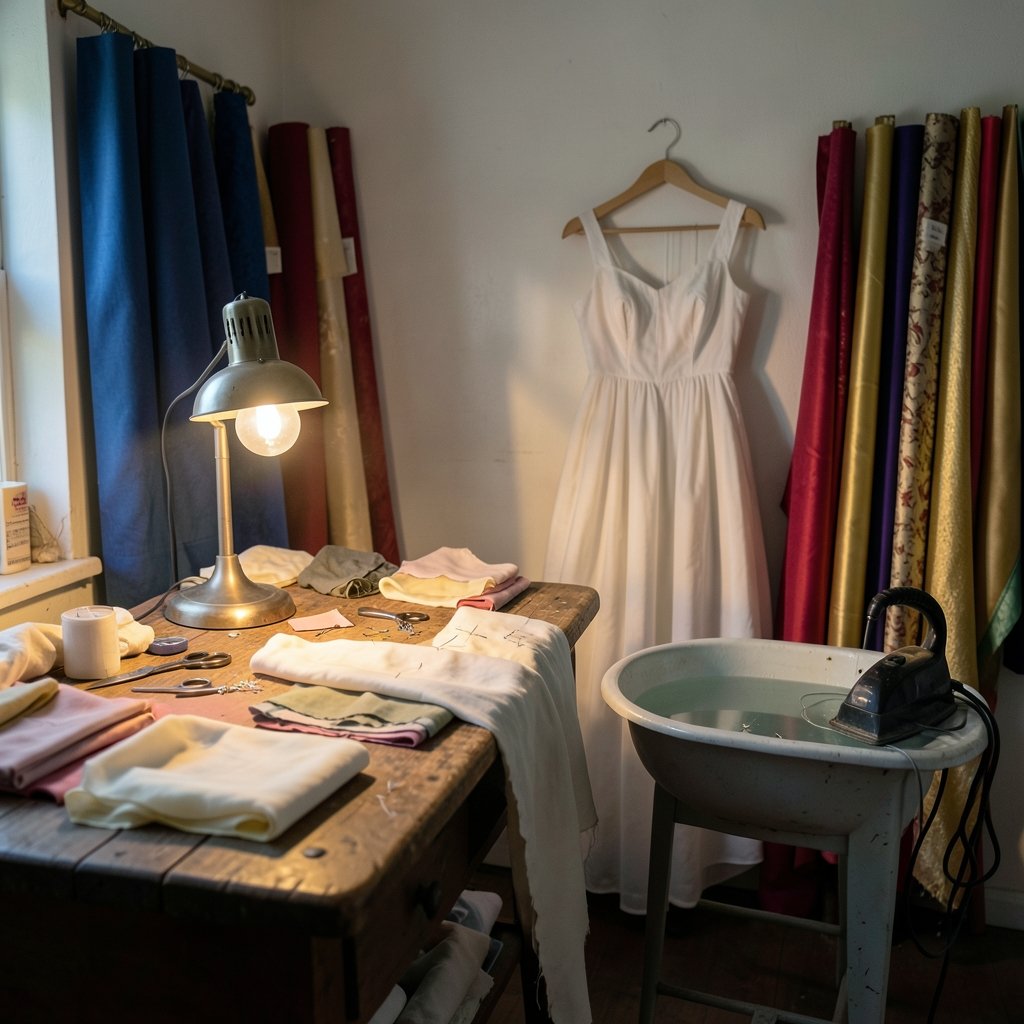
White muslin became the emblem of the era. Day dresses and evening gowns were made in muslin, cotton, lawn, and lightweight silk, often in white or pale tints. The look was soft, slightly translucent, and deliberately unadorned compared with what came before.
Here is where a common mistake creeps in. People assume “simple” meant “cheap” or “democratic.” It did not. Fine muslin was expensive, white fabric showed every mark, and keeping a pale gown presentable required laundering that most households could not manage easily. The apparently effortless neoclassical look was often achieved with costly materials and frequent changes of dress. The simplicity was engineered.
Practical tip for anyone studying or recreating this look: pay attention to weight as well as colour. A modern quilting cotton will hang nothing like a fine lawn or voile. The whole silhouette depends on drape, and drape is a function of how thin and how softly woven the cloth is.
Daywear Versus Eveningwear: A Real Difference
Regency dress was not one uniform. Women changed clothes for the occasion, and the gap between indoor evening dress and outdoor dress was wide.
| Feature | Evening dress | Day and outdoor dress |
|---|---|---|
| Fabric | Light silk, fine muslin, lawn | Heavier cotton, wool, lined fabrics |
| Colour | White and pale tints common | Deeper colours, prints, practical tones |
| Sleeves | Short, often puffed | Long sleeves common |
| Outer layer | Shawl or none | Spencer jacket, pelisse, cloak |
| Headwear | Turbans, ornaments | Bonnets, caps |
The spencer was a short, fitted jacket that ended above the waist, perfect for adding warmth without crushing the high-waisted line. The pelisse was a long coat-dress worn over or instead of a gown. Both were cut in heavier fabric and gave the era its structured outdoor counterpoint. This is the part of Regency style that gets ignored in film adaptations, which tend to keep everyone in thin white indoors and out, in the rain, in England, in January.
What Was Underneath: Stays, Shifts, and Soft Support
The underwear changed too. Stays of this period were generally softer and less heavily boned than eighteenth-century examples. Their job was to lift and separate the bust and support the high line of the gown, not to cinch the waist into a hourglass.
That said, generalising is risky. Regional and class variation was enormous. A wealthy woman in London and a farmer’s wife in Yorkshire were not wearing the same objects, even if both were technically “Regency.” Surviving garments are often dated only approximately, so museum labels frequently hedge with phrases like “c. 1800–1810.”
A practical point for costume makers: if you build Regency stays with modern tight-lacing expectations, the dress will not sit correctly. The gown is designed to hang from the bust, and the underpinning needs to create a smooth, lifted platform rather than compression.
Men’s Fashion: Beau Brummell and the Clean Suit
Regency menswear moved decisively toward dark, fitted tailcoats, waistcoats, and trousers or breeches. The figure most associated with this shift is Beau Brummell, prominent from roughly 1799 into the 1810s, who championed clean tailoring, restraint, and personal cleanliness over the ornate embroidery of earlier decades.
This is the birth of the modern suit’s logic: fit over decoration, dark over bright, subtlety as a status signal. Brummell’s influence was social rather than institutional, but it stuck. The plain, well-cut coat became the default of respectable male dress for the next century.
Accessories That Did the Work
With a plain gown, accessories carried the visual weight. The characteristic pieces were:
- Bonnets, including the poke bonnet with its forward-projecting brim.
- Reticules, the small handheld bags that replaced tie-on pockets in everyday use.
- Shawls, notably Kashmir and Norwich shawls, draped over the shoulders.
- Long gloves, especially for evening.
- Turbans and hair ornaments for formal occasions.
The shawl deserves special mention. It solved a real problem: thin dresses in cold rooms. A large shawl added warmth, colour, and a diagonal line that broke up the column silhouette. Norwich shawls were a domestic British industry answer to imported Kashmir shawls, which were costly and exclusive.
Jane Austen as a Reference, Carefully Used
People reach for Jane Austen constantly when discussing this period, and it makes sense. Her novels were published between 1811 and 1818, right in the window. But there is a trap here. Austen’s books contain very few detailed clothing descriptions. She mentions muslin, ribbons, and bonnets in passing, usually for characterisation rather than cataloguing.
So using Austen as a costume source requires care. She is excellent social context for how people thought about dress, expense, and appearance. She is a poor technical manual. Treat her as atmosphere, not pattern.
Fashion Plates and the Dating Problem
The best primary visual sources are fashion plates, particularly those in Ackermann’s Repository, founded in 1809. These hand-coloured prints show the ideal version of the look: the posture, the drape, the accessories.
But plates show idealised dress, not everyday dress. They were commercial products designed to sell fabric and patterns. A woman reading them in Bath might copy the sleeve and ignore the rest. Surviving garments, meanwhile, are often altered, remade, or dated approximately. Anyone building a timeline of Regency fashion should expect fuzzy edges rather than crisp start and end dates.
This is a useful lesson for reading any fashion moment. The polished version and the lived version are different things. The same gap shows up in modern dress history, which is why analyses like this piece on how 2010s fashion, athleisure, streetwear and Instagram rewrote the rules tend to focus on what people actually wore rather than what magazines promised.
Common Mistakes People Make With Regency Style
A few errors show up again and again, whether in historical sewing, museum interpretation, or themed events.
Mistake one: treating the whole era as one look. A gown from 1798 and a gown from 1818 are related but not identical. Skirts gradually widened, trims crept back in, and sleeves changed shape. Pick a narrow date and stay there.
Mistake two: ignoring outerwear. The spencer and pelisse are not optional extras. They are half the story, and they are where the tailoring skill lives.
Mistake three: assuming white everywhere. Pale gowns dominate the visual record partly because they photographed and illustrated well. Printed cottons, coloured silks, and practical daywear existed in quantity.
Mistake four: modern posture. Regency gowns sit differently on the body. A slouched modern stance makes the high waist look like a mistake. Standing tall with the bust lifted is what makes the line read correctly.
Mistake five: cheap shiny fabric. The era’s charm is in matte, soft, slightly stiff drape. Anything with a synthetic sheen fights the silhouette.
How Regency Fashion Connects to Later Style
The Regency did not vanish in 1820. Waists began dropping back toward the natural position through the 1820s, sleeves inflated dramatically, and skirts widened again. But the underlying idea, that clothing could be light, washable, and cut for the body rather than built around it, never fully left.
That idea resurfaces constantly. It shows up in the pared-back tailoring of Italian luxury fashion, which favours line and fabric over ornament. It shows up in every minimalist trend cycle. And it shows up in the way contemporary designers keep returning to the column dress, the simple white cotton gown, and the fitted short jacket. If you follow the current fashion trends 2026 conversation, you will notice the Empire line keeps reappearing in summer collections, usually described as “Grecian” or “column” without anyone crediting the Regency.
Illustrators and image makers love this period too, because the silhouette is easy to read and dramatic to draw. The way a single garment can define an entire visual era is exactly the kind of thing explored in this piece about how Angelica Hicks turns runway moments into illustration, and the same principle applies to Regency plates: one strong line, endlessly reproduced.
Conclusion
Regency era fashion looks delicate, but it was a hard reset. In roughly twenty-five years, British dress abandoned heavy structure for lightness, swapped width for height, and pushed men’s tailoring toward the plain dark suit that still dominates formal wear. The white muslin gown is the poster image, but the real story is a whole system changing at once: fabric, underwear, outerwear, accessories, and the social rules around them.
For anyone studying, sewing, or simply curious, the practical takeaway is to look past the pretty plates. Notice the spencer over the gown. Notice the shawl solving a cold-room problem. Notice the cost hiding inside the simplicity. That is where Regency fashion becomes legible, and where it stops looking like a costume and starts looking like a decision.
Frequently Asked Questions
What years count as the Regency era in fashion?
The political Regency ran from 1811 to 1820, but fashion historians usually extend the style period from about 1795 to 1820. Some writers push it to the mid-1820s as waists dropped and sleeves grew. If you are dating a garment or planning a costume, pick a narrow window rather than the whole span.
What is an Empire waist dress?
An Empire waist dress is gathered just under the bust and falls in a narrow column to the hem, with no seam at the natural waist. It was the dominant women’s silhouette of the period and drew on classical Greco-Roman models. It was popularised in France from the late 1790s and spread quickly to Britain.
Did Regency women really wear only white muslin?
No. White muslin was emblematic and dominates surviving fashion plates, but women wore printed cottons, coloured silks, wools, and heavier fabrics for day and outdoor wear. Pale gowns were also expensive to keep clean, so the “simple” look was often a display of wealth rather than a democratic one.
What did men wear during the Regency?
Men moved toward dark, fitted tailcoats, waistcoats, and trousers or breeches, with an emphasis on clean tailoring and cleanliness. Beau Brummell, prominent from about 1799 into the 1810s, is the figure most associated with this shift away from ornate embroidery toward restrained, well-cut dressing.
What were spencers and pelisses?
A spencer was a short fitted jacket ending above the waist, worn for warmth without disturbing the high-waisted line. A pelisse was a long coat-dress worn over or instead of a gown. Both were cut in heavier fabrics and served as the structured outdoor counterpoint to thin indoor dresses.
Were Regency corsets tight-laced?
Generally not in the Victorian sense. Stays of the period were typically softer and less heavily boned than eighteenth-century examples, designed to lift and support the bust rather than cinch the waist. Variation by region and social class was large, so broad claims about tightness should be treated with caution.