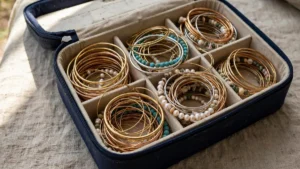
Silver and gold bangle bracelets look simple at first glance, but choosing between them is not simple at all. Both metals have been worn for centuries and both come in designs from slim everyday bands to heavy statement cuffs. The difference is in the details: how the metal behaves on your skin, how it ages, what it costs, and how much care it asks for in return.
The honest answer is that neither metal wins outright. Gold is warmer, heavier, and holds its value better, but it scratches easily and costs far more. Silver is cooler, lighter, and much more affordable, but it tarnishes and needs regular cleaning. The right choice depends on your skin tone, your budget and how often you plan to wear the bangle.
Below are nine comparisons that matter in 2027, each one looking at silver and gold bangles side by side, so you can see exactly where each metal is stronger and where it falls short.
Key takeaways
- Gold bangles suit warm skin tones and hold their value better, while silver bangles suit cool skin tones and cost far less.
- Silver tarnishes and needs regular cleaning; gold does not tarnish, but it scratches more easily and is softer.
- A solid silver bangle is often the better everyday choice, while a gold bangle is the better choice for occasions and long-term value.
- Check the hallmark before you buy: 925 for sterling silver, and 9ct, 14ct or 18ct for gold, so you know exactly what metal you are paying for.
- Neither metal is maintenance-free, and a bangle that is never cleaned, stored badly, or worn in the wrong conditions will look tired whatever it is made from.
What silver and gold bangles actually are
A bangle is a rigid bracelet, usually a closed circle or a slightly open cuff, that slides over the hand and sits on the wrist. Silver bangles are most often made from sterling silver, 92.5 percent pure silver mixed with other metals, usually copper, to make it strong enough to wear. Gold bangles are also made from an alloy, and the carat tells you how much gold is in the mix: 9ct is about 37.5 percent gold, 14ct about 58.5 percent, and 18ct 75 percent.
The two metals feel different on the wrist. Gold is dense and heavy, so even a slim gold bangle has a satisfying weight. Silver is lighter, so a silver bangle of the same size is easier to forget you are wearing, which matters if you wear bangles all day. Our guide to gold bangle bracelets looks at the gold side in more detail, from slim everyday bands to heavier cuffs.
Both metals come in the same range of finishes: polished and mirror-bright, brushed or satin, hammered, engraved, and set with stones. A polished silver bangle and a polished gold bangle can look almost the same shape, but the colour, the weight and the way they age are completely different.
How to compare them and what to look for
Compare the two metals on the same points, not on reputation: colour against your skin, price for the same weight and design, how the metal reacts to water and air, how it feels after eight hours on your wrist, and what it will be worth in five years. Compare like with like: a solid sterling silver bangle against a solid gold bangle, not a silver-plated bangle against a solid gold one.

Look first at the hallmark, which is stamped inside the bangle. Sterling silver should be marked 925. Gold should be marked with its carat, such as 375 for 9ct, 585 for 14ct, or 750 for 18ct, and a reputable maker will also stamp their own mark. If there is no hallmark, ask for one, or buy elsewhere. A bangle without a hallmark is a guess, and jewellery is too expensive for guessing.
Look next at how the bangle is made. Solid bangles are heavier and last longer than hollow ones, which can dent and are hard to repair. Check the joins, the clasp if it has one, and the inside of the band for rough edges. Try it on with your watch and your other bracelets, because a bangle that looks perfect alone can feel crowded next to a watch.
Silver vs Gold Bangle Bracelets 2027: 9 Comparisons That Matter
Colour and warmth against skin tone
What it shows: Gold has a warm, yellow tone that flatters warm skin with yellow or golden undertones, while silver has a cool, bright tone that flatters cool skin with pink or blue undertones. Hold each metal against the inside of your wrist in daylight and the difference is usually obvious within seconds.
What to consider: Skin tone is a guide, not a rule, and many people wear both metals happily.
Best for: Gold for warm skin tones; silver for cool skin tones. Material: 14ct or 18ct gold, or sterling silver 925. Price range: Silver bangles from around £40; gold bangles from around £300. Standout feature: Gold warms the wrist; silver brightens it.
Price and what you actually pay for
What it shows: Silver is far cheaper than gold by weight, so a silver bangle costs a fraction of a gold bangle in the same design. A solid silver bangle that looks substantial can cost less than a slim, hollow gold bangle, which surprises many first-time buyers.
What to consider: Gold prices move with the gold market, so the same bangle can cost noticeably more or less from one year to the next.
Best for: Silver for a generous budget-friendly collection; gold for a single significant piece. Material: Sterling silver 925, or 9ct to 18ct gold. Price range: Silver £40 to £250; gold £300 to £3,000 and above. Standout feature: Silver buys more bangle per pound; gold buys more lasting value.
Everyday durability and scratching
What it shows: Sterling silver is harder than high-carat gold, so it resists scratches and dents a little better in daily wear. An 18ct gold bangle is softer and will pick up fine scratches from desks, keys and door handles more quickly, while a 9ct gold bangle is harder and more practical for everyday wear.
What to consider: Both metals scratch eventually, and a scratched bangle is not a damaged bangle.
Best for: Silver or 9ct gold for daily wear; 18ct gold for occasions. Material: Sterling silver 925, or 9ct gold for hardness. Price range: Similar to the price comparison above. Standout feature: Silver and lower-carat gold are the tougher everyday metals.
Tarnish and long-term care
What it shows: Silver tarnishes. It reacts with sulphur in the air and turns dull, yellowish or dark, especially if it is stored in a damp room or worn in a pool or hot tub.
What to consider: Tarnish is not damage.
Best for: Gold for low-maintenance wear; silver for people happy to clean it. Material: Sterling silver 925, or any carat of gold. Price range: A silver cloth costs a few pounds; professional cleaning is inexpensive for both. Standout feature: Gold stays bright with almost no effort; silver rewards a quick polish.
Weight and comfort on the wrist
What it shows: Gold is nearly twice as dense as silver, so a gold bangle feels noticeably heavier than a silver bangle of the same size. Some people love that weight and find it reassuring; others find a heavy gold bangle tiring by the end of a long day, especially if they wear several bangles at once.
What to consider: A slim gold bangle can be as light as a chunky silver one, so weight is really about the design, not just the metal.
Best for: Silver for all-day comfort and stacking; gold for a single statement bangle. Material: Sterling silver 925, or 14ct gold for a balance of weight and durability. Price range: Weight adds cost in gold; silver stays affordable even when chunky. Standout feature: Silver is the lighter, easier metal to wear all day.
Versatility with outfits
What it shows: Silver suits cool colours, denim, black, white and grey, and it pairs naturally with a watch with a steel bracelet. Gold suits warm colours, cream, navy, olive and earth tones, and it pairs naturally with a leather-strap watch.
What to consider: Mixing metals is no longer a mistake.
Best for: Silver for cool, casual and monochrome wardrobes; gold for warm, formal and evening looks. Material: Sterling silver 925, or 14ct gold. Price range: Both metals cover every budget. Standout feature: Each metal has its own colour palette, and both mix well together.
Resale and lasting value
What it shows: Gold holds its value far better than silver. A gold bangle can usually be resold for a meaningful share of what you paid, because the gold itself has a high and fairly stable market value.
What to consider: Buy a bangle to wear, not as an investment.
Best for: Gold for a piece you may one day sell or pass on; silver for a piece you buy to enjoy. Material: 18ct gold for the strongest resale; sterling silver 925. Price range: Gold from £300; silver from £40. Standout feature: Gold is the metal that keeps its value.
Mixing with other jewellery
What it shows: Silver mixes easily with white gold, platinum and steel, so a silver bangle sits happily next to most watches and rings. Gold mixes easily with rose gold, brass-toned hardware and warm gemstones, and a gold bangle can tie a whole outfit together when the rest of your jewellery is warm-toned.
What to consider: The rule that used to matter, never mix silver and gold, is gone.
Best for: Silver for steel-watch wearers; gold for leather-strap and warm-metal wearers. Material: Sterling silver 925, or 14ct gold. Price range: Both metals cover every budget. Standout feature: Each metal anchors a different set of companions.
Which metal suits which occasion
What it shows: Gold reads as more formal and celebratory, which is why gold bangles are the classic choice for weddings, anniversaries and evening events. Silver reads as cooler and more understated, which is why silver bangles are the classic choice for work, travel and everyday wear. Our bangle bracelets for everyday wear guide shows how both metals work in a daily rotation.
What to consider: Occasion is a starting point, not a rule.
Best for: Gold for weddings, evenings and celebrations; silver for work, travel and daily wear. Material: 18ct gold for occasions; sterling silver 925 for daily wear. Price range: Gold from £300; silver from £40. Standout feature: Gold celebrates; silver accompanies.
Which metal suits which wrist, wardrobe and occasion
Start with your skin. Warm skin with golden or olive undertones usually looks better in gold, and cool skin with pink or blue undertones usually looks better in silver. If you are not sure, hold a gold and a silver bangle against the inside of your wrist in daylight; the one that makes your skin look brighter is the one that suits you.
Then think about your life. If you wear bangles every day and work with your hands, silver or 9ct gold is the practical choice. If you want one special bangle for occasions, something to keep for years and perhaps pass on, 14ct or 18ct gold is the better spend. The wider gold versus silver bracelet comparison covers the same question across all bracelet styles, not just bangles.
Finally, think about your wardrobe and your watch. A steel watch pairs naturally with silver, a leather strap pairs naturally with gold, and a mixed-metal collection works best when one metal leads and the other is the accent. There is no wrong answer, only a better answer for your skin, your budget and your daily life.
The caveats that matter
Both metals have honest drawbacks. Silver tarnishes and needs cleaning, and it can cause a reaction in the small number of people sensitive to the copper in sterling silver. Gold is soft, scratches easily at higher carats, and costs enough that a mistake is expensive. Neither metal should be worn in a chlorinated pool or a hot tub, or sprayed directly with perfume or hairspray.
| Detail | What is known |
|---|---|
| Best for warm skin | Gold, especially 14ct and 18ct yellow gold |
| Best for cool skin | Silver, especially polished sterling silver |
| Price for a similar bangle | Silver is usually a fraction of the price of gold |
| Tarnish | Silver tarnishes and needs cleaning; gold does not tarnish |
| Scratching | High-carat gold scratches more easily than sterling silver |
| Weight on the wrist | Gold is nearly twice as dense as silver, so it feels heavier |
| Resale value | Gold holds its value far better than silver |
| What neither metal likes | Chlorine, hot tubs, perfume sprayed directly on the metal, and damp storage |
If you have sensitive skin, patch-test a new bangle by wearing it for a day before you commit to keeping it, and check the hallmark so you know exactly what alloy you are wearing. If you are buying gold, get a receipt stating the carat and the weight, because those two numbers determine the value of what you are buying.
Checklist: choosing between silver and gold bangles
Use these checks before you buy a new bangle.
- Hold both metals against the inside of your wrist in daylight and see which one makes your skin look brighter.
- Check the hallmark: 925 for sterling silver, and 375, 585 or 750 for 9ct, 14ct or 18ct gold.
- Compare like with like: solid against solid, the same weight and design, not plated against solid.
- Try the bangle on with your watch and your other bracelets, and wear it around the shop for a few minutes.
- Ask about care: how often the metal needs cleaning, and whether the shop offers free polishing.
- Keep the receipt, the box and any certificate, because they matter for resale and for insurance.
Frequently asked questions
Is silver or gold better for everyday wear?
Silver is usually the easier everyday metal, because it is harder than high-carat gold, lighter on the wrist, and much cheaper to replace if damaged. A 9ct gold bangle is also practical, because lower-carat gold is harder and more scratch-resistant than 18ct gold.
Does silver tarnish if I wear it every day?
It tarnishes more slowly when worn every day, because the friction of wearing keeps the surface polished. Silver tarnishes fastest when it is left unworn in a damp room. Store it in a dry place, in a pouch or a lined box, and give it a quick polish with a silver cloth every few weeks.
Is 9ct gold worth buying, or should I choose 14ct or 18ct?
9ct gold is worth buying if you want a hard, practical, affordable gold bangle for daily wear. 14ct is a good middle ground, and 18ct is the richest colour and the best for resale, but it is softer and scratches more easily. The right carat depends on how you will wear the bangle.
Can I wear silver and gold bangles together?
Yes. Mixing metals is a normal, modern look. It works best when the mix looks deliberate, such as one silver bangle with a stack of gold ones, or a gold bangle paired with a silver watch. Avoid wearing many mixed pieces all at once, which can look scattered rather than styled.
Which metal is better for sensitive skin?
Both can suit sensitive skin, but the alloy matters. Sterling silver contains copper, which a small number of people react to. Gold is generally well tolerated, especially at higher carats. If you have reacted to jewellery before, wear a new bangle for a day before committing to it.
Does a gold bangle hold its value better than a silver one?
Yes, by a wide margin. Gold has a high market value per gram, so a gold bangle can usually be resold for a meaningful share of its price. Silver is worth far less per gram, so buy a silver bangle to enjoy, not as a store of value.
The bottom line
Silver and gold bangles are both beautiful, and the better choice is the one that suits your skin, your budget and your daily life. Gold is warmer, heavier and better at holding its value, which makes it the stronger choice for a single special piece. Silver is cooler, lighter and far more affordable, which makes it the stronger choice for everyday wear.
Try both metals on in daylight, check the hallmark, compare solid against solid, and choose the bangle you will actually wear. A bangle that sits in a box because it was the wrong metal or the wrong weight is the only real mistake.