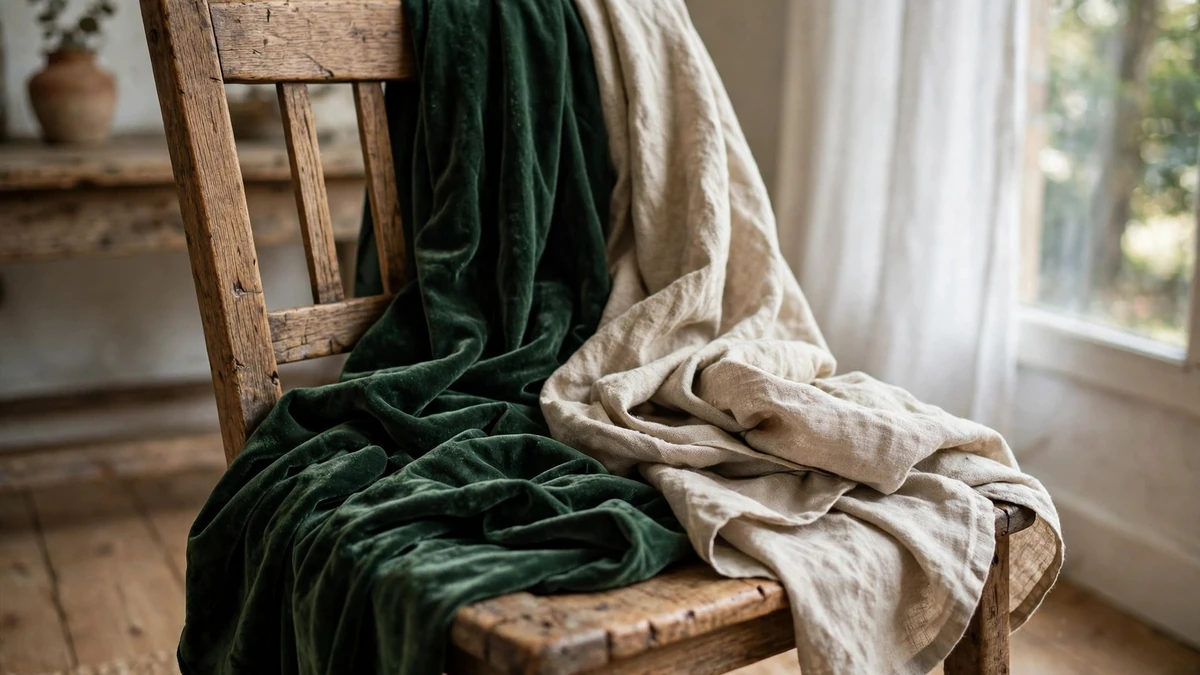

Velvet and linen scarves could hardly be more different, and that is exactly why the choice between them trips people up. One is heavy, soft and wintery. The other is light, crisp and made for warmer weather. Yet both turn up in the same shops, at similar prices, which makes it easy to buy the wrong one for the season you actually live in.
The difference is not about quality. A good velvet scarf and a good linen scarf are both well-made and long-lasting. The difference is about what each fabric does. Velvet traps warmth, catches the light, and drapes in heavy folds. Linen breathes, stays cool against the skin, and softens a little more every time you wash it.
Below are nine comparisons that matter in 2027, from warmth and drape to care, cost and how each fabric ages. Each one says what each fabric does well, what to watch for, and who it suits best.
Key takeaways
- Velvet is the warmer, heavier scarf by a clear margin, while linen is the cooler, lighter one.
- Velvet drapes in heavy, light-catching folds and suits evening and winter outfits, while linen falls loosely and suits daytime outfits.
- Linen is the easier fabric to live with, because it washes well and softens with wear, while velvet needs brushing and steaming.
- Both fabrics age well when looked after, but velvet shows crushing and shine, and linen shows creasing.
- No scarf is worth its price if it is bought for the wrong season, so match the fabric to the weather you actually face.
What velvet and linen scarves actually are
Velvet is a woven fabric with a short, dense pile, which gives it that soft, almost liquid surface. The pile is made of fine fibres cut short and brushed upright, so light catches it unevenly and the colour seems to shift as the fabric moves. Most velvet scarves are made from silk, cotton or a blend, and the best ones feel heavy in the hand, with a smooth surface that warms up quickly against the skin.
Linen is made from flax fibres, and it is one of the oldest fabrics in the world. Its fibres are long, strong and slightly irregular, which gives linen its characteristic texture: a little crisp, a little slubbed, and never perfectly smooth. A linen scarf feels dry and airy in the hand, weighs almost nothing, and lets air pass through it.
The two fabrics are made for opposite ends of the year. Velvet belongs to cold evenings, winter coats and occasions where a little richness is welcome. Linen belongs to warm days, open collars and outfits that need to breathe. Neither is a substitute for the other.
How we chose these comparisons and what to look for
Look first at the weight and the season. A velvet scarf should feel substantial, with a pile that springs back when you press it, and a drape that falls in heavy folds. A linen scarf should feel light and dry, with a weave you can almost see through in strong light. If a velvet scarf feels thin and papery, or a linen scarf feels heavy and stiff, the fabric is a poor example of its type.

Look next at the finish and the edges. Good velvet has an even pile with no bald patches, and a backing that does not show through when the fabric folds. Good linen has a tight, even weave with a slight natural irregularity, and neatly finished edges. Our comparison of velvet and satin scarves covers similar ground on the velvet side, and the same checks apply here.
Finally, look at the fibre content on the label. A scarf labelled silk velvet or cotton velvet should be exactly that, and a scarf labelled pure linen should contain no other fibre. Blends behave differently, and a velvet scarf that is mostly polyester will not breathe or age the way a natural-fibre one does.
The 9 comparisons that matter in 2027
Warmth and insulation
What we like: Velvet is genuinely warm. Its dense pile traps air close to the body, and a velvet scarf wrapped twice around the neck holds heat the way a thin wool scarf does. Linen, by contrast, is cool by design, and offers almost no insulation, which is exactly what you want on a warm day.
What to consider: Velvet can be too warm indoors, and a heavy velvet scarf under a winter coat can leave you overheating. Linen gives no protection against a cold wind, and wearing one in winter is a style choice, not a practical one. Best For: Velvet for cold evenings and winter; linen for warm days and spring. Fabric: Velvet pile over a woven base; woven flax linen. Price Range: Velvet £30 to £150; linen £25 to £120. Standout Feature: Velvet’s warmth without bulk; linen’s coolness without weight.
Softness against the skin
What we like: Velvet feels soft in a rich, almost plush way, and a good silk velvet scarf is gentle enough to wear against bare skin. Linen feels different, crisp and dry at first, but it softens noticeably with every wash, and a well-worn linen scarf is one of the most comfortable fabrics you can wear.
What to consider: Cheap velvet can feel scratchy if the pile is coarse, and a velvet scarf that has been crushed loses its softness. New linen can feel stiff, and anyone expecting instant softness will be disappointed for the first few wears. Best For: Velvet for sensitive skin and evening wear; linen for everyday wear once broken in. Fabric: Cut pile velvet; plain-weave linen. Price Range: Velvet £35 to £160; linen £25 to £110. Standout Feature: Velvet’s immediate softness; linen’s softness that improves with age.
Drape and movement
What we like: Velvet drapes in heavy, sculptural folds that hold their shape, which is why it looks so good looped once around the neck or left to fall over a coat. Linen drapes loosely, falling in soft, unstructured folds that suit a relaxed knot.
What to consider: Velvet’s weight can pull a light outfit out of shape, and a heavy velvet scarf over a fine blouse can drag the neckline down. Linen’s lightness means it can slip, and a loosely knotted linen scarf may need retying. Best For: Velvet for structured, evening looks; linen for relaxed, daytime looks. Fabric: Heavy pile velvet; lightweight linen. Price Range: Velvet £30 to £140; linen £20 to £100. Standout Feature: Velvet’s sculptural drape; linen’s easy, unstructured fall.
How each fabric handles light
What we like: Velvet is famous for the way it catches light. Its pile reflects light unevenly, so the colour deepens and brightens as the fabric moves, and a dark green or burgundy velvet scarf can look almost black in shadow and richly coloured in sunlight. Linen has a matte finish that absorbs light, which gives it a calm, understated look.
What to consider: Velvet’s shine can look too formal in bright daylight, and a crushed velvet scarf can show uneven patches. Linen’s matte finish can look flat in photographs, and a pale linen scarf can look washed out in strong sun. Best For: Velvet for evening and low light; linen for daylight and natural light. Fabric: Light-reflecting pile velvet; light-absorbing linen. Price Range: Velvet £30 to £150; linen £25 to £110. Standout Feature: Velvet’s shifting colour; linen’s calm, even tone.
Durability and ageing
What we like: Both fabrics last well when they are looked after. Velvet keeps its colour and pile for years if it is brushed and stored properly, and linen is famously strong, with fibres that resist tearing and become stronger when wet.
What to consider: Velvet shows crushing and shine where it is folded or pressed, and those marks are hard to remove once they set. Linen thins at the fold lines over many years if it is always folded in the same place. Best For: Velvet for occasional, careful wear; linen for daily, hard wear. Fabric: Pile velvet; long-fibre flax linen. Price Range: Velvet £35 to £160; linen £25 to £120. Standout Feature: Velvet’s lasting colour; linen’s lasting strength.
Care and cleaning
What we like: Linen is the easier fabric to care for by a wide margin. It can be machine washed on a gentle cycle, it dries quickly, and it softens with every wash. Velvet needs more attention: brush it, steam it, and dry clean it sparingly.
What to consider: Velvet should never be ironed directly, and a wet velvet scarf needs to dry flat, away from heat, or the pile will flatten and mark. Linen can be washed, but it creases heavily, and a linen scarf that is not pressed or steamed after washing will look crumpled. Best For: Velvet for those happy to brush and steam; linen for those who want machine washing. Fabric: Velvet pile; washable linen. Price Range: Velvet £30 to £150; linen £20 to £100. Standout Feature: Linen’s wash-and-wear ease; velvet’s simple brush-and-steam routine.
Water and weather resistance
What we like: Velvet handles cold, dry weather well, and a velvet scarf under a coat keeps the neck warm in wind and frost. Linen handles heat and humidity well, and it dries quickly after a light shower.
What to consider: Velvet hates rain. Water flattens the pile and can leave permanent marks, so a velvet scarf is a poor choice on a wet day. Linen absorbs water readily and can feel damp in a downpour, even if it dries fast afterwards. Best For: Velvet for cold, dry days; linen for warm, humid days. Fabric: Water-sensitive pile velvet; quick-drying linen. Price Range: Velvet £30 to £140; linen £25 to £110. Standout Feature: Velvet’s cold-weather comfort; linen’s quick drying.
Price and value
What we like: Both fabrics offer good value when bought well. A mid-priced linen scarf in pure flax is an honest, hard-wearing piece that will last for years. A mid-priced velvet scarf in silk or cotton velvet looks far more expensive than it is.
What to consider: Cheap velvet is usually polyester, and it will not breathe, age or feel like the real thing. Cheap linen is often a linen-look blend with very little flax in it, and it will not soften or last the way pure linen does. Best For: Velvet for a statement piece; linen for an everyday staple. Fabric: Silk or cotton velvet; pure flax linen. Price Range: Velvet £30 to £160; linen £25 to £120. Standout Feature: Velvet’s rich look for the price; linen’s long life for the price.
Versatility and styling
What we like: Linen is the more versatile scarf day to day. It works with a denim jacket, a linen shirt, a summer dress or a light coat, and it folds small enough to carry in a bag. Velvet is the more dramatic scarf, and it transforms a plain coat or a simple evening outfit.
What to consider: Velvet can overwhelm a casual outfit, and a heavy velvet scarf with jeans and trainers can look unbalanced. Linen can look too casual for a formal occasion, and a crumpled linen scarf at an evening event can look underdressed. Best For: Velvet for evening and winter occasions; linen for daytime and warm-weather outfits. Fabric: Statement pile velvet; everyday linen. Price Range: Velvet £30 to £150; linen £20 to £100. Standout Feature: Velvet’s ability to dress up an outfit; linen’s ability to fit any daytime outfit.
Which scarf is right for you
If your winters are cold and your evenings are often formal, buy velvet first. A dark velvet scarf in green, burgundy or black will work with your winter coat and your evening outfits. It is the scarf for the cold half of the year.
If your summers are warm and your days are mostly casual, buy linen first. A natural or pale linen scarf will work with almost everything you own in warm weather, it will not make you hotter, and it will soften every time you wash it. Our comparison of linen and silk scarves is a useful next read, because silk and linen behave very differently in heat.
If you can only buy one, choose the fabric that matches the season you are in now, not the season you are looking forward to. If you can buy both, do, because they cover the whole year between them, and neither one can do the other’s job.
The caveats that matter
Neither fabric is perfect. Velvet is not practical for wet weather, and it is not for people who want to throw a scarf in the washing machine. Linen is not warm, and it is not for people who hate creasing. Both ask for a small amount of care, and both reward it.
| Detail | What is known |
|---|---|
| Warmer fabric | Velvet, by a clear margin, thanks to its dense pile |
| Cooler fabric | Linen, which breathes and stays cool in heat |
| Easier to care for | Linen, which machine washes and softens with wear |
| More formal look | Velvet, with its light-catching pile and rich colour |
| Better in rain | Neither, but linen dries faster than velvet |
| Longest lasting | Linen, whose fibres are stronger and improve with age |
| Most versatile day to day | Linen, which suits more outfits and more occasions |
| What neither does well | Neither is warm and cool, formal and casual, at the same time |
One more honest note: a scarf is not a financial investment, and neither velvet nor linen will hold its value the way a piece of jewellery might. Buy a scarf because you will wear it.
Checklist: choosing between velvet and linen honestly
Use these checks before you buy, and again before you wear the scarf for the first time.
- Check the season: velvet for cold weather, linen for warm weather, and do not buy one expecting it to do the other’s job.
- Check the label: pure silk or cotton velvet, or pure flax linen, and be wary of blends sold under the fabric’s name.
- Check the weight: velvet should feel substantial, linen should feel light, and neither should feel thin or papery.
- Check the finish: even pile on velvet with no bald patches, and a tight, even weave on linen with neatly finished edges.
- Check the care: are you happy to brush and steam velvet, or do you want the machine-wash ease of linen?
- Check the outfit: try the scarf with the coat or jacket you will actually wear it with, not just on its own.
Frequently asked questions
Can I wear a velvet scarf in spring?
Yes, on a cool spring evening, but a heavy velvet scarf will feel too warm once the day heats up. A lighter velvet in a pale colour works better in spring.
Can I wear a linen scarf in winter?
You can, as a style choice, but it will not keep you warm. A linen scarf in winter is a layer for looks, not insulation, and it works best indoors or under a heavy coat on a mild day. For real cold, velvet or wool is the practical choice, as our winter scarf roundup shows.
Which fabric lasts longer?
Linen, in most cases. Its fibres are stronger than velvet’s pile, it survives machine washing, and it improves with age. Velvet can last just as long, but only if it is brushed and stored with care, and it is more easily damaged by water and crushing.
Does velvet crease like linen?
No, velvet does not crease the way linen does, but it crushes instead. A crushed velvet scarf shows flattened patches and shine, while a linen scarf shows creases. Both marks are part of the fabric’s character.
Is linen really worth the price?
Yes, when it is pure linen. A well-made linen scarf costs more than a cotton one, but it lasts longer, breathes better and softens with wear. A cheap linen-look blend will not give you the same value, so check the label before you pay.
Can I own both velvet and linen scarves?
Yes, and most people who wear scarves regularly do. Velvet covers the cold half of the year and the formal occasions, while linen covers the warm half and the everyday outfits.
The bottom line
Velvet and linen scarves are not rivals, even though they are often sold side by side. Velvet is the warmer, richer, more dramatic fabric, made for cold evenings and occasions where a little luxury helps. Linen is the cooler, lighter, more practical fabric, made for warm days and outfits that need to breathe. Neither one can do the other’s job.
Buy velvet for winter and evening, buy linen for summer and daytime, and buy both if you can. Judge each one on how it feels and how often you reach for it, not on how it looks on the shelf.