


What if the most dramatic change in women’s fashion history happened without a single designer’s name attached to it? That is roughly what happened between 1837 and 1901. Victorian era fashion was not one look. It was a moving target, reshaped every decade or so by new technology, new dyes, new machines, and new arguments about what women should be allowed to wear.
Most people picture one dress when they hear “Victorian” — a big skirt, a tight waist, a lot of black. That picture is only accurate for a slice of the period. Queen Victoria reigned from June 1837 to January 1901, and fashion historians usually split those 64 years into early, mid, and late phases. Each phase had its own silhouette, its own rules, and its own rebels. Understanding the era means watching the shape of the body change decade by decade, and understanding why.
The Three Phases of Victorian Fashion
The easiest way to make sense of the era is to track the skirt. Everything else follows from it.
| Phase | Rough Dates | Defining Silhouette | Key Shift |
|---|---|---|---|
| Early Victorian | c. 1837–1860 | Bell-shaped skirt over layered petticoats | Dropped shoulders, natural waist, softer lines |
| Mid Victorian | c. 1860–1880 | Cage crinoline, then the bustle | Steel hoops replace petticoats; volume moves backward |
| Late Victorian | c. 1880–1901 | Second bustle, then the slim “leg-of-mutton” look | Shoulder volume grows, skirts narrow sharply |
Notice what the table does not show: any single “Victorian dress.” A woman dressing in 1845 and a woman dressing in 1895 would have recognized each other’s clothes as foreign. That gap is the real story.
Early Victorian Fashion: Softness Before the Hoop
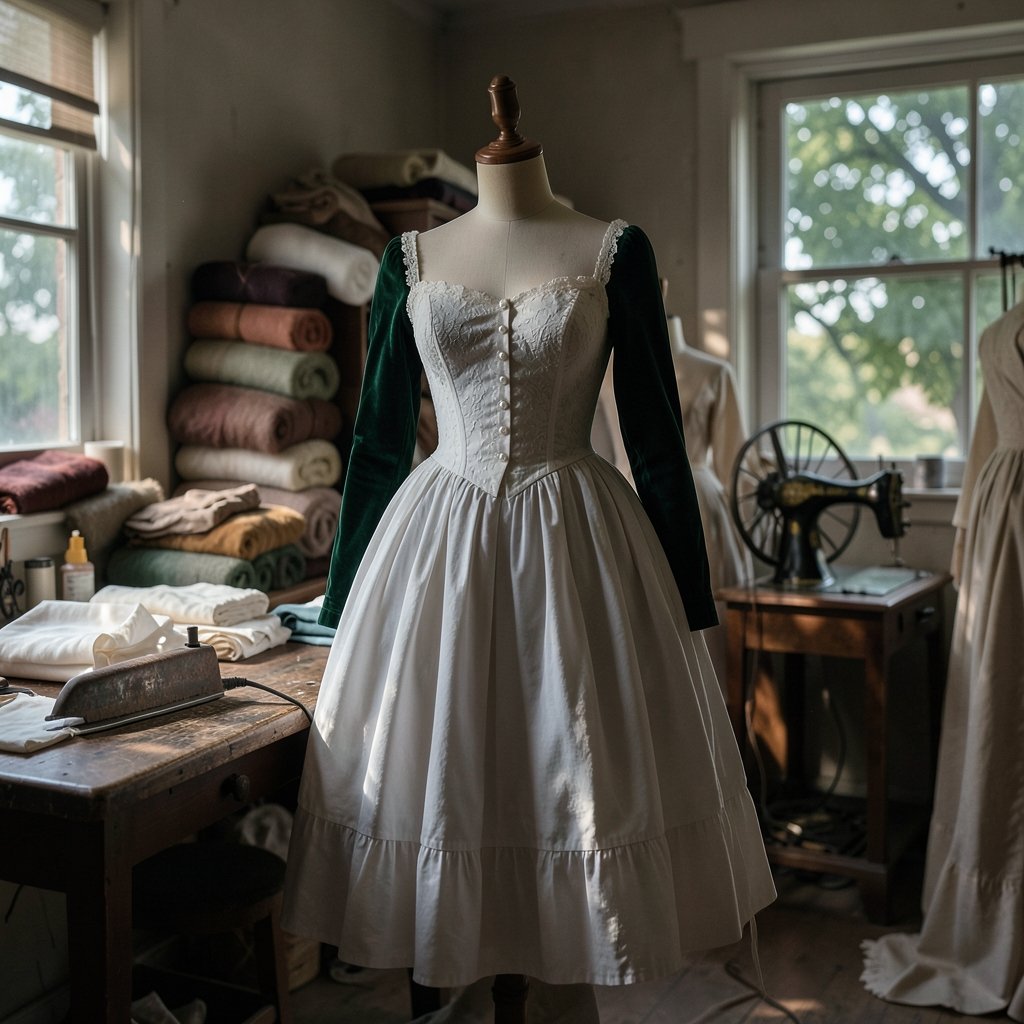
Early Victorian dresses sat on the natural waist and dropped off the shoulder, creating a sloping line that made the torso look long and the shoulders look small. Sleeves were fitted. Skirts were full but built from layers of petticoats, which made them heavy, hot, and expensive to maintain.
This is the era most period dramas set their ballrooms in, and for good reason. The look was romantic, and it was also labor-intensive. A full skirt meant yards of fabric and hours of ironing, which put the style out of reach for working households. Fashion in this phase was a clear marker of class, and it was meant to be.
What Changed First
Two inventions did more to alter everyday dress than any royal decree. The sewing machine was commercialized in the 1850s, with Isaac Singer’s improvements arriving from 1851, and it sped up both home sewing and workshop production. Then came the cage crinoline, patented in 1856.
The cage crinoline was a spring-steel hoop cage worn under the skirt. It replaced stacks of petticoats, which made wide skirts dramatically lighter and cheaper. Skirt width peaked in the early 1860s. The irony is sharp: the most exaggerated feminine silhouette of the century was a product of industrial metalwork, not delicate handcraft.
The Crinoline and the Bustle: Engineering the Skirt
By the late 1860s, the crinoline’s round shape began to flatten at the front and pile up at the back. From roughly 1868 to 1870, the bustle took over. Volume migrated backward, supported by padding and wire frames.
The bustle came in two waves. The first, in the 1870s, was softer and more draped. The second, in the mid-1880s, was rigid and shelf-like, jutting out at a sharp angle. If you have ever seen a caricature of a Victorian woman who appears to be carrying a small table under her skirt, that is the second bustle.
Practical problems came with the fashion. Sitting required care. Doorways became obstacles. And the weight of a fully structured skirt fell on the waist and hips, which is one reason the corset debate grew louder as the century went on.
Color Explodes: The Aniline Revolution
Victorian clothing was not all sepia. Aniline dyes, commercialized from 1856 after William Henry Perkin’s mauve, made bright colors cheap and widely available. Before that, vivid dyes were costly and often unstable. Afterward, a middle-class household could afford a dress in a strong, saturated shade that would have been a luxury a generation earlier.
The result was a palette shift that shows up in surviving garments and photographs: sharper purples, magentas, and greens alongside the sober tones people associate with the era. The Victorian love of color is one of the most underrated details of the period, and it connects directly to how later decades kept pushing toward bolder visual statements in Italian luxury fashion and beyond.
Mourning Dress and the Weight of Black
Mourning dress was governed by social convention, not law. Widows conventionally wore black for about two years, then moved into “half-mourning” in grey, mauve, or white. Exact durations varied by class and region, so treat any single rule as a guideline rather than a statute.
Queen Victoria’s mourning after Prince Albert’s death in December 1861 popularized and prolonged black. Her choice turned personal grief into a public style, and it gave mourning dress a cultural weight that outlasted the century. For anyone building a Victorian wardrobe today, this is the single most misunderstood element: black was not the default. It was a statement with a calendar attached.
The Corset: Standard, Contested, and Misrepresented
The corset remained standard throughout the era, but it was never uncontested. Medical and press debate over tight-lacing ran from the 1860s through the 1890s. Historians still argue about how extreme the practice actually was, and the popular image of the fainting Victorian woman owes more to caricature than to evidence.
What is clear is that the corset was a shaping garment with a range of fits, not a single torture device. Working women wore corsets too, often looser and more flexible ones. The debate was as much about respectability and control as about health.
The Rational Dress Movement
In 1881, the Rational Dress Society formed to challenge tight corseting and long, heavy skirts. This was the era’s real fashion rebellion, and it set up arguments that would echo into the twentieth century. Reform dress was not universally embraced, but it planted the idea that clothing should serve the body rather than constrain it.
That tension between constraint and freedom is still visible in how fashion cycles work. If you want to see how a similar push-pull played out a century later, the story of how 2010s fashion athleisure and streetwear rewrote the rules is a useful parallel.
Ready-Made Clothing and the Birth of Shopping
Ready-made clothing expanded sharply in the second half of the century, especially menswear and workwear, while high fashion stayed bespoke. Historians debate the pace of this shift, but the direction is not in doubt. Standard sizing, mail-order catalogs, and department stores all took root in this period.
For the first time, a buyer could purchase a garment made to a general size rather than to her own measurements. That change did more for everyday wardrobes than any couturier. It also created the modern expectation that fashion should be accessible, an idea that now drives everything from fast fashion to the seasonal trend cycles covered in the 2026 fashion trends guide.
The 1890s: Shoulders Up, Skirts Down
The final phase flipped the silhouette again. The 1890s brought the leg-of-mutton sleeve, also called the gigot, with volume concentrated at the shoulder. Skirts narrowed toward the end of the century, and the overall line became taller and more athletic.
This is the decade that looks most modern to contemporary eyes. The shape is closer to what came next than to what came before, and it shows how quickly Victorian fashion adapted once the technical barriers fell.
How to Read a Victorian Garment Like a Historian
For anyone who collects, sews, or studies period clothing, a few practical habits separate a good read from a guess.
- Date by the sleeve first. Sleeve shape is the fastest dating tool. Dropped shoulders point early, fitted sleeves point mid-century, and shoulder volume points to the 1890s.
- Then check the skirt support. Petticoats mean pre-1860. A round hoop means the 1860s. A back-heavy frame means the 1870s or 1880s.
- Check the dye as well as the cut. Bright synthetic color suggests post-1856 production.
- Do not assume black means mourning. Black was fashionable in its own right, and half-mourning used grey, mauve, and white.
- Check the seams for machine stitching. Machine-sewn seams point to the 1850s and later, though hand-finishing continued on visible areas.
The most common mistake is treating a single garment as representative of 64 years. The second most common is assuming corsets were uniformly tight. Both errors flatten a period that was constantly in motion.
Why Victorian Fashion Still Shapes What We Wear
Victorian era fashion matters today because it produced the systems we still use. Standard sizing, seasonal change, department store retail, synthetic dye, and the machine-made garment all matured in this period. Even the reform arguments sound familiar: comfort versus structure, individual expression versus social expectation.
The era also shows up in modern runway cycles. Designers keep returning to the high collar, the bustle, and the dramatic sleeve, and each revival reads differently depending on the decade doing the borrowing. You can see the same pattern in how 2026 fashion trends for women recycle historical references, and in how illustrators translate runway moments into lasting images, as with Angelica Hicks turning runway moments into illustration.
If you want to go deeper into the visual culture of the period, fashion illustration and fashion writing are good entry points. Curated reading lists help, and a guide to finding the best fashion substacks without wasting your inbox can point you toward writers who cover historical dress seriously. For a broader sweep of where style is heading now, the 2026 fashion trends tag is a reasonable starting point.
Conclusion
Victorian era fashion was never one dress. It was a 64-year experiment in silhouette, powered by steel hoops, sewing machines, and synthetic dye, and argued over by doctors, reformers, and shoppers. The crinoline gave way to the bustle, the bustle gave way to the shoulder, and the shoulder gave way to something recognizably modern. What looks like nostalgia was, at the time, relentless change. That is the most useful lesson the period offers: fashion does not stand still, and the rules people defend most fiercely are usually the ones about to break.
Frequently Asked Questions
What years count as Victorian era fashion?
Victorian era fashion covers Queen Victoria’s reign, from June 1837 to January 1901. Historians usually divide it into early, mid, and late phases because the silhouette changed so much. Sub-period boundaries vary by author, so treat any date range as approximate rather than fixed.
What is the difference between a crinoline and a bustle?
A crinoline is a rounded hoop cage that supports a wide skirt, and it dominated from the late 1850s into the 1860s. A bustle shifts volume to the back of the skirt, and it replaced the crinoline from roughly 1868 to 1870. The bustle came in two waves, a softer 1870s version and a rigid mid-1880s version.
Did Victorian women always wear black?
No. Black was common in mourning, and widows conventionally wore it for about two years before moving to half-mourning in grey, mauve, or white. Queen Victoria’s mourning after Prince Albert’s death in December 1861 made black highly visible, but bright synthetic dyes were also widely available after 1856.
Were Victorian corsets as tight as people think?
The corset was standard, but tight-lacing was contested rather than universal. Medical and press debate ran from the 1860s through the 1890s, and historians still disagree about how extreme the practice was. Working women wore corsets too, often in looser, more flexible styles.
What was the Rational Dress Society?
The Rational Dress Society, founded in 1881, campaigned against tight corseting and long, heavy skirts. It was the era’s main dress reform movement and pushed the idea that clothing should support the body rather than restrict it. Reform dress was not universally adopted, but it influenced later debates.
What is the easiest way to date a Victorian dress?
Start with the sleeve. Dropped shoulders point to the early period, fitted sleeves to the mid-century, and shoulder volume to the 1890s. Then check the skirt support and the dye. Machine-sewn seams suggest 1850s production or later, while hand-finishing often continued on visible areas.














