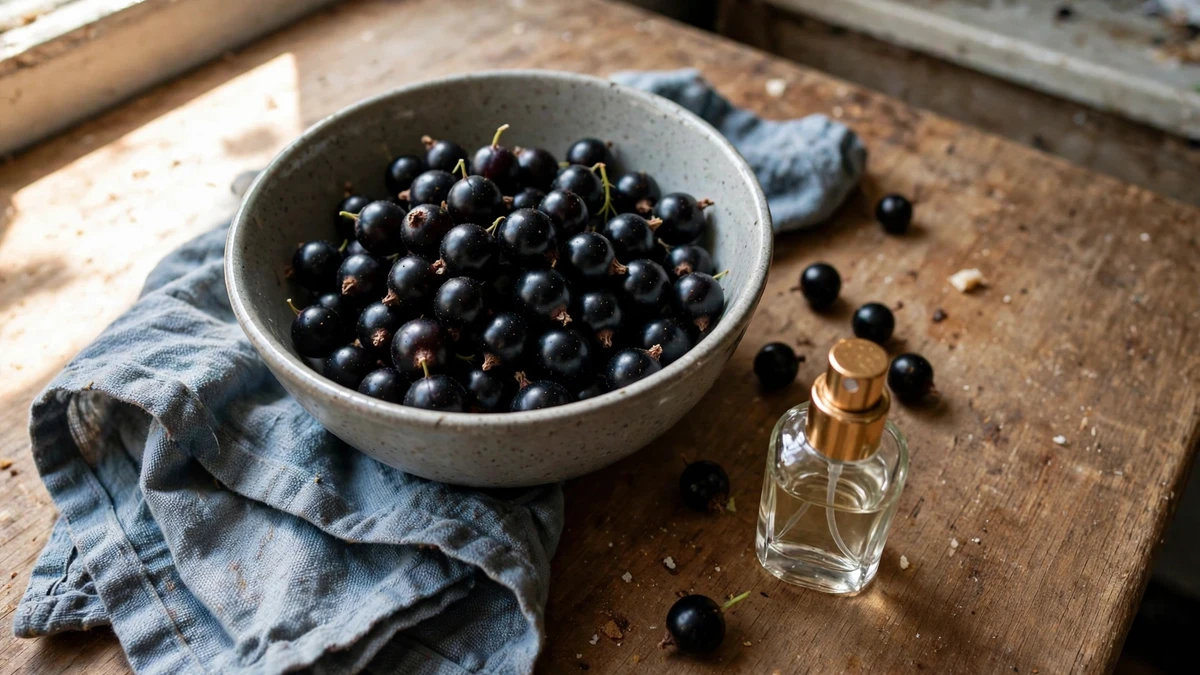

What Is a Blackcurrant Perfume 2027
Blackcurrant is the dark berry that gives a perfume its first sparkle. It smells tart and green and faintly jammy at once, like crushed berries on a cold morning, and it sits at the top of a pyramid where it opens the perfume before the flowers and woods take over. A perfume with blackcurrant in the opening smells brighter, fruitier, and more alive in its first minutes than the same blend without it, which is why the note appears in everything from fresh designer eau de toilettes to niche woody orientals.
Most people meet blackcurrant before they know its name. It is the sharp berry brightness at the start of Creed Aventus, the green fruitiness under the rose in Diptyque L’Ombre dans l’Eau, the dark sweetness that lifts the vanilla in Armani Sì. The word itself is a small puzzle: perfumers call it cassis, the berry is Ribes nigrum, and the scent in the bottle usually comes from the bud rather than the fruit. But the material is older and stranger than its reputation, a green, slightly wild absolute that has travelled from Burgundy hedgerows to Parisian perfume houses over two centuries.
This guide explains what blackcurrant is, where it comes from, how to read it on a pyramid, and which perfumes show it best. It also covers the mistakes buyers make most often, from confusing blackcurrant with blackberry to judging a top note by its first minute on a blotter. Our chervil explainer follows the same plain-language approach, and it works here too.
Key takeaways
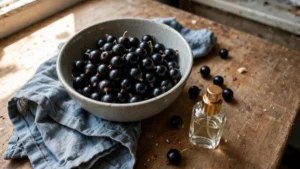
- Blackcurrant is the fruit of Ribes nigrum, but perfumery usually uses the bud absolute, which smells greener, sharper, and wilder than the berry itself.
- It is most often a top note, which means it opens the perfume and fades within the first hour, leaving the heart and base to carry the rest.
- On French pyramids it is called cassis, and the finest buds are harvested in Burgundy, the same region that makes crème de cassis liqueur.
- It pairs most naturally with rose, pear, bergamot, and vanilla, and it turns up in famous perfumes from Creed Aventus to Armani Sì.
- At full strength the bud absolute has a sharp, almost animalic edge, so a little goes a long way and heavy doses can smell catty rather than fruity.
What blackcurrant actually smells like
On a blotter, blackcurrant smells like dark berries crushed between green leaves, with a tart, jammy sweetness on top and a sharp, leafy bite underneath. It is not a soft or creamy fruit smell. First it smells bright and slightly sour, close to redcurrant juice, then it deepens into something darker and greener, nearer a hedgerow after rain than any dessert.
The smell changes with the material. The berry itself is round, sweet, and jammy, while the bud absolute is green, sharp, and faintly wild, with a sulphurous edge that perfumers describe as catty. A perfume that uses the bud smells very different from one that uses a fruity reconstruction of the berry, which is why two blackcurrant perfumes can smell like different notes entirely.
In a blend, blackcurrant acts like a spark. It lifts heavy roses and dark vanillas, gives citrus openings a berry depth, and adds a green freshness to woods that would otherwise feel flat. It rarely closes a perfume. Spray it, enjoy the bright berry opening, and expect the fruit to soften into the heart within an hour while the flowers and woods take over.
Concentration changes the note too. An eau de toilette lets the tart, green opening lead, while an eau de parfum or parfum pushes the darker, jammy side forward, so the same berry can smell almost like two different materials depending on the bottle you pick up.
How to read a pyramid that names it
A pyramid sorts notes into three tiers: top, heart, and base. Blackcurrant usually appears in the top, where it gives the perfume its first brightness and then steps aside. When you see it there, expect a fruity opening that fades within the hour. When you see it in the heart, as in Byredo Black Saffron, expect the berry to show itself in the middle hours and linger longer.

The name shifts from house to house. “Cassis” on a French bottle is the same material as “blackcurrant” on an English one, and “blackcurrant bud” names the absolute made from the buds rather than the fruit. What matters is the word itself: a pyramid that says only “fruity notes” or “berry notes” is not naming blackcurrant at all, and neither is one that lists blackberry, which is a different fruit with a softer, sweeter smell. The same plain reading shaped our night-blooming jasmine roundup and marigold explainer, and it works here too.
Watch the company the note keeps. Blackcurrant with rose and musk is soft and floral, blackcurrant with pear and vanilla is sweet and warm, blackcurrant with bergamot and apple is bright and green. The company it keeps says more about the finished perfume than the note on its own.
9 facts about blackcurrant
Buds, not berries, make the absolute
What it shows: Blackcurrant perfume usually comes from the bud absolute, made from the small, sticky buds of Ribes nigrum, rather than from the fruit. The buds are picked in early spring, before they open, and their absolute is dark, green, and intensely fruity.
What to consider: Because it is a bud absolute, blackcurrant smells greener and sharper than the berry you eat. Anyone who expects jam will be surprised by the leafy, almost wild bite in the first sniff.
Cassis is the name on French pyramids
What it shows: French perfumers call blackcurrant cassis, and the word appears on pyramids from Parisian houses far more often than the English name. The same material may also be listed as blackcurrant bud, bourgeon de cassis, or simply cassis, and all three name the same absolute.
What to consider: The name changes nothing about the smell, but it changes how easy the note is to spot. A buyer who only looks for the English word will miss half the blackcurrant perfumes on a French shelf.
The leaf and the bud smell different
What it shows: The blackcurrant leaf gives a greener, sharper, more herbal scent, close to crushed tomato leaves, while the bud absolute is rounder, fruitier, and darker. Diptyque L’Ombre dans l’Eau uses the leaf beside rose, which is why it smells green and dewy rather than jammy.
What to consider: A pyramid that names the leaf is promising a green perfume, while one that names the bud is promising a fruity one. The two materials share a family resemblance but lead the perfume in different directions.
Dijon is the home of the cassis bud
What it shows: The finest blackcurrant buds come from Burgundy, in eastern France, where the shrub has grown in hedgerows for centuries and where the same berries are pressed into crème de cassis liqueur. The region around Dijon is the historic centre of both the liqueur and the perfume material.
What to consider: The Burgundy link is why cassis smells French to most noses. It is a hedgerow material from a wine region, not an exotic import, and the association with French gardens never quite left it.
It opens bright and fades fast
What it shows: As a top note, blackcurrant is one of the first things you smell and one of the first things to leave. The bright berry opening usually lasts thirty to sixty minutes on skin, and by the second hour the heart notes have taken over entirely.
What to consider: The short life is why blackcurrant rarely defines a whole perfume. If you love the opening, enjoy it while it lasts, and judge the bottle by the heart and base that follow rather than by the first spray.
One drop is enough to lift a blend
What it shows: The bud absolute is so strong that perfumers use it in tiny amounts, often well under one per cent of a blend. A single drop can lift a whole composition, and a fraction more can tip it from fruity into sharp.
What to consider: The strength is also why the note is expensive to use well. A cheap blackcurrant perfume usually relies on a synthetic fruity reconstruction, while the real absolute appears in small, careful doses in costlier bottles.
Blackcurrant makes rose smell darker and greener
What it shows: Blackcurrant and rose are the classic pairing, and they appear together in perfumes from Diptyque L’Ombre dans l’Eau to Diptyque Eau Rose. The berry sharpens the flower, the flower softens the berry, and the two together smell more natural than either does alone.
What to consider: The pairing is so common that a rose perfume with a bright, fruity opening often has blackcurrant in it whether the pyramid says so or not. If the rose smells darker and greener than expected, cassis is usually doing the work underneath.
Blackberry is a different berry entirely
What it shows: Blackcurrant and blackberry are different fruits from different plants, and they smell different in a bottle. Blackberry is softer, rounder, and sweeter, while blackcurrant is sharper, greener, and more tart, with a leafy edge blackberry never has.
What to consider: The confusion is common because the names sound alike and both berries are dark. A pyramid that says blackberry is not naming blackcurrant, and a perfume built on blackberry will smell sweeter and less green than one built on cassis.
Aventus carried it to the top of the charts
What it shows: Creed Aventus, launched in 2010, opens with blackcurrant beside bergamot, apple, and pineapple, and it became one of the best-selling men’s perfumes in the world. Aventus proved that a fruity, berry opening could carry a mass-market masculine, and it put cassis in millions of homes that had never heard of Ribes nigrum.
What to consider: Aventus also fixed blackcurrant’s public image as a bright, fruity top note. The pineapple and apple do much of the sweetening in Aventus, and the blackcurrant underneath is far greener and sharper than the finished perfume suggests.
Who it suits and when to wear it
Blackcurrant suits anyone who likes a bright, fruity opening without a sweet gourmand drydown. It flatters people who find fresh citruses too thin and heavy orientals too dark, and it rewards patience: the note is at its best in the first half hour, when the berry brightness is at its peak and the heart is just beginning to show. Wear it when you want to smell fresh without smelling simple.
Spring and summer are its seasons. Warm air carries the tart berry brightness well, and a fruity blackcurrant feels natural in sunlight in a way it never does under a winter coat. The darker picks, such as Black Orchid and Black Saffron, work in autumn and even winter, but the bright ones belong to warm weather.
At work, keep it to two sprays. A fruity opening is friendly in an office, but a heavy blackcurrant dose can smell sharp in a small room. Save the strongest picks for evenings, and test any new blackcurrant on skin for a full day before you wear it out.
Skin chemistry matters with blackcurrant more than with most notes. On warm skin the jammy sweetness comes forward quickly, while on cool skin the green, leafy opening lingers longer, so the same bottle can smell fruity on one person and sharp on another. That is one more reason to live with it for a full day before you choose.
The caveats that matter
Blackcurrant is easy to love and hard to buy well: the note fades fast, the spelling changes from house to house, and the bud absolute hides inside perfumes that never name it as a star. Bear these warnings in mind before you buy.
| Detail | What is known |
|---|---|
| What “blackcurrant” means on a pyramid | Usually the bud absolute of Ribes nigrum; “cassis” on a French bottle is the same material |
| Where the note usually sits | Top in most perfumes; it opens bright and fades within the first hour |
| Longevity | Short on its own, because the berry brightness evaporates fast; the heart and base carry the perfume after it leaves |
| Best season | Spring and summer suit it best; the darkest picks work in autumn too |
| Who should sample first | Anyone who dislikes sharp, green fruit should try L’Ombre dans l’Eau and Eau Rose first |
| Natural versus synthetic | Natural bud absolute is green, sharp, and wild; fruity reconstructions are rounder, sweeter, and jammier |
| Bud versus leaf | The bud is fruity and dark, the leaf is green and herbal; the two lead a perfume in different directions |
| What it does not do | It does not make a perfume last longer, and it does not suit every skin chemistry |
Test any new perfume on a small patch of skin and wait a day before wearing it properly. On its own blackcurrant is gentle, but the spice, citrus, and amber around it can irritate, and no perfume is ever a single note.
Checklist: understanding blackcurrant honestly
Work through these before you buy.
- Start with the pyramid: it should name “blackcurrant”, “cassis”, or “blackcurrant bud”, not just “fruity notes” or “berry notes”.
- Ask whether the note is bud or leaf: the bud is fruity and dark, the leaf is green and herbal.
- Wear it on skin, never on paper alone: warm skin reveals the jammy sweetness, while paper dulls it.
- Let an hour pass before you decide: the bright berry lifts first, and the heart underneath is what endures.
- Put two bottles next to each other before you choose: L’Ombre dans l’Eau beside Eau Rose, or Aventus beside Silver Mountain Water.
- If you are torn, take the smallest bottle: a 50 ml you empty beats a 100 ml left on the shelf.
Frequently asked questions
Is blackcurrant a real fruit?
Yes. Blackcurrant is Ribes nigrum, a dark berry grown across Europe, and it is eaten as a fruit, pressed into juice, and made into crème de cassis liqueur in Burgundy. In perfumery, though, the scent usually comes from the bud absolute rather than the fruit itself.
What does cassis mean on a pyramid?
Cassis is the French name for blackcurrant, and it is the word perfumers use most often on pyramids. A pyramid that says cassis is naming the same material as one that says blackcurrant, usually the bud absolute, and the two words can be read as identical.
Why does the berry note disappear so quickly?
Because it is a top note made of small, light molecules that evaporate quickly on warm skin. The bright berry opening usually lasts thirty to sixty minutes, and by the second hour the heart notes have taken over. That is normal for a top note, not a fault in the bottle.
How is blackcurrant different from blackberry?
No. Blackcurrant and blackberry are different fruits from different plants. Blackberry is softer, rounder, and sweeter, while blackcurrant is sharper, greener, and more tart, with a leafy edge blackberry never has. A pyramid that says blackberry is not naming blackcurrant.
Can you wear a blackcurrant perfume to work?
You can, if you keep it light. Two sprays of a fruity blackcurrant such as Eau Rose are fine in an office, but a heavy dose can smell sharp in a small room. Save the strongest picks for evenings, and test any new blackcurrant on skin for a full day before you wear it out.
Can you tell the real bud absolute from a fruity reconstruction?
Read the pyramid. Natural blackcurrant is listed as “blackcurrant”, “cassis”, or “blackcurrant bud”, while a synthetic fruity note is usually hidden inside “fruity notes” with no fruit named.
The bottom line
Blackcurrant is a hedgerow berry with two centuries of history behind it: a Burgundy liqueur fruit, a green bud absolute, and one of the brightest top notes in perfumery. It smells tart and jammy and faintly wild, it opens a perfume with a spark, and it fades fast enough that the heart and base matter more than the first spray. For the clearest introduction, try Diptyque L’Ombre dans l’Eau; for the purest berry brightness, try Creed Aventus.
Whatever you go for, make sure the pyramid names “blackcurrant”, “cassis”, or “blackcurrant bud” rather than just “fruity notes”, wear it on skin for a full day, and judge it by how the heart deepens over hours rather than by the first minute. That is how you settle on a blackcurrant perfume you will actually wear to the last drop.