A chronograph watch looks like an ordinary watch until you notice the extra pushers on the side and the small subdials crowded into the face. Those details are not decoration. They mean the watch can time an event, just as a stopwatch does, while still telling the time of day. It is one of the oldest complications in watchmaking, and it remains one of the most useful, because it turns a watch from something you glance at into something you use.
The idea is simple, but the execution is not. A chronograph needs extra gears, extra hands, and extra buttons, all working together without disturbing the timekeeping. Knowing what the pushers do, what the subdials show, and what the different movements offer is the difference between buying a watch you enjoy using and buying one whose extra features you never touch.
This guide explains the chronograph in plain terms: what it is, how it works, the nine facts that matter in 2027, and which type suits which wrist. No jargon is left unexplained, and no claim is made about a watch being an investment, because a chronograph is a pleasure to wear, not a financial plan.
Key takeaways
- A chronograph is a watch with a built-in stopwatch: pushers start, stop and reset the timing, and subdials show the elapsed time.
- The tachymeter scale on the bezel or dial turns elapsed time into speed, which is how racing chronographs earn their name.
- Quartz chronographs are the most accurate and the easiest to own; mechanical chronographs are bought for the craft, not the precision.
- Chronographs are thicker and heavier than plain watches, so try the size on your wrist before you buy.
- No watch is a guaranteed investment, and a chronograph that is never serviced, or whose pushers are used underwater, will cost more to fix than to admire.
What a chronograph watch actually is
A chronograph is a watch that contains two instruments in one case. The first is the ordinary time display: hours, minutes and seconds, running all day. The second is a stopwatch that you start, stop and reset with the pushers on the side of the case. When you press the top pusher, the long central seconds hand starts sweeping around the dial. Press it again and it stops. Press the bottom pusher and it flies back to twelve. The elapsed time is read off the subdials, the small circles inside the main dial that count minutes and hours.
The word comes from the Greek for time-writing, and the first chronographs were made for horse racing and astronomy, where timing an event to the second mattered. The idea spread to pilots, racing drivers and divers, who needed to time laps, legs of a flight, or minutes underwater.
What separates a chronograph from a watch with a stopwatch mode is that the timing is mechanical or electronic hardware, not a screen. On a quartz chronograph the stopwatch is driven by a battery-powered circuit. On a mechanical chronograph it is driven by gears and levers, and you can feel the pusher click as the mechanism engages. Both are genuine chronographs. The difference is in how they feel, how accurate they are, and how much care they need.
How we judged a chronograph watch and what to look for
Start with the pushers. They should press cleanly, with a firm click and no mushiness, and the seconds hand should start instantly, without a stutter. On a good chronograph the reset is just as clean: one press and the hand snaps back to twelve. If the hand creeps back slowly, or stops short of twelve, the movement needs attention. This is the single most useful test you can do in a shop, and it tells you more than the price tag does.
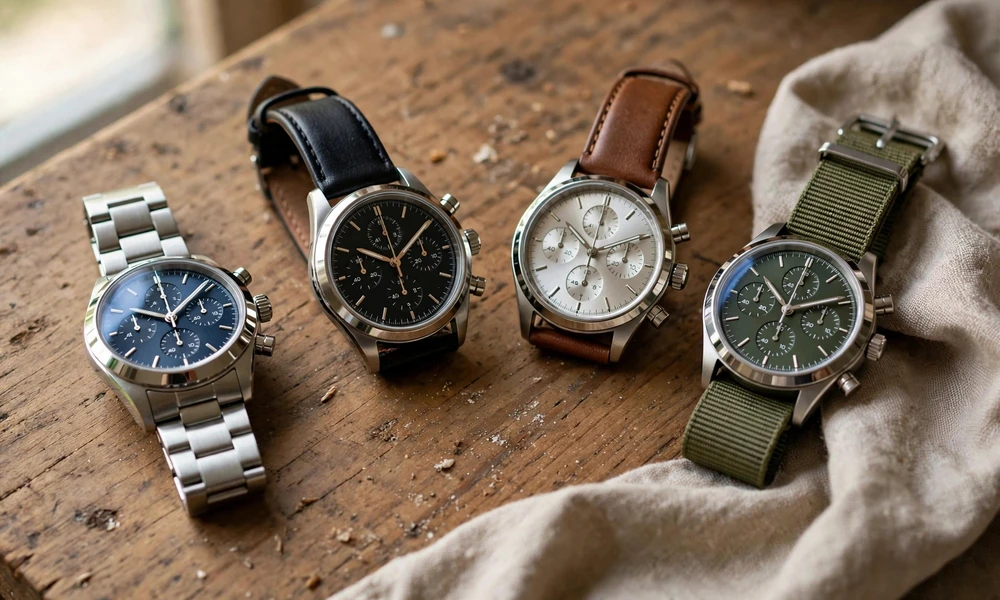
Look next at the dial. A chronograph face is busy by nature, and readability is the real test. The subdials should be easy to tell apart at a glance, the hands should stand out against the background, and the tachymeter scale should be legible without squinting. A watch that looks impressive in a photograph but cannot be read in daylight will spend more time in a drawer than on your wrist. Our guide to luxury watches explains how case size and dial design affect everyday wear, and the same logic applies here: a chronograph you can read quickly is one you will actually use.
Finally, consider the movement and the service. A quartz chronograph needs a battery every few years and little else. A mechanical chronograph needs a service every four to six years, and a service on a chronograph costs more than on a plain watch, because there is more to take apart and put back together. Ask the price of a service before you buy, not after, and keep the papers and the box. A chronograph with a full service history is a far easier watch to own, and to sell, than one without.
The 9 facts about a chronograph watch in 2027
A chronograph is a stopwatch built into a watch
What we like: One watch does two jobs, so you do not need a separate timer for cooking, running or parking. What to consider: The extra mechanism adds thickness and weight, and the dial is busier than a plain watch. Best for: Anyone who times things during the day and wants the function on the wrist. Cost: From a few hundred pounds for quartz to several thousand for mechanical. Time needed: A minute to learn the pushers, a week to make using them a habit.
The pushers start, stop and reset the timing
What we like: The controls are simple: top pusher to start and stop, bottom pusher to reset. What to consider: On some watches the pushers are stiff, and on a mechanical chronograph they should never be pressed underwater. Best for: People who want timing they can operate without looking at a screen. Cost: Included in the price of the watch; no extra cost to use. Time needed: A few seconds to time an event, and a moment to read the subdials.
A tachymeter scale turns elapsed time into speed
What we like: The scale around the dial or bezel lets you read speed directly, with no calculation. What to consider: It only works over a fixed distance, usually a kilometre or a mile, and it is useless if you do not know the distance. Best for: Drivers, cyclists and anyone timing laps over a known distance. Cost: Free with the watch; it is printed on the dial or bezel. Time needed: A few seconds to read, once you know the distance you are measuring.
Quartz chronographs are accurate and low-maintenance
What we like: A quartz chronograph is accurate to a few seconds a month, runs for years on a battery, and costs far less than a mechanical one. What to consider: The seconds hand ticks in small steps rather than sweeping smoothly, and the watch has little of the mechanical charm collectors value. Best for: A first chronograph, daily wear, and anyone who wants the function without the upkeep. Cost: A few hundred pounds for a good one, plus a battery every two to four years. Time needed: No daily winding, and a battery change takes minutes at a watchmaker.
Mechanical chronographs are valued for the craft, not the accuracy
What we like: A mechanical chronograph is a small machine on the wrist, with a sweeping seconds hand and a pusher action you can feel. What to consider: It is less accurate than quartz, needs winding or wearing daily, and servicing costs more. Best for: Collectors, enthusiasts, and anyone who enjoys the mechanism itself. Cost: Several thousand pounds and up, plus a service every four to six years. Time needed: Daily wear or winding, and a service visit every few years.
The subdial layout changes how readable the watch is
What we like: A clean two-subdial layout is easy to read at a glance, and a three-subdial layout gives hours as well as minutes. What to consider: More subdials mean a busier dial, and small subdials can be hard to read in poor light. Best for: People who want the elapsed time at a glance, not a puzzle. Cost: No price difference; it is a design choice. Time needed: A week of wear to learn where each subdial sits.
A chronograph is thicker and heavier than a plain watch
What we like: The extra depth gives the watch presence on the wrist, and the pushers make it feel like an instrument. What to consider: A thick case can catch on shirt cuffs, and a heavy watch can tire a small wrist by the end of the day. Best for: Larger wrists, casual wear, and anyone who likes a watch with substance. Cost: No extra cost, but a slimmer chronograph usually costs more. Time needed: A day of wear to know whether the weight suits you.
Water resistance drops when the pushers are used underwater
What we like: Many chronographs are rated to 100 metres or more, so swimming and showering are usually fine. What to consider: Pressing a pusher underwater can let water into the case, even on a watch rated for swimming. Best for: Everyday water exposure, with the pushers left alone while wet. Cost: A water-damage repair can cost hundreds of pounds. Time needed: A minute to check the rating, and a lifetime of remembering not to press the pushers in the pool.
A chronograph is a wardrobe piece, not an investment
What we like: A well-chosen chronograph holds its style for years, suits most outfits, and is a pleasure to wear daily. What to consider: Most chronographs lose value when sold, and a few famous models are the exception, not the rule. Best for: Anyone buying a watch to wear and enjoy, not to resell. Cost: Buy for the watch, not the return; servicing and straps add to the cost of ownership. Time needed: Years of wear to get your money’s worth in pleasure, if not in pounds.
Which chronograph watch is right for you
If this is your first chronograph, start with quartz. It is accurate, affordable, and easy to live with, and it lets you learn whether you actually use the stopwatch before spending several thousand pounds on a mechanical one.
If you already own a watch or two and want a mechanical chronograph, look at the movement first and the brand second. A column-wheel chronograph has a smoother pusher action than a cam-actuated one, and it usually costs more. Our guide to automatic watch brands is a useful starting point, because the brands that make good automatic movements are usually the ones that make good mechanical chronographs too, and the same names come up again and again for a reason.
For smaller wrists, look for a chronograph under 40 millimetres, or a two-subdial design, which is often slimmer than a three-subdial one. For larger wrists, a 42 or 44 millimetre case will look balanced, and the extra weight will feel natural rather than clumsy. Whatever the size, wear the watch for at least ten minutes in the shop, with your own shirt cuff, before you decide. A chronograph that feels right in the first minute can still feel heavy by the evening.
The caveats that matter
A chronograph is a mechanical device, and it needs the same respect as any other. Do not press the pushers underwater unless the watch is specifically built for it. Do not force a pusher that feels stuck. Do not leave a mechanical chronograph unwound for months, and do not leave any watch in a hot car or a steamy bathroom. These are small habits, but they are the difference between a watch that lasts decades and one that needs an expensive repair.
| Detail | What is known |
|---|---|
| What it is | A watch with a built-in stopwatch, operated by pushers, read on subdials |
| How to time an event | Top pusher to start and stop, bottom pusher to reset the hand to twelve |
| Tachymeter scale | Reads speed over a known distance, usually one kilometre or one mile |
| Quartz vs mechanical | Quartz is more accurate and cheaper to own; mechanical is bought for the craft |
| Thickness and weight | Thicker and heavier than a plain watch; try it with your own shirt cuff |
| Water and pushers | Do not press the pushers underwater unless the watch is built for it |
| Servicing | Mechanical chronographs need a service every four to six years |
| Value | Most chronographs are not investments; buy one you enjoy wearing |
If you are buying second-hand, check the chronograph functions before you pay. Start the stopwatch, let it run for a minute, stop it, and reset it. Check that the hand returns exactly to twelve, and that the minute subdial has advanced by one. If the hand stops short, or the reset is slow, the movement needs a service, and that cost should come off the price. A seller who will not let you test the pushers is a seller to walk away from.
Checklist: buying a chronograph watch honestly
Use these checks before you buy, and again after a week of wear.
- Test the pushers: they should click cleanly, start instantly, and reset the hand exactly to twelve.
- Read the dial in daylight: you should be able to read the elapsed time in two seconds.
- Check the size: wear it with your own shirt cuff, and make sure it does not catch or feel heavy.
- Ask the service price: a mechanical chronograph costs more to service than a plain watch.
- Check the water rating: know whether you can swim with it, and never press the pushers while wet.
- Buy for wearing, not for profit: choose the watch you like, and keep the papers and box.
Frequently asked questions
What is the difference between a chronograph and a chronometer?
They are different things. A chronograph is a watch with a stopwatch function. A chronometer is a watch that has passed an accuracy test and earned a certificate. A watch can be both, neither, or one without the other, so check which word the seller is actually using.
Can I wear a chronograph every day?
Yes. A quartz chronograph is an easy daily watch, and a mechanical one is fine too if you wear it daily or keep it on a winder.
Do I need a mechanical chronograph, or is quartz enough?
Quartz is enough for the function, and it is more accurate. Mechanical is for the pleasure of the movement: the sweeping hand, the pusher feel, and the craft. If that matters to you, it is worth the price. If it does not, quartz is the smarter buy.
How do I use the tachymeter?
Time something over a known distance, usually one kilometre or one mile. When the stopwatch stops, the hand points to the speed on the scale. If it took 30 seconds over a kilometre, the scale reads 120, meaning 120 kilometres per hour.
Is a chronograph the same as a GMT watch?
No. A chronograph times events with a stopwatch. A GMT watch shows a second time zone, usually with an extra hand and a 24-hour scale. They solve different problems, and some watches offer both, but the functions are separate. Our guide to GMT watch brands explains the second-time-zone side in more detail.
How often does a chronograph need servicing?
A quartz chronograph needs a battery every two to four years and little else. A mechanical chronograph needs a full service every four to six years, and the service costs more than for a plain watch because the chronograph mechanism has to be taken apart and reassembled.
The bottom line
The best chronograph watch in 2027 is not the most expensive or the most famous. It is the one whose pushers feel clean, whose dial you can read in daylight, and whose size and weight suit your wrist and your clothes. For most people that means a quartz chronograph, or a mechanical one bought with open eyes about servicing and accuracy. Either way, the stopwatch should be something you use, not something you admire in a photograph.
Choose one chronograph, wear it for a week, and time something with it every day. If you reach for the pushers without thinking, you have bought the right watch. If you do not, you have bought a handsome dial, and that is a different purchase entirely.