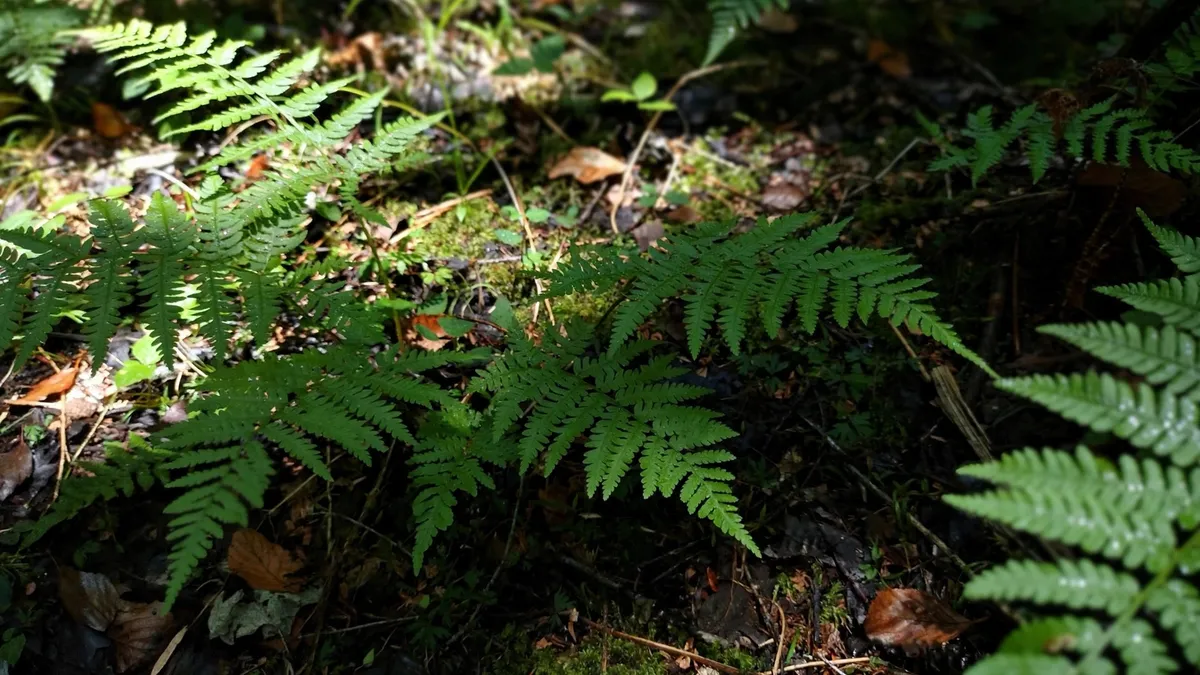

Ask a perfumer what a fern smells like and you will get a smile, because the honest answer is almost nothing. Ferns are ancient, quiet plants. They grow in damp shade, they reproduce by spores instead of flowers, and they give off so little scent that you could press your nose into a frond and smell only wet earth. And yet fern perfume is one of the oldest and most successful ideas in perfumery, a scent family that has been in continuous production since 1882.
The explanation is that a fern perfume is not made from ferns. It is made from an accord called fougère, the French word for fern, which was invented to capture the idea of a fern rather than the plant itself. The accord is built from lavender, coumarin and oakmoss, and it smells green, clean and slightly sweet, like a freshly mown lawn crossed with a barbershop. It is a fantasy, and it is a very good one.
This guide explains what a fern perfume actually is, how the accord was invented, what each part of it does, and how to tell a good fern perfume from a soapy imitation.
Key takeaways
- A fern perfume contains no fern extract at all, because ferns have almost no scent, and the note is built from lavender, coumarin and oakmoss instead.
- The fougère accord was invented in 1882 by Houbigant, and it is the template every fern perfume since has followed, changed, or reacted against.
- Coumarin, the sweet hay-like molecule from tonka beans, is the part that makes a fern perfume smell like hay rather than like soap or cleaning fluid.
- Modern fern perfumes usually replace real oakmoss with a synthetic called evernyl, because oakmoss is restricted for allergy reasons, and a well-made synthetic base smells just as green.
- A fern perfume is a fantasy of green and shade, not a botanical extract, and a very soapy or very sweet fern scent is a sign the accord underneath is thin or unbalanced.
What a fern perfume actually is
A fern perfume is a perfume built on the fougère accord. The accord has three parts, and each one does a different job. Lavender gives the scent its fresh, herbal opening and its clean character. Coumarin gives it a sweet, hay-like warmth that stops the lavender from smelling medicinal. Oakmoss gives it a dark, damp, forest-floor base that holds the whole thing together and makes it last on skin.
The perfumer who invented it, Paul Parquet at Houbigant, was not trying to copy a fern. He was trying to bottle the feeling of walking through a woodland, and he used lavender, coumarin and oakmoss because together they suggested that feeling better than any single ingredient could.
That is why a fern perfume smells familiar even if you have never thought about ferns. The accord became the backbone of traditional men’s perfumery, and its ingredients became the backbone of shaving soaps, aftershaves and barbershop scents for more than a century.
How to read a fern perfume and what to look for
Start with the notes list, and look for lavender and coumarin or tonka bean. If both are there, you are looking at a fern perfume, or at least at a perfume built on the fern accord. If the list mentions oakmoss or evernyl as well, the base is likely to be properly mossy and the scent is likely to last.

Smell it on skin, not just on paper, because the accord changes as it warms up. On paper, a fern perfume often smells soapy and tidy, because the lavender dominates and the coumarin has not had time to open. On skin, the lavender softens, the hay note comes forward, and the mossy base appears. Give it an hour before you judge it, and wear it through a whole day if you can, because the drydown is where a fern perfume shows its real character.
Think about the balance between the three parts. A good fern perfume keeps the lavender fresh, the coumarin warm and the moss dark, without letting any one of them take over. If the lavender dominates, the scent smells like soap. Our guide to what a moss perfume is explains the mossy part in detail, and it is worth reading alongside this one, because moss is the ingredient that gives many fern perfumes their depth.
9 facts about fern perfume
Ferns have almost no scent, so the fern note is a fantasy built from scratch
A fern is a plant that reproduces by spores, not by flowers, and it has no need to attract pollinators with scent. That is why a woodland full of ferns smells of damp earth and leaf mould rather than of the ferns themselves. No perfumer has ever extracted a meaningful fern oil, because there is nothing meaningful to extract.
The fern note in perfume is therefore a construction. Perfumers built it from ingredients that suggest greenness, shade and dampness, and they named it after the plant it evokes rather than the plant it comes from.
Houbigant created the first fougère in 1882, and it is still the template
In 1882, the French perfumer Paul Parquet, working for the house of Houbigant, created Fougère Royale, the first perfume built around the lavender, coumarin and oakmoss accord.
Fougère Royale is still in production, and its structure is still the template for the family. Even the modern, aquatic fern scents are variations on the same 1882 skeleton.
Coumarin is the hay note that makes fern smell like fern
Coumarin is a molecule first isolated from tonka beans, and it smells of cut hay, warm almonds and a little vanilla. It is the ingredient that stops a fern perfume from smelling like soap. With it, the lavender turns green and warm, and the scent starts to smell like a meadow rather than a medicine cabinet.
Coumarin is also a fixative, which means it helps the lighter ingredients in a perfume last longer on skin. The hay note is not decoration. It is doing structural work, holding the lavender in place and giving the moss something to anchor to.
Lavender is the note that makes a fern perfume, not the fern itself
If you took the lavender out of a fern perfume, you would not have a fern perfume any more. You would have a sweet, mossy base with nothing fresh on top of it. Lavender is the note that gives the accord its lift, its cleanliness and its recognisable opening, and it is the first thing you smell when you spray a fern perfume.
That is why perfumers are so particular about which lavender they use. French lavender is herbal and a little camphorous, English lavender is softer and sweeter, and lavandin, a hybrid, is sharper and more medicinal.
The classic fougère is a triangle: lavender, coumarin and oakmoss
Think of a fern perfume as a triangle with three corners. Lavender is the fresh corner, coumarin is the warm corner, and oakmoss is the dark corner. A good fern perfume keeps all three corners in balance, so the scent is fresh without being cold, warm without being sweet, and dark without being heavy.
Most of the variation in the fern family comes from pushing one corner harder than the others. Push the lavender and you get a bright, soapy fern. Once you can hear the triangle, you can tell at a sniff which corner a perfumer pushed, and that makes choosing a fern perfume much easier.
Modern fern perfumes swap oakmoss for evernyl, and the rules are the reason
Real oakmoss contains two allergens, atranol and chloroatranol, and European regulations now restrict how much of them a perfume can contain. As a result, most modern fern perfumes use evernyl, a synthetic molecule that smells very like oakmoss without the allergens, or they use a heavily purified oakmoss extract with the allergens removed.
This is not a loss. Evernyl is clean, stable and reliably mossy, and a well-made synthetic base can smell just as green and just as deep as the real thing.
Fern reads as barbershop-clean because shaving soap borrowed the accord
For most of the twentieth century, the fern accord was the standard scent of shaving soap, shaving cream and aftershave. Barbershops smelled of lavender, coumarin and musk because those were the ingredients that smelled clean, masculine and reassuring, and they were cheap enough to use in everyday products.
That history is why a fern perfume smells like a barbershop to so many people. A generation of men was shaved with fern-scented soap, and the scent became shorthand for being clean, tidy and well turned out. Modern fern perfumes inherit that association whether they want it or not.
The fern accord lives in the heart, and the drydown is woods and musk
A fern perfume does not lead with its fern character. It leads with lavender and citrus, and the fern accord appears in the heart, once the opening has settled. That is where the coumarin and the lavender meet, and where the scent turns from fresh to green. If you only smell the opening, you have not smelled the fern yet.
The drydown is quieter and woodier. The lavender fades, the coumarin softens into something like warm hay, and the base of woods, musk and moss takes over.
Heat turns a fern perfume sweet, and cold keeps it green and sharp
Temperature changes a fern perfume more than it changes most other families, because coumarin is sensitive to heat. On warm skin in summer, the hay note comes forward and the scent turns sweeter and rounder. On cold skin in winter, the lavender and the moss stay sharper, and the scent reads greener and more formal.
A heavy, mossy fern that feels perfect in December can feel cloying in August, and a bright, citrus fern that feels fresh in June can feel thin in February.
Which fern perfume is right for you
If you like clean, classic scents, start with a traditional fern perfume such as Houbigant Fougère Royale or Caron Pour Un Homme. They are the purest expressions of the accord, and they will teach your nose what a fern perfume is supposed to smell like. Wear one for a full day, and pay attention to the drydown, because that is where the fern character lives.
If you like green scents but find classic ferns too soapy, try a modern or aquatic fern perfume, such as Tom Ford Beau de Jour or Davidoff Cool Water. They keep the lavender-and-coumarin skeleton but dress it in brighter, sharper clothes, and they are easier to wear in warm weather and in casual settings. A look at the best driftwood perfumes can help here too, because driftwood scents share the fern family’s dry, mineral edge and are often the next step for people who like green, woody perfumes.
If you are still unsure, sample three fern perfumes side by side: one classic, one modern and one aquatic. The one that still smells interesting at the four-hour mark is the one for you, because a fern perfume is judged on its drydown, not on its opening.
The caveats that matter
Fern perfumes are well-made, honest scents, but they are not for everyone. The lavender can read as soapy on some skin, the coumarin can turn sweet in heat, and the whole family can feel old-fashioned if you are used to fresh, fruity or gourmand scents. None of that is a flaw in the perfume.
| Detail | What is known |
|---|---|
| What it is | A fougère accord of lavender, coumarin and oakmoss, built from scratch, not extracted from ferns |
| When it was invented | 1882, by Paul Parquet at Houbigant, with the perfume Fougère Royale |
| The key molecule | Coumarin, from tonka beans, which smells of cut hay and warm almonds |
| Where it sits | The fern accord appears in the heart, and the drydown is woods, musk and moss |
| Modern change | Real oakmoss is usually replaced by evernyl, a synthetic, because of allergy rules |
| Why it smells familiar | The accord was the standard scent of shaving soap and aftershave for decades |
| Who should sample first | Anyone who dislikes soapy or powdery scents, and anyone sensitive to lavender |
| What it is not | It is not a botanical extract, and it does not smell like an actual fern plant |
If you have sensitive skin, patch-test a fern perfume before wearing it all day, because lavender and oakmoss are both known sensitisers for some people. A skin test also shows you how the accord develops on you, which is the information that matters most. Our guide to the best petrichor perfumes is worth a look if fern turns out to be too soapy for you, because petrichor scents are green and earthy in a different way, built on rain and soil rather than on lavender and hay.
Checklist: choosing a fern perfume honestly
Use these checks before you buy, and again after a full day of wear.
- Check the notes list for lavender and coumarin or tonka bean: both should be there in a real fern perfume.
- Smell it on skin, not just on paper, and wait at least an hour for the fern accord to appear.
- Judge the drydown, not the opening: the last few hours are where a fern perfume shows its character.
- Test it in the season you will wear it, because heat makes the coumarin sweeter and cold keeps it greener.
- Start with two sprays: fern perfumes are composed scents, and too much turns them stiff.
- Do not pay luxury prices for a name alone: the classic fern perfumes are affordable, and the accord matters more than the brand.
Frequently asked questions
Does a fern perfume contain any real fern?
No. Ferns have almost no scent of their own, so there is no fern extract to put in a bottle. A fern perfume is built from lavender, coumarin and oakmoss, which together suggest the idea of a fern glade: green, shaded and a little damp.
Why is it called a fougère if it is not made from ferns?
Fougère is the French word for fern, and it was the name Paul Parquet gave his 1882 perfume because the accord was meant to evoke a fern glade. The name stuck, and it became the name of the whole family, even though no fern was ever involved.
Can women wear fern perfumes?
Yes. The accord itself is unisex, even though most classic fern perfumes were marketed to men. Anyone who likes clean, green, herbal scents can wear a fern perfume, and the softer, powdery versions work particularly well across genders.
Is a fern perfume the same as an aftershave?
Not quite, although they share the same history. Aftershaves borrowed the fern accord because it smelled clean and reassuring, but a fern perfume is a complete fragrance with a heart and a drydown, while an aftershave is a lighter, shorter-lived product. A fern perfume lasts far longer on skin.
Which season suits a fern perfume best?
It depends on the fern. Heavy, mossy fern perfumes suit autumn and winter, when their warmth has room to breathe. Lighter, citrus-led and aquatic fern perfumes suit spring and summer. The accord itself works year-round, but the base decides the season.
Is a fern perfume a safe blind buy?
Usually, if you already know you like clean, green, herbal scents. If you dislike soapy or powdery scents, sample first, because lavender is the first thing you will smell.
The bottom line
A fern perfume is a fantasy, and knowing that makes it more interesting, not less. It is a scent built from lavender, coumarin and oakmoss to suggest a plant that barely smells of anything, and it has worked so well that the fantasy has become one of the most enduring ideas in perfumery, in continuous production since 1882.
Start with the triangle: lavender for freshness, coumarin for hay-like warmth, oakmoss for dark, damp depth. Test a fern perfume on skin, wait for the drydown, and judge it in the season you will wear it. If the green, clean, quietly confident character suits you, a fern perfume is the kind of scent you can wear for years without tiring of it.